
Scott Suchman
Interviews have been lightly edited for clarity.
On a cold, late autumn day in Parma, 1869, Giuseppe Verdi and his wife, Giuseppina Strepponi, were out shopping for bowls. The composer was handling earthenware when he heard the sing-song voice of a vendor hawking cooked pears on the street. “Verdi’s face suddenly lit up with one of those flashes that often blazed in his eyes,” Stefano Sivelli wrote. “[He] rapidly scribbled a few lines in his notebook, returned merrily to the counter, and accepted without discussion his angelic wife’s expert choice of bowl.” Months later the observer, coincidentally a musician in the orchestra at Aïda’s Cairo premiere, was rehearsing the first scene of Act III when he recognized a familiar, otherworldly hymn, an echo of that cold day in Parma, when a fruit vendor filled the maestro with inspiration.
It was around this time that Verdi penned his aesthetic maxim: “Inventare il vero” – “Invent the true.” Verdi never visited Egypt. Ancient instruments and tonalities were beyond his ken. Yet with the skill of a historical novelist, Verdi manufactured a sonic landscape that illustrated fundamental human struggle in a foreign locale. He flattened harmonics. He teased alien melodies from Western woodwinds. He even, like a musical magpie, wove found melodies into the tapestry of his genius – and he did it while rejecting the Orientalism that made Meyerbeer’s L’Africaine so popular. The sound world of Aïda is, in fact, completely made up. And yet, it is true all the same. In the anguish floated by the clenched pianissimo of Aïda’s theme, in the frenzy of strings that signifies Amneris’s jealousy, it is Verdi to the core, and it is true.
“Invent the truth” might be Francesca Zambello’s slogan as well. This fall, the director leads the Washington National Opera (WNO) on a journey up the Nile infested with political snares both inside and outside the company. Over a series of interviews ahead of their opening night on Friday, I sat down with the WNO creative team to discuss these obstacles, as well as glean insights for a contemporary perspective.
In our pluralistic, postcolonial world, Aïda – a love story set amidst a conflict in the middle east – is ripe for critical interpretation. Zambello, who first staged the production in 2012 for the Glimmerglass Festival, and then again for the San Francisco Opera in 2016 told me that she’d thought hard about the aesthetic implications of an exoticized Egypt.
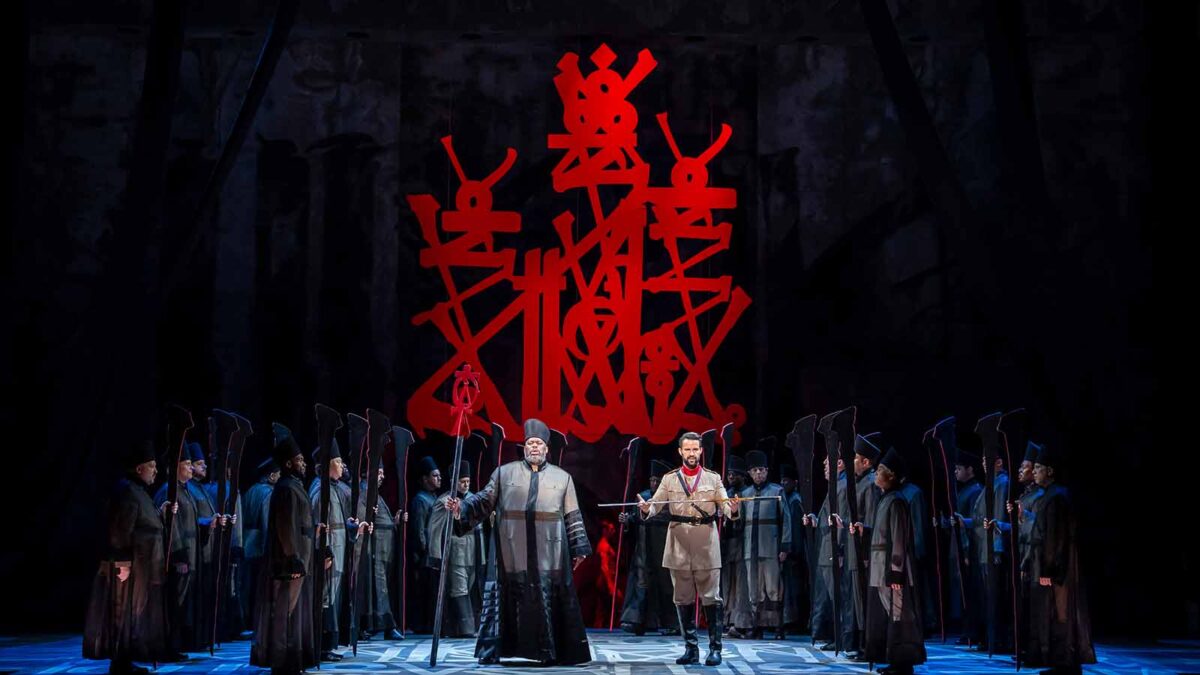
“I tried to create a visual world that evoked something historic, vaguely Egyptian. I worked with a graphic artist (RETNA) who uses hieroglyphics in a visual style…That to me gave it an eye to the past but also felt contemporary. [It] also helped erase that sense of columns and people walking around by fake pyramids, but still gave people a sense of history. That was my goal.” By relocating the narrative to an indeterminate space and time, it seems, Zambello seeks to emphasize the emotional authenticity of Verdi’s score – a kind of modern truth cloaking, or perhaps showcasing, Verdi’s larger, invented truth. “Same thing with the costumes, she said. “You know, the women are clothed in these incredibly beautiful bright costumes which again suggest something I think nomadic, Sahara-like, but…they’re not walking around with headpieces and snakes coming out of their head.”
Every production of Aïda stands in the long shadow cast by Edward Said, who argued that Aïda was created by, and for, the European presence in Egypt. “Studied as a highly specialized form of aesthetic memory,” he writes, “Aïda embodies, as it was intended to do, the authority of Europe’s vision of Egypt at a particular moment in its nineteenth-century history…” Not everyone shares this view. In fact, it’s far from clear that Verdi’s sympathies lie with the Egyptians, or, as musicologist Paul Robinson contends, that Egyptian characters are even themselves “Orientalized.” Meanwhile, Verdi depicts Ethiopian characters, specifically Aïda, with lilting melodies Robinson describes as “the polar opposite of the sort of music he writes for his massed Egyptians.” Many interpretations of Aïda identify with what I believe was Verdi’s ultimate anti-war, anti-imperial argument. This year, for example, in Paris, Shirin Neshat, an Iranian artist, included black and white footage depicting war crimes flickering across the screen as Verdi’s Triumphal ballet pulses underneath.
Scott Suchman
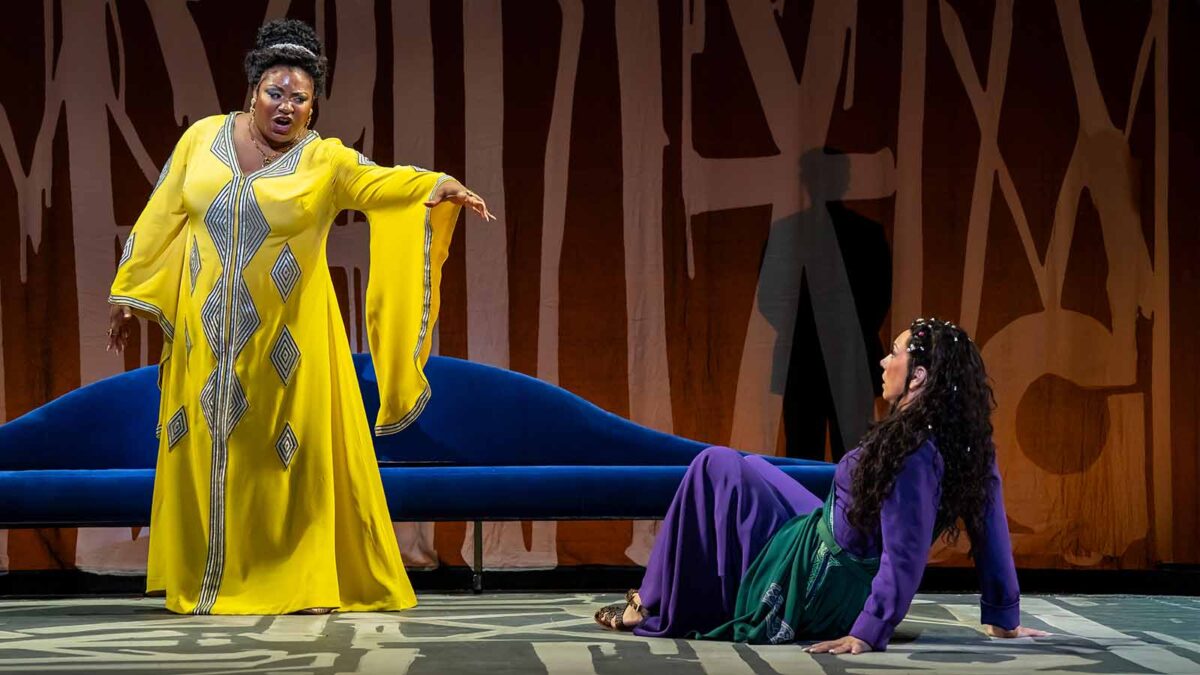
Asked about the claim of Orientalism embedded in the opera, this production’s Aïda, Jennifer Rowley, directs our attention to a close reading of the musical text. “The one thing we do know very clearly is that Aïda is very intelligent,” Rowley explained. “This is very clearly outlined in the libretto in the way that she speaks to other characters. For example, her poetry and rhyme scheme changes as she speaks with people in authority. As she speaks with Amneris, she uses one rhyme scheme and one poetic form; when she speaks with her father, she uses a different rhyme scheme and different poetic form; and when she speaks with Radames, she uses a more familiar form. It’s almost as if Aïda speaks various languages.”
This spirit of emotional authenticity has the ability to transform the discourse on representation and cultural appropriation when it comes to making characters “true.” “I am never going to understand what it means to be a slave,” said Rowley, who is white and refuses to wear darkening makeup for this opera as many other singers have done. “When you see summaries of Aïda, she is described as an Ethiopian slave, when what she really is, is an Ethiopian princess who is enslaved—essentially, a prisoner of war. What her character wants throughout the entirety of the opera is freedom. And that I can research and internalize.” That research is an integral part of Rowley’s process for this opera and all the works she performs. “I can study what it might have been like to be a prisoner of war—the fear, the longing for home, the desperate wish for freedom. There are countless firsthand accounts and sources that help me understand that experience.”
“We’re actors,” Rowley continues. “I played Violetta, and I don’t have consumption, and I’m not a courtesan. But I can tell you I have five books on courtesans, and I have various sources I can learn from.“
Bass Morris Robinson, who here sings the Egyptian priest Ramfis, recognized the dilemma: “I’ve always said that if we’re going to do Aïda accurately, everyone on stage should be brown.” A beat later, he qualified the statement. “[On the other hand], you have to have room to play and imagine and be an artist and allow art to be art. If [strict representation] were the case, I wouldn’t sing King Phillip, or King Mark, or the Grand Inquisitor…there are only a few roles I’d really be able to sing. Art has to be art and art has to be able to have the latitude to do what it does.” He then mused thoughtfully on Pavarotti’s rendition of the opera’s love interest: “I mean, Radames is a war hero. But Pavarotti as Radames? People didn’t say ,‘he doesn’t look like he could go to war.’ No. They said, ‘Can he sing ‘Celeste Aïda’?’”
Scott Suchman
For this Amneris, Raehann Bryce-Davis, diversity in casting reframes social and historical questions for a modern audience. “When you have a diverse cast then you don’t really have to have all those conversations about the power structure, because then it can just be, ‘this person is in love, and this person wants to get in there!’” She said, punctuating the last phrase with a jubilant laugh. “This is a universal story that we see every day on Love Island.”
“Opera is not about reality,” added Shenyang, the Chinese Baritone and 2007 Cardiff Singer of the World who plays Aïda’s father, Amonasro. “It might be a story about 3,000 years ago. Well, 3,000 years ago, there was no bel canto!…we have different forms. [Opera] is about connecting with the music and the story.”
All of this is not to say that the rigorous analytical mold of Said and others is always an unnecessary or vulgar approach to art. Unpacking what’s happening in any art form can help us think more critically about who is hailed in a work, its accessibility to a range of audiences, and what potential harms are embedded in its performance. “The first time I did an opera in Atlanta,” Morris Robinson told me, “where my son’s high school and middle school kids and friends could come, they were on big tour buses and they came out to see me sing – it was Porgy and Bess…the first ten minutes of the opera, there’s a murder, there’s drugs, there’s alcohol, there’s domestic violence, there’s police brutality… I’m a beggar, and I’m poor. It’s sung in a dialect. And I thought, ‘We’ve got to do better than this.’”
The creative team of WNO’s Aïda are keenly aware of racial disparities in opera; several have specific strategies to grow audiences. Half of Zambello’s cast in a given opera, for example (except for Porgy, which is staged with an all-Black cast) is people of color. There are also two casts presenting Aïda, one showcasing newer, local talent. Moreover, the director seeks to incorporate children into productions. Her production of Aïda features “a group of young kids who are acrobats” which she’s made as though “they are young soldiers in training, because this society is a warring society.” In addition to adding historical verisimilitude, participating in a high-level production can unlock a lifelong love for opera for children, she says. Bryce-Davis’s new album, Evolution, is a mashup of classical with dance hall, Afrobeats, and Latin beats, all “without a dumbing down of anything,” she said. “It’s a time for exploration. It’s a time to not be limited by sound worlds.” Rowley invites the public into her classical artistry with a deft handling of social media, taking viewers behind the scenes of her “Aria Bootcamp,” and other episodes in the life of an opera singer.
Verdi’s truth is one thing. Said’s is another and Zambello and the WNO team offer still another truth. Yet truth itself is under fire in the very theater itself, the Kennedy Center’s Opera House, where this production will open on Friday and where the Trump administration has exercised startling artistic overreach. “A year ago, we were doing fantastically with sales, like, killing it,” she said. “Now, our sales are down 38%. Our contributions are markedly down because people don’t want to give or come. So my response is don’t take it out on us…Find ways that are constructive to disagree rather than boycotting art and artists. So you’re not only killing the opera, the symphony, [you’re also hurting] all the people who work at the Kennedy Center.”
“The Washington National Opera is an apolitical organization,” Zambello specifies. “We believe culture, opera, art is our calling. It’s a bridge to people…And by boycotting us, you are killing art.” She also stressed that the WNO is not the Kennedy Center, but rather an “affiliate organization.” “When you give to WNO, it goes to us, it doesn’t go to anyone else.”
Bryce-Davis described the Trump meddling as tragic. “I think art is where we wrestle with humanity and growth and who we are as human beings, and to have any political influence on that is a tragedy…It’s tragic when we aren’t able to make art representative of our society, which includes LGBTQ people, trans people, people of every shade, includes men, includes women, includes non-binary people. All these people make up the fabric of America.” But Bryce-Davis is convinced that the power of diverse casting, exceptional voices, and Verdi’s genius can “help erase” racism, exoticism, and imperialism, present or not, in Aïda. “That, and, of course,” she added in an email after our interview, “not having the traditional Moorish slave dance.”
One point is conceded by every camp: the music of Aïda, snaking, sparkling, surging, is some of the most iconic, popular, and innovative in opera, and in the hands of capable musicians, that can go quite a long way. Perhaps, after all, we can enjoy Jennifer Rowley’s crisp soprano, Raehann Bryce-Davis’s creamy mezzo, and the rolling thunder of Morris Robinson’s bass. Perhaps it is in the interpretation of truths – this case, in WNO’s production of Aïda – in which a newer, more durable reality can be forged.
Aïda is playing at Washington National Opera from October 24th to November 2nd.