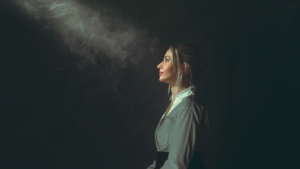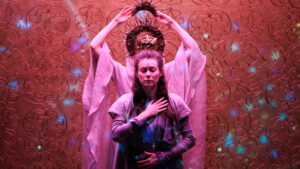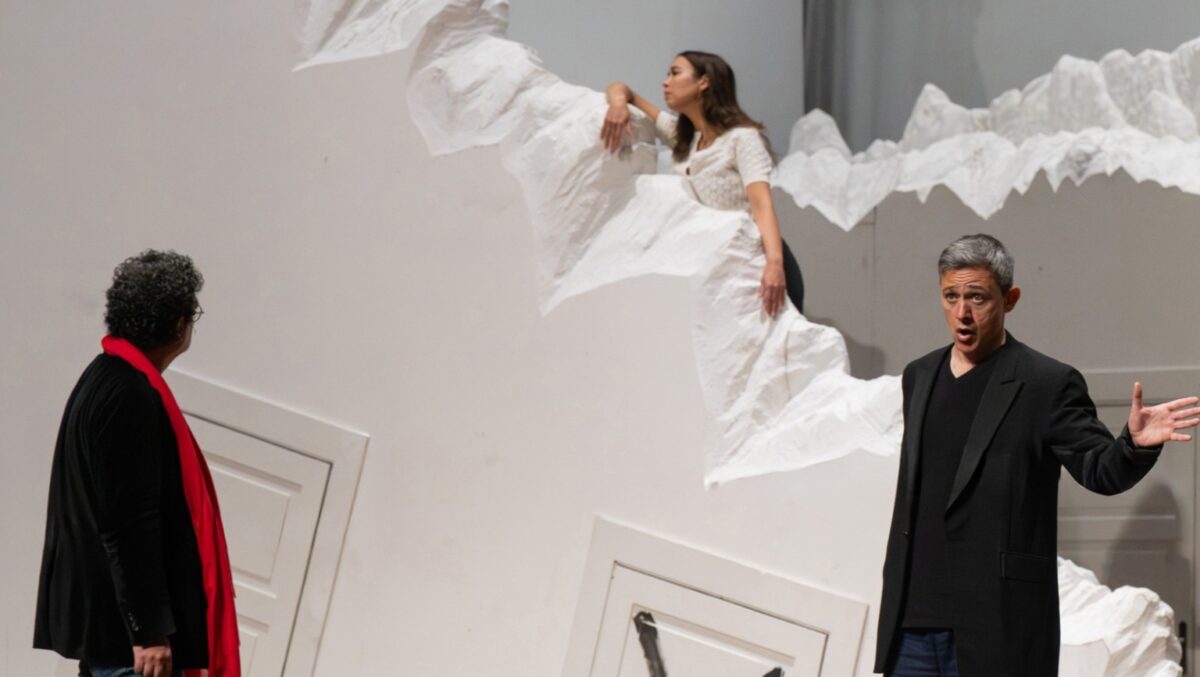
Rolando Villazón, in his signature red scarf, rehearses La sonnambula, Jonathan Tichler / Met Opera
On October 6, Rolando Villazón’s production of Bellini’s La Sonnambula premiered at the Met. While the Mexican operatic tenor developed a parallel career as an opera director starting in 2011 with a new production of Werther at Opéra de Lyon, his Sonnambula—mounted on the same stage where he’d performed as a singer as recently as 2023—marks a turning point in his later career.
Villazón rose to early stardom in 1999 when he won Placido Domingo’s Operalia competition. For the better part of the next decade he performed as Rodolfo in La bohème, Alfredo in La traviata, and Don José in Carmen, to name only a few starring roles he performed at the Met and numerous prestigious European opera houses. His voice in this early period was extraordinary. His performance style was raw and energetic. He was winning, open, and witty and sometimes looked a little surprised that he was radiating out these incandescent phrases.
As I prepared to interview him, I found it nerve wracking to watch videos of him singing from this era knowing that he would soon lose his voice and enter a period of personal turmoil. He had surgery for congenital cysts on his vocal cords in 2009, recovered, and then underwent a period of stage fright. We know these intimate details about his travails because he has spoken about them honestly, intelligently, and eloquently in interviews throughout his career. Unusually for a singer, Villazón has a knack for narrativizing his inner life.
For the length of Villazón’s career, reporters have noted his intellectual curiosity and literary bent and how unusual that is among operatic tenors of his caliber. Amidst the jocks of the industry, Villazón is a scholar-athlete. As an interview subject (whom I have edited somewhat for clarity) he is smart, affable, and interested in being interesting. We spoke about his intellectual journeying through literature, psychoanalysis, religion, and philosophy. He discussed Boethius, Christopher Hitchens, Freud, Jung, and Eric Fromm with unpretentious enthusiasm. As we spoke, he took out his current recreational reading: Henry Miller’s Colossus of Marrousi and Paul Auster’s The New York Trilogy. He was immersing himself in American writers during his visit stateside. He described breaking these books out in rehearsals to help performers better understand their characters.
“I believe that opera is closer to choreography, to Kabuki to Noh theatre,” Villazón said when we spoke over Zoom a few weeks before Sonnambula opened. “I don’t believe you need to ask the singer to find the emotion; they will do it, they are professionals. If not, the music will do it for them.”
He told me that where Noh or Kabuki performers spend years learning to point to the moon, opera singers have mere weeks to learn their characters’ gestures and relationships. He described his job as a director as creating “a map of positions and gestures that go in line in the understanding of every performer of the universe they’re in.”
“Why are we doing what we’re doing? Why are we doing this gesture? Why are we standing here? Why do I have to move there?,” Villazón asks. “When all those questions are answered, then it comes to life. When the audience comes, they should feel like this is all happening for the first time and if the audience comes to three shows, they will see the same performance three times. It’s never the same — but the staging will remain exactly the same.”
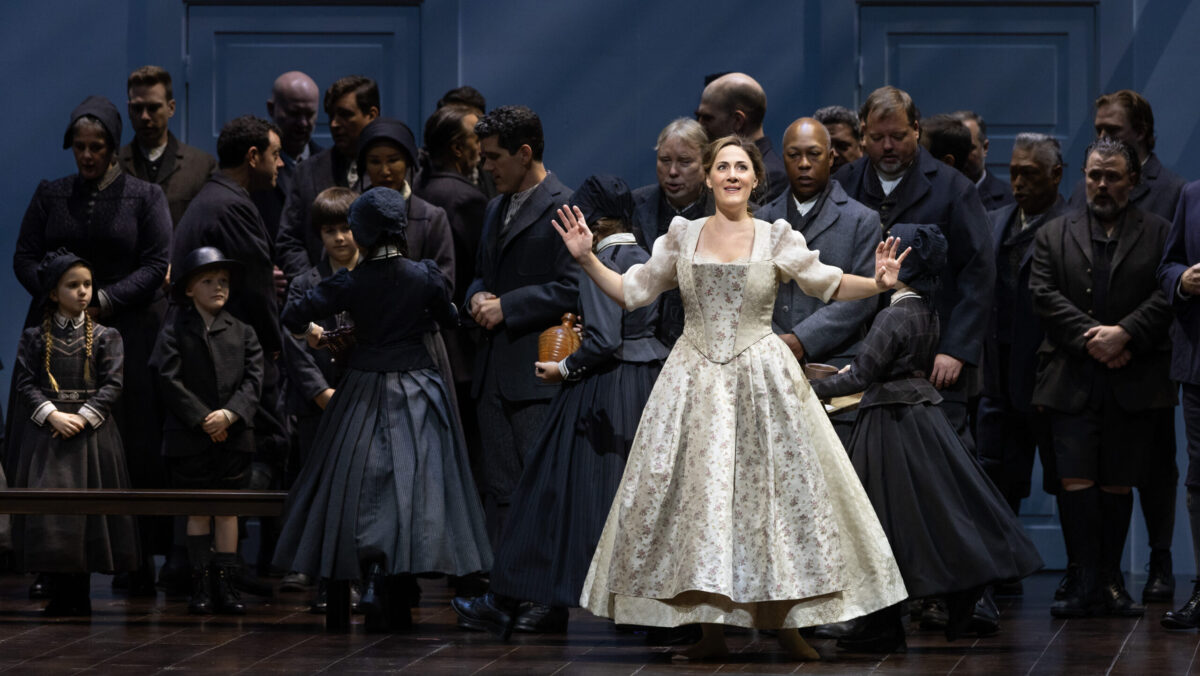
Sydney Mancasola as Lisa in Bellini’s “La Sonnambula.” Photo: Marty Sohl / Met Opera
When I spoke to Sydney Mancasola, who plays Lisa in Sonnambula, about her experience working with Villazón as a director, she described an energetic, hands-on, collaborative director with a keen interest in specific gestures. “Rolando had an acute sense for how large the gestures needed to be to read in a space as large as the Met and would clean and sharpen as he went to focus the storytelling.”
“I think I know what annoys singers and I think I know what singers like on stage,” Villazón told me. “I also know how much one can push singers even if they say no.” He told me he was interested in every character, no matter how small the part. “I want them to feel that, ‘ah, this is exactly where I want to be,’ but also I want everybody to tell a story and for that I want to create complete characters of every one of them.”
Delving into his vision for Sonnambula as a whole, he let me peek underneath the hood and examine his artistic process. He told me that upon receiving the request to direct Sonnambula, he locked himself in his studio for two days listening to the music and trying to figure out what he described as the most challenging opera he had ever directed. “The first 45 minutes, nothing happens except everybody expresses happiness in the most beautiful way with the most beautiful melodies and gorgeous and difficult singing,” said Villazón. “It’s wonderful from a concert point of view, but then as a stage director, what do you do except for having people there and letting them express their love?”
Villazón’s central innovation for Sonnambula is in character development. Each of the principal performers has their own narrative and acts conspicuously within their character arc, without regard, at times, to what else is happening on stage (Bellini, meet Bruegel.) His approach to character inserts a modern and novelistic device into the storyline. Beginning with Amina, Villazón develops her journey in an overtly psychoanalytic mode: her sleepwalking is a liberation from her superego where she is freed from society’s judgement and allows herself to express her true nature.
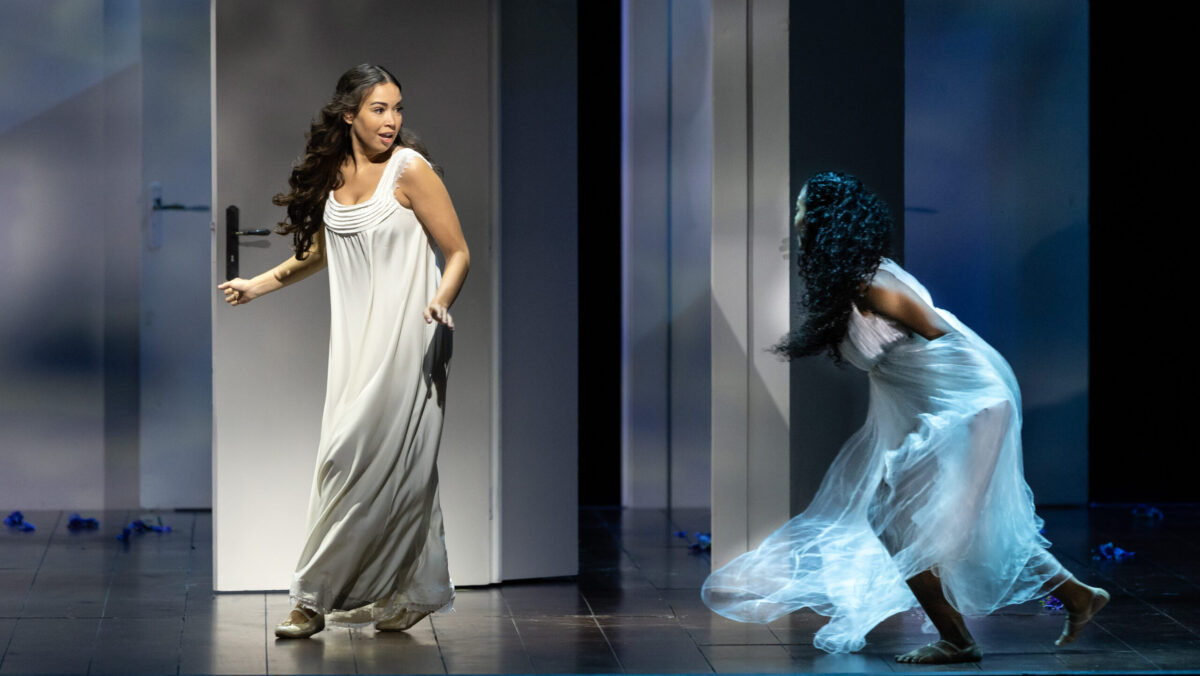
Nadine Sierra as Amina and solo dancer Niara Hardister in Bellini’s “La Sonnambula.” Photo: Marty Sohl / Met Opera
Villazón was himself in psychoanalysis several days a week for 20 years and his fascination with the life of the psyche runs deep. In his Sonnambula, a dancer in diaphanous white, named the “call of the wild,” moves along the ramparts, leaping above the heads of the performers. The dancer is meant to be something like Amina’s spirit, soaring free in the mountains where her waking form is trapped among the paranoid religious villagers (another Villazón innovation). Amina behaves while sleepwalking like her spiritual form: free, bursting with vitality, and connected with nature.
“I speak of the inner world of Amina, the somnambulism, when it is a struggle of the psyche, of her trying to belong to a society but follow her own self and who she wants to be,” said Villazón. “The sleepwalking comes as a liberation from that struggle where she subconsciously, but also physically, can become who really she is and fight with the problems that she has: love for Elvino and freedom to be the person she wants to be in a world where she’s not conscious but subconscious.”
Villazón’s concept for Sonnambula centers on a paranoid, religious, closed-in society with strict rules for men and women. Amina’s waking world is circumscribed by a society separate from the rest of humanity and even the natural world pressing in on them. She is an adopted child from outside this world, who nevertheless manages to have Elvino, one of the village’s proudest sons, fall in love with her. The two touchstones in Villazón’s production are the village and Amina, and all the characters, including the more minor ones, circle these two nodes. Sydney Mancasola told me that he gave special care to secondary roles: “Where secondary characters can sometimes become cliches and stereotypes, he found a way to make their narratives just as human by making them each an integral part of the world he had built.”
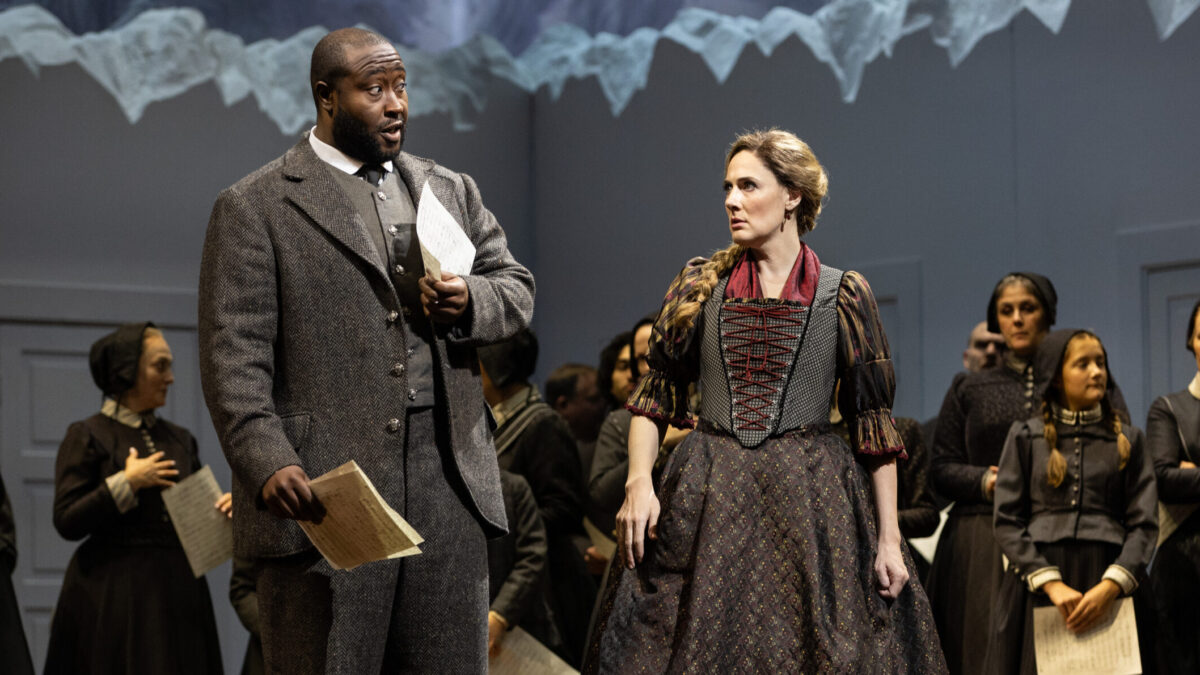
Nicholas Newton as Alessio and Sydney Mancasola as Lisa in Bellini’s “La Sonnambula.” Photo: Marty Sohl / Met Opera
Delving into Sonnambula’s secondary characters with Villazón, he began by describing lovelorn Alessio as the leader of the community who tells people how they should behave but who is also strangely attracted to Lisa, a single woman who lives on the periphery of their community. Lisa, although unmarried, is nevertheless accepted because she brings money into the community through her inn. Amina’s mother, Teresa, who adopted the girl from outside the village, must ultimately decide whether to reject her daughter with the rest of her community when Amina’s sleepwalking leads people to believe that she has slept with Count Rodolfo, or to break with them and become an outcast with her daughter. Elvino, meanwhile, though belonging firmly to his society, has discovered Amina’s charm and is attracted to it. He wants Amina to formally join his community so that he can take that charm for himself.
Because Villazón’s approach to character is modern and novelistic, he doesn’t buy Amina throwing herself back into the arms of Elvino at the opera’s end. “First of all, I need to see if there really is happiness for her with this man who doubts her and was ready to marry somebody else and treats her so bad? If not or if so, where do I put the struggle? I need to come up with a society that is very patriarchal, very conservative, very misogynistic, where women are second. A society where tenderness is not welcome, where touching each other is not welcome — very formal, very strict, a society that does not believe in science.”
In his production, inspired by Count Rudolfo, with his globe and encyclopedia, Amina spirits up a ladder, away from the cruel village that rejected her and towards the “call of the wild” spirit who has been beckoning her home since Act I. Her psychic perambulations, as designed by Villazón, gesture towards a more modern interpretation of character.
Villazón took very little for granted as he performed plastic surgery on Felice Romani’s fairytale libretto to infuse it with psychological realism. The subtext that Villazón plays with presents us with hand grips so we can climb from one end of the opera to the other. It gives us texture to keep us embedded in the story. My opera companion noted how odd it was that the village seemed so singularly obsessed with Amina, her downfall and rehabilitation. I don’t think the enclosed world of a fairytale or musical would elicit that kind of response—it came from Villazón’s additions.
While some critics found these literary developments distracting, I found the eclectic mix jagged but interesting. I admired Villazón’s ability to pump psychic air into such a static plot. Given the static nature of Sonnambula’s first half, these modestly complicating surface innovations give the production a little boost. It is quirky, inventive, and bouncy in a casually boyish style that I was inclined to like, despite uneven moments. Stylistically, Villazón’s Sonnambula is Frozen meets Freud; it’s Caspar David Friedrich by way of Hanna-Barbera. Love it or hate it, it encapsulates Peter Gelb’s vision for the Met, for which Villazón has been a proud ambassador.
Near the end of our interview, Villazón spoke about how opera can connect us. In the opera house, he told me, “the atheist, the believer can come together. The right wing, the middle wing, the left wing, and the extreme left wing, they all come together joined by the same emotions. Suddenly we discover that all of those things are these fictions that we create and that divide us. In reality, at the essence, is that who we are?”
Many artistic practitioners share a similar, near supernatural belief in the ability of their craft to link us all to a shared humanity and I found Villazón’s paean to opera’s universalism affecting, far more so than Peter Gelb and Chuck Schumer’s cloddish speeches during opening night of the season. Villazón attempts to give opera a universal appeal: a wise course, or at any rate the only course left to the industry, since tomorrow’s bitcoin magnates are unlikely to pour their billions into Bellini and Verdi. “These things that opera is talking about, these emotions in the talent and the genius of these composers that have been translated through the text through the music are where we connect — when time stops, when divisions stop, when borders stop, when everything goes away and we’re all there and we’re feeling the same and we’re joining the story. And the story of this or that character is the story of all of us.”