Stephanie Berger
The concerto form, by its nature, juxtaposes the individual performer against a collective mass of instrumentalists that can support, comment upon, argue against, or even subsume the musical materials of the soloist. We can hear, for instance, in the masterpieces of the concerto’s late 19th/early 20th-century heyday, the relationship between the Romantic Hero on one hand, and on the other, Society—or Nature—or the Universe—modeled in the interactions between the soloist and the orchestra.
Austrian-born composer Georg Friedrich Haas’s 11.000 Saiten, receiving its New York premiere this week as the “concert installation” 11,000 Strings, subjects this tradition to a shocking inversion. I did not, for instance, expect the piece to open with a rich, lovely, quasi-tonal introduction worthy of Ravel, before the piano took the spotlight with a textbook entry from the keyboard’s growling bottom octaves.
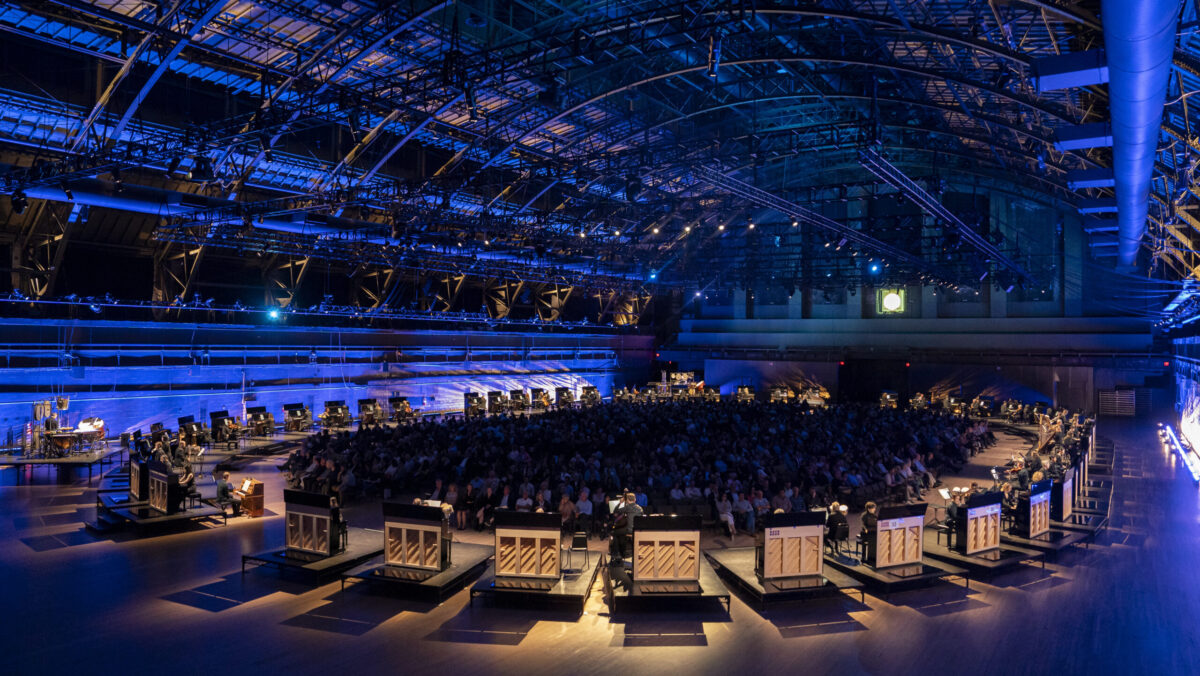
Why not? Because what I knew about this piece going into the Park Avenue Armory’s huge Drill Hall, where the performance took place, was that it was an audacious experiment by a composer from the European avant-garde: the little ripieno chamber orchestra providing that introduction, Klangforum Wien, was actually outnumbered two-to-one by pianos. A concertino (concertone?) ensemble of fifty (50) piano players sat at fifty (50) upright pianos, each piano tuned to a different concert pitch, one percent of one tone apart from the piano next to it, in a vast ring around the audience, their backs to us and also to the other musicians encircling us.
And so when the piece was handed over from “orchestra” to “soloists,” instead of hearing some melodic material emerge from that entrance in the piano’s muddy low register, the audience was instead washed over by a tsunami of noise. The sound of the pianos obliterated the gentle strumming arpeggios of harpsichord, harp and celeste, and as their crashing sonorities faded away, the orchestra was reduced to a tinnitus-like drone, as if a bomb had gone off mid-performance and left all our ears ringing. (Worth noting that of all the instruments in the room, only the harpsichord was amplified: the rest were totally subject to the acoustics of the giant room.)
The piece then spent the rest of the evening treating each pianist as just one part in an enormous, complex system—not the individualistic hero of the traditional character, but something more like a crowd, or a movement, or a mob. Sometimes, the pianists formed a strange choir, spanning the performance space, as Haas’s palette of 4400 distinct pitches allowed him to approximate the pitches of the overtone series, thereby tuning tonal harmonies more far more precisely than any conventional piano keyboard. Harmonies spiraled uncannily, individual pianos harmonized with others spread out across the room, and I felt like I was floating in zero gravity, unmoored from a center in pitch or in space, unsure which way was up.
At other moments, Haas used the pitches to create strange timbres, combining pitches from this piano’s top register and that piano’s bottom register to make a new, metallic sonority more like the sound of a construction site than of a musical instrument; or adding up to a single, constantly evolving, highly complex drone, like God’s own tambura.
Okay, so I was kind of joking up there when I said that thing about all piano concerti being political, but the uncanny specificity and novelty of Haas’s sonorities had my imagination desperately trying to project concrete antecedents for the intense, elusive sense-memories that this music stirred, like aural déjà vu. (Er, “déjà entendu,” I guess.) And, presumably because my brain has been fully melted by watching American democracy collapse in real time on social media, many of those images were distinctly political. When members of the orchestra suddenly put down their instruments and started accompanying the pianistic cacophony on bongo drums? I heard the joyous tumult of a political demonstration, scattered protesters drumming out their resistance in the milling crowd. When the air became heavy with dark, ominous drones? I heard squadrons of bombers, flying low over a ruined city.
Stephanie Berger
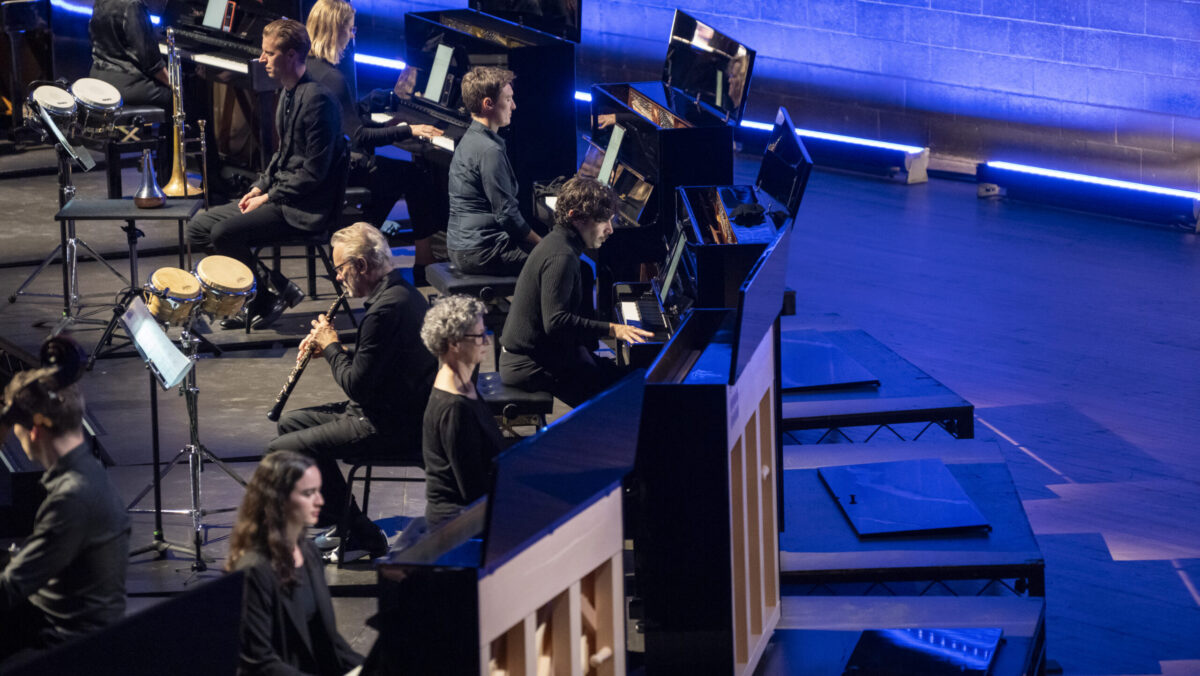
Suddenly, the pianist directly in front of me—Australian-born new music legend Lisa Moore—burst into a sequence of chromatic chords, immediately evocative of Rachmaninoff-style post-Romantic writing, the epitome of the concerto’s heroic character. But as more and more of the other players around the room picked up this material, the sound rapidly dissolved into another undifferentiated mass. That’s the illusion of Romantic individualism, isn’t it? One stubborn individualist is a hero; fifty stubborn individualists, all too often, are just another herd.
I will admit that when I saw this piece listed on the review calendar for Parterre Box, I wondered if a mistake had been made. While Haas has written plenty of operas, we have not—to my dismay—heard any of them in New York. We haven’t heard his recent Hyena, either, a piece he composed with a speaking part written by and for his wife and muse, the BDSM writer/activist/educator Mollena Lee Williams-Haas (who, as the tabloids say, STUNNED at the premiere, resplendent in a monarch butterfly-patterned gown and matching lepidopteran fascinator), and there is no singing in this piece. Well, look, I was dying to hear it, I wasn’t about to complain.
Nevertheless, I hope I’ve managed to convey that there was something of the music-drama to this piece and its presentation. The layout of the players, as well as the static lighting setup (by designer Brian H. Scott), generated a sense of space, and the explorations of the different possibilities of the army of pianos felt carefully calibrated in terms of theatrical timing.
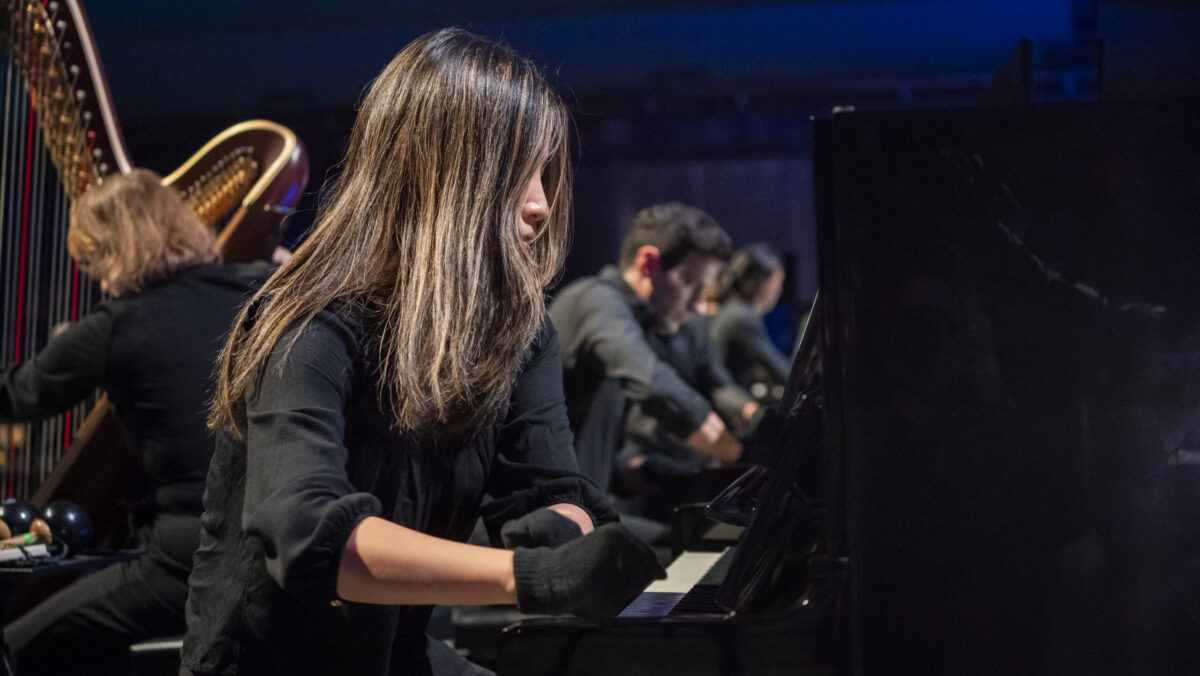
And then, at a moment near the end, the pianists, clad all in black, discreetly, one by one, slipped on matching pairs of soft black gloves. Notwithstanding the heterosexual notion that the moment in which “the gloves come off” is when things get exciting, I have found that the opposite is far more often the case, and I hope that Prof. Haas, who 10 years ago this month was honeymooning with Mollena at the Folsom Street Fair, is on my wavelength here: when the gloves snap on, zip on, or slide on, that’s when the night is about to get interesting.
Stephanie Berger
In this case, the gloves served a pragmatic function, as the next grand gesture in the score was a long string of ferocious, finger-busting glissandi up and down the keyboard, thundering from 50 instruments in 50 different tunings all at once, and so the gloves were a necessary measure to keep everybody from losing blood, skin and fingernails to the ivories. But they’re also a beautiful example of how the composer took an element that served a purely necessary function in the mechanics of the piece and turned it into a tiny bit of business, a tiny bit of costuming, a tiny bit of theater in this “pure,” abstract instrumental work.
And after all, this moment, where every newly-gloved pianist seemed to be making as much noise on the keyboard as they possibly could, was the climax of the piece, a wild moment of “black MIDI”-esque piano madness, and it was marked ingeniously by this intriguing bit of almost accidental stagecraft. 11,000 Strings is not just a piece of music, it is a show, a gripping, exhilarating, moving, evening-length production.
Stephanie Berger
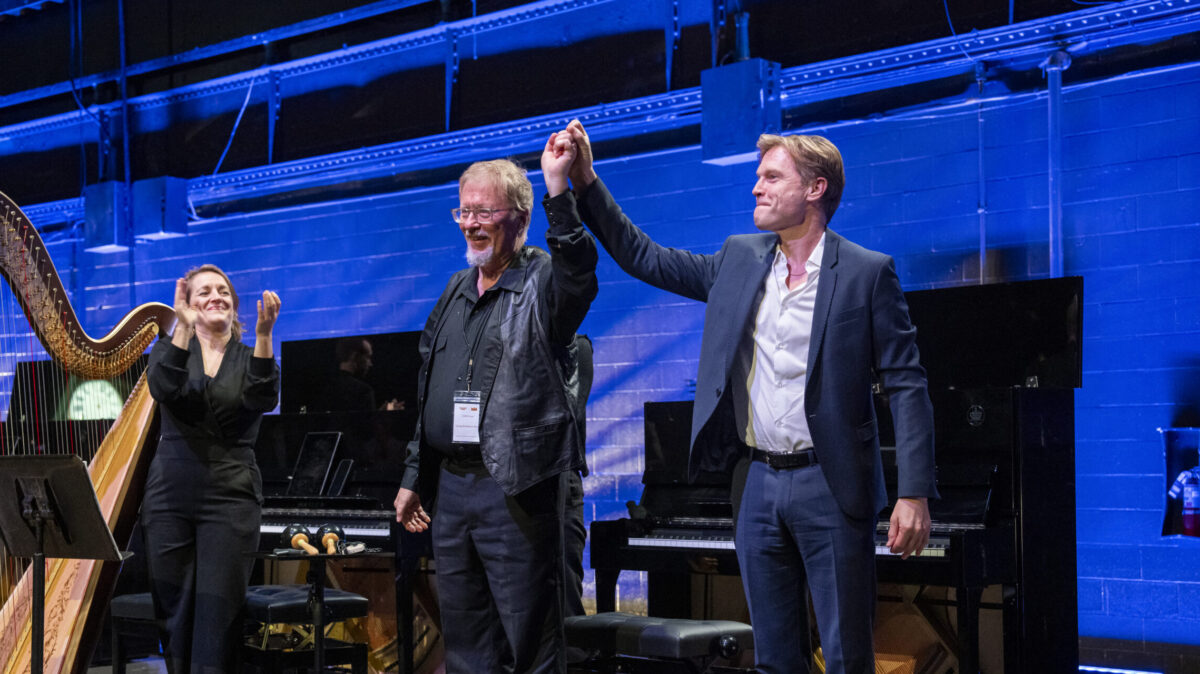
Those gloves are also an example of how the wild ambition of Haas’s experiments demand certain practical solutions, which he then integrates into the material of the piece. For instance: if fifty piano players are all playing upright pianos in a ring around the audience, how can they see the conductor? Solution: they don’t look at a conductor; their parts instead incorporate indeterminate elements controlled by strict timings they can follow on electronic devices. Each player has a certain freedom, but within the narrow confines of the system Haas has built. (Bas Wiegers took a bow as music director of the exquisitely well-prepared ensemble, but I didn’t see him on a podium anywhere waving his hands—I did watch with great interest, however, as the iPads on the players’ music stands turned their own pages, and as their phone displays ticked off the seconds of the performance.)
The whole of the piece was constructed according to this logic. Each molecule of the piece was dramatically, acoustically, or harmonically necessary to the whole, adding up to a form that was conceptually elegant and efficient, yet in its realization dizzyingly complex. I left the hall immediately wanting to see it again, like the kids who walked out of Star Wars (1977) on opening weekend and got back in line to buy a ticket to the next screening. I had to settle for buttonholing all my friends in the lobby and ranting at them about the beauty of what we had just witnessed. When was the last time a new piece of music got me so excited, so giddy, over and over again, from start to finish?
As I type this, I think there are still a few cheap seats available for Saturday’s performance. Maybe I’ll see you there.