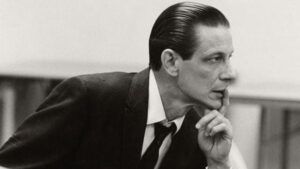
And no other performance that I know of puts those contradictions front and center like this one, by Michael Wolle, in Barrie Kosky’s Bayreuth production from 2017. The monologue itself starts at 4:55
Kosky’s premise is that Wagner intended Beckmesser to be a thinly disguised caricature of a Jew, and that a deep current of antisemitism runs through in the work. In this production, the first Act takes place at Wahnfried, where Wagner/Sachs receives Hermann Levy/Beckmesser. The second Act ends with a pogrom, in which all Nürnberg torments and humiliates Beckmesser/Levy, explicitly as a Jew. The third Act takes place in the courtroom of the Nürnberg War Crimes Tribunal, where Sachs/Wagner confronts his role the violence that has occurred.
It is an infuriating but brilliant staging. Infuriating because I do not believe for a moment that Wagner saw Beckmesser as a Jew. When I was studying for my bar mitzvah, the cantor who coached me was a former opera singer. Frederick Lechner was born in Berlin and had an international career (he sang Alberich at the Met) before becoming a cantor in New York. His signature role, of which he was very proud, was Beckmesser. I did not yet know Meistersinger, but my father (whose hometown is less than an hour’s drive from both Nürnberg and Bayreuth) was impressed, and thought it was hilarious that I was being corrected by Der Märker himself.
On the day, my cousin Eva (born in Prague and named for Fräulein Pogner) and her husband (an executive of the ADL, born in Regensburg) – presented me with the von Karajan recording of Meistersinger. At the lunch afterward, they, my father, and Mr. Lechner sat trading stories about the good old singers of the bad old days. I find it hard to believe that Kosky rooted out antisemitism that none of them – all intelligent people who had come face to face with the Nazis – could not recognize. Kosky claims that Beckmesser’s mangling of the Prize Song is supposed to sound like Yiddish, and others have claimed that his serenade references klezmer music. If so, it is Yiddish and klezmer music unlike any I have ever heard.
But the production is brilliant, too and this is the scene in which it all pays off. Ultimately, it doesn’t matter whether Wagner intended Beckmesser to be a Jew or whether this or that moment in his operas is or is not antisemitic. Nor does it matter that Wagner explicitly rejected Gobineau’s theories of racial inequality. Nor does it matter that none of the Nazi leaders – except for Goebbels, in one or two speeches – invoked Wagner’s antisemitism as an example, or that Rosenberg and others considered him too soft and Christian. Wagner was an antisemite. His name and work will always be tainted by the use the Nazis made of them. What we see in this scene is not just Sachs, shaken to his core by his role in the previous night’s violence, but also Wagner confronting his unforeseeable, involuntary, but undeniable association with the Third Reich.
On the day the Second World War ended, U.S. Technical Seargent Joseph Wechsberg, who would go on to write for the New Yorker for years, was driving through Bayreuth and stopped to see the Festspielhaus. He found the stage door open, and the stage set for the first scene of Act III of Meistersinger, which must have been in rehearsal when the 1945 season was called off. According to Frederic Spotts (Bayreuth, Yale University Press, 1996), Wechsberg, who had fled Prague in 1939 and whose mother had died in Auschwitz, sat down in Sach’s chair and sang through the Wahn monologue to a dark theatre, empty except for a single custodian who had come in the see what was happening.