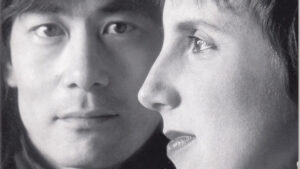
Many singers and operagoers out there nowadays are apt to dismiss her outright, due to a quality in her sound that they view as excessive vibrato. I exhort them to listen again! A voice afflicted with too much vibrato obscures true pitch, whereas Mesplé’s pitch is always spot-on. And with her singing, it’s not vibrato so much as a “flutter,” which gives the impression of a shimmer—a luminosity—in the voice. What Mesplé also possessed in abundance was something rarely encountered onstage today that can’t really be taught, best described simply as sincere, totally unaffected charm.
The sound of Mesplé’s voice is quintessentially French and, unlike many of her ilk, she connected completely with the text in anything she sang. I think immediately of the first music I ever heard her sing: “Je suis Titania,” recorded for her album entitled “Airs d’Opéras Français,” released in 1972 when she was in her absolute prime. From the moment Mesplé’s Philine uttered the first phrase of the recitative”—“Oui, pour ce soir, je suis reine des fées”—I was smitten.
The frisson I felt listening to that performance so many years ago, which continues to this day, has to do with so many elements: the elegance of her diction, the grace of her phrasing, her technical mastery, but above all, her ability to put her sound at the service of character. You can clearly envision the irresistibly radiant actress, having just portrayed Shakespeare’s Tytania and now basking in the post-performance attention of her admirers.
Then, of course, comes the aria itself. Everything is there: terrific rhythmic drive, pinpoint accuracy for the passages of rapid-fire articulation, perfect staccati, wonderful trills, tastefully sculpted legato in the few passages that require it. Vocally speaking, Mesplé saves the best for the very end when, after the ascending octave leaps in the cadenza, she jumps a sixth up to a sustained, full-voice F above high C. Neither a steam whistle, a squeal, nor a scream, it’s seemingly effortless and astonishingly beautiful.
That album presents one exceptional performance after another, with Mesplé also including Lakmé, Juliette, Ophélie, Manon, Leïla, and Olympia. She illuminates every one of those characters, with her Lakmé, not unexpectedly, the definitive portrayal of Delibes’s gentle heroine. (Fortunately, she later recorded the complete role.) There’s so much else in her huge discography to savor as well, covering just about everything for a light soprano, from standard repertoire to operettas and a marvelous variety of French songs. In every piece she takes on, she’s always a thorough, thoughtful musician, and always a matchlessly elegant, illuminating interpreter.
To appreciate Mesplé as a born singing actress, go not to opera but to one of her most suprising performances: Poulenc’s dramatic monologue for soprano and orchestra, “La Dame de Monte-Carlo.” There’s a video on YouTube from the 1990 gala farewell in Paris for Mesplé’s colleague and compatriot, Régine Crespin. Nearly sixty at the time, with career nearing the four-decade mark, Mesplé walks onstage looking fabulous in a black sequined ball gown. She then proceeds to revel in the subtleties of this exquisite work, one that can be memorably performed only by a truly mature artist to whom elegance simply comes naturally. Shaping Cocteau’s text line by line as specifically as any great legitimate-theatre actress would, she transforms herself through voice and presence into the desperately unhappy woman adrift in Monte-Carlo, lonely, addicted to gambling, and now thinking of suicide. It’s as far removed as one can imagine from any character Mesplé ever portrayed onstage, yet she’s totally convincing, vocally and dramatically, at every moment—and that intoxicating shimmer in the voice is still there.