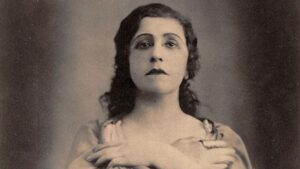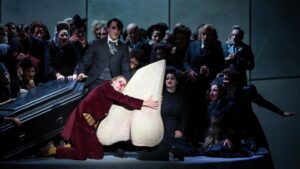
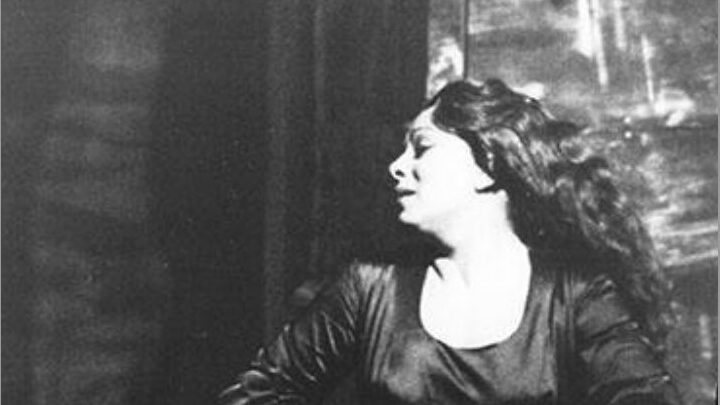
From my reading and listening, I suspect that Cruz-Romo is one of those performers who in her time was appreciated but perhaps taken for granted, while if she were singing today would be a big star.
Before I checked, I had assumed her New York City Opera career was more substantial than it was. She was on its roster just from the fall of 1969 until the fall of 1972 by which time she was appearing with some regularity at the Met.
Her NYCO debut came at the end of the wildly acclaimed first run of Boito’s Mefistofele. She succeeded Carol Neblett as Margharita/Elena and they continued to alternate in these roles throughout Cruz-Romo’s career there. She also appeared as Cio-Cio-San (perhaps her most notable role), Mimi, and Tosca. Her only NYCO new production was as Amelia in Un Ballo in Maschera.
Though her Met career was considerably longer, she only starred in one new production there as well: as Suor Angelica when the entire Il trittico was staged in 1976. She was Desdemona in an early live Met telecast when its Opening Night Otello featured Placido Domingo’s first Met Moor.
She did, however, appear in nine Saturday afternoon broadcasts including her familiar Aida, Madama Butterfly, Suor Angelica, Manon Lescaut and Un ballo in maschera. Less expected might have been Violetta in La traviata.
Among her 160+ Met performances, more than fifty took place outside of Lincoln Center, either on the annual Spring Tour or in NYC parks. Her company debut actually came on a tour stop in Atlanta in 1970 when she appeared as Maddalena in Andrea Chénier, a role she never sang again with the company.
She occasionally appeared outside of the U.S., briefly as a Verdi favorite of Riccardo Muti with whom she sang Forza, Trovatore and the Requiem.
Following her Met career which ended—again on tour–in 1984, she visited smaller companies in more dramatic repertoire including Macbeth, Medea (heard today in perhaps her only outing as its lethal heroine), Norma and Turandot.
The Met Tosca offered today was a rather unusual occasion. As it did several years later when again faced with a Leontyne Price cancellation in Ariadne auf Naxos, the Met changed the planned opera. On March 1, 1977, a Price-less Forza was scrapped but James Levine stayed on the podium. Domingo moved to Cavaradossi and Ingvar Wixell, in the midst of the new La Bohème, returned as Scarpia. It was just Cruz-Romo’s second Tosca with the company, a role she never broadcasted.
Do readers have memories of Cruz-Romo?
Puccini: Tosca
Tosca: Gilda Cruz-Romo
Cavaradossi: Placido Domingo
Scarpia: Ingvar Wixell
Sacristan: Renato Capecchi
Angelotti: Allan Monk
Spoletta: Andrea Velis
Sciarrone:Russell Christopher
Shepherd: Godehard Rau
Conductor: James Levine
Metropolitan Opera
1 March 1977
In-house recording
Cherubini: Medea—Lackner edition
Medea: Gilda Cruz-Romo
Glauce: Trufy Ellen Craney
Neris: Beverly Evans
Giasone: Gaetano Scano
Creon: Richard Cowan
Conductor: Gabriele Bellini
Connecticut Grand Opera
Palace Theatre, Stamford
30 March 1987
In-house recording
Tosca and Medea can be downloaded by clicking on the icon of a cloud with an arrow pointing downward on the audio player above and the resulting mp3 file will appear in your download directory.
Never miss an episode of Chris’s Cache! Subscribe to this podcast via Apple Podcasts or RSS.