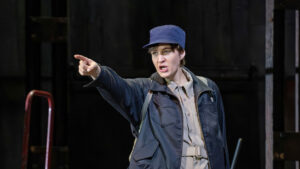
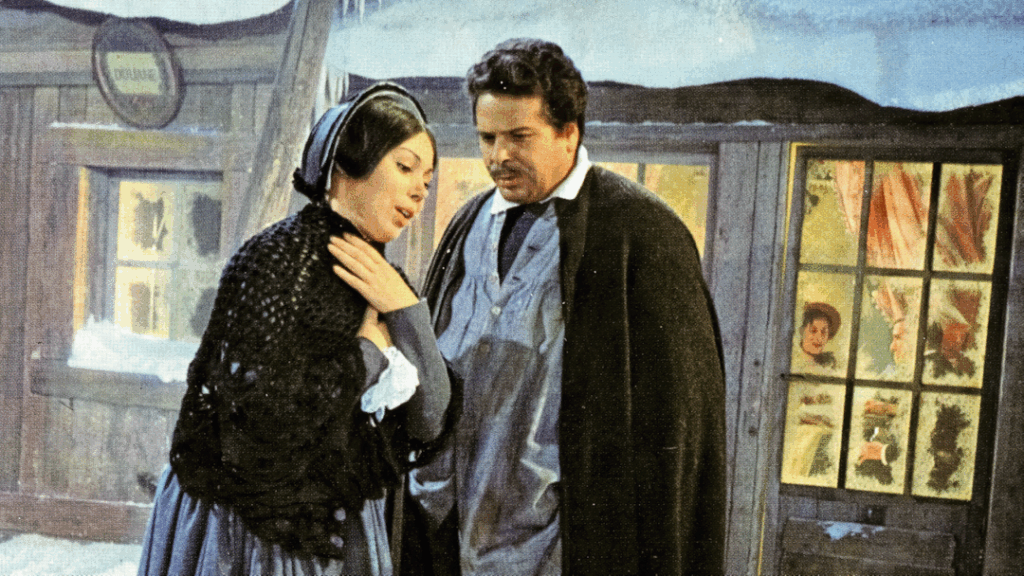
During lunch in Berkeley with the soprano Marie Plette (who numbers Mimì as one of several Puccini heroines in her repertoire) she pulled out her score of La bohème to take me through an aria in musical terms. As she was doing an analysis of the various demands of singing Mimì, I couldn’t help but notice in the upper margin of a page in Act III: the word “Patience”.
It’s a word that fits Giacomo Puccini quite well; for all the urgency and impetuosity of his operas, all of his heroines are asked to be patient, to wait for what they want or need. By the time we get to Act III of La bohème, patience has run out.
If you know and love La bohème, you probably know and love Mimì’s two standalone arias: the Act I aria “Mi chiamano Mimì” and “Donde lieta uscì” later in Act III. These are the arias that find their way onto recital discs and onto gala programs, but for me, the aria “O buon Marcello, aiuto!” from early in Act III is where a singer cast as Mimì can really show what she’s got.
And by the time we get to it, Mimì cannot be patient any more.“O buon, Marcello, aiuto! Aiuto!” Two pleas for “help!”. Two pleas for Marcello’s wisdom, for some explanation of why Rodolfo has turned so sour, so cruel. After the meet-cute of Act I and the joyous celebration of life in Act II, we make an unsettling turn in Act III. Mimì has also had to grow up fast. We hear the woodwinds at the top of Act III indicate not just the lilting drops of snowflakes, but we also hear anxiety, a descending scale of despair.
Once Mimì and Marcello meet, and Mimì declines Marcello’s quest to go inside, she can’t hold back any more. She has to let it out. Things are not good.
| MIMÌ O buon Marcello, aiuto! Aiuto! MARCELLO Cos’è avvenuto? MIMÌ Rodolfo m’ama e mi fugge. Rodolfo si strugge per gelosia. Un passo, un detto, un vezzo, un fior lo mettono in sospetto… onde corrucci ed ire. Talor la notte fingo di dormire e in me lo sento fisso spiarmi i sogni in viso. Mi grida ad ogni istante: non fai per me, ti prendi un altro amante, non fai per me. Ahimè! In lui parla il rovello, lo so; ma che rispondergli, Marcello? MARCELLO Quando s’è come voi non si vive in compagnia. MIMÌ Dite bene. Lasciarci conviene. Aiutateci, aiutateci voi. Noi s’è provato più volte, ma invano. |
MIMÌ Oh! help me, good Marcello! Help me! MARCELLO What’s happened? MIMÌ Rodolfo – he loves me but flees from me. Rodolfo is torn by jealousy. A glance, a gesture, a smile, a flower arouses his suspicions, then anguish and rage… Sometimes at night I pretend to sleep, and I feel his eyes trying to spy on my dreams. He shouts at me all the time: “You’re not for me. Find another. You’re not for me.” Ah! I know it’s his jealousy speaking, but what can I answer, Marcello? MARCELLO When two people are like you two, they can’t live together. MIMÌ You’re right. We should separate. Help us, Marcello, help us. We’ve tried again and again, but in vain. |
Mimì begins on “O, ”the most open of sounds, compelling Mimì to lay it all out there but also tempting the singer to unleash too much sound at once. From the “O,” the pitches actually descend to middle C on the “o” of Mimì’s second “aiuto.” She is exhausted already, that “O” taking it out of her, from stalking Paris to find Marcello and from the emotional weight of what she must confront. Puccini is the master of portraying the reality that when we say something, it becomes real. She has to say aloud that her affair with Rodolfo is a disaster. And doing that hurts.
As Mimì approaches her first big crescendo, the pitches rise and fall, like the rising and falling of her hectic breathing and the summoning of her will to continue. Interestingly when she tells Marcello, “Rodolfo m’ama” (“Rodolfo loves me”) the pitches of “m’ama” are constant. She so wants to be sure that it’s true. Yet Puccini tells the singer and the audience that Mimì is not so confident. Mimì starts to ramble, Puccini giving her a lot of words to sing quickly, as she tries to put words to what she wants to say. She finally can only issue a cri du coeur on her lover’s name via that huge B-flat on the “dol” of “Rodolfo.” She is desperate to slow down the pace of her thoughts and her panic before it takes over again, before she blurts out the real reason for her predicament. This big musical moment ends on “gelosia” (“jealousy”), the reason why her relationship is over.
After a bit of a break, the dramatic tension picks up on “Mi grida ad ogni istan” (“He shouts at me all the time”) and we get more menace from the orchestra and a heaving throb in Mimì’s vocal line with heavily accented syllables, the heavy, mechanical meter telling us that the worst is yet to come. Mimì details Rodolfo’s abusive behavior and Puccini pushes the soprano back up to A-naturals on “Ahimè!” (“Alas!”). The vocal line ricochets, plunging down to low Fs as she backpedals, assuring Marcello that Rodolfo doesn’t mean to be cruel while also asking for his help. She’s rationalizing. But it’s not working.
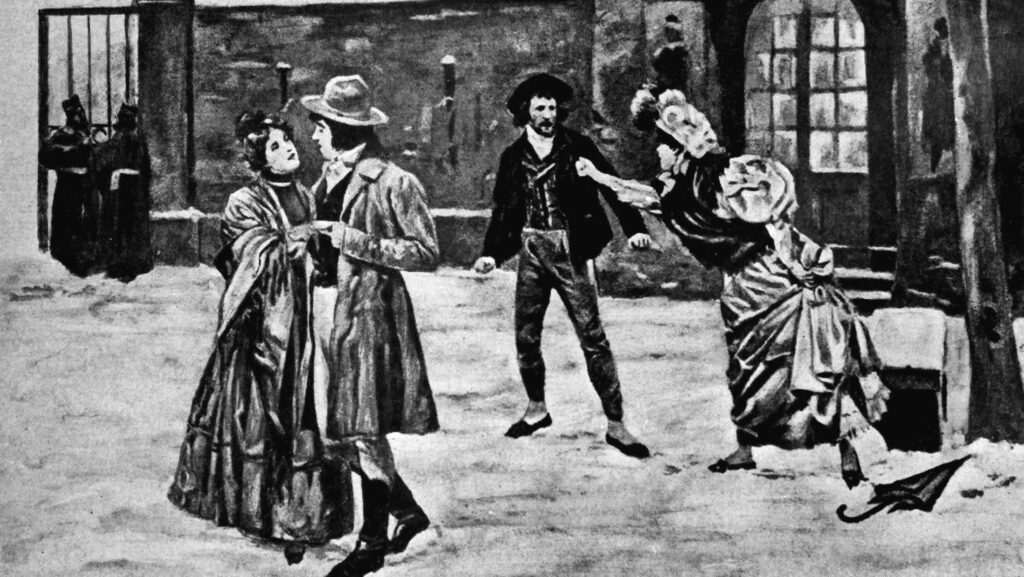
Internet Archive Book Images, No restrictions, via Wikimedia Commons
Marcello interjects some sense into the proceedings, telling Mimì that maybe she and Rodolfo aren’t a good match. It’s obvious that Mimì hears what Marcello is saying. She is not some starry-eyed kid, but a grown woman. It makes sense, in a way, why a mature woman is best equipped to sing this music that is far too technically demanding for a young soprano. With maturity (hopefully) comes the ability to listen to reason.
Mimì gears up to repeat the soaring crescendo to that B-flat as she responds “Dite ben, dite bene” (“You’re right, you’re right”). The singer has to hit another A on that second “ben” as emotions well up again—not desperation to fix the relationship but from the anxiety of ending it.
Mimì’s ascent to the final crescendo happens over Marcello. (Rare is the production where Mimì isn’t facing the audience, in her own world, outsinging him.) This time that crowning B-flat is on the first “ben” in the phrase “Dite ben, dite ben, lasciarci convien” (“You’re right, you’re right, to leave each other is best”). Instead of the B-flat being on Rodolfo’s name in frantic confusion as before, this time it’s on the word whose direct translation is “well” or “good.” Perhaps we cannot say that she’s made peace with this separation from the man she loves (loved?), but it’s revealing that the rest of the aria is about realizing that it’s over—and the anxiety that can come with that, too.
There are just so many recordings to choose from that it’s a fool’s errand to narrow them down, but narrow them down I must. Left off this list are such greats as Renata Tebaldi, Lucine Amara, Maria Callas, Licia Albanese, Renata Scotto, and more recent singers such as Nicole Car and Ailyn Pérez (my favorite among Mimìs today). Ahead of revivals in New York and San Francisco that feature Corinne Winters, Car, and Karen Chia-ling Ho, respectively, here are six different sopranos and their takes on this thrilling aria.
Bidu Sayão
The Brazilian soprano Bidu Sayão recorded Mimì several times both live and in studio. This is the oldest recording on this list (1947) and features Francesco Valentino as Marcello. Sayão began her career as a soubrette singing Debussy, Donizetti, Gounod, Delibes, and Mozart, then turning to heavier repertoire like Verdi and Puccini. However, she never really lost the flexibility and purity of tone that comes with being a light lyric soprano. Mimì is a bigger lift than Susanna, but Sayão brings the same impeccable diction and clean attack that a singer needs for Mozart. It’s clear to me she remembered what it’s like for Mozart to leave you so exposed, unable to cover up bad habits. The phrasing is crisp, almost more conversational, even as the voice soars emotionally over the orchestra (conducted with deference to the singers by Giuseppe Antonicelli). This also leads to some chopped up, even plucky phrasing, less Mimì than Adina from L’elisir d’amore. Sayão’s is an emotionally immediate Mimì, unafraid of the big moments. Sayão wanted to be an actress before she wanted to be a singer. It shows.
Victoria de los Ángeles
Victoria de los Ángeles had a resumé you’d be hard-pressed to find today: Rosina, Nedda, Carmen, Cio-Cio San, Marguerite, Desdemona, and Elisabeth (Tannhaüser), not to mention a vast concert career which included songs of Falla and Ravel. Like Sayão, her technique was solid enough that she could hop around among repertoire types. Her famous 1951 recording of Bohème, sampled here, is, in some ways, the most iconic. Listening to de los Angeles take on Mimì alongside Jüssi Björling and Leonard Warren (conducted by Sir Thomas Beecham), it’s obvious she relished singing the role. This doesn’t mean she oversings or is otherwise too precious. She isn’t afraid of the emotional content and truly acts the role, but there is also a bluntness to her take on “O buon Marcello, aiuto!” It’s both heartbreaking and technically solid.
Since the studio technicians perfectly balanced the orchestra and the voices, de los Ángeles is not pushing in the lower register to be heard so she can use those moments to convey Mimì’s despair and conserve a bit for the big moments. (And she does not hold back.) Her embrace of the big moments leads to more breaths which chops up the legato of Mimì’s final crescendo. (Most sopranos do that, to be fair.) Yet it’s a classy take on the role without being diffident or at-arms-length.
Anna Moffo
If one had to design a bionic lyric soprano, out would come the American soprano Anna Moffo. Her first recording of La bohème was as Musetta alongside Maria Callas in 1956, and Musetta was probably a more natural fit for her voice. She famously pushed her voice past its limit, throwing caution to the wind far too many times, yet I have to include her Mimì in this list, if for no other reason than it’s a thrilling listen.
Moffo was a screen actor, even leading her own variety show on Italian television. That commitment to acting comes through in her 1961 recording under the baton of Erich Leinsdorf and alongside Robert Merrill, the sweetest-voiced Marcello I can think of and one who would never pull focus from La Moffo.
There are times when the acting takes the reins and the voice goes along for the ride. There are some really chesty low notes, some lurching at other notes, some heaving tears, and then there’s the famous Moffo scoop to high notes. (I prefer a direct attack on that final B-flat as a cry of confused frustration, but to each his own.) Many would throw their Moffo CDs at me for suggesting that these are faults in technique, but Moffo’s Mimì is also the most believably frantic and confused.
Mirella Freni
For many, even more than Moffo, the perfect Mimì is the Italian soprano Mirella Freni. She recorded the opera in the studio no fewer than three times in her career. I chose this 1963 recording opposite Mario Sereni under Thomas Schippers—and not the more famous 1972 version with Pavarotti under Karajan—because I think it reminds us of what made Freni unique in the Italian repertoire.
One of the first opera disc sets I ever bought was her EMI Romeo et Juliette with Franco Corelli. (It didn’t grab me, truth be told.) Yet as I listen to Freni’s take on Mimì, I can absolutely hear the singer who recorded the very lyric French roles of Gounod, Rossini, and Bizet, as well as Donizetti, Mozart, even Handel. (Like Bidu Sayão.)
After the moving theatrics of Anna Moffo, Freni’s take on the character sounds far more lyrical. It works. Moffo’s realism is in giving over fully (perhaps too fully) to the emotional circumstance. Freni’s Mimì is trying to convince herself it’s all fine. Freni brings a true sense of bel canto to the role, a hesitancy to push or to sound ugly. I’m usually turned off by this at-arms-length approach to Italian opera, but Freni also understands that less is more. Her Mimì might be more reserved than Moffo’s or Sayão’s, but it makes total sense that her Mimì would protect herself from further hurt.
Montserrat Caballé
I acknowledge this may be a controversial choice, but in terms of being the whole package, I have to go with another Catalan soprano: Montserrat Caballé. Her recording of La bohème with Georg Solti and Sherrill Milnes as Marcello was done at her absolute prime. The voice shimmers above the staff, those B-flats hit dead-on and with a textbook squillo she shares with Freni, an incisive quality so prized in Italian singing. Also like Freni, Caballé is in complete control of her voice, able to manipulate the vibrato. In some moments her Mimì feels the weight of her predicament, and in others her heart clearly flutters around in her chest as she realizes what she has to do. Caballé’s legendary breath control means she does not break the legato line, and her secure bottom notes means she only drops into her chest voice when she truly pleads with Marcello to help her. And we get hints of those legendary pianissimi.
Caballé is convincing in Mimì’s youth. But it takes a woman of considerable confidence and maturity to do battle with Solti’s Wagnerian conducting. It makes me wonder if he really thought he was conducting Die Walküre, yet it somehow works. Caballé definitely was a singer who acts, not an actor who sings, and she needed a Solti to push her. Caballé was a musician, first and foremost. Goose her a bit with the music, and she can find the sturm und drang in the character without ever losing her bel canto technique, a true heir to fellow Catalan de los Ángeles and an equal match with Freni.
Angela Gheorghiu
I first saw the Romanian soprano Angela Gheorghiu at San Francisco Opera in 2007. The company mounted the much-traveled Nicolas Joël production of La rondine that was seen at the Met last season. In 2012, she returned to San Francisco to sing Tosca. I remember being surprised, each time, by how relatively small and lyrical her voice was. (She’s way more Freni than she is Caballé.) Watching her take on “O buon Marcello” is a case in point. Much like Anna Moffo, she takes what is essentially a lyric instrument and pushes it to its limits, with Moffo’s commitment to acting as well.
In her 2008 Met appearance as Mimì (under the baton of Puccini specialist Nicola Luisotti and with Ludovic Tézier as Marcello), Gheorghiu is in total control of her instrument and she’s asking it to do big things. The middle voice is in fine form, laser-beam accurate and with a bit of duskiness to it. As she climbs up to each B-flat, the voice thins and spreads out, a wounded soul crying out in pain. It’s a little disconcerting to hear a lovely instrument pushed so hard. It’s a voice that was practically engineered to sing Violetta (her breakout role) but is forced into mature womanhood. There are moments when you can almost hear her Mimì wish to return to the joy of the Café Momus as Gheorghiu finds small moments of lyric delicacy amid the chaos. She’s a smart singer, but she also compels us to appreciate the demands that come with singing Puccini’s heroines.
Maija Kovalevska
The 2012 production of La bohème at the Royal Ballet and Opera in London is perhaps more famous because Rolando Villazón struggled through Rodolfo. The Latvian soprano Maija Kovalevska has a take on the role that is not particularly new or innovative against Audun Iversen’s Marcello (how much can one fundamentally fuss with Mimì, really?), but her approach to the role has integrity. Within the past year she has added Gutrune in Götterdämmerung to her repertoire. It’s not a surprise, since there is a bigness and a ‘ping’ to the voice that makes her a good fit for the more lyrical Wagner roles. I have to imagine there is an Elisabeth or Eva in her future, maybe even a Sieglinde farther down the line.
Here she plays it right down the middle with the stock gestures and the stock vocal ‘tics’ to indicate despair. It’s all a bit old-fashioned, but it works. Conductor Mark Elder isn’t making it easy on her; hearing him conduct Berlioz and Strauss here in San Francisco a few months ago, I can hear the same muscular approach to Puccini. Yet Kovalevska has a lot of voice, and she clearly knows how to use it when it counts.
Looking at Marie’s score, a few pages after Mimì finishes pleading with Marcello, the word “Listen!” appears handwritten in the margin. It’s a direction I happily take whenever “O buon Marcello, aiuto” comes to mind.
Have your own perspective on an aria you’d like to share? Get in touch.