
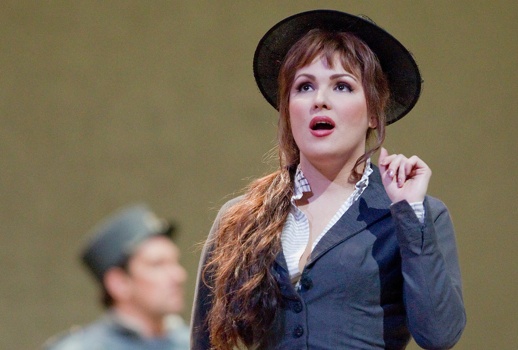
 “…Manon as a gold-digger from the start. There’s no innocence to be lost, and no contest between impoverished love with Des Grieux and riches with the morally bankrupt De Brétigny; this Manon kisses the boys, shows some leg, and goes for the money every time.” The Wall Street Journal‘s Heidi Waleson is the latest to chime in with the “Manon must be an innocent virginal child” thesis, and La Cieca is uneasy about the implications of this line of reasoning.
To begin with, here’s the inference drawn by La Waleson: “Of course, in this scenario, Manon’s moments of vulnerability and regret are unconvincing. But Ms. Netrebko doesn’t project those emotions anyway…”
Now, stop me if I’m wrong here, but it seems to me that the position taken here is that unless the singer semaphores early on that Manon is a blameless victim, incapable of any sort of consent, just a kid—infantilized, in other words—then the audience cannot and should not have any sympathy for her. After all, she gets just what’s coming to her: shame and painful death, and next time maybe she’ll think about that before being sexually aggressive.
To be sure, La Cieca admits that as a technical matter of dramatic arc, starting off Manon as an innocent allows for a bolder and steeper progression and therefore a more spectacular downfall. It’s perfectly valid. But it’s not the only valid way to describe that arc.
Why can’t Manon be a complicated or even “dark’ heroine? Why can’t she be flawed from the beginning, making her (bad) decisions based on questionable values she has gleaned from society? Or, for that matter, why can we not, in the 21st century, accept the idea of Manon as, from the beginning, a woman whose conscious use of her sexuality as power so threatens society that she must be destroyed?
These I think are more interesting readings of this opera, and to my mind at least they are supported by the text. More to the point, they are plausible rationales for Netrebko’s take on the character of Manon, i.e., a conscious decision that Manon is not a sweet virgin when we first meet her, but a budding sexual outlaw.
A more complicated Manon is, to La Cieca’s mind, a Manon who might achieve tragic status. I wonder why, then, so many critics want to reduce her to an ingenue in a melodrama.
Photo: Ken Howard