 Okay, it wasn’t Sister Act all the way, but in the middle of Acts IV and V, ENO’s new production of Gounod’s Faust (September 18) almost turned me into a straight Catholic Republican conservative. But we’ll get to the reason why a bit later.
The Ouverture started with a projection of Doctor Faust’s (Toby Spence) face on a screen covering the stage. It did look very good and when it went up, we see a lab with all it’s utilities and tables covered and some Smeagol-like figures moving on the stage. There’s plenty of projections and actually, it was probably one of the most well achieved moments in Des McAnuff‘s production.
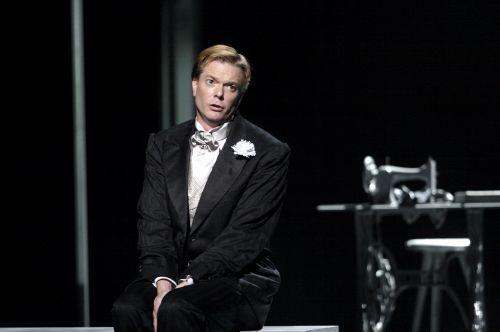
Then, Spence delivered his first lines and I have to say I was very surprised to hear someone usually associated with Song repertoire to deliver such a rich and ringing tone. This was the start of what would be a rock-solid performance from the english tenor with only one slight stain at the end of “Salut, demeure chaste et pure where” he failed to do anything interesting with his top C. The note wasn’t that good, and like the intelligent singer he is, he came off of it ASAP.
Although he wasn’t very adventurous with his dynamic range (sang between mezzo-forte and fortissimo), his delivery was always controlled and at times really exciting with plenty of sonorous and extremely well placed top B’s. He does however seem a bit immature as a person for this role, in a way that although he managed to convey Faust’s anger at what he becomes, he didn’t really strike me as an old man in deep agony faced with the consequences of having his soul sold.
After invoking Mephistopheles (Iain Paterson), the Devil appears in a white suit (the production has been moved to the recent war period) and some bombs also appear hanging on stage as well as the Smeagol-figures are replaced by laboratory assistants, who we get to know later apparently are angels(?) Anyway, Paterson did deliver the goods. Always a very compelling actor, he compensated on stage presence what he lacked in vocal weight. Although beautifully and evenly produced with glorious top notes, his voice didn’t sound adequate to the role for me, as it lacked this Sarastro-esque quality that defines this type of roles. This lead to a couple of underpowered bottom notes.
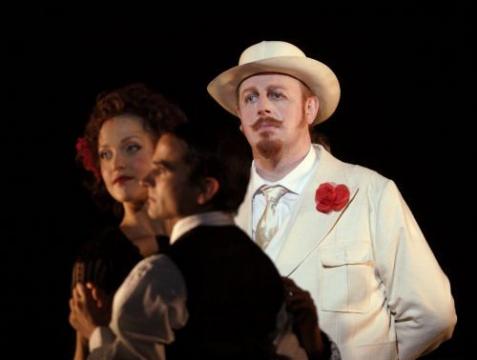
After Faust’s transformation, the scene changed to a bar where the soldiers get ready to go for war and Siebel (Anna Grevelius) appears with very light-hearted manners, as was to be expected (and not really very coherent with Marguerite’s matronly portrait, but we’ll get to that) and she did deliver the aria a bit ahead very nicely.
Baritone aria time and this was one of the let downs for me. Benedict Nelson‘s Valentin failed to strike me as the character it is. In my opinion, the voice wasn’t adequate at all for the role, as it was too dark and lacked this éclatant quality which I believe this character requires . The basic sound is nice and appealing, but it did come across as over darkened which caused some inaudibility problems in some specific point. Valentin’s aria is supposed to be like this ray of light as a brother prays God for protection over his sister and Nelson’s excessively veiled and dark baritone proved incapable of channeling this.
“Le veau d’or” followed and Paterson once again excelled. Nice choreography from the dancers as well. Just as well, because after this point the production becomes a Catholic camp-fest! The scene where Valentin exorcises Mephisto was just over the top with the chorus picking up a couple of benches from the bar where the scene was set, and forming a giant cross. “Too much”, I thought. Well, the worst was yet to come.
Then come Marguerite’s scene and although Melody Moore sang securely, the voice didn’t strike me as very compelling for the role. The same I said about Valentin applies: I found it too veiled and not ringing enough for what is desirable to this character, no matter how securely she sang. The Jewel Song was nicely done as was the love duet with Spence (despite the tacky visuals which, by this time, had blooming roses projected and rose petals fluttering over the stage—appalling!)
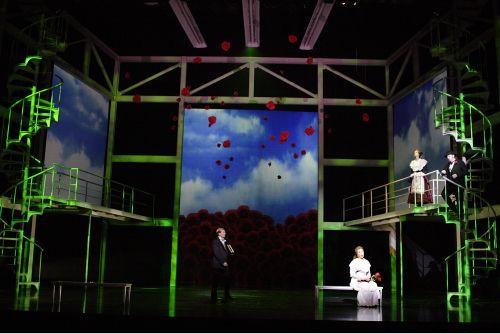 Nevertheless, on her first scenes, I didn’t find her girly enough. Anyway, Moore did grow considerably during the evening and on her solo scene on Act IV where she complains about having become an outcast, she did grow dramatically and deliver a very believable portrait of a single mother.
Then the church scene!
This huge whonking crucifix descends and after being tormented by Mephisto and his Devils, Marguerite finally gets some answer from the Almighty, and dear God, was He ever mighty! The crucifix illuminates and it literally dazzled me. It looked like some sort of massive vampire-destruction weapon, really unnecessary and just plain ugly. Faust is already very moral in its essence. Re-inforcing that morality with this sort of tricks is just not trusting the music’s ability to convey a message and if a director fails to understand that, then he fails to understand the whole concept of opera. The scene was very well sung though, and following this, Valentin’s curse scene was more effective with Nelson’s darkened tone serving the drama better.
The hell scene. Hell, actually…. The Smeagol-esque figures did at one point engage on a dance that was just plain Michael Jackson‘s “Thriller}. Really really terrible and ugly. The colours also became uglier, Hell being this toxic dump green thing. For the final scene, all of the participants delivered the goods vocally speaking. Faust disappears under the stage with Mephisto and Marguerite goes up a stairway straight into heaven, finally redeemed. After that, Faust rises from hell, old again, drinks the poison and dies. ‘
“Was it all a dream?” seemed to be the cliffhanger of this production. Well, it certainly did become a bad dream from Act III onwards. Anyway, this is the sort of production that makes you understand that opera is still about singing, because if the singing from the leads hadn’t been good, this wouldn’t be worth to see. However, if you’re in London during it’s run, it’s definitely worth a see.
There were actually some booing the stage director in the end—and for the Brits to boo you can imagine how bad it became! In fact, you don’t really need to imagine, since this production is due at the Met in 2011-21012.
Last but definitely not the least, a note on Edward Gardner‘s absolute command of the score: he firmly conducted some fantastic playing from the ENO’s orchestra, which portrayed Gounod’s rich score splendidly! The chorus was, as usual, world class! (All photos: Catherine Ashmore)