
À l’opéra ce soir

When I was a kid growing up in Paris, there was a weekly TV broadcast of a theater play called Au Théatre Ce Soir that I loved. But that my father would rarely let me watch this show, because the plays were all were silly comedies, usually badly acted and filmed without any creativity or originality. Basically, it reflected rather poorly on The Theater.
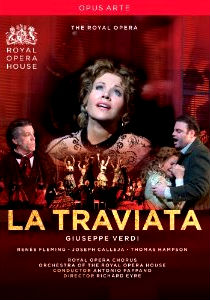
As I was watching this newly released DVD of La traviata filmed at the Royal Opera House in a Richard Eyre production, with Renée Fleming and Joseph Calleja, I could not help but think about those old French TV broadcasts.
It starts well enough, and if nothing else, this DVD soundtrack of the Orchestra of the Royal Opera House conducted by Antonio Pappano reminded me how beautiful and touching and powerful Verdi’s score is. With the first few notes of the overture over the opening credits, I thought I was in for a treat: still photographs of a young girl, badly dressed, lower class, are inserted among close-ups of Violetta (Ms. Fleming) bathed in a blue light, seemingly contemplating both her past and her future.
That was probably the most creative moment of the whole film.
As the curtain opens and the action of Act I begins, what strikes the viewer is how small the stage seems as used by Eyre: the set appears crammed, overcrowded with Violetta’s guests, confusing, with no depth. The impression remains throughout the film, with a similar effect in the ball scene of Act II, but also in the “at home” scene of that act, where the back of the stage is lined with a “house” backdrop, and all the action takes place near the orchestra pit. Only in the last act does the stage seem to open up and provide some depths, possibly as a sign of Violetta’s imminent liberation from the sufferings of her existence.
This decision of setting the action within obstructive sets and under dominant monochromatic lighting (red for the crowd scenes, blue for the last act, natural light only for Act II, scene 1) probably made sense for a live performance and for the audience of an opera house. But, because film automatically tends to flatten everything, what comes through in this film is essentially a lack of depth and dimension, and the limitations of the action and characters as fully developed entities. So while Pappano’s conducting brings out the beauty of the score, the film of Eyre’s staging emphasizes the shortcomings of the work, the over-simplifying and one-dimensionality of the characters’ motivations and of the dramatic structure.
This could have easily been remedied with some creative and original camera works, shots or editing. If I look back at the last few filmed operas I have seen (by “filmed opera” I mean the film of a staged opera, as opposed to an “opera film,” which is is a film made from an opera, such as Joseph Losey‘s Don Giovanni), and though filmed at different times and in different cities—from Soviet Russia to the Met in 2010—and of varied quality, all had at least one element, one attempt to use film techniques creatively and inventively to not only put the stage work under the best light, and sometimes offer a new insight onto the opera itself, but also to draw the audience fully into the work. Film, the moving image, the thoughtful use of varied shots and editing techniques has this uncanny ability to capture the imagination and the full fledged attention of its viewers.
Unfortunately this film of La traviata, directed by Rhodri Huw and assembled from the recordings of two separate performances (on 27 and 30 June 2009, an information only available on the last page of the booklet) makes no such attempt to draw the audience in. It is a very pedestrian film, to which little thought seem to have been given, a simple recording and broadcast of an event, without any point of view, any fresh outlook or guts, and so lacking in depth and originality.
Of course it does not help when you bring together one of the most awkward castings I have seen. Violetta, as pictured by Alexandre Dumas fils’s play and Francesco Maria Piave’s libretto is a young thing, not older than 25, who acts her age (and her social position) as a coquette in Act I, before evolving through her love for Alfredo and her self-sacrifice into a saint and a martyr. Watching Ms. Fleming playing coquette in Act I and prancing around the stage under the drooling gaze of Mr. Calleja (pre-makeover surely, since this can’t be the same man I saw in Lucia this season at the Met) was not only awkward but disturbing. It reminded me of Claire Bloom in her fifties playing the ingénue wife in the film A Doll’s House when she acts like a little squirrel to seduce her husband—An image that to this day still makes me nauseous.
Close-ups do not lie. And though I do not find it odd to watch a stage performance by a singer who may not fit perfectly his or her character because of age, ethnicity, body type, etc, on film the inadequacy resulting from miscasting cannot be avoided. Film has this power to enhance the focus of the viewer on every little details that is offered to the eye: a facial expression, the blink of an eye, the movement of a finger. As viewers of the small or the big screen, we are avidly desperate to find meaning into each frame.
And what we get from Ms. Fleming’s acting is at best uncomfortable, at worse unwatchable—although she does somehow redeem herself in the last act and her dying scene, where she appears all disheveled and wretched. Her voice, though a bit mature for the part, is rather enjoyable, once she gets past Act I, where Pappano obviously has to hold back the orchestra and the tempo to allow her to get through her first aria and the cadenza. Mr. Calleja on the other hand is in perfect command of his instrument and would have made the perfect Alfredo if it had been a CD recording. Thomas Hampson as Germont is the most satisfying principal, both vocally and as an actor.
With all the many available filmed versions of La traviata on DVD (a search on Amazon brings up over a dozen, including the same Eyre production in the same house some years back with Angela Gheorghiu and Sir Georg Solti conducting, and another production with Ms. Fleming at the Los Angeles Opera), one can wonder why the Royal Opera House has felt that this film was worth a DVD release. As the market of filmed operas develops through live transmissions and DVDs, it is to be hoped that opera houses will come to realize the full extent of the power and the opportunities that the medium of film offers, and make better use of it.
I hate this stupid production with a deep hatred, almost as much as the equally paleolithic ROH Boheme. It’s bad enough that it’s lazily traditional (“lazily” is the operative word here, I’m no regie freak by any stretch and although I prefer updatings as a rule, clever traditionals are very welcome); but it has some of the most bizarre set choices ever: the cramped round reception room with the silly stairs around it, the one couple dancing past the doorway that completely fail to create the illusion of a crowded ballroom, the massive table in Act 2 that the principals struggle to get around, the overall flatness of the Act 2 set, the victory lap in the end… I could go on. And the ROH keeps churning it out almost twice a year – I think next season there is going to be something like 21 performances with 4 different casts. It’s enough to have me contemplate passing on this seasons Friends subscription.
As for the singing (I saw this live in the house while entertaining some visiting friends, otherwise I wouldn’t be caught dead re-watching this tripe): Hampson was excellent, Calleja was entirely serviceable but uninspiring, and Fleming had a weird timbre throughout that I just couldn’t get over. No technical problems that I could notice with my untrained and unrefined ears, just an overall unpleasant tone. Netrebko/Kaufmann/Hvorostovsky in that cancellation-prone Jan 2008 outing was a far superior cast, but even they were still not enough to overcome my revulsion for the awful production.
A performance for the tourists, typical of Covent Garden in July. Yuck.
I dislike the production – I’m not sure there is anything quite distinctive enough about it to provoke something as strong as hatred. But I suppose I do hate the fact that they revive it so often because it does smack of the cynical motives you mention. On perusing the 2011/2012 season yesterday, I was surprised to see that the Falstaff will be a new production – it is from the 2000/2001 season if I’m not mistaken, and has been performed far less in the intervening seasons than Traviata. Not that I liked the Falstaff production either – I didn’t – but it seems odd to replace that and not the Trav. The McVicar Rigoletto seems to be cropping up almost as often as the Trav now, and it isn’t really any more interesting.
You are mistaken. The new Falstaff is to be directed by Robert Carsen and will replace the Graham Vick one that you and I loathe.
Richard Eyre may be many things, but I don’t think ‘lazy’ is one of them. Dislike the production all you like, but making a guess about the director’s level of commitment isn’t really on.
And it seems perverse to damn its ‘lazy traditionalism’ and then complain about something like the ‘victory lap’, which is a genuinely original idea inspired by medical research (not to mention the music itself). With Gheorghiu that moment was a genuine coup de theatre, although admittedly nobody since has made it work.
I’m with CK really- I don’t think it’s an interesting enough production to get so het up about. But ‘lazy’ is a word which really, really annoys me in a theatrical context, because in fifteen years in the business I’ve never seen a shred of it anywhere. Ironically enough, it’s become quite a lazy word to use in itself- a catch-all euphemism for ‘I didn’t like this’.
Eyre can be brilliant in the theatre. Just off the top of my head I recall “Private Lives” from last year – commercial, but excellent. It succeeded in getting Coward’s frothy imagery without falling victim to Art Deco overload, like most Coward productions seem to fall to. I am certainly an admirer, though no fan. But does this get him a free pass when he phones it in? Nope.
And please spare me the “level of commitment” comments. It’s lazy to just depend on crinolines for atmosphere and add a couple of “clever” tricks like the dancing on the gambling table or, yes, the victory lap (and it’s not ‘research’there, just a popular urban legend about consumptives that circulated until penicillin did away with all that tripe – they even said this of my grandfather who died of TB in the war, whereas I have it on good authority that the poor man just wasted away with no ‘false dawn’ just before he died). It’s equally “lazy” for the proverbial German regie-man to dress singers as clowns or have Trov take place in an oil refinery on the spurious argument that the word ‘fire’ is 50 times in the libretto. Lazy, lazy, lazy. Depending on shock value or a few props. I didn’t say “unprofessional” though, which is really what you seem to take exception to. Eyre is professional, as always. But his production is lazy. In the same way I would not call two other ROH productions I dislike (Zambello’s Don G and the antediluvian 70s Boheme) lazy. Don G is ugly as sin and the Boheme is pedantic and boring. But neither are lazy.
I go to the opera for the producer. Honest. Singing is just an extra. I want to see evidence of thinking there. I will forgive faliure (as long as it’s not revived a trillion times), but I will not do so when the production is mailed in.
In my personal opinion, Fleming’s problem in this role is that she is the epitome of Miss Middle Class America (although Fleming herself is probably quite well to do). She exudes the values of America and there is nothing European about her. I actually like Fleming as a singer, but I think Violetta is a role that is all wrong for her. It is totally beyond her world view to play a woman who would sleep around in order to enjoy the finer things in life. When she sings “Sempre libera” you think, “Really?” She looks so inhibited…..the exact opposite of free.
Meanwhile, Gheorghiu has European-ness dripping from every finger. She can’t help that either.
When I lived in Germany my German fag hag told me she was totally confused that American women wear tennis shoes to go to work and put their high heels on once they got there (this was the rage in the U.S. back in the early 90s I believe). I explained that it is so they do not get their high heels dirty on the street. Jasmine told me, “But fashion is for the street. You are trying to impress strangers on the street. People you work with already know you and you don’t have to impress them!” This is the difference between Europeans and Americans. Europeans understand that fashion is a sort of drag. It is an illusion to be used to get catcalls. You don’t need the catcalls from the people who are familiar to you. I suspect Fleming would wear tennis shoes to rehearsals. Gheorghiu probably wears heels everywhere she goes.
The tennis shoes phenom originated during a lengthy NYC transit strike in 1980. It was not a fashion statement. Most people who lived in Manhattan had to hike to work and so they wore shoes that could take it. You can’t do 40 blocks from the upper east or west side to midtown in heels. Their soles are too thin for that much walking on cement. They would wear out in one day, and so would the feet, pinched and brutalized by fashionable female footwear. For almost two weeks, women hiked in comfortable shoes as a necessity, and after that, some kept it up. It never looked good, but it no longer looked strange and odd.
Ironically, other women took this up in other cities as a fashion statement. The “anything they do in New York must be okay here” thing. Asinine.
When I lived in DC in the 80′s, men also wore tennis shoes to work. It was ridiculous, men wearing suits and ties with those shoes! They looked like idiots—as if men’s shoes were so uncomfortable that they needed tennis shoes to ride the Metro.
This tennis shoes versus shoe formality point is interesting in regard to balancing practicality, ‘class’ and ‘rigidity’ in outlook. I knew an old rich opera doyen that always wore to first nights, a hideously expensive full length ermine coat with a head scarf (worn in the pattern – as typically used by housewives once, when cleaning the house) with a pair of white tennis shoes. Excusably though , she had major foot problems.
Today, I know of women that dress ‘to the nines’ to go to some gala or opera. Entering in comfortable walking shoes,that do not clash color-wise with what they are wearing: they then go the cloak room where they slip on full glam high heels for the rest of the time spent ‘promenading around’ in the theater. On leaving, go back – retrieve and slip on their more comfortable shoes to go home.
What pisses me off is people going to opera and the theater dressed ‘in some shoddy -cheap rack – jeans outfit’. Oh! where is Kathleen Turner’s murderous fashion sense character from the film’ Serial Mom’…please, when people need her? Today there is no sense of ‘basic good manners respect’ for the performers by some people attending performances.
Happy 66th Birthday Frederica von Stade
Happy Birthday Frederica! Von Stade…..one of the truly, truly great performers. Always polished and prepared for whatever, she ever performed. I know of several people -totally unknown to each other- although ‘not into opera at all’ by chance upon hearing her voice, then ran out and brought everything available she had recorded, including the operas, she performed in. What a remarkable phenomenon.
Any performer capable of such artistic persuasion and communication, is rare indeed.