
Headshot of La Cieca

Cher Public

  • MrGuy1804: You are right on the money. I was not terribly impressed with any of the singing. There were a few... 12:29 AM
  • Camille: That was fun, thanks! I had completely forgotten Eastern Airlines, the Wings of Man. With a name like... 12:22 AM
  • Henry Holland: Thanks! Too bad they didn’t do Der Zwerg instead of the (wonderful) Puccini. The LA Opera... 12:09 AM
  • Camille: Thanks Blue, for the review. Lord, what are “earthy colorings”? 12:06 AM
  • Gualtier M: Here is Carmelita Pope in the actual 70′s era Pam commercial at 2:36 in: httpv://www.you... 12:03 AM
  • CruzSF: kashania, please tell us more about these performances. Who? How presented? And don’t neglect the... 12:03 AM
  • bluecabochon: Lucky you, Bob! I;d see it again if I could. Here’s TT’s New York Times review:... 11:53 PM
  • kashania: HH: I thought of you tonight while watching the COC’s double of Florentine Tragedy and Gianni... 11:28 PM

À l’opéra ce soir

When I was a kid growing up in Paris, there was a weekly TV broadcast of a theater play called Au Théatre Ce Soir that I loved. But that my father would rarely let me watch this show, because the plays were all were silly comedies, usually badly acted and filmed without any creativity or originality. Basically, it reflected rather poorly on The Theater.  

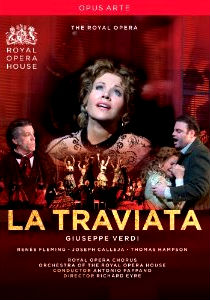
As I was watching this newly released DVD of La traviata filmed at the Royal Opera House in a Richard Eyre production, with Renée Fleming and Joseph Calleja, I could not help but think about those old French TV broadcasts.

It starts well enough, and if nothing else, this DVD soundtrack of the Orchestra of the Royal Opera House conducted by Antonio Pappano reminded me how beautiful and touching and powerful Verdi’s score is. With the first few notes of the overture over the opening credits, I thought I was in for a treat: still photographs of a young girl, badly dressed, lower class, are inserted among close-ups of Violetta (Ms. Fleming) bathed in a blue light, seemingly contemplating both her past and her future.

That was probably the most creative moment of the whole film.

As the curtain opens and the action of Act I begins, what strikes the viewer is how small the stage seems as used by Eyre: the set appears crammed, overcrowded with Violetta’s guests, confusing, with no depth. The  impression remains throughout the film, with a similar effect in the ball scene of Act II, but also in the “at home” scene of that act, where the back of the stage is lined with a “house” backdrop, and all the action takes place near the orchestra pit. Only in the last act does the stage seem to open up and provide some depths, possibly as a sign of Violetta’s imminent liberation from the sufferings of her existence.

This decision of setting the action within obstructive sets and under dominant monochromatic lighting (red for the crowd scenes, blue for the last act, natural light only for Act II, scene 1) probably made sense for a live performance and for the audience of an opera house. But, because film automatically tends to flatten everything, what comes through in this film is essentially a lack of depth and dimension, and the limitations of the action and characters as fully developed entities. So while Pappano’s conducting brings out the beauty of the score, the film of Eyre’s staging emphasizes the shortcomings of the work, the over-simplifying and one-dimensionality of the characters’ motivations and of the dramatic structure.

This could have easily been remedied with some creative and original camera works, shots or editing. If I look back at the last few filmed operas I have seen (by “filmed opera” I mean the film of a staged opera, as opposed to an “opera film,” which is is a film made from an opera, such as Joseph Losey‘s Don Giovanni), and though filmed at different times and in different cities—from Soviet Russia to the Met in 2010—and of varied quality, all had at least one element, one attempt to use film techniques creatively and inventively to not only put the stage work under the best light, and sometimes offer a new insight onto the opera itself, but also to draw the audience fully into the work. Film, the moving image, the thoughtful use of varied shots and editing techniques has this uncanny ability to capture the imagination and the full fledged attention of its viewers.

Unfortunately this film of La traviata, directed by Rhodri Huw and assembled from the recordings of two separate performances (on 27 and 30 June 2009, an information only available on the last page of the booklet) makes no such attempt to draw the audience in. It is a very pedestrian film, to which little thought seem to have been given, a simple recording and broadcast of an event, without any point of view, any fresh outlook or guts, and so lacking in depth and originality.

Of course it does not help when you bring together one of the most awkward castings I have seen. Violetta, as pictured by Alexandre Dumas fils’s play and Francesco Maria Piave’s libretto is a young thing, not older than 25, who acts her age (and her social position) as a coquette in Act I, before evolving through her love for Alfredo and her self-sacrifice into a saint and a martyr. Watching Ms. Fleming playing coquette in Act I and prancing around the stage under the drooling gaze of Mr. Calleja (pre-makeover surely, since this can’t be the same man I saw in Lucia this season at the Met) was not only awkward but disturbing.  It reminded me of Claire Bloom in her fifties playing the ingénue wife in the film A Doll’s House when she acts like a little squirrel to seduce her husband—An image that to this day still makes me nauseous.

Close-ups do not lie. And though I do not find it odd to watch a stage performance by a singer who may not fit perfectly his or her character because of age, ethnicity, body type, etc, on film the inadequacy resulting from miscasting cannot be avoided. Film has this power to enhance the focus of the viewer on every little details that is offered to the eye: a facial expression, the blink of an eye, the movement of a finger. As viewers of the small or the big screen, we are avidly desperate to find meaning into each frame.

And what we get from Ms. Fleming’s acting is at best uncomfortable, at worse unwatchable—although she does somehow redeem herself in the last act and her dying scene, where she appears all disheveled and wretched. Her voice, though a bit mature for the part, is rather enjoyable, once she gets past Act I, where Pappano obviously has to hold back the orchestra and the tempo to allow her to get through her first aria and the cadenza. Mr. Calleja on the other hand is in perfect command of his instrument and would have made the perfect Alfredo if it had been a CD recording. Thomas Hampson as Germont is the most satisfying principal, both vocally and as an actor.

With all the many available filmed versions of La traviata on DVD (a search on Amazon brings up over a dozen, including the same Eyre production in the same house some years back with Angela Gheorghiu and Sir Georg Solti conducting, and another production with Ms. Fleming at the Los Angeles Opera), one can wonder why the Royal Opera House has felt that this film was worth a DVD release. As the market of filmed operas develops through live transmissions and DVDs, it is to be hoped that opera houses will come to realize the full extent of the power and the opportunities that the medium of film offers, and make better use of it.
64 comments

  • armerjacquino says:

    I saw the big screen relay of this production in Trafalgar Square and while I was not blown away by Fleming’s Violetta I think ‘at best uncomfortable, at worst unwatchable’ is a little unfair, especially when you go on to talk about how she ‘redeems herself’ in Act 3- is that her best work, then, and therefore merely ‘uncomfortable’?

    As for why it’s been released, I think that’s pretty obvious. It’s disingenuous to pretend that there won’t be a huge market for the combination of Fleming, Calleja and Hampson.

  • MontyNostry says:

    That production was kitschy and pedestrian when it was new in 1994.It has been revived about 300 times since then and they have it lined up with, I think, three different sopranos of varying wattage for next season.
    zzzzzzzzzzzzz

    • Regina delle fate says:

      Four! Poplavskaya, Perez, Jaho, Netrebko.

      More baffling is why the RO would want to release a second DVD of Zambello’s “kitschy and pedestrian” Carmen with Christine Rice and Bryan Hymel when one already exists starring Antonacci and Kaufmann. As least Renée, Calleja et al has a slim chance of shifting a few copies. The second RO/Zambello casting is Vicar of John Wakefield level.

      • armerjacquino says:

        The Carmen release with Rice et al is because of its cinema run in 3D at the Imax and worldwide. Again, not too hard to see why that’s happened.

      • The Vicar of John Wakefield says:

        ” The second RO/Zambello casting is Vicar of John Wakefield level.”

        There was hardly a need to deploy the callow American Hymel and a supbar Baltic Micaela when such fine British singers as Boe and Glanville might have been showcased!

  • Clita del Toro says:

    ZZZZZZZZ and GAG

  • OpinionatedNeophyte says:

    Again, I find myself wondering why? The 1994 Gheorghiu isn’t the most insightful production ever, but Solti’s conducting and Angie’s performance more than justify the release. But this? One wonders who is the market for a post her prime Fleming and pre his prime Calleja? And old Foghorn Hampson.

    • MontyNostry says:

      … especially as Renee’s overly histrionic Violetta has already been immortalised in a similarly dreary production from LA. That cover-shot makes her look like Kim Basinger, doesn’t it?

    • sensibility says:

      OT, or maybe not.A Diva remains a Diva.
      Angela several days ago in Valladolid.
      [img]http://parterre.com/wp-content/uploads/2011/05/DSC_3915.JPG[/img]

      • sensibility says:

        picture@Irina Stanescu

      • MontyNostry says:

        I heard the other day that, at the dress rehearsal of Adriana in London last year, Ange did a Sharon Stone at one point — twirling round in a way that lifted her skirts, and revealing that she had gone commando for the performance. Quite by accident, of course. There’s nothing calculated about our Ange, is there?

        • Harry says:

          Monty Nostry: Perhaps In the future, that is what we will call a ‘hairy or fluffy’ type of performance. If they have waxed….

        • Ruxxy says:

          Like most things Monte- it’s been done before (and better). One night Llubja Welitsch did Musetta “au commando” and at one point stood on a table and whirled around, leaving the ladies in the front three rows agog and aghast.

    • kashania says:

      Oh, if we start asking why, there’s a long list of them. Just for starters, why did the Met feel that the Urmana/Botha/Zajick/Guelfi/Gatti Aida needed to be released on DVD when the same production is already available with the superior cast of Millo/Domingo/Zajick/Milnes/Levine? Or the Ghulegina/Giordano/Poplavskaya/Ramey Turandot when compared to Marton/Dominigo/Mitchell/Plishka?

      • marcello52 says:

        But surely Kashania, you must know that both the new Aida and Turandot are available exclusively at “Tarjé”

        • Harry says:

          marcello52: All the best people shop there at TaarJAH!! Remember the motto: ‘Money saved, is better than money earned’.
          You did not have to work to earn it – saving also income tax in the first place nor then, pay purchase tax on the product saving, you made!
          Taken to extremes though, one could go broke making reckless savings and finish up in debtor’s prison.

      • Gualtier M says:

        Well, Kashania, one thing is new technology – HD and the blu-ray format. For popular titles in popular productions, a new filming with higher resolution and five channel sound is considered good business. The cast and its competitiveness with prior filmed versions is really a paltry matter…

        There is this glut of operas out there with really poor casts – “Norma” and “Aida” with sopranos you wouldn’t want to hear once in the part, let alone in multiple viewings. Dynamic puts out a lot of stuff some with really obscure casting from Italian provincial houses. Stuff from the St. Margarethen festivals with truly from hunger singers. How many “Boheme” performances do you need yet here comes a new DVD with Hibla Gerzmava (who does have a voice) and some “who is he?” tenor. I think the technology has gotten cheaper and better and the record companies have stopped making audio only recordings and moving towards the dvd and blu-ray market.

        • Regina delle fate says:

          The who-he tenor was a replacement for Piotr Beczala who was ill for the filmed performances. Next season, the RO has a Boheme with Harteros and Calleja conducted by Semyon Bychkov. Why didn’t they wait to capture that cast?

        • Ruxxy says:

          Gualtier- I have it on good authority (recording company exec) that that is precisely the case and I think I can understand why.

          As much as I love my old recordings the temptation to put on a DVD and have the visuals as well most often wins out most (not all) of the time.

          It’s noticeable too that the opera companies are well aware of the new marketable idiom now- just look at how the Met’s forray into HD broadcasts has now spawned HD performances (and DVDs) from La Scala, the Royal Opera, San Francisco Opera and even Opera Australia.

  • scifisci says:

    I haven’t seen this DVD, but weren’t these the performances that produced some true gems of filth from fleming in “teneste la promessa”? I seem to recall a particularly unique “curatevi” or should i say “cooooraaaatevvvvvi”

    My biggest problem with fleming’s violetta has always been her lack of rhythmic urgency….everything is always too overwrought and precious and tends to sit just behind the beat, most noticeably in the germont-violetta scene. But who knows, perhaps she shaped up for these performances.

  • Alto says:

    I feel sorry for anyone who is so little susceptible to the power of theater that he can become “nauseous” even to think of Claire Bloom (though in her fifties) in A Doll’s House. Thank the gods you didn’t have to suffer through Bernhardt or Duse or Edwin Booth or Garrick, when they were a gift to people who could appreciate *acting* instead of just the accidental similitude of nature. And how you would have hated Caballé, Callas, or Sills as Violetta! But clearly their art would have been wasted on you.

    • La Cieca says:

      To be fair, the writer talks about Bloom’s appearing in a film of Doll’s House, not a stage performance, and of course Bernhardt et. al. were almost exclusively stage actors. (Bernhardt when she did finally make a few film appeareances mostly performed in character parts, notably Jeanne Doré. Though, Sarah being Sarah, she did play Marguerite Gauthier in her mid 60s.)

      There is definitely a difference in the audience’s suspension of disbelief in film and on the stage. Margaret Sullavan was 44 when she played Sabrina Fair on Broadway and doubtless she was enchanting. But the canny actress would not have been so foolish as to attempt to play a girl 20 years her junior on film.

      • Bosah says:

        La Cieca,

        Are you saying, then, that, even if they have the voice and acting ability, parts that will be filmed should be cast at least as equally for looks as for voice?

    • Bosah says:

      Indeed. I was surprised at the lengths gone to in the review to suggest Fleming looked too old for the part, and the unavoidable implication that the part should have been cast with the film in mind. But, to each his/her own.

      Not surprised at the negative review or responses. Fleming’s fame and age (reference review again) doom her here on Parterre, of course.

      (before anyone responds with – “No, it’s her singing that dooms her,” I’ve already said it for you so you don’t need to.)

      But, as one who is obviously not as smart as everyone else, I enjoyed this, although the LA version is better, IMO.

      And why release it? Well, because most of the opera-buying general public actually likes Fleming, as well as Hampson and Calleja.

  • Donna Carlo says:

    The unforgettable (for good reason) La Fabs in her La Scala Traviata, 1991, with Paolo Coni, Muti conducting:

    • antikitschychick says:

      this is pretty awesome…thanks for sharing Donna Carlo :D …I will definitely be checking out the rest of this performance as I am not familiar with it.

    • mrsjohnclaggart says:

      I don’t know how to take the comment. I saw several late rehearsals of this as well as the dress and first two nights. It was a remarkable experience live and was wonderfully directed (Cavani)with amazing lighting, gorgeously conducted, full of many very subtle touches and very moving (haven’t seen the video, don’t know how it comes across). Sadly vocally it was awful save for the young Alagna, (even the suppurating singers were ghastly, well below the Scala standard of say 1951) Mo. Muti locked the loggione so the expected demonstrations did not take place and in context, making a lot of allowances, Fabs did kind of carry it off, which Fleming very definitely never has (and I have seen her try at least ten times, one worse than another). In a different context (Met, Domingo as beyond appalling “conductor”) she was pretty terrible from all perspectives with Farina and Pons, though Nerva and Krunoslav and Clita all LOVED Bernard Fitch as Gastone. She also managed an absolutely horrendous Lucia vocally in Dallas but it was acted as I would do it, and John Ardoin detected the sacro fuoco. He kind of had a point, as I saw when I wore ear plugs to the second performance.

      Some idiot who always says the same things claims somehow that “the PUBLIC DEMANDS!!!!!!!! Fleming et al” hence the release. Actually there is a contract signed that guarantees a release within a given period of time, or a penalty is paid. Loses (and can there be any doubt about them?) are simply eaten. As with many opera DVDs, which end up heavily discounted after a few months they are useful for sex toys for the kinky (my sister ties sailors up and runs Fleming and Voigt DVD’s over their exposed flesh inducing far more shrieks and thrills than their singing, acting, interpreting, understanding, stylistic command ever does).

      • Bosah says:

        Since I am no doubt the “idiot” you described, I never said the public “demanded” a DVD release. I said – quote – “And why release it? Well, because most of the opera-buying general public actually likes Fleming…” You could deny this if you want. But objective evidence would suggest that Fleming does have a certain popularity.

        I’m fairly certain that no company would hire a cast and sign a contract that included a DVD release unless the company thought the public liked the cast – and that the public would buy both tickets and the DVD.

        And, if I recall, that’s the third time you’ve discussed DV in relation to some sort of intimate fantasy in a response to me. Just fyi.

        I’m actually beginning to enjoy your posts. Go figure.

        • Bosah says:

          Upon reading that, I realize the ending may have come out a bit harsher than I intended. I hope you realize, MrsJC, that I was joking with you. I honestly do find those particular references you make both perplexing and humorous….

          • Harry says:

            Well may I throw down a gauntlet and admit I tend to hate opera DVDs compared to a straight made sound recording. Perhaps watching once, fair enough, but to be expected to actually sit and watch the same ‘business’ of presentation and acting, captured and visually frozen – time and time again……never! One tends to zero in -on every minor detail, or every irritable flaw one personally visually perceives with repeat viewings.

      • oedipe says:

        I have seen the whole video of this La Scala Traviata and Fabbriccini’s acting is fab indeed, an incredibly dramatic experience. To boot, she also looks the part.
        You get the feeling she is going dangerously far in her involvement. In the last act, when she is frightened of her approaching death, she desperately clutches at the life around her, which in this case happens to be Alagna’s hair! Needless to say, poor Bobby (then 28 years old and looking like Adonis) winces in pain… At curtain calls, both of them look emotionally drained. I haven’t seen many Traviata performances like this (in spite of the fact that the rest of the cast is entirely forgettable).

      • thomas says:

        MrsJC, I am really shocked at your anti-Fleming outburst. You’ve said many positive things about her on this site before. And you wrote such a glowing and gushing piece about her in one of her CD booklets…it could have been written by her mother. What gives?

        • mrsjohnclaggart says:

          Thomas, thank you for even noticing all that. But I think you are young. I’m old and I’ve had it. I used also to be pals with someone whose ‘article’ was called brilliant by someone here yesterday. I wrote this person a letter, which I almost published here, shocked by the stupidity of the piece as published.

          Fleming, who I met in 1988 and who I was instrumental in giving the Tucker Award, which was in those days important for launching a career (Famous Quickly had to be harshly spoken to as one would to a dog to go along with this) was an amazing talent with huge potential. She came close to realizing it for about a decade, a magnificent Fiordaligi, one of the best I’ve ever seen, a fabulously sung series of Manon, despite her diction and inability to act the role. I had an insane adventure with her in Bayreuth, which involved us both getting into a lot of trouble and I adored her personally. There was the incredible concert Armida with Quaalude and so on.

          She is a phenomenal musician. But the first warning came after one of those Manon(s), when I told her she was not solving the business of the production and could do some things. “I just can’t deal with all that,” she said. I lost some respect for her then. Then came a falling off vocally. The tone shrank, she began to save and her imagination shriveled. Her inability to connect emotionally with characters and music made her an appalling Arabella (one of the worst I’ve seen), a boring Marschallin, and then around 2000 she seemed to make a decision to coo as much as possible. I thought the first Traviata(s) and pirata(s) were awful, clueless.

          She became a selfish product, saving, crooning, posing, a phony and though she has kept a tone and some control, her lack, I would say her DEFIANT lack of an artist’s spirit has made her irrelevant to any experience one would hope to have in the opera house. The year, the Capricio was so remote and unenterprising my life kept passing in front of me, and when you’ve had my life — that is very bad.

          I feel the same about Meryl Streep. She is one of the greatest talents I have ever encountered and I knew her well. But after The Devil Wears Prada and Mamma Mia and that appalling It’s complicated and Jules and Julia, who needs her? Sure a movie star needs to keep a certain profile and demonstrate an on going earning power (didn’t help her in the appalling Lions for Lambs)but is she really concerned at this point with all that? She is so rich she could have come back to to stage or hooked up with the most enterprising indie pro people and continued to do amazing work.

          When someone gets trapped into the maul of the stupid celebrity game and takes one dump after another unnecessarily, I’m done with them, and to hell with them.

          Just me, but thanks for even paying attention to poor old, irrelevant me.

          • Clita del Toro says:

            Renay’s Traviata might have been “clueless,” but they were certainly not “coo-less.” (sorry about that, couldn’t he!p myself)

            Btw, I walked out on Renay’s Rosenkavalier HD. Couldn’t bear it! Yuchy-poo–especially after having seen della Casa, Lizzie, Steber, Crespin and Söderström.

          • antikitschychick says:

            Interesting how you compare her to Meryl Streep, even if indirectly.
            Reading my comment over I realize my critique sounds a bit harsher than I originally intended, though I stand by what I said. Her acting ability is lacking, but I do think she has been very successful (and deservedly so) in other repertoire. I can’t speak for her Arabella but I didn’t find her Rosenkavalier boring, I thought it was very good vocally and suited her well dramatically.
            However I agree that her inability to relate to certain roles is a lack of imagination on her part and you are very right to call her out on that, especially since she is very smart. This is perhaps an instance where the success she had stymied her drive for creativity.
            On the other hand, I think her current efforts of finding interesting and certainly challenging concert/recital repertoire is admirable and I do commend her for giving piano recitals at this point in her career I mean the voice is so very exposed, but obviously she has excellent technique and can pull it off.
            I agree that the tone has lost some of that very very rich quality she had, but the cause(s) of that is/are debatable and it’s still mostly there.
            Also, while many (like you) dislike her mannerisms I can appreciate that’s its her form of interpretation (i.e. an artistic choice rather than a vocal limitation) so they don’t really bother me all that much, although I understand perfectly why some people don’t care for them and that stylistically they may be misguided…
            It really is a shame that in terms of repertoire she went off the deep end a bit, despite her success.
            But I wouldn’t go as far as saying she is lazy or “phony”. As far as her ‘saving’ her voice, well, that may be true but I genuinely believe that she does it because she feels it is necessary for her, I mean it would be counter-intuitive to hold back and not give the best performance you can give.
            Overall I am a fan, but I don’t care for some of the things she has done. This is one of them.

          • nachdover says:

            “someone…trapped into the maul of the stupid celebrity game” seems an odd way tp describe Meryl Streep. The fact that she doesn’t rush back to 8 shows a week on stage at every opportunity, or that she chooses to slam-dunk fare like Prada, doesn’t diminish her in my eyes. Likewise, though one might not like all of Fleming’s choices, she is anything but lazy, and has been (to her discredit in these pages, at least) pretty adventurous.
            Not sure who Mrs. JC is in the light of day, but she boasts an impressive array of former friends. The last two sentences of her post. “I’m done with them, and to hell with them,” and “poor old, irrelevant me” seem like honesty to a fault, and tell me much about the criticism that has come before.

          • operadunce says:

            Welcome back, Nachdover! Your comments are always on the money.

          • Arianna a Nasso says:

            Nachdover – I think you’re missing the subtleties of the Streep analogy. I think MrsJC’s point, and I would agree, is why doesn’t Streep balance her career better. She doesn’t have to run to the stage “at every opportunity” but how about every other year? She’s doesn’t have to give up the mainstream films, but how about alternate each Mamma Mia with an indie film that stretches her acting chops in a different way?

            It’s a frustration for me to see an artist who is capable of greatness stop challenging themselves, especially when they have attained the clout to get the kind of projects that would allow them to continue to create some more great art.

          • armerjacquino says:

            The film world is not noted for its abundance of challenging roles for women over 50.

          • nachdover says:

            Thank you, OD. I like to pop in now and then to see who’s getting kicked around. While I see your point, Arianna, I’m not sure we all know what a particular artist regards as a challenge, especially artists who are actors. Meryl Streep knows she can put over Cherry Orchard and Measure for Measure. Where film is concerned, I look at her career, and see someone who has had a go in an extremely wide range of genres. Take “The River Wild”– Action-adventure, certainly not what one would expect, and not Shakespeare by a long shot. But she knocked that out of the park. There were scenes in that movie that I can’t imagine another actress performing as fiercely. And then, going even farther from my idea of good material, there’s Mamma Mia. I think it’s dreck. But I can easily see someone who has had Meryl Streep’s career saying, let’s give this a shot. Let me try to put over an ABBA tune as the dramatic climax of a film. I might be ridiculous. That’s pretty risky. Or maybe it’s just a big paycheck, after all. But I’ve never seen her phone something in. I think that she challenges herself on every project she undertakes, whether or not the material fits everyone’s idea of edgy, or artistic. And that’s why she’s Meryl Streep.

          • armerjacquino says:

    • Regina delle fate says:

      Tiziana Fabbriccini; Paolo Coni – where are they now?

  • antikitschychick says:

    I have to admit I don’t particularly like Fleming’s Traviata, except for some moments in Act II…she has said herself that vocally Act I is a real stretch for her and that is clear by the very labored and thin sound she produces throughout…I agree that her acting abilities are less than convincing, especially for this role and what it requires dramatically (i.e. sex appeal, the ability to transform as the Opera goes on, subtlety, nuanced and tender phrasing, sudden outbursts without looking crazed or neurotic, etc.) in order to really flesh out the character and not make her look like a sympathetic victim like many of the other tragic heroines in Opera, she must act the part and yes looks help too.
    I do believe she waited too long to sing the role and frankly her portrayal does come off as a bit ridiculous but I don’t think its because of her age or looks I think it is almost solely due to her inability to act effectively. The same problem goes for Armida. I remember watching a clip of it and thinking to myself, “goodness, she looks drunk! How awkward.” LOLz. I couldn’t bare to watch the rest of it.
    I think some work with an acting coach would have been very beneficial for her, especially for Traviata. God knows she could certainly afford it.
    BUT I will say she does seem very committed in a sincere way which I can appreciate, especially when you have someone like Angela G. who to me comes off as totally banal, self-absorbed and artificial.
    I’m not fond of her portrayal either even if she is more vocally suited for the part.
    To be able to pull off this very demanding role I really think the artist has to “let go” in a way and embrace the urgency and fluidity of the music in an externalized way.
    Of course there are various ways of going about this or that approach and everyone may see/hear/experience something differently and the constant comparisons to other performances may stifle us in the end, but still expecting that the artist embody their character shouldn’t be too much.
    A bit more detail in the review wold have been nice.
    Tis all from me.

    • sensibility says:

      Oh,I have to react!Angela can come off as anything but NOT banal or artificial!It’s amazing how much the perception on her persona can distort the way she’s viewed as an artist.

      • Regina delle fate says:

        When was this O mio babbino caro? From the dress and the audience it looks as it it was when President Ceaucescu was still running Romania. She was enchanting when she first came to Covent Garden in the early 1990s – Zerlina, Nina in Chérubin – but her youthful charm soon wore off.

        • Ruxxy says:

          If it had been when Ceaucescu was running Romania there would have been a good chance she could have been wearing one of British Betty’s frocks because when the Romanian delegation with the Ceacescu’s stayed over one night at the palace- they stripped the rooms of their gold taps etc! I’m not making this up you know!!

          • oedipe says:

            So you think that Ceaushescu’s Securitate boys were all Robin Hoods, eager to strip the rich Brits and then go back home and distribute the booty to the children of the working class?

        • manou says:

          YouTube says :

          Angela Gheorghiu sings the aria “O mio babbino caro”, from Puccini’s opera ‘Gianni Schicchi’
          (Queen Beatrix of The Netherlands Silver Jubilee Concert in Amsterdam, April 29th, 2005)

  • Donna Carlo says:

    This performance beats the Night of the Three Tristans hands down:

    PS Can someone tell me which one has a trill?

  • Cocky Kurwenal says:

    I saw this Trav in the house, and Fleming sang well. Unfortunately, I wasn’t moved by her at all until the later stages of Act III, which was a big disappointment, but at the time I couldn’t fault the actual singing.

    Comments about how appropriate her age is for the role seem very unfair. I can see that this matters more on a DVD than it does in the house, but she was engaged first and foremost for a run of Traviatas in the theatre, the DVD is ancilliary. All Violetta really needs to be appropriate from the scenic-casting point of view, in my view, is to be suitably charismatic to make the infatuation of Alfredo, and the coterie of other admirers, believable. Fleming surely has that, whether 25 or 50.

    And at least Fleming has good intentions in terms of acting, even if they didn’t succeed on this occasion (I have seen her act beautifully in other things). This is a lot more than can be said for Calleja, who I have never seen make the slightest effort to act. His singing is always wonderful, but his manner on stage just seems to demonstrate contempt for what his colleagues and the director are trying to achieve in terms of drama.