
Headshot of La Cieca

Cher Public

  • kashania: HH: I thought of you tonight while watching the COC’s double of Florentine Tragedy and Gianni... 11:28 PM
  • Camille: I hope one day……e tc. 9:47 PM
  • Camille: Nerva, you are the funniest. TY for the word pn Carmelita Pope. Supposing I know her from PAM. I am one... 9:46 PM
  • Nerva Nelli: Surely it must be Christopher Alden’s ENO restaging of THE ENCHANTED ISLAND . 9:19 PM
  • actfive: Also saw this at LOC…Zajick looked totally bored, occasionally annoyed (maybe she was pissed at... 7:56 PM
  • phoenix: Fanciulla is primetime Puccini – I find Voigt about as italianate as Niamh Parsons – still,... 7:23 PM
  • Henry Holland: Good Dame Gwyneth as Minnie, Domingo as Jack Rance, LA Opera, 90′s sometime. At the end of... 7:16 PM
  • PushedUpMezzo: Well of course the mike’s the clue. She famously had no need of such things. The lady... 6:25 PM

Good gracious, Great Gatsby!

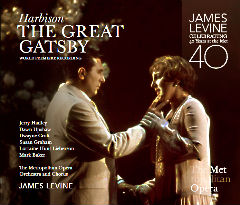
gatsby_coverThe first opera to be performed in the 21st century at the Metropolitan Opera, thankfully after the lack of total destruction from the Y2K bug, was the recently premiered The Great Gatsby by John Harbison. Commissioned to mark James Levine’s 25th anniversary with the company, the recording of this New Year’s Day broadcast is now being released in the upcoming 40th Anniversary Box Set of James Levine’s greatest unreleased recordings. We’ve waited 10 years for a recording of this performance to be commercially available, which also featured the Met debut of Lorraine Hunt Lieberson, and now we can with bated breath partake in one of the great forgotten treasures of the Met’s recent history. 

Setting F. Scott Fitzgerald’s American masterpiece of a novel was a very difficult task; one that needed both a deft composer and singers with incredible range and expressive capability. Harbison rises to the challenge admirably, making the clear decision to segregate the tuneful 1920’s jazz-age songs from the contemporary operatic writing of the rest of the drama. He even devotes a singer entirely to the songs on the radio which appear frequently throughout the opera – a young Matthew Polenzani four years before his Richard Tucker Award win.

This evening was also bursting with the best talent in contemporary opera for the day. As Jay Gatsby, Jerry Hadley sang with moving lyricism and cocksure arrogance, tossing off his characteristic repetitions of “old sport” often and with a welcoming familiarity. Dawn Upshaw astounds as his Daisy, singing with her now well-known shining soprano, which brings an ingénue sound to a deeply psychological interpretation.

Adding to the uniformly strong cast is a Dream Team of Mezzos, Hunt Lieberson as Myrtle Wilson and Susan Graham as Jordan Baker. This character established Hunt Lieberson as one of the most promising singers that people had heard at the Met in years. She wields her luscious, versatile voice with careful attention to using expressive diction and dramatic effects only when needed. Her sardonically sexy Myrtle illustrates many of the incredible talents that made her a fast rising star before her tragic death. Graham gets fewer opportunities to flaunt her lovely voice, but still turns in a fine performance, relying on her ability to be both cold and alluring at the same time.

As the thread that runs through all their lives, Dwayne Croft brings his dark, easy voice and well-meaning interpretation to the somewhat less featured Nick Carraway. While he doesn’t factor much into the drama of the piece – it really revolves around Gatsby and Daisy – Croft certainly has the longest sing of the night which he handles with no sign of strain.

Levine conducts a wonderfully varied score, consisting of everything from authentic 1920’s early jazz to a multi-layered scene involving the Lohengrin wedding chorus and a thickly dissonant confrontation ensemble, with command and consistency. The music is wonderfully unique, effortlessly flowing between Harbison’s not-so-atonal-that-it-won’t-play-in-the-suburbs sonic pallette and newly written popular tunes. It is hard to image such an individual work came out of a previously existing story, but the world of Fitzgerald’s Gatsby is beautifully crafted in this score.

I never saw this show live, and in a way I’m a little happy about that. When I listen to this marvelous recording I imagine the story vividly in my mind as some sort of Fellini film; sudden cuts to unrelated scenes where the story plays out quickly and with vivid emotions. I doubt that this kind of story telling could be so effective live on the operatic stage, especially before the current crop of directors who use video projections so well.

In short, this recording stands as an homage to two amazing artists who sadly passed before their time, Hadley at 55 by his own hand and Hunt Lieberson at 52 from breast cancer. For this alone it is worth seeking out, but the work as a whole is stunning by its own merit, certainly musically and possibly dramatically under the right circumstances.
56 comments

  • papopera says:

    Don’t buy that, its a bore.

    • ianw2 says:

      I have to admit I haven’t listened all the way through, but I agree- what I’ve heard, I’ve found an insipd Cliff’s Notes.

  • dallasuapace says:

    I attended one of the performances at the Met. Much of the music is good, and Lorraine Hunt Lieberson was riveting. But there were also many boring stretches. I thought at the time it might work better in a smaller theatre with a smaller stage. Maybe it would seem less boring with the close-ups that video can provide. At least one would not have the impression of seeing boring little people spread out over a very large stage.

    I also thought the work could use some revision and some cuts, but I guess that never happened. The libretto includes too much from the novel to work as drama.

    • dallasuapace says:

      My comments about the visual aspect might have made sense if this had been issued on DVD. I thought this would be a DVD but I realize now it’s on CDs.

    • WeillFan says:

      Harbison did indeed revise the opera for the 2000 Lyric Opera of Chicago staging. The overture was shortened drastically and other nips and tucks were made throughout.
      When THE GREAT GATSBY returned to the Met in 2003, it was not part of the Saturday matinee radio broadcast series, so we don’t have an audio record of the changes (I’m not sure if an opening night recording of the Lyric Opera of Chicago GREAT GATSBY was made, since the company lost its funding for live radio broadcasts for a few years in the past decade).
      Harbison’s GREAT GATSBY does has its problems, but I have enjoyed listening to my taped Met radio broadcast of it far more than other American Met premieres in the past decade.

      • LittleMasterMiles says:

        I saw Gatsby at the Met in 2000 and again in 2003, both before and after the revisions. I couldn’t identify specific changes at two years’ remove, but the opera made a much stronger impression the second time—it seemed to have been shortened far more than it actually was.

        It’s a real pity that the final version wasn’t recorded instead of this first draft, and an even bigger pity it wasn’t videoed. It may not be a masterpiece, but it’s the best 21st-century opera yet performed at the Met, and it should have been documented.

    • louannd says:

      Santa Fe, are you listening?

  • I am getting this one, thanks for the review Valmont. I actually saw this live in 2000 and I don’t remember a goddamned thing except my date’s love of Dawn Upshaw (and of the Met chandelier). And I actually heard Lorraine Hunt live back then, which only now I know. Ah, things are wasted on the young.

    Getting this DVD’ll be an f-u to time that managed to smuggle 10 years since.

  • Camille says:

    Lorraine H-L really did evoke a vivid characterization, with a superb diction, too. The music was not exactly bad, but mostly worked too hard to achieve an effect which didn’t happen.

    What would probably be of interest about this release will be to contemplate the respective talents of Hunt Lieberson and Hadley, to remind ourselves of the fleeting nature and fragility of human life, and to wonder, sadly, what otherwise might have been.

  • Nerva Nelli says:

    I’m sorry, Upper Middlebrow Icon Upshaw was utterly miscast as Daisy: clueless dramatically, and Fitzgerald specified that she had a low contralto “sounding like money”. Dawn sounded like the vice-president of the Literature Club.

    Bill Burden would have been ideal as Gatsby.

    Graham and LHL and Polenzani were wonderful.

  • Hans Lick says:

    A misbegotten monstrosity, stillborn on arrival. And I was working at the Met then, so we heard the rehearsals on the in-house speaker system. The music had time to become endearing. It never did. Colorless rubbish. The only exceptions were the faux-twenties pop tunes, which had a certain jollity, and the soprano-mezzo duet in the opening scene which never became anything more. Casting the two least attractive singers in opera as the exquisite Daisy and the iconic Gatsby didn’t help either. And giving them nothing but yards and yards of unutterably tedious arioso to sing at each other … the result was we didn’t know who these two people were, and we didn’t want to know … we didn’t want them around at all … we wanted to go back to the dance tunes and be rid of the story.

    Mind you, Gatsby is not a dramatic property; no opera, film, play, whatever of it has ever been a success. The story is about a hollow man in love with a plastic woman; it is a bitter satire on the falseness at the heart of the American dream. The story takes place in Carraway’s head, and if you’re going to dramatize The Love Story, you don’t need him at all, and should discard him. He’s a device for story-telling (which Scott Fitzgerald was good at, and Harbison is not).

    But then, full-length novels are almost impossible to turn into good operas — you have to drop 3/4 of the novel before you begin. Thus, Lucia and War & Peace succeed. Also Thais, sort of. I can’t think of many other successful operas based on full-length novels. Carmen and Manon Lescaut and Werther and Billy Budd come from novellas. I guess Don Quichotte … but one hardly ever hears it. Nor Verdi nor Wagner nor Mozart nor Strauss ever modeled an opera on a novel. They were right.

    I’ve seldom regarded an evening at the Met as a total waste of time (and money). Gatsby was. At least at Dr. Atomic some of the music the orchestra was playing was attractive.

    • CruzSF says:

      But didn’t you enjoy seeing Shelley Winters run down by that car in the original film version?

      • La Cieca says:

        Any movie in which Shelley Winters is run down by a car can’t be all bad.

        • luvtennis says:

          How about a movie where her throat gets slit?

          Why hasn’t some enterprising composer thought to adapt “Night of the Hunter” for the operatic stage?

          Robert Mitchum role would be perfect for a singer like Nathan Gunn. The Lillian Gish role would be a snap for Fleming, Brewer, or Margaret Jane Wray (were she as famous as she deserves to be). The Winters role would be PERFECT for a hot mezzo like Garanca. The kids could be non-singing roles. The poor tortured father would be a perfect role for a tenor like Kaufman.

          What say you?

        • Indiana Loiterer III says:

          Robert Mitchum role would be perfect for a singer like Nathan Gunn.

          A baritone, yes, but I don’t see or hear Gunn in the role; the man is a nice guy without an ounce of torment about him. Howzabout Gerald Finley?

        • Camille says:

          Luvtennis — I just LUV your movies.

          Please, please keep them coming.

          Anyone heard anymore about the Callas Greek Firestorm thang?

        • luvtennis says:

          I agree about Gunn, but the contrast between the evil (true evil with a capital E – the squirming-snake-in-our souls evil) of that character and his surface charm would make Gunn perfect. Assuming the composer knows his stuff

          Remember Mitchum seduces first, and then kills (Love/Hate – remember).

          Gunn, with his folksy all-American charm, would be perfect.

    • MirtoP says:

      In near total agreement here. I was at the premiere, and found it a dreadful bore. Stillborn? Yes. Waste of time? For sure, but not total: Lorraine H.L. was riveting, Susan Graham was swell. But the music…

    • Aida Lottapasta says:

      Having been at the premiere, I agree that the opera was a bomb – BUT, you should go see GATZ at the Public if you are in New York this fall. Brilliant. It’s not that the material can’t or shouldn’t be dramatized. It’s that the man responsible for this opera is not a dramatic writer. In more imaginative hands, I’d still like to see and hear a Gatsby opera. But I can do without this one.

      Interestingly, Harbison himself wrote: “The Great Gatsby is a music-driven opera in which the composer bullied the librettist as they worked together. Every choice was in favor of musical opportunities; Fitzgerald’s novel was “respected” only insofar as it furthered the musical design.”

      Harbison was his own librettist (only the lyrics to the ‘songs’ were by Murray Horwitz)- so sarcasm aside, a little more respect for the novel, and for the value of librettist as dramatist (not to mention working with a skilled librettist) probably would have helped. Not that some composers can’t also be effective librettists, but it’s rare – and it certainly is not the case here!

    • Graefin Geschmutz says:

      I attended the premiere of Harbison’s ‘Great Gatsby,’ & I can only second every one of Hans Lick’s assessments of this tiresome score, as well as his more general comments about using novels as the source material for operas.

      • ianw2 says:

        Novels? My dear, where have you been? Nowadays its all adaptations of classic films.

        As may have been hinted in my earlier comment, I have a special distate for what I call (but I’m pretty sure I may have lifted it from someone else) ‘Cliff Notes Operas’- where inoffensive arioso links together the key quotes from book (or film). I have no qualms if Joe Bloggs wants to adapt Pride and Prejudice if he can justify- a) that it has to have music b) that the music can drive the story and c) he is prepared to ‘own’ his source material, not merely venerate it.

    • M says:

      Respectfully, Mr.Lick: La Traviata and Porgy and Bess get done now and again, I understand. Was La Boheme easier to adapt because it was based on a collection of short stories, like South Pacific? Why would one think so? And, re Carmen: how short does a novella have to be before it escapes the novella/novel distinction you draw? Nothing is EASY to turn into a good opera. Either you adapt t well, or you don’t.

    • Krunoslav says:

      “Nor Verdi nor Wagner nor Mozart nor Strauss ever modeled an opera on a novel. ”

      Um.. Hans, mein Freund! What do you call RIENZI, modeled on an 1835 Bulwer-Lytton novel?

      By and large you are right, but a great opera from an unconventonal novel is EUGENE ONEGIN.

  • Camille says:

    Shelley Winters? Aren’t we, or shouldn’t we be speaking of An American Tragedy?

    As well, Herr Dr. Hans Lick, I must concede that your remarks accurately reflect what I felt about the music, but was loathe to say. I think William Burden would have been a far more appropriate choice, as Nerva suggested, but that is neither here nor there. Why was this novel chosen? So the rich folk from Long Island would haul themselves in to Manhattan to see themselves reflected in some sort of gauzy, soft focus mirror?

    For that matter, and as the world is going to hell in a handbasket, why not have Rufus Wainwright write an opera based on ‘The Poseidon Adventure’ with the Shelley Winters going to Montserrat Caballe, coming out of her, ahem, retirement???

    As far as the brouhaha about the Met renting out to Bocelli, does anyone here not recall the MTV Awards of a decade ago, at the Met? I still own, and cherish, a postcard of not only Madonna as ‘Norma’, but Britney Spears as ‘La Traviata’!!!!!!!!!!!!!!!!!!!!!!

    • luvtennis says:

      Okay – Monserrat in the Shelly Winters role in an opera based “The Poopsidedown Adventure” (remember the Mad magazine parody?) wins the award for best casting EVER.

      Camille, go to the head of the class please.

      Just think – she sings an aria underwater while drowning and she expires on an exquisitely sustained pianissmi!

      • LittleMasterMiles says:

        There has to be a moaning after.

      • luvtennis says:

        Getting back to Night of the Hunter though:

        The opera would write itself – think of all the set pieces:

        The Chase and Capture;

        The hiding of the money in the doll (talk about a pregnant image – a child’s toy stuffed with stolen money that destroys and corrupts (Wagner’s Ring should be so resonant an image);

        The seduction of the Mother;

        The Murder;

        The escape by the children on the river;

        Introduction of the Gish character in the scene where she takes the children from the river and gives them a home;

        Christmas scene;

        The night battle;

        The banishment of the demon.

        Perfectly suited to operatic treatment. And could there be a more appropriate work of art for these troubled times. Remember, Night of the Hunter was one of the greatest artworks to come out of the depression – at least in my estimation – and its themes would be particularly resonant in these times.

        • Harry says:

          What has always struck me about the film version is the murder scene as set by Laughton the director. It is framed like an Othello murdering his Desdemona

      • manou says:

        she sings an aria underwater while drowning – think of the bubbles and the borborygmi…

      • Camille says:

        Yes, absolutely, an underwater scene, marked ‘pppp’.

        Thank you for the promotion Luvtennis. Coming from you, I appreciate it very deeply. If you need a script girl or even heavens, a gofer, do not hesitate to contact La Nostra Cieca Illuminatissima to mediate as gobetween.

        Interesting, too, the idea about Nathan Gunn, as I first thought–oh no, no, NON!, but your manner of explanation has convinced me of your idea. I’ve liked him ONLY as Billy Bigelow’s in his Monologue from Carousel; a conflicted character he.

        Yes, indeedy, Evil is always so much the better when countenanced by a high+sheen, glossy surface: think Catherine Deneuve’s blood-red lipstick The Hunger.

        • luvtennis says:

          Thanks, Camille, for putting a much needed smile on my face.

          Just think of that handsome Gunn mug, smiling as he slits Elina Garanca’s throat and sends her to her watery grave.

      • Harry says:

        At lest when the ship tips upside down and everybody lands in the water, Caballe would do a good ‘balle -wacker’.The rest of the cast would be instantly swamped and drowned in the tsunami.

    • LittleMasterMiles says:

      Oh, are we doing fat jokes again?

    • NYCOQ says:

      Wasn’t that the one where Diana Ross grabbed Little Kim’s exposed breast with the starfish pasitie on it? NYC doesn’t do transplanted L.A. awards shows well. Guiliani gave the Grammys no respect and they vowed never to come back. Plus since NYC isn’t a one-horse town like L.A. we don’t cotton to crazy award show mania like our brethren on the Left Coast. It’s all about getting from point A to point B and if your awards show disrupts traffic – we don’t have time for that :-)

      But I digress…I am sorry Valmont, but Harbison’s Gatsby was just tedious verging on the GAWD-AWFUL.

      • Camille says:

        NO NYCOQ, I am referring to the MTV awards. I think you are remembering some Grammy Award.

        Thanks for injecting a note of sobriety regarding the ‘bottom line’.
        People like to imagine there is some anonymous beneficent machine that dispenses money for ‘ART’. T’aint so.

      • Henry Holland says:

        Plus since NYC isn’t a one-horse town like L.A. we don’t cotton to crazy award show mania like our brethren on the Left Coast

        *Cough* The Tony’s? *Cough* Every year I’m told that I MUST care about what happens on Broadway, even though it’s a deader artistically than even opera and as a gay man, I MUST care who wins best musical but sorry, ain’t buyin’ that stale, tired crap that The Tony’s are selling. Not even with Neil Patrick Harris hosting…..

        • CruzSF says:

          But NPH is sooooo good. He’s the only thing that could get me to watch the Tonys. ;-)

        • NYCOQ says:

          Not to argue the point, but the Tonys do not cause the traffic mayhem that the Grammys did a few years back. As we all know the Tonys is the lowest rated award show on television and on the verge being no longer televised. You don’t get the scads of bystanders, gawkers and fans on the periphery that you do with an award show like the Grammys or the MTV Awards. As an opera queen who also has a dual life as a theatre queen I cannot live without the Tonys and really just where else are they going to be presented in Kalamazoo MI? Its an award show celebrating Broadway, which the last time I checked is in NYC.

        • NYCOQ says:

          Mr. Holland – just to let you know that I am not anti-Grammys. I have had to attend for the past 6 years due to work.

    • reedroom says:

      “why not have Rufus Wainwright write an opera based on ‘The Poseidon Adventure’ with the Shelley Winters going to Montserrat Caballe, coming out of her, ahem, retirement???”

      I’m rolling on the floor laughing my ass off (I believe the youngsters would simply say ROTFLMAO).

  • I only have to make one small caveat. Even though LHL was making her Met debut, she was by no means a raising star; nor a “promising singer”. She was making her Met debut as the star she already WAS. At this point in her career he had already done the Sellars Giovanni and had been singing for several years in Boston and other companies on both sides of the Atlantic.

    During the 1996-1997 season alone, she appeared as Charlotte at the Opéra de Lyon; as Sesto in Giulio Cesare at the Opéra National de Paris; Phèdre in Rameau’s Hippolyte et Aricie at the Palais Garnier in Paris and at the Brooklyn Academy of Music with William Christie and Les Arts Florissants. This along with performances of Bach’s Magnificat with the San Francisco Symphony Orchestra and Michael Tilson Thomas; Alban Berg’s Seven Early Songs with the Berlin Philharmonic and Kent Nagano; G.F. Handel arias at Tanglewood; and a program of Mozart and Brahms at the Mostly Mozart Festival.

    The 1997-1998 season saw her taking the title role in the NYCO’s Xerxes; Jocasta in the Netherlands Opera; Ottavia in L’Incoronazione di Poppea at San Francisco Opera; and god knows what else. These are hardly the engagements of a raising star, but the ones of someone who had arrived and was at the peak of her powers; and a full 3 years before her Met debut.

    • Cocky Kurwenal says:

      This is exactly what was going through my mind as I read the review, Lindoro. She was already much loved in the UK, having done her sensational Irene at Glyndebourne in, I think, 1996. She was not a rising star at her death, she was an established star, albeit one with a repertoire rather different from your usual ‘star’ singer. One of her most recent engagements in London before her death was a one woman show of staged Bach cantatas at the Barbican centre – a recital stage used by the likes of Fleming, Hvorostovsky, Alagna, Bartoli and Mattila.

  • Melot's Younger Brother says:

    No one is a star until he or she has sung at the Met. Everything else is a one-horse town.

    • Harry says:

      On that basis, every knackered hack the MET plugs in, in an emergency for a night or two…is a ‘star’???!!! Talk about smugness. How many times do we see broken down singers filling in …. and then the spin starts , trying to ameliorate the stark fact. Down through the years there are singers would deliberately avoided the MET. Not wanting to be treated as a disposable piece of mechandise in an operatic department store in a culture shopping plaza. Reality check: The MET could fold…….yes COLLAPSE!….and opera would survive without it. Period! It is not the center of the operatic universe. Where is the long term vision and complimentary contracts, or the development of a real team spirit, or the nurturing of artists the loyalty a smaller house can give?
      It is like – those that years ago, who thought it ‘de rigeur’ having on their resume : a proclamation of having attended a master class with the incessantly nattering Madame Blackhead. Shit, some people have tickets on themselves and the opera house they frequent. World class performances happen everywhere. And there are opera houses elsewhere with greater more modern technical facilities to pull off difficult productions and provide greater rehearsal time.

      The greatest threat to the biggest opera companies is the administrative ‘strangles’ , the baggage that develop.Where no one really knows who answers to who.

      • Cocky Kurwenal says:

        Harry, I think Melot’s Younger Brother may have been joking. We’ve talked about this before.

  • Nerva Nelli says:

    “No one is a star until he or she has sung at the Met. ”

    Correct. This cachet is what distinguishes today’s elite vocalists–like Dancin’ Danielle, Susannah Glanville, Minimo Giordano and Juha Uusitalo–from the chaff.

    • Harry says:

      Nerva Nelli, perhaps the MET needs to put the chaff filled hessian bags on a few horse heads at the MET stable. The sound ……..WHHHHIIIINNNNNNNNNNNNNNNEY!