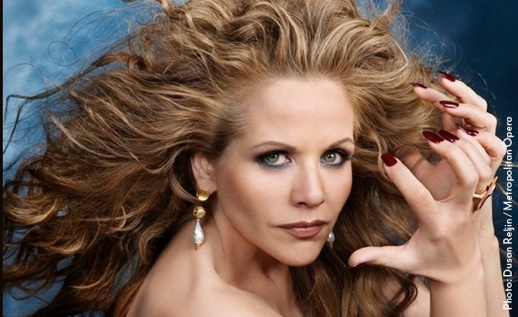
The face that launched
She without whom La Cieca would not cast a shadow, Renée Fleming, has a newly revamped website!
Copyright © 2012 parterre box - All Rights Reserved
Powered by WordPress · Parterror Theme by Nick Scholl for DIS Magazine
To claim the title of “people’s diva” you have to be more than just the most popular female opera singer in the country. You have to be so popular that people who aren’t particularly interested in opera know who you are, realize that you are at the top of your class, and still find you someone they can relate to on a personal level. For example, Callas certainly fulfilled the first two requirements, but not the third. So she will always be one of opera’s greatest divas, but not a “people’s diva”.
So, Renaaaay is the US’s Lesley Garrett, then?
Seriously, was Leontyne over the people’s diva?
… ‘ever’, I mean.
It is unjust to our doyenne to write: “Really, it seems rather desperate to seek out her website just to have a reason for another tired Renee bash-a-thon” when La Cieca — no doubt while reclining serenely in her boudoir — passively received an e-mail alert from moi-même, who had just received publicity from the new site itself. I imagine her then issuing a decree to her people to post the link so that Renée can have the publicity that she seeks. It is, after all, our doyenne’s noble vocation to keep us up-to-date.
The “bashing” follows as night the day, with the “drooling” that you so irreverently attribute to our benefactress. Renée and her minions are extremely proud of that little display, and it does not take a wild-eyed Cieca to find it, um, as many of us find it …
And, Javier, to keep dismissing recordings as “thirty years old,” etc. is not to pronounce upon them a valid criticism that will convince the musically and vocally aware. There is not a shelf-life on excellence.
“Seriously, was Leontyne [ever] the people’s diva?”
When did she ever claim to be?
And, seriously, why is it that defense of Renée always seems to require attacking other great singers? That’s a really bad sign.
Dear Monty, Price is sure a contender for a “people’s diva” title. She came from a modest, old-fashioned American family, she learned to sing in the church choir, she studied at Wilberforce, she overcame obstacles and prejudice to achieve her goals. The only thing standing in her way is that her public persona has that glamorous mystique that kind of moves her out of the people’s diva category. But she’d get my vote!
Dear Alto: Thank you for the explanation. However, it simply calls up another image of you and our benefactress doing an e-mail equivalent of junior high-school girls giggling in the cafeteria. “Oh, did you see what Renaay said on her website?!” No doubt you intended your remarks to be sarcastic, but I seriously doubt that anyone who wants to find the website of a particular singer needs La Cieca’s assistance. And if so, why not similar guidance for Angie, Anna, JDF, and the rest? Furthermore, although I am unquestionably a Renee fanatic, I have taken much pleasure in the singing of others as well. Whether she is the people’s diva or not is of little consequence to me. Frankly, such a title reminds me a little too much of the days of the dear old USSR. And just to show there are no hard feelings, may I complement La Cieca and the Parterrians for being a constant source of interesting and witty commentary. If I could lose weight from all the laughing I’ve done while reading these posts, I’d have a waistline to rival even Renee’s.
I mean, it seems like 7+ is a small number, but she has done more bel canto roles
And in that you are right. Renee Fleming has sung more bencanto roles than that:
Armida, Maria Padilla, Lucrezia Borgia, La Sonnamabula, Il Pirata, Il Viaggio, Rosmonda, La Straniera…
To that list we must add Violetta, which is a bel canto role. She has also sung other roles that are more transitional:
Amelia Boccanegra, not strtictly belcanto but close enough.
Manon, again, not strictly belcanto but with enough of it to make a slim claim.
The case could also be made for Alcina. While certainly pre-belcanto, handel and his operas certainly were laying down the base for what would become the bel canto of the 19th century. So a dotted line could be traced.
Another case could be made for Eva in Meistersinger. This last one, while not a stylistic bel canto role, it is in spirit because that is what Wagner had in mind when he composed the opera. (in this and in Lohengrin, Wagner wanted a new bel canto of sorts) The role of Eva had many of the requirements of a bel canto role (the trills, the long legato lines, the purity of tone and the attention to the accents of the music) and it is actually only missing one: the cabaletta with ornamentation.
One hardly knows what to say to the kind of person who comes to a well-established and FREE Web site, one that is endowed with a well-known and pronounced tone and character, to rail against its ethos, characterize the conduct of its inventor and sustainer as that of a “junior-high girl,” giggling or not, and evidently not understand that it is quite normal for a news-rich site like this to receive e-mail alerts from numerous sources, including the humblest of its readers, like your servant. If even you, as a professed “Renée fanatic” cannot see the value of our Doyenne’s passing on the publicity blast from the People’s Diva’s own site, then it’s hard to know what would satisfy your discriminating needs — aside, that is, from the kind of singing that you evidently admire to distraction. Literally.
And let me add another one: Anne Truelove.
Again, while no one would claim that Stravcinsky’s music is bel canto, he composed this opera using the rules of the style. A quick listen to Anne’s scene would make you realize that it is a 2-part piece (aria and cabaletta) and that even the cabaletta is ornamented (just that Stravinsky wrote the ornamentation as opposed to leave it open for the singer to improvise)
Musically it might not be a bel canto role, but stylistically, Stravinsky was wanting to achieve something close to it.