Peak performance
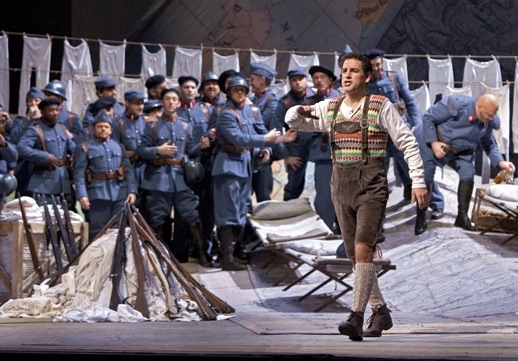
It’s that time of week once again, cher public, the Saturday afternoon chat accompanying the Met’s matinee broadcast. The topic of today’s colloquy? Why, it’s La Fille du Régiment beginning at 1:00 PM!
During the single intermission, Mary Jo Heath will interview Diana Damrau, Juan Diego Flórez and Kiri Te Kanawa. Plus there will be a feature about the passaggio, sure to provoke lively discussion among the parterriani.
The real-time chat is, as usual, over at La Casa della Cieca.
I think another thing is that this is a role Florez is very comfortable with, and one in which he knows he can pull off with big applause. He has stated over and over again that he doesn’t find the 9 high C’s hard. Other singers might be terrified of them but the note seems to lie in a comfortable part of his highly placed voice. He’s comfortable with this production, having sung it in many different houses. He probably did not have to rehearse all that much. I’m not saying he wasn’t admirable for going on even with a cold (he was), but also that for him, this probably was not that challenging of an afternoon for him.
Poor pathetic Dorian must resort
to personal attacks, always the refuge
of the insecure .
Hey everyone, this is how you sing bel canto and add comedy to the performance without breaking the vocal line or resorting to histrionics.
I was so disappointed with Damrau this weekend. She should not be allowed to sing bel canto at the Met ever again.
to Cruzsf: I love operetta as much as Opera. Someone, I think here, only a short time ago compared Lehar very favorably as a musician to Puccini, so maybe I’m PC ok. I am not a musician though. I’d say, if you are going to look at G&S, I’d go beyond the BIG Three (although “The Mikado” is a favorite) and definitely NOT miss “Iolanthe” and “The Gondoliers.” You’ll have a hard time getting the tunes out of your head, especially “Bow, bow, ye multitudes and masses” and “the Cachuca.” I have the same problem with Milocker’s “Der Bettelstudent.” This operetta made Millocker a financially secure composer!
To All: I’m going to see The Philly Opera Company’s “Tea: A mirror of soul” by Tan Dun. It was done in Santa Fe. Anyone seen it and care to comment? It’s going to be different, from what I hear.
Bluessweet, I am charmed that you like operetta and Lehar. So do I!, very much! Have you been to the summer operetta festival in Ohio? I must go!
I include Noel Coward’s “Bittersweet” on my list, too; it is so sweetly sentimental and charming and simple, and the songs and duets are delightful. We are, of course as everyone knows, in very interesting company as admirers of Lehar, for Adolf Hitler was said to be his greatest fan and would travel anywhere to hear The Merry Widow! Ahem! There are some interesting anecdotes about all that; I’ll save them for when we lunch.
Don’t expect much with “Tea.” I had to review it for American Record Guide, so presumably my review is out there somewhere; I’ve more or less forgotten it. The music is utterly vapid and immemorable, and the story is “spiritual,” which you may translate as, nothing happens. Santa Fe got by on a highly colorful and zippy production — but even so, just sitting there and looking at it for two hours became tiresome. Perhaps Signor Tan Dun has made some revisions, si?
I surely hope so. I myself have decided to stick with Lehar.
jim/santa fe
armerjacquino says: “Is that Met Tito recorded anywhere? Would love to hear Scotto as Vitellia.”
Ah, be careful what you wish for. I heard her in it twice. Best summation: She was wonderful in the recits.
The project was done mainly for Troyanos; her Sesto was maybe a notch more unruly than on the fine Salzburg video. Tatiana missed opening night and was spelled by .. wait for it, Vicar… Ann Murray, whose role as (later, a very good) Annio was spelled capably by Ariel Bybee.
Gail Robinson, lovely in coloratura roles, was a “highly adequate” Servilia and John Cheek a good Publio, though we’ve had better since. Kenneth Riegel was no kind of replacement for Pavarotti.
Things improved Vitellia-wise with the advent of Vaness (1984) and Connell (1985).
Vaness is THE Vitellia as far as I’m concerned. Although I think Bumbry would have been a lot of fun in the part.
Hey Armer what about Varady and Casula? Far better legato and a richer tonal palette than Vanness I should think.
Wow. That would have been fun — with Verrett as Sesto, Domingo as Tito, Kiri as Servilia and Margaret Price taking on the mezzo role of Annio,
… of course, for sheer sensuality as Vitellia, Bumbry couldn’t have held a candle to sizzlin’ sexbomb Dame Granite/
MN- I know it sounds odd, but Bumbry sang the Mozart Requiem on record and studied lieder with Lotte Lehmann, so there’s no reason why it should have been much of a stylistic stretch for her. The vocal range would have suited her too, and you must admit that the acting would have been fun.
As for Verrett- well, she did sing ‘Deh Vieni, Non Tardar’ in concert. Don’t believe me? It’s on YouTube and is… interesting.
CF: I think there was something special that happened to Vaness when she was singing Vitellia. I suppose it helps that I saw her do it on stage when I was young and impressionable, but for me nobody has come close to the way she sings the lower-lying sections of ‘Non Piu di Fiori’ or the panic in ‘Vengo, Aspettate’. Roschmann’s pretty terrific in the part these days, despite or perhaps because of being right at the limit of her vocal capacity in the role.
Your comment is strange – “the
philosophy of a thug “The Met isn’t there to do social work -it’s there to
make money as are the so called artists they hire . If either were
dedicated to the “art” they wouldn’t
be playing half of the crap they put
out year after year -but it is about
money and the lowest common denominator to make that money ,
and no matter how poorly the star
sings ,if they fill the house they have
a performance -nowadays singers send out notices that they are slightly
ill but, will go on nevertheless and we are made sure to know this -it
is all to cover their asses for a possible second rate performance ;
None take responsibility for their work-it’s always a cold , a virus,
the clap , whatever but not their
own lack.You will never see the “Licht” operas of Stockhausen at
the Met because it doesn’t have
an intelligent curious audience to
explore further than the standard operas which bring in the money.
The Met is about money only, as are
most opera houses ,though once in a while others take a long shot and
produce a daring work . The Met
will not do the “Licht ” set because
money drives the house not art . So
to lable them thugs is rather unfair
as they show no sign other than
that of earning of money -as do the
so called artists the appear there .
It was stated that Pavarotti and Price only sang once together in a staged opera. I would like to humbly offer the 1977 Trovatore from Salzburg under HVK.
It was Wien, but you are correct: Price and Pavarotti did sing Trovatore together. I think the point stands though that so infrequent a partnership is hardly a good example to represent Pavarotti’s level of collegiality. (Though one might well draw the conclusion that with such sacred monsters as Price and von Karajan flanking him, even the generally naughty Pavarotti was cowed into good behavior.)
Someone pirated a recording that I have around here somewhere. I forget the rest of the cast (Ludwig and I forget the baritone—Capucilli perhaps?). You know, la Cieca, your comment about sacred monsters reminds me of the HvK Verdi Requiem from the 60s. The clean shaven young Pav looks just a bit frightened, IMO. But I think that the diminutive maestro brought that out in the best of singers. Price even said so herself regarding this late Trovatore after playing for her a recording of the 62 Trovatore in order to remind her of that whole singing on interest thing.
Leontyne Price and Pavarotti sang Trovatore together under von Karajan’s baton at the Wiener Staatsoper from May 8th, 1977 to May 15th, 2977. Believe they sang only 3 performances together in Vienna and the first night also included Christa Ludwig and Piero Cappucilli plus Jose van Dam as Ferrando.
It was not a new production but an updated one utilizing the sets from 1963 which was a new production also led by von Karajan. In 1977 von Karajan returned to the Staatsoper after a long lapse doing Trovatore, Figaro, and I believe Boheme all with steller casts. I believe the production in 1977 was also filmed but utilizing Bonisolli rather than Pavarotti as Bonisolli was more photogenic in Karajan’s eyes. Neither Price nor Pavarotti were regular fixtures at the Staatsoper though surprisingly Price sang two Paminas there in 1959.
1977 not 2977 (see above)
How did you DO that? First it said “It was 1976″ and 15 seconds later it said “It was Wien.” I guess if you’re the boss you can do anything, but boy are there things I’ve posted I wish I could take back.