
Out of the past
![]()
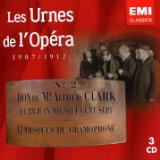
Since I had already gotten my Hanukah gift this year (my Nikon D3000 DSLR), I was surprised to receive a box from my sister this past week. One of the gifts inside was Les Urnes de l’Opera
, a collection of arias and scenes recorded shortly after the turn of the last century and buried in urns beneath the Paris Opera. The collection is 62 tracks by various artists, not limited to singers, but also including such distinguished musicians such as Fritz Kreisler and Ignaz Paderewski. I wish there were space to review all of the tracks, but rather, I’m going to single out some highlights.
American soprano Berthe Auguez de Mantalant, a singer completely new to me, sings two arias from César Franck’s La Procession, a piece I’d never heard of. Her voice is lovely, evenly produced, but the music itself doesn’t cry out for revival. She makes a stronger impression on the last disk, with “D’amour l’ardente flamme” from Berlioz’ Damnation of Faust. She sings with great beauty of tone and expressions genuine pathos.
Belgian baritone Jean Noté sings a very stylish “Pour tant d’amour” from La Favorite, and makes a strong case for the opera in French. The voice is lovely. French baritone Hector Dufranne sings “Arretons-nous ici… Vallons de l’Helvétie” from Adolphe Adam’s Le Chalet (an aria I have sung). He tosses off the coloratura with great ease.
Raoul Pugno, a French composer (1852-1914), plays his own “Sérénade à la lune.” It is played beautifully and is quite atmospheric.
Selma Kurz sings the lovely song by Eva Dell’Acqua (1856-1930), “J’ai vu passer l’hirondelle”. It is a showpiece that should be revived by an enterprising lyric-coloratura. Ms. Kurz has a gorgeous voice, and uses it with great taste. (Remember the taste issue. It will be mentioned again later).
Track 22 is Francesco Tamagno singing “Niun mi tema” from Otello, a role he sang in the world premiere. It is quite thrilling. The only fault I can find with this track is that it was recorded with piano rather than orchestra. Compared with later interpreters, such as James McCracken, he is rather restrained, especially at “Desdemona, Desdemona, morta, morta” but more effective, I think. This track is followed immediately by “Solenne in quest’ora” sung by Caruso and Antonio Scotti, a beautifully matched pair of singers, caught in their prime.
Mattia Battistini sings “Da quell di che t’ho veduta” from Ernani. No mention is made, however, of who the soprano is, which is a shame, because she gives a terrific, rip-roaring performance. Perhaps because the recording is for his benefit more than hers, he’s placed a little closer to the mic, but they are terrific together. Next up are Fernando de Lucia and Giuseppina Huguet singing a duet, in Italian, from Les Pêcheurs de Perles. De Lucia has an incredible head voice with some of the loveliest floated high notes. This duet is really stunning.
Adelina Patti recorded “Batti, batti, o bel Masetto” at age 62. Besides the fact that she barely has the top notes for what isn’t a very high aria, it is so far stylistically with what we’re used to hearing in Mozart. It was a shock to listen to. The biggest disappointments, though, come from Nellie Melba. She sings “Caro nome” with almost no vibrato (I suppose it could be the primitive recording, but since the problem is only apparent in her track, I’m assuming it was her singing). She also sings an execrable “Voi che sapete”. The tempo seems to change with every measure and is too slow throughout.
Other highlights in the set include Ernestine Schumann-Heink (a German “Mon coeur”), a truly lovely “Madre pietosa, vergine” from Forza, sung by Celestina Boninsegna and Emma Calvé singing Carmen.
Caruso demonstrates why he’s such a legend in “Celeste Aida” – gorgeous line, expressiveness, and ringing tone. Paul Franz makes a strong case to me for Wagner for singing Lohengrin in French. His voice is nothing short of perfect in the music.
My favorite singing of the set, though, is French tenor Leon Campagnola singing “Ah! Leve-toi, soleil” from Roméo et Juliette and “Salut, demeure chaste et pure” from Faust. His voice is perfectly suited to both pieces. Lovely lyrical singing, with a strong top. And he holds the last note of the Romeo forever. Also tops is Léon Beyle singing a gorgeous “Aubade” from Eduoard Lalo’s Le Roi d’Ys. I’d like to hear more of the opera.
Earlier I mentioned taste, and here’s why. I have always had a fetish for coloratura sopranos, perhaps because my first taste of opera was Roberta Peters. I grew up seeing Sutherland and Sills on TV, and as we all know, I am hooked on Anna Moffo. The worst singing in the set, and least judging by taste level, is by Maria Galvany, singing a little known Arditi trifle called “L’Incantatrice”. Galvany was famous both for her acuti, on full display here, and the speed with which she sang fioratura, But just because she could doesn’t mean she should have. It’s rather vulgar.
All in all, though, this is an excellent collection for anyone interested in the history of opera in general and singing specifically. It is from EMI Classics.
Here is the link for the Rameau-Delunsch video
Operatic style was changing all throughout the nineteenth century. In Italy it was changing fast. By the 1850′s Henry Chorley was complaining that there were no longer singers capable of singing the operas of Rossini. A revival of “La Donna del Lago” was hobbled by tenors without the ability to perform the arias properly. By the time the phonograph was being invented the style was moving into verismo and everything was being sung as verismo.
Singers like De Lucia, Patti and Battistini who were trained pre-verismo (De Lucia and Battistini sang some new verismo operas) reflected an earlier and vanishing style.
In France the compositional and vocal style remained the same. Massenet lived and composed close enough to the 20th century that many singers who created roles in his operas lived to record them. Singers who worked with Gounod for important revivals like Leon Melchissedec lived to record their arias. These singers also trained younger singers in exactly the same style. So the 19th century style and techniques of singing French Opera are preserved on those acoustic Pathé recordings in the “Urnes D’Opera” collection.
So the early recording of Italian Opera by Italian singers most reflect the taste and style of the period when it was recorded with the exception of real old-timers. Mozart probably was sung like Bellini in the 1830 on up and like Rossini before that.
In France, the schooling and style were more fixed and the recordings would closely reflect what the composer heard at the premiere of the opera.
Early Mozart recordings are usually problematic for me. Lots of Romantic singers like Battistini, Patti or Melba treated them like dainty little porcelain knick-knacks -- twee and delicate and affected. They sang it like faux antique Donaudy or Tosti songs. I hate it. The best Mozart singer on early recordings is Lilli Lehmann. Here is her “Or Sai Chi L’Onore”
Her “Non Mi Dir” is impressive too:
As for Melba and her vibratoless voice. Melba described her own voice as being like a boy’s. Melba’s great fan base and areas of popularity were in England, America and France. Latin audiences and composers like Puccini found her cold. Rosa Ponselle heard Melba in “Faust” and complained that her voice had too many “still tones” in it. Essentially that it was a straight tone. I think she appealed to an Anglo-Saxon Victorian fetish for pure, ladylike singing. Dignified and sexless.
Gualtier, thank you very much for your posting. I remember others like this one and always enjoy them.
It does amuse me, no end, that the Immortal Olive should have been posted on her mentor/teacher’s singing…perhaps poised to wrest away her husband, even in the great beyond?
Re Lehmann’s Or sai chi l’onore – it’s interesting that she sings appoggiature on the words onore, volse and traditore – you hardly ever hear them today, even in so-called period performances. I wonder when it became fashionable to sing the notes “come scritto” rather than with the more graceful ornamentation….does anyone know? Appogiature in Mozart seem to have died out by the time of the Fritz Busch Glyndebourne recordings of Figaro, Don Giovanni and Così.
with my brand-spanking-new laptop I can finally enjoy some of the videos posted here—and I just had to say how much I enjoyed that clip of the end of Louise. Wonderful performances—this music just speaks to me, for whatever reason. So emotionally abandoned—almost unhinged.
Too bad about that set, tho—I’ve seen more evocative scenery at middle schools.
Keep in mind with Melba that she was one of those singers whose voice took extra badly to early recording techniques. It wasn’t just people who heard her who said this, it can be heard by comparing her last recording sessions (in 1926) to the recordings she made for Victor in the acoustic era. Melba was near retirement then (her retirement gala at Covent Garden was recorded too), and her repertoire had become extremely restricted. And 1926 isn’t “state of the art studio surround sound” either. Still, she’s one of the voices that sounds markedly different in the acoustic/electrical comparison. (A lot of singers sound basically the same. Rosa Ponselle and Amelita Galli-Curcic come to mind.)
The straight tone is still there, but the voice sounds warmer, richer, and you can get a clearer picture of the things people gushed about: the voice’s size, it’s “star-like” brilliance, the purity.
Here’s a chunk of a live farewell performance from Covent Garden from 1926:
And here’s her last recording:
To compare, here is Melba in her prime, in an acoustic recording.
Poisonivy you and I are the only ones defending Melba — the generalizations above about her are — let’s say — limited. In her best records can be found full bodied tone, fearless attack and tremendous vigor. There was nothing ‘frail’ or ladylike in a bad sense about her singing. Her sobbing through several different records of Tosti’s Goodbye is as passionate as one can find. And at her farewell her utter abandon in act three of Boheme is a shock and presumably how she actually did the role (in an early recording studio being pushed toward and pulled back from the equipment which shattered easily and often when she sang full out, she obviously sounds more cautious and ‘dainty’.)
Anyone who actually knows Melba’s recordings and isn’t just throwing horse manure around has heard the ‘distance’ tests where she was positioned in three separate places: close, less close and the one they chose, far away from the horn. In the close test the impact of her singing is stunning. The sorts of generalizations made above are an odd melange gotten I don’t know from where.
“De Lucia sang ‘some’ verismo operas?” His fame was as a verismo tenor and EVERYBODY who heard him criticized him as personifying all that was bad about the singing of the new school (you can look at Shaw and Henderson for starters but the Italian critics were not complementary). He sang the world premieres of Iris, I Rantzau, Silvano and other works, and he was the first famous international Canio and Turridu. He was acclaimed as Cavaradossi even commanded to sing it for Queen Victoria, also as Rodolfo in Boheme (he also sang Marcello in Leoncavallo’s
Boheme — the tenor role.) He was also praised as Don Jose — Bizet was a big influence on the verismo composers and whether he would have wanted his work to sound that way it was considered an appropriate approach.
When he tried the “old repertoire” he was considered a disaster despite much later English critics praising his records; his contemporaries thought his Almaviva, Don Ottavio and Elvino in Sonnambula ‘appalling” and his Alfredo and duca were not thought of with any great enthusiasm. (Read Klein and Henderson)
Far from exemplifying the old school, he had all the mannerisms and faults deplored by connoisseurs — he bleated (again the English craze for De Lucia of the 60′s and afterwards dealt with this by insisting that ALL his records were playing at the wrong speed, reissuing arias and songs in keys a baritone would have found low) — the feverish vibrato was a part of the new school and can be heard in another verismo tenor Anselmi, as well in the more cultivated (and more greatly admired generally Bonci. The first Caruso records are made in this style too — he changed for America). In De Lucia’s case the vowels were not equalized, which meant that he shifted pharyngeal positions for each vowel and couldn’t produce an easy “i” vowel (it emerges as eeeeeeeee).
There is something to be said for de Lucia’s manner in many of his records, most made late when he was semi-retired and probably more rested. Oddly there is a lot of charm, but most commentators thought he was dull outside the verismo carry on (read Klein and Shaw again). In NO way was he typical of an older school — in fact all of his singing is heavily contrived. The florid technique the English told us was so wonderful is him bleating up and down the scale — anybody with an ear can hear how fake and inelegant this is, how smeared the notes are (and compared to the amazing classically trained Clara Butt with her enormous voice in ‘lusinghe piu care’ or Battistini or even Anselmi, de lucia is a faker).
Much more typical of an ‘old school’ tenor is Vinas (a three CD Marston is available), a gleaming, silvery sound produced entirely on the breath (an ‘appogiare’ technique) with no forcing and no throatiness (de Lucia is capable of both). Vinas could sing a range of roles including Lohengrin (his most famous role) with a limped legato approach that is breathtaking in its sweetness and elegance. The voice ‘rolls’ easily from very soft to loud without any apparent shift in production, the vowels are all beautifully managed. His singing is clean with very clear intervals. Marconi is another old school tenor (recording after operations for nodes) with a beautifully focused and elegant delivery though a somewhat worn and occasionally quavery sound. Finally of course one would look to the Russians, most Italian trained, such as Labinsky, Sobinov and the young Smirnov and most remarkable the dramatic tenor Yershov whose brilliant thrust in the Forging Song of Siegfried is the result of careful training in florid music, his voice is so responsive that it literally bounces off the rhythms with an irresistible charm — surely what Wagner intended.
Battistini sang some versimo operas, none with enthusiasm, he was renowned as Carlo Quinto in Ernani and Alfonso in Favorita among other ‘older roles’. He had begun in the 1870′s and awed people with the floaty sweetness of his tone, the endless breath, the amazing legato and the astonishing dynamic range (as in the song “L’amour” the final F is attacked softly and gets softer and softer and softer until the record’s groves run out). His passage work is amazing (listen to Riccardo’s scena from Puritani, there is none like it on records). His vowels are perfect, the spinning sweetness of the tone unforgettable. And yet, he has plenty of force when needed. His Mozart dainty? The person above has never heard his scena with Zerlina from Don Giovanni, where the entire recitative interchange is a riot of color and erotic insinuation every appogiatura in place and the duet proper is utterly erotic with the pressing of ‘andiam’. There is also the stunning vigor of ‘finch’an del vino…’ Other older school baritones can be heard, such as Magini-Coletti (a Verdi favorite), Kaschmann and Pacini remarkable for their elegance, charm and spin though none recorded in their prime.
As for poor Patti I don’t know what generalizations can be made from records made when her voice was mostly gone — yet the amazing trill, the gorgeous words, the stunning rhythm, the conception of tone and line (even if tone is thin and line gets interrupted for breaths) are all stunning and do contain insights into how ‘it was done’ years before.
And Mozart was done like Bellini? How is this provable? Or even meaningful? Bellini studied Mozart and there’s no reason to believe there was a radical shift in performance practice. There is such a thing as ‘common practice’ and musicians performed in an international style passed on from teacher to pupil certainly up until the First War, and even in some cases beyond.
But I’m sick of myself suddenly and tired of telling the truth. Go ahead Camille and worship the windy generalizations. They’ll do you good; there’s nothing so warm as a bath in ignorance.
Extremely interesting post, Mr JohnClaggart. I love Patti, and it’s not difficult for me to understand why she was such a legend. The sheer beauty of her timbre, and the stunning trills. I am confused about your statement regarding De Lucia’s recordings. I thought it was a certain thing that he had recorded most of them one step or even one third down. Or do specialists still have doubts about it?
In any case all these recordings are extremely fascinating; they are like a time machine for me.
Thank you Ercole Farnese. The biggest issue with De Lucia’s keys is with the piano accompanied songs and to a lesser degree the arias. Nearly all the Pearl (and Opal) issues of songs are impossibly low for anyone who actually sang as a tenor and both the sound of the piano and his tone at those keys is odd (“underwater” sounding).
There is some argument but more agreement about the orchestrally accompanied opera selections, (there is a three CD Pearl opera aria and ensemble set where some effort was made to establish the reasons for their pitching). For one thing string tuning makes some keys impossible and that is a guide. He sang some things at score pitch on those records, others are at a minor third, though sometimes he sings at score pitch but rewrites a high climax, which is what he tended to do live apparently (in Mascagni’s letters there are many jokes about De Lucia, untranslatable since they result from colloquialisms — I remember one where Mascagni literally writes that De Lucia ‘suddenly wrecked the roof like the wind’ at one high passage in Iris — he means that De Lucia brought the top down suddenly in a way that made no musical sense. He is also funny about De Lucia’s faking of high and not so high notes in Puccini’s Boheme — “Giacomo should have just gone ahead and cast [the bass] Nazzarini — oh, wait, HE could have sung it at score pitch.”) There is also the famous comment when someone reported that a young tenor named Caruso was really a baritone, and the response: “if he is a baritone then De Lucia was a basso profundo”.
De Lucia was one of the first to take recording really seriously and to understand how to ‘color’ his voice for emotional effect in a way that would sound ‘in the horn’ but might not have worked in a big opera house. According to those who heard him live and also heard at least some of the records, the records were a lot more interesting (though I see no reason to doubt he was a very effective Canio and Turridu — he was admired by Leoncavallo and Mascagni in those roles, and neither was a big fan otherwise).
I love both Patti and Melba. I think Melba’s CG farewell recital is an ear-opener, especially her Ave Maria, perhaps the most moving on disc.
As I often experience when hearing reasonbly well-preserved voices, the mechanics of the technique are apparent, making fascinating listening experience. Like hearing Ponselle’s Villa Pace recordings or the very late Flagstad. Of course, I’m talking about the real vocal giants.
Well you see dearest Camille, this is what you get for welcoming Ortrud into the hause, to think you were the first to make a loud welcome, and now you have to remember Telramundovich warning So Zieht das Unheil in dies Haus, my german very no good but I know how to use google, that’s the lot of us die arme ignorant pubs. I love the record with the welsh dame Jones, she is the beste Ortrud, maybe the bestest of all time. I hate the director Kubelik though, cscheckisch no good for music, only for war, always win in war. In sovok we only listen to wagner now, before no good, so I know more about italian, and of course our beste City of Kitesh, Ruslan et Ludmila, very patriotic, we feel proud to be sovok, and proud of Anya from Krasnodar. I hope our Anya from Krasnodar doesnot follow on the footsteps of that stupid Melba and singts Brunhilde with that voice and wrecks it quickly. But Melba did make Haagen Dasz very rich, I mean PR rich, choke a full in Dushanbe
Chinchi from warm Dushanbe
Camille please forgive but I forgot to tell you my ignorant pub advice, never trust who falls down and says Hier zu deine fussen. Be very achtung.
You know it’s me again Chinchi from dushanbe
forgive one more, but Camille, I love you for loving beethoven, he is beste, he writes of sboboda, freeiheit, the great amrikan word freedom, the good people, I once heard his symphonia 9 in dresden semper, I was only baby, everyone cried, they remembered the terrible firebombing, they projected the pictures behind the orchetra, boom boom boom, like an einsenstein moving picture.
Chicnhi sad in dushanbe
August, Revered and Esteemed Mme. Claggart:
Were you not constrained to fighting in the trenches with others who are unworthy of your apercus , you would have been here to have intervened on this important subject at an earlier point. I was puzzling over the Mozart/Bellini connection, and as I read it very late in the day I thought perhaps it was only the fact I was tired that made me unable to compute the connection. Look, there was no one really talking about any of it, and I was trying to keep the subject going, that’s all.
I bathe in Guerlain, FYI!! Also, Creed!!!!!
Now, please do excuse me, as I must recover from a day spent on Long Island at a wedding reception with my Sicilian in-laws(!)
Mrs. Çlaggart, I do think so much of your writing and I hope that this New Year will bring you a venue worthy of your formidable talents.
Pax vobiscum,
Camille Beauchamps
My dear Madame Beauchamps, you seem to have attracted your own illiterate and idiotic stalker who like many really stupid people is self infatuated with its own offal. My apologies for an irritable remark and gratitude for your kind ones.
You write: “I hope that this New Year will bring you a venue worthy of your formidable talents.” But if I didn’t think this venue were worthy I wouldn’t be here. True there are obstacles, including some preposterous morons — I’m amazed at what The Behrens boy with the sticky Isolde sock puppet revealed about itself to Gospodin(a) Krunoslav after pretending some other things earlier.
But these trolls are so repetitive and uninformative save in their expanding delusions, of interest only to students of mental illness everywhere, most of whom, even the deaf, know more about music, opera and singers than the trolls do, that it is very easy to ignore their sniping. Your fans suffer from coprolalia, a kind of tourettes of the soul, notable in advanced schizophrenia and usually associated with diminished intelligence. They chatter on and on senselessly in attacks sometimes more personal, sometimes ‘disguised’ by onanistic displays of meaningless drool. Tant pis. (or do I mean piss?)
I look forward to your postings in the new year and your occasional corrections of myself too!!
I’m so glad someone mentioned Alain Vanzo and Barbara Hendricks, two of my favorite singers of French rep. Vanzo had a beautiful voice and I have fond memories of his recordings with Mady Mesple (another favorite singer). And Hendricks recorded Chabrier’s gorgeous “Le roi malgre lui”, which has beautiful music but what I seem to recall is a pretty bad libretto. And her album of French arias is terrific, though I’m pretty sure it’s no longer available. It includes Comme autre fois from Pecheurs and a really lovely Elle a fui
Mr. Sanford — could you give us you feeling on Reynaldo Hahn’s selections, if you have the time.
My partner saw ‘Le roi malgre lui’ a few years ago and was greatly impressed by the music but the libretto made him hysterical, it was so absurd. Shame it would be so.
I haven’t explored the French song repertoire too much outside of Faure, so I don’t know either song. But they’re both quite lovely. I really admire anyone who can sing and play at the same time; my piano playing was never my strong suit. His voice is beautiful and his top is lovely; very light. I really enjoy them. If you want, you can click on my name and I can send them to you. Speaking of French songs, someone was kind enough to send me Anna Moffo singing Debussey songs from very late in her career, but which are beautiful. Again, rep I don’t know very well, so I have nothing to compare them to.
Addison — very happy that you posted that bit on Tamagno, as now I don’t have to feel as guilty for being so unsatisfied with him.
Poisonivy — loved the Emma Eames record. There was no ice on the Nile when she sang this song!
tks to both
Thanks, Mr. Sanford, I’ve got the recordings so no need to send me them.
I just wondered about your impression of Hahn.
I’m glad you posted this as I feel it’s important to look at what has come before. I will return to listen some more.
Ps – you are right to love la Bellissima Moffo — do not let people forget her!
Here is Melba’s “distance test”:
You can hear that the farther away she’s made to stand from the horn, the more the “typical Melba complaints” are evident — the boy soprano sound, at times tinny (the way a person can sound on a poorly received cell phone), the pennywhistle high notes. The things she was praised for become less evident — notably, that this was a huge voice. Stories of the “tricks” she used to do to show off how big her voice was are legendary — she apparently used to sing “Dite alla giovine” with her back to the audience, knowing that her voice had the power to project to the very back of any auditorium.
Does anyone know if Melba had perfect pitch…there is something in the way the tone is able to glow dead center on pitch that makes me think she had perfect pitch.
Singers who have perfect pitch sing out of tune too …
Don’t know about Melba though.
Just sayin’…
“Since I had already gotten my Hanukah gift this year (my Nikon D3000 DSLR)….”
I must confess that reading this excited me far more than “Les Urnes de l’Opera”. Congratulations and may your new camera bring you much pleasure!
I am currently using a D80 but, one day, hope to own a D300.
The D3000, has no live view so be warned. You have to use an a view finder. I love the camera. For examples of my photography, see http://so-snapped.imagekind.com