Headshot of La Cieca

Cher Public

  • Betsy_Ann_Bobolink: Is it all right to say "John Huston," "Angelica Huston," or ...
  • kashania: Extravaganza is the word, all right. What fun! Congratulatio...
  • brooklynpunk: thanks, S-conductor!..... a much more "up-beat" rig...
  • whatever: mille grazie, IL3!
  • armerjacquino: Oh, that's the wrong one, isn't it? Hang on.
  • Indiana Loiterer III: September 24 – Elisir 26 – Turandot September 27 – L’El...
  • oedipe: Let's not be reductionist ourselves: I don't believe the art...
  • armerjacquino: http://parterre.com/2011/08/08/rip-brad-wilbers-met-futures-...
  • grimoaldo: Has anybody posted the classical Grammy winners?Engineer...
  • almavivante: When I read an inspired extravaganza like DharmaBay's, I rea...

blog advertising is good for you

It’s never too late for a bitchslap

crash

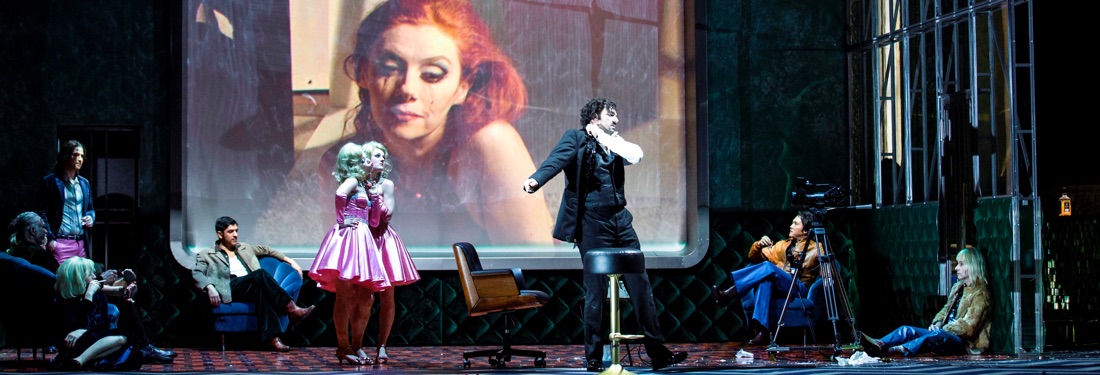
La Cieca thinks that Marcelo Àlvarez should be reminded that he is a tenor, and nobody is really interested in a tenor’s views on theology.  And even if he doesn’t know better than to badmouth an ongoing production at a theater that presumably is (or anyway was) contemplating offering him future contracts — he is a tenor, this bears repeating — surely his management needs to rein him in.

Even if you’re in a car wreck, Sr. Àlvarez, until the wreckage is completely towed away, you’re supposed to say you’re having a wonderful time. That’s what colleagues do.

96 comments

  • CruzSF says:

    of all people him, who sucked as Mario

    I knew Scarpia received the sucking in Act II, but this detail escaped all the reviews I’ve read. Now THAT would be a controversial Tosca.

  • kashania says:

    Maybe that was his torture.

  • Lindoro Almaviva says:

    You know? in the midst of the rant, I think paddy brings a good point. These days singers have been (for the most part) stripped of their voice as partners in the creation of art.

    For years it was conductors and in the past 20 years or so, it has been directors. Thankfully you still get some who are truly interested in hearing what singers have to say about their characters (Kay Walker Castaldo is one of those) but some have turned into the Muti’s of the other side of the footlights.

    I remember several years ago when I did Ottavio, the director was adamant that Ottavio and Anna would never marry. I told him I disagreed and he would not even let me finish before he just told me that I was wrong and walked away. Mind you, I had an argument that took into consideration the spycological state of Anna’s mind at the time, her place as a woman in the general society of the XVIth century and the predicament she is in.

    I think that sometimes singers do get a little tired of not being used as beings with brains and opinions. Seems like unless you are some big diva who can get his/her way, your only part in the artistic process of putting an opera is to sing your notes, hit your glow in the dark mark and be thankful for having the opportunity of drinking from the immense fountain of knowledge that God sent you as your stage director. It gets tiring…

    Now, as to my argument over Ottavio and Anna, Funny part is that I ended up having the conversations with the lady who played Anna and she agreed with me 100% on my arguments and we played like she was going to lean on me and we would take it from there.

    If you are curious, what I was going to argue was:

    1. it is the XVIth century, women are not allowed to inherit property. This means that if Anna does not do anything about it and soon, she will end up in a very precarious legal situation. The only way for the situation to go away would be for her to marry after a period of mourning or give all her father’s assets to the church and enter a convent. If Anna marries, her husband will inherit the property and Anna will secure her financial and legal situation.

    2. Anna is in a compromising position. Her honor has been put to question and the only way to recover it would be to marry Giovanni, marry Ottavio or go into a convent. She can not turn into a more socially acceptable state of widowhood because she was never married. She can not either enter into a perpetual state of mourning for her father because an unmarried woman could only do this kid of perpetual mourning in a convent.

    3. Her father had arranged for her to marry Ottavio and now that he was gone, she (being a little emotional and maybe nostalgic about it) would see that daddy’s wishes would come true.

    4. If Anna does not follow the conventions of the society she lives in, she will be socially outcast; and that would put her in danger of loosing her property and her honor, the 2 things that she would be most interested in protecting.

  • La Cieca says:

    Lindoro, everything you say is correct and authentic. I agree with what you say about the relationship of Donna Anna and Don Ottavio and your prediction of their future. But ultimately you as a single singer are not in charge of formulating the opera’s dramatic message: that’s the director’s job. Similarly, it’s really not your privilege to set the tempo for an ensemble; that’s the conductor’s job.

    Now, a good director, like a good conductor, should take the singers’ abilities and ideas into account, but ultimately the one in charge gets the final decision. Otherwise what you get is democracy, which is good of course, but you also get chaos, which is not what you want in Mozart, anyway.

    “What would the character do” or “what happens next” I do not think are set in stone; they’re subject to interpretation. The quality of the art depends very much upon how well the ideas are carried through, even if the ideas themselves are not in agreement with the way you see things. The up side here is that Don Giovanni has been performed thousands of times before now and surely will be performed thousands of times more in the future. Each performance provides new opportunities to do the work differently, always with the hope that the “different” way of doing it is thoughtful and well-crafted.

  • Lindoro Almaviva says:

    Now, a good director, like a good conductor, should take the singers’ abilities and ideas into account, but ultimately the one in charge gets the final decision.

    I could not completely agree with you more. I think you ultimately nailed it right in the head in saying that a good director seeks (or takes)singers’ abilities and input and in the end, even if he didn’t agree or applied it, the singer is heard.

    I am not sure this is what we are getting a lot of times though. You move in the circles more than I do. Is my perception accurate?

    This has nothing to do with Bondy because whether I (and we) like or not his Tosca, he has a reputation for coaxing amazing performances out of singers. I wonder of directors like Bieito, Katarina Wagner and the like are able to do the same. (I know that Bieito has, not sure how often)

    I see these videos of operas where the singers look like they are hitting a sopt and moving without any purpose that sometimes i wonder if they have been sold in what the director wanted to accomplish of whether the director was unsuccessful in that regard and ultimately turned into a traffic cop where the “cars” are turning right, but in reality they needed (or wanted) tu tuen left to get to the same place.

  • La Cieca says:

    My impression is that there is a lot of assembly-line opera out there, productions that have to be done on time and on budget with singers who are generally overworked and don’t have the luxury of time to break down their preconceived notions and build a whole new performance when, in between rehearsals, they are jetting off to Munich to save a performance of Elektra.

    This lack of time and commitment from singers is perhaps why a lot of productions seen today seem to revolve around big sets, lighting, choreography and movement by extras, while the leads sort of stand downstage with stuff moving around them. It’s a way of getting an at least superficially interesting show on the stage, but not the ideal.