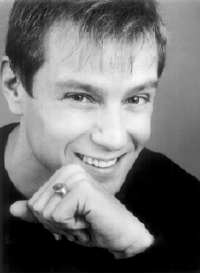
Photo: Christian Steiner
August 2001: Mark Adamo was only a couple of hours off a plane from Charlottesville, Virginia (site of the latest production of his breakthrough hit opera Little Women) when he welcomed me into his Upper West Side apartment. Obviously weary from a hellish flight (“it helped to pretend I was on a bus”), but apologizing for behaving “like a pasha” as he reclined on a chaise longue, the improbably boyish blond composer chatted about his opera, including an upcoming telecast on PBS’s “Great Performances.”
When you say “Jo wouldn’t be put into the opera by any means?”
That wasn’t me, that was Alcott!
But as it turns out, she makes a wonderful opera heroine.
Well, thank you. As a matter of fact we got the best reviews ever in LA this past May. Daniel Cariaga in the LA Times called it “a natural for operatic adaptation,” to which I said, “That’s news to me!” because at first I felt it was like raising the dead! There is so much that the audience needs to know, so much exposition and data. Of course there’s still no plot — a psychological process, yes, but otherwise, one sister writes, one gets married, one dies, spring comes? To make the subtext the motor of the work took a lot of doing.
There’s another line in the libretto that maybe is more applicable here: “It helps to have a subject, but it’s better to have a style.”
That’s courtesy of June Allyson. She’s playing the same script as Katharine Hepburn from 1934, but there’s this one scene where she really communicates Jo’s sense of abandonment by Meg. That’s when I realized what the piece is really about. It’s not at all a “feminist struggle.” Jo has it all from the beginning, a career and a family. Not a houseful of children, not a lover, but a family. But through no fault of her own, people are outgrowing her. That just seemed so contemporary, so full of texture, that I had to stop and ask myself, “Am I making this up out of whole cloth?” But everything in the opera is in the novel somewhere. Well, except for Aunt March, I changed her a lot, made her younger and added that brittle glamour — what Stephen Sondheim called her “Bette Davis” quality, not so harrumphy as she is usually portrayed.
I really didn’t know the opera until I sat down with the CD this afternoon, and I said to myself, “What happens if I don’t like it; what kind of questions and I going to ask then?” But by the end, I was saying, “This is better than Vanessa!”
Well, thank you. Maybe in the sense that there’s more for the mezzo to do?
And goodness knows your people are more likable!
Someone described Vanessa as “the sort of European opera that could only an American could write,” and John [Corigliano] jokes it should be subtitled “Sam and Gian Carlo at Home.” The mannerism of it, and the stiffness of those people! The most successful production I saw of this was at Washington Opera — even though Barber and Menotti might have loathed it a lot. Michael Kahn directed the singer playing Vanessa [Elizabeth Holleque] to be very actressy, near camp. This worked. You were encouraged to laugh at her, like Chekhov’s Arkadina. That took the bombast out of the piece and aimed the attention at Erika, where it belongs.
It’s hard to believe that Little Women is your first opera; it’s seems so savvy in how it works on stage, the way the vocal lines are written, the word-setting.
My first opera, and only my second piece for orchestra. All I was trying to do was not to be embarrassing. So this kind of success really feels like winning the lottery, a string of the most remarkable coincidences. It was a small company in Washington that asked me to write Little Women, I thought it couldn’t be done, and then I found a way to do it, and then they didn’t want it. Carlyle, whom I had met as a reporter, liked the opera and sent it David Gockley, which just shocked me because, after all, I’m not Leonard Bernstein or John Adams. At first Houston wasn’t interested, they wrote they were booked through 2002, bon chance. And then David called back and said he had the singers, could offer me two performances with what was then a 12-piece orchestra (though I nudged and nudged and got 15 and finally 18). And from that, here we are, and what can you say but thank you!
Jo it totally a great role for young American mezzos. I’ll bet when Frederica von Stade hears this opera, she will say, “Where the hell was this piece 20 years ago?”
Yes, Jo would have been her role then, and now she would be a beautiful and moving Aunt March now. Which makes sense because the way I conceived that role is as someone Jo might grow into. There are a couple of musical clues to that: Aunt March’s “You alone” is the same theme as Jo’s “Perfect as we are,” displaced in key. Aunt March I think was if anything even more vulnerable than Jo, and when she was stung she just cut herself off completely from emotion. That’s the source of her impatience with her family, their combination of intelligence and emotional availability — that makes Aunt March nuts. She’s disgusted by it because she knows that’s something she can never have again. I have been very very lucky I must say with the performers who have chosen to do this work — the commitment is staggering. The singers all dig right into it, even the smaller roles, Amy and Beth, plus Brooke among the men are all deliberately underwritten. They’re onstage a great deal but they don’t sing very much, and always there is so much energy on the stage, in all five productions so far.
The Houston kids who were cast in the opera were terrifically overworked: Stephanie Novacek had 150 Hansels, or so it seemed. The most recent piece they had done was Jackie O and I got the impression that was not a very happy experience for them. So they were, naturally, a little careful the next time, which was Little Women. And then the recitative particularly is pretty angular, really Bergian in method. At first Stephanie really despaired, saying she didn’t know if she could do it, or even if she could, maybe I ought to think about rewriting some of it, because not everyone could have the high notes or the low notes. And the coaches were sidling up to me, saying, this passage or that passage was just impossible. I was thinking, “Oh great, now I’ve written an opera that nobody can ever perform.” But once it was done once, now people all over are learning it. And I think they’re loving it because young singers are so skilled now, really thoroughly trained, so quick, and this opera really gives everyone in the cast something to do, not just stand there and be a feed to the two or three leads.
I love being around performers, but the thing that really makes me nuts is to be at a rehearsal and you’ll see these singers with all this energy and all this sexuality. But when they start to sing, the roles ask so little of them that you get only a fraction of that personality. So I try not to write easy roles, walk-ons — I would rather exhaust singers than leave them bored! Of course Jo is a monster role, they all say they can’t get through it, and it does take a few rehearsals before they can sing the finale without breaking down crying, remembering their sisters or their friends whom they’ve lost, the ones who have moved on or lost touch. Women all seem to have that sort of relationship, pizza nights and pajama parties, and then it all ends when someone meets — the man. “I can’t make it tonight because Brad wants to go to the Hamptons?” Jo’s turning point is when Meg sings, “Things end — no, things change,” that realization that they will be friends again, but in a different way.
I didn’t even see this as a woman’s story. It was my story, so far as I could tell.
How so?
Gay men don’t want to grow up, we don’t want to change. And we don’t want our friends to grow up.
That’s true, and you know I never thought of it. Though shortly after David Gockley announced the revival, I saw a New Yorker cartoon, obviously a dig at the Bourne Swan Lake. The typical beetle-browed husband is telling his wife, “No, I do not want to see an all-male Little Women.” I sent it to David with a note, “If you can get David Daniels and Bejun Mehta?”
Do you have any ambitions for musical theater?
No, but that is definitely where I come from. My mother was a band singer, beginning as a child. In those days there was a sort of circuit for kid singers, and she was a mimic — she would do Rosemary Clooney and all the other big band singers of the time. She continued doing this into her 20s, but she had this stage mother who really drained all the joy out of it for her. She kept that from me until I was in my early 20s when she started dropping hints about a record here and a record there. Her taste, which helped to form my taste, was for those band singers that sort of overlapped with Broadway, those with a stage technique. Eydie Gorme in the early 60s, not a subtle sound, but such joy in that sound, fabulous. Or k.d. lang, I remember hearing one of her first albums on radio, “Absolute Torch and Twang,” with that huge vocal exuberance. Or Streisand. That kind of pop music led me to the theater, then, Gershwin and Bernstein and so forth.
I grew up with the great Sondheim scores from the 70s, Sweeney Todd, especially. I guess even then I was vaguely aware that this kind of music was never going to be the mainstay of the Broadway stage, that the theater was going in another direction. The people who are writing seriously for Broadway now have the most tremendous difficulty. You look at the critical acclaim for The Producers, a show I enjoyed like everybody else, but you think, “Jesus Christ, South Pacific couldn’t get a backers’ audition in this climate.” So the answer is, I actually am getting to write the kind of musical theater I want to do, without having to conform to the increasingly lowered standards of what you are permitted to do on Broadway. There are wonderful theater singers out there, Audra MacDonald and Carolee Caromello and Donna Murphy, but even they are not working that much. Bernadette Peters or Patti Lupone — you know 30 years ago, they would have composers writing for them constantly, and now we’re lucky if we see them once in five years — and then it’s a revival.
It’s clear, though, that there’s a strong Broadway influence on Little Women.
I’ve learned so much from Broadway as a librettist, the way great lyricists write so compactly, the way they use those verbal symmetries as a sort of shorthand, so the lines really fly. And the use of rhyme to point up musical symmetry; that’s one of things nobody ever talks about, how in Sondheim or in Gilbert and Sullivan the rhyme outlines in audience’s memory the shape of the theme so they can follow it through time. Plus verbal elegance, like a triple rhyme scheme, sets that section apart, so there is no mistaking that “Things change, Jo” is more important dramatically than, say, the horse music. I kind of wanted both: when the arias happen, they’re actually a condensation of a texture that was there throughout. Much of the text gives the illusion of being in prose, but in fact it’s never very far from song forms. And so the strophic pieces don’t just come out of nowhere, they appear and then they evanesce back into the texture. And again, the musical form has to be so tight because we’re not dealing with a theatrical subject, the “Perfect as we are” and “Things change” themes have to be unmissable because the music is the action.
Is it difficult having two composers in the family?
Not between John and me. There’s a bit of age difference, for one thing, but more important is that even though we don’t sound particularly alike, we tend to approach the problem of composition from the same direction — finding the big shape first, the arch of the piece, and then deciding what kind of materials to use. Now, if we were, say, Sam and Gian Carlo, the same age, similar in style, that might be itchy. But even — let’s think big here — even if a critic called John “the most interesting composer of his generation,” and another critic said the same thing about me, there’s still no competition there. I knew John’s work before I knew him and at first, before I met him, I thought I wouldn’t like him so much as a person. You know he hates to be photographed even though he’s gorgeous, so what comes across is this forbidding, rather Nureyev-like glamour, and in interviews he was very clearly saying, in effect, “I know exactly how good I am.” After the symphony, which was devastating, I was asked if I wanted to meet him and at first I refused, because I was sure I would just blither in front of John Corigliano.
When we were introduced I was very formal, very “Mr. Corigliano,” and he said, “Wait, I’ve heard your name before,” and the whole image just dissolved. I thought first, “He’s from Brooklyn!” and then, immediately after, “And he’s so cute?” And then it gets rather farcical because I thought he was involved and he thought I was involved, when in fact both of us had recently ended long-term relationships only a few months before. For six months we exchanged phone calls and the occasional postcard, thinking, “if only” until eventually it was revealed that we were both single, and after that things progressed rather quickly? to the horror of our friends! After six short weeks it was all over but the real estate, amazing. To assuage the doubts of those who love us, I did keep my apartment in Washington, but since then we’ve never looked back. Oh, stop me before I drown you in valentines!
Are you an opera queen?
Alas, no, I hope I don’t make the readers of parterre box angry, but even though singers are delicious and and joy forever, but they are not independent of the work. We know that Anja Silja is a great singer, but only when she sings a great work. There’s a reason we say “a Strauss soprano” or a “Wagner tenor” — you need that dialogue between performers and score. Being a composer, I can’t help being more interested in the pieces than in the performers. But here’s a question for you: is there such a thing as an opera queen who is primarily interested in the score?
Well, there are Mascagni queens and Korngold queens, and queens who adore second-drawer Strauss. So I guess to be a queen’s composer you have to be second-rate.
Oh, my. Well, if I notice a lot of wild-eyed people trailing after me, I should be very afraid. Fortunately that hasn’t happened yet. Of course I adore singers, but for me, the real thrill is hearing Dapnis et Chloe for the first time and saying, “How did Ravel do that?” Or Crumb, or one of John’s works.
So in 2003 we can look forward to The Nude Goddess, or is it called Lysistrata?
I’m thinking “The Nude Goddess” has at least the advantage of being easily pronounceable! David attended the showcase of the first 20 minutes of the opera, and he was happy with it, which is nice, and says he doesn’t give a damn what we call it. I would be happy with either. Another argument for “The Nude Goddess” is that I am keeping only the title, the premise and three scenes from the original play; the rest I’m making up. I’m a firm believer than in opera, as in sex, there is such a thing as too much respect. You say to the piece, “I know what you think you want, but I also know what you need.” I think that work will mark a bigger change in how I think as a librettist rather than as a composer.
The interlocking foreground-background score that I used in Little Women suggested itself. The recitative is a sort of Bergian row, but only in the same sense as the Violin Concerto in D, so you can segue into the tonal for the set pieces, and then that free tonality can dissolve back into the recitative again. Lysistrata is a kind of chunky bitonal score, with a lot of dance rhythms, a more strutting, public, presentational, erotic style. My intuition is that the Dracula libretto will need a style closer to Elektra or much of Wagner. This is for a big house, my grand opera. So I want to emphasize the distance between the audience and the stage, separated by this vast lagoon of an orchestra pit, with this tiny creature fluttering over an ocean of celli. Not a “folksy” Dracula, or maybe even a characterized Dracula — he may be a feverish archetype. I don’t know if I can do it, but then I didn’t think I could do Little Women either. I figure the worst that can happen is I’ll fail! But that happens to everyone — how often do we hear Oberto? You can’t be afraid of failing — one day, in one capacity or another, I doubtless will fail! No one has ever died from failing.
