
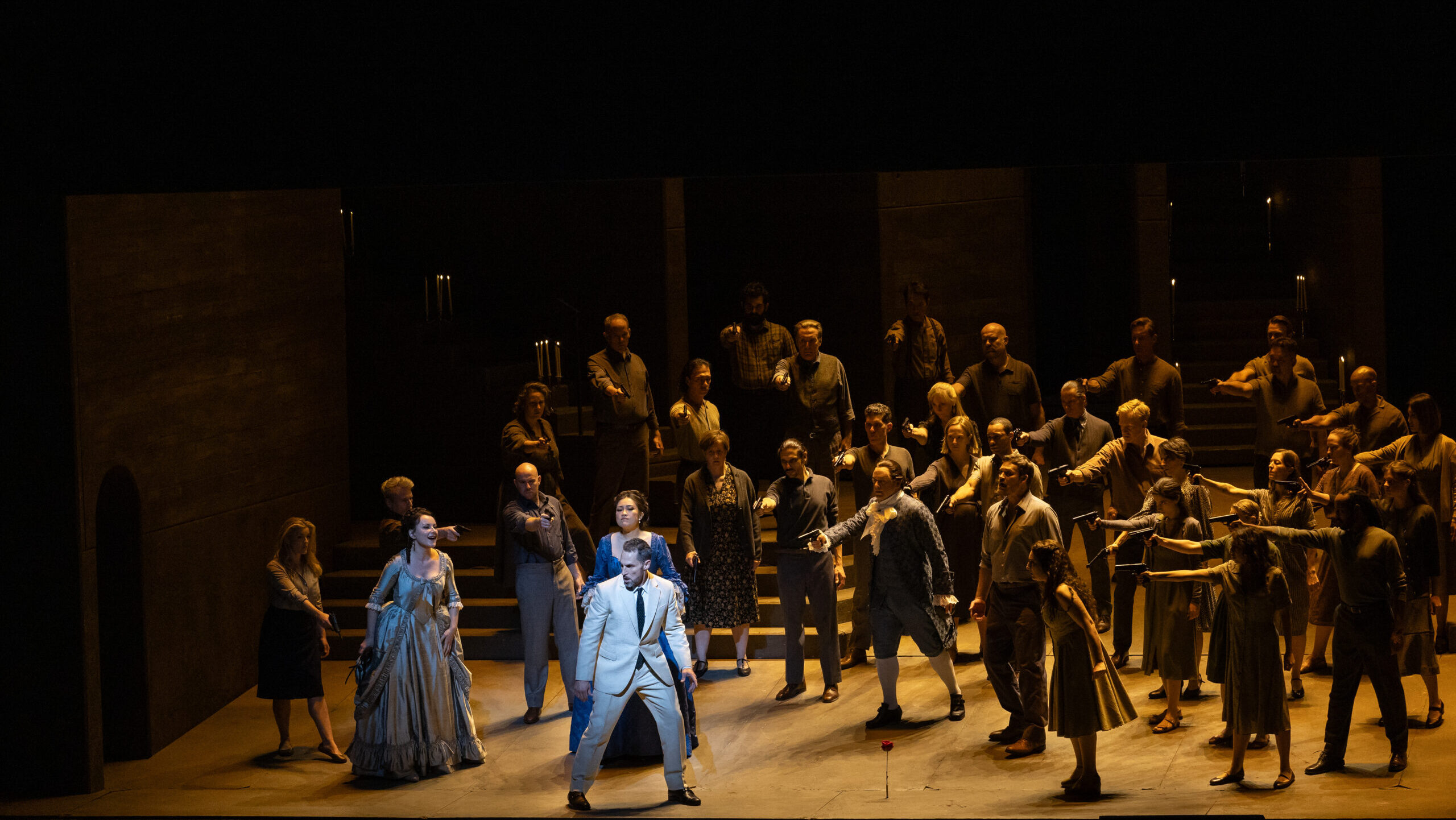
The annual Richard Tucker Gala is probably the event of the year to indulge your love of verismo staples and can belto screaming.
Simply put, Christine Goerke is a stupendous Elektra.
One Saturday afternoon during my freshman year in college, Richard Strauss’s Elektra made me fall in love with Ursula Schröder-Feinen—or maybe vice versa.
Would exciting American dramatic soprano Christine Goerke be the next great ice-princess we have been waiting for?
I think the sturdier of you will enjoy Nina Stemme’s Elektra from Saturday night at Wiener Staatsoper.
James Levine turns 72 this year. Even though his health has improved considerably in the past year and he may continue to conduct for a decade or more, it seems inevitable that he will step down as the Met’s Music Director sometime in the next few years to assume the role of Conductor Laureate.
None of my previous Elektra experiences prepared me for this stunning, overwhelming performance from the Festival d’Aix-en-Provence.
“Conduct Salome and Elektra as if they were by Mendelssohn: Fairy music.” Seriously, how often has that happened?
Coming as Peter Gelb did from the music industry, opera lovers hoped that he would display a more distinctive knack for casting and an improved talent pipeline than Joe Volpe offered during the waning years of his tenure.
We were not at Carnegie Hall to hear superb opera singers bestow their vocalism upon Alban Berg’s Wozzeck; we are there to hear the Wiener Staatsoper’s house band work their magic upon an intricate, spooky, devastating score.
Each year, Leon Botstein leads the American Symphony Orchestra in a concert opera or two.
Sergey Taneyev, pupil of Tchaikovsky and teacher of Scriabin and Rachmaninov, composed just one opera, Oresteia, premiered in 1895 when he was 39.
When people talk about an opera “production,” they tend to mean “the sets and costumes,” that is, the physical production.
De Nederlandse Opera’s remarkable 2011 feat of premiering productions of Gluck’s Iphigénie en Aulide and Iphigénie en Tauride on the same day and virtually the same set has been issued on a 2-DVD set by Opus Arte.
The Met has finally released the contents of the James Levine 40th Anniversary box sets separately for those of us who didn’t have $500 lying around.
In 1967, Rolf Liebermann , General Manager of the Hamburg State Operas, undertook to produce 13 operas for television, securing the Hamburg-based film and television company Polyphon Film und Fernsehgesellschaft to record the productions with the original Hamburg casts. The director Joachim Hess adapted the stage productions for the requirements of television. The second of…
La Cieca was just sent an announcement about “James Levine: 40 Years at The Metropolitan Opera, an extraordinary insider’s view of the legendary conductor’s Met career, illustrated with vivid historic photographs…. Marking the 40th anniversary of Met Music Director James Levine’s company debut on June 5, 1971, the book celebrates his unparalleled artistic achievements through…
Is it possible for a performance of Richard Strauss’s Elektra to be exciting without an exciting Elektra? It of course depends on your priorities and expectations, which will ultimately determine whether such a performance, as preserved on this DVD from Baden-Baden is for you. Linda Watson’s first assumption of the punishing role of Elektra (she…
The relative obscurity of Karol Szymanowski‘s Krol Roger (King Roger, 1924) can only be blamed on its being in Polish. The music is often as thrilling as anything by Janácek or Bartók, and the libretto by Jaroslow Iwaszkiewicz (heavily adapted by the composer) is as full of provocative philosophical ideas as operas by those composers…
James Levine: Celebrating 40 Years at the Met includes not only unreleased video performances on DVD but also live radio broadcasts on CD. This performance is one of the latter, originally heard April 19, 2003. The Rake’s Progress has one of the greatest operatic pedigrees of all time. It was inspired by a series of…
Richard Strauss’s brilliantly disturbing Elektra was first performed at the Dresden State Opera in 1909, and arrived in America in 1910 at the Manhattan Opera House. A second American premiere, this time in the original German, was in Philadelphia in 1931 with – and this will kill you – Nelson Eddy as Orestes. Along with…
Blazing Jupiter, the Jovial Star, my personal magical azimuth, plus Perseid meteors wafting about, burning out as do our souls, as we arrived home from Seattle Opera’s new production of Tristan und Isolde.
Siegfried Wagner ‘s 1903 opera Der Kobold (The Goblin) is a fascinating yet infuriating work. It often seems as if both music and libretto were written by a committee that couldn’t come to agreement. The plot structure careens wildly from realism to mysticism to symbolism; the music hops from style to style and influence to…
I was there in the house and it was a good night. I still think that Mattila and the production were fresher in 2004 with a wider range of colors and dynamics. However, she didn’t sound frayed or at the end of her rope. Some of the louder high notes can get a blanched quality…
Tell us: Filth or dementia?
Hasten thee to feed another quarter of conversation for The Talk of the Town!
Sign up for our free Newsletter.
Support Parterre Box
Donate to keep opera's liveliest publication free and independent. No paywalls, no institutional backing, no bootlicking.
Get our free newsletter
Opera's top reads delivered to your email weekly…ish.
Join over 100k readers.
The best opera magazine on the web.
Reviews, breaking news, critical essays, and brainrot commentary on opera from those demented enough to love it.
Essentials
Copyright © 2026 Parterre Box.
All rights reserved.
Registration or use of this site constitutes acceptance of our Terms & Conditions and our Privacy Policy. Do Not Sell or Share My Personal Information.
Sign up for Parterre’s free newsletter.
Exclusive opera reviews, commentary, and top reads
delivered to your email weekly…ish.