
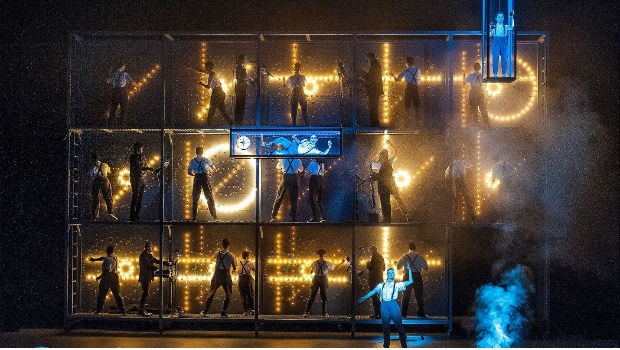
Short answer: yes. But let’s begin by dismissing the a blatant canard. One thing that the Metropolitan Opera does not need to do is to scale back the number of performances in a season.
For one week every two years since 1981 the eyes—and ears—of those interested in period performance turn to the Boston Early Music Festival, particularly to its opera centerpiece, but that organization doesn’t rest on its laurels in between festivals.
Lincoln Center hosted two milestones this week.
Is there anything more essentially operatic than the suffering of women?
In the program for Opera Omnia’s production of Monteverdi’s Il ritorno di Ulisse, Crystal Manich, the company’s stage director, speaks of producing “baroque works in non-traditional ways.”
You have only until Sunday to catch the most heart-breaking moments seen on New York City operatic stages this season.
Like Miss Adelaide the well-known fiancée in Guys and Dolls, the New York City Opera may be down but she’s not flat as all that.
Cecilia Bartoli and Joyce DiDonato are not the only ladies who have recorded recitals this year featuring music from the 17th and 18th centuries.
If you’re the sort who prefers his diva to be an unapproachable sphinx prone to infuriating cancellations while radiating ennui, I suspect that the sunny, hard-working, grateful persona of American mezzo soprano Joyce DiDonato will not appeal to you at all.
“Is a work an opera simply because its creators choose to call it one?”
After 23 years, the Queen of Carthage has finally made it to Manhattan.
Is the threnody, the lament over a beloved corpse, the oldest form of song? Surely it is among the oldest; one of the most widespread and stylistically various, millennia before opera was devised.
Janácek’s Makropulos Case has only chalked up thirteen performances in three previous runs at the Met and will have just five more this season. Try to catch at least one.
“Hey the line forms, on the right dear / Now that Macheath’s back in town / You’d better lock your doors, and call the law / Because Macheath’s back in town.” So concludes Marc Blitzstein’s famous English translation of the song that opens Die Dreigroschenoper.
Every year New York City opera-lovers eagerly anticipate the autumn because it means that summer is finally over and we can get back to serious opera-going, and this September promises “The Battle of the A’s.”
Handel’s Orlando is one of three operas Handel based on episodes from Ariosto’s best-selling sixteenth-century epic, Orlando Furioso. The story was, in 1733, well known throughout the Mediterranean world, and everyone set it to music—Vivaldi’s and Haydn’s settings have enjoyed recent revivals, and the libretto Handel set had originally been devised for Domenico Scarlatti. Intricate…
La Cieca was cced the following letter sent by a “long-time patron of NYCO” in response to “the recently received Subscription Renewal Brochure.” She has withheld the patron’s name by request.
Despite baby-steps over the years, America’s musical scene, especially opera, remains decidedly un-HIP. (HIP: “historically-informed performance,” also called “period performance.”) While European opera houses turn increasingly to “original instrument” orchestras and specialist singers for seventeenth and eighteenth century works, this rarely occurs in the US.
Cher public, who else but La Cieca brings you such in-depth arts coverage that you get not one but two reports from spies at the dress rehearsal of the Met’s new La Damnation de Faust ? After the jump, eyewitness accounts of the Lepagerie from Our Own Gualtier Maldè and Sanford.Â
Just imagine! The legend herself, Anja Silja taking time out of a busy rehearsal schedule (and despite her concern about the orchestra, problematic in early runthroughs)—to talk to parterre box. I confess I imagined she would be at least a little bit like her character of Emilia Marty—cynical, burned out, impatient. What a surprise, then,…
Tell us: Filth or dementia?
Hasten thee to feed another quarter of conversation for The Talk of the Town!
Sign up for our free Newsletter.
Support Parterre Box
Donate to keep opera's liveliest publication free and independent. No paywalls, no institutional backing, no bootlicking.
Get our free newsletter
Opera's top reads delivered to your email weekly…ish.
Join over 100k readers.
The best opera magazine on the web.
Reviews, breaking news, critical essays, and brainrot commentary on opera from those demented enough to love it.
Essentials
Copyright © 2026 Parterre Box.
All rights reserved.
Registration or use of this site constitutes acceptance of our Terms & Conditions and our Privacy Policy.
Sign up for Parterre’s free newsletter.
Exclusive opera reviews, commentary, and top reads
delivered to your email weekly…ish.