Come sail away with me
On the heels of Christopher Nolan’s blockbuster film adaptation, John Danaher muses on operatic iterations of Homer’s Odyssey.
 By
John Danaher
By
John Danaher
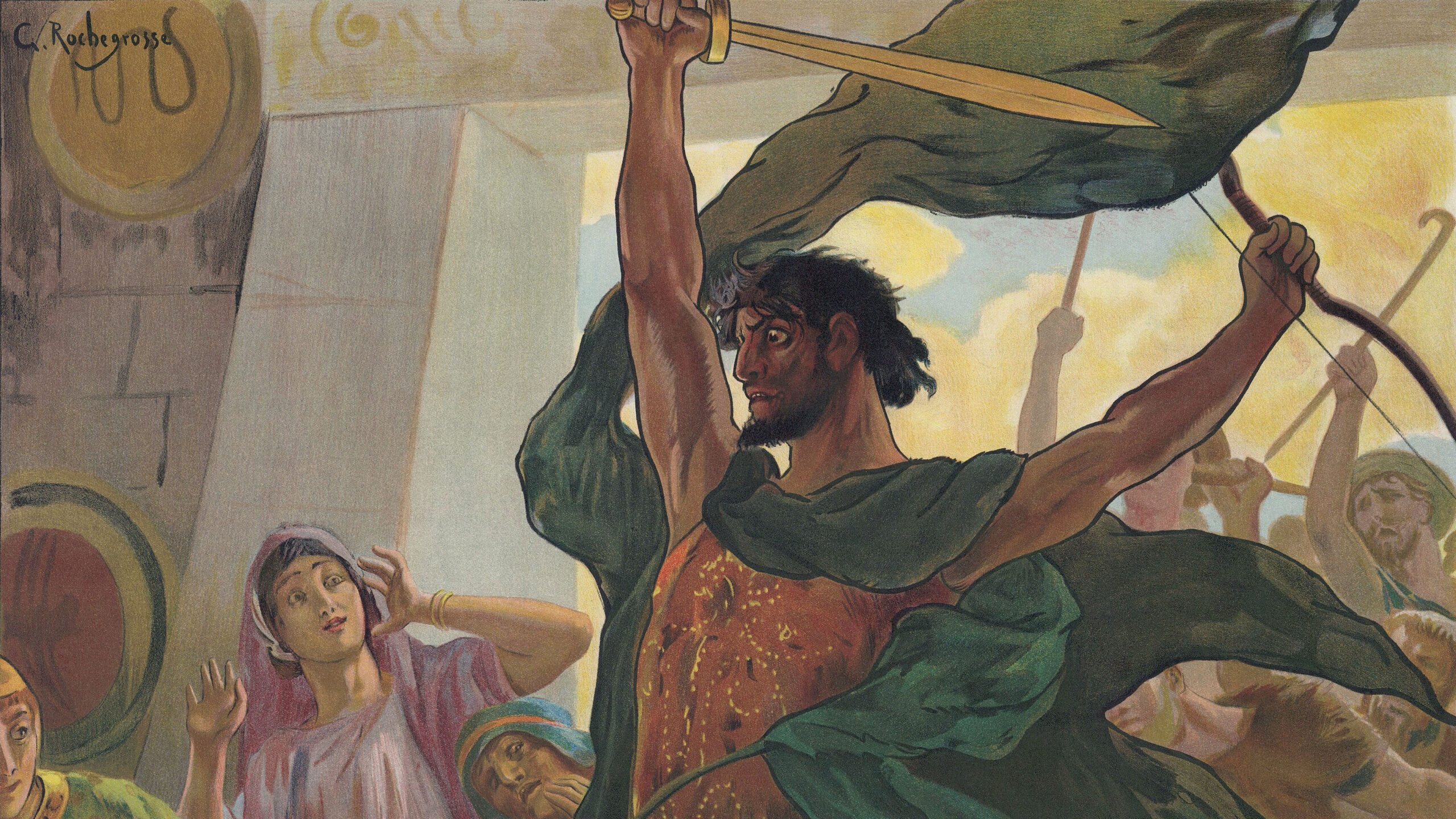
Portion of poster by Georges Rochegrosse for René Fauchois and Gabriel Fauré’s Pénélope, used for the Paris première at the Théâtre des Champs-Elysées which premièred on 10 May 1913.
It has been the summer of The Odyssey. By most measures, Christopher Nolan’s film inspired by Homer’s two-thousand-eight-hundred-year-old epic poem has been a smashing success. The movie grossed over $1 billion in its first ten days of release and it has more than recouped the reported $250 million it cost to make. Tens of thousands of theater goers have seen it, and I can report that here in Chicago, 7:00 A.M.—that’s not a typo—screenings were routinely sold out. Those who work in other art forms, including opera, would kill for a tiny fraction of that enthusiasm.
Some critics, including esteemed classical scholars, have been more muted in their ardor for Nolan’s Odyssey than the general public. Writing in The New York Review of Books, Daniel Mendelsohn, a recent translator of The Odyssey, points out the difficulty of compressing a twelve-thousand-plus-line epic that utilizes a complex narrative structure (“stories within stories”) into a two- or three-hour presentation. Choices must be made about what elements of the story to include, to add to, and to cut. Sound familiar, opera fans?
The classicist Emily Wilson’s translation of The Odyssey was justly celebrated for its innovative approach—using English blank verse in place of the original Greek dactylic hexameter—when it was published in 2017. It has now sold a jaw-dropping one million copies, many as a result of the film. In her review for The London Review of Books which achieved virality online, Wilson takes issue with Nolan’s aesthetic: the film “lacks many of the elements that make the poem great. It has nothing to say about time, memory, history or about the relationship between one warrior’s glorious return and the lives of his family, friends, and neighbors.” Most devastatingly, she writes that it “lacks psychological, emotional, and ethical depth. None of the characters has convincing motivation for their actions or words.”
Wilson is, in essence, outlining what is required of a great adaptation of Homer’s Odyssey. As opera fans well know, composers and librettists have been wrestling with the material of The Odyssey for over four hundred years. They have been making choices on how to shape Homer’s narrative, how and where to take creative license with it, and most importantly how to use the combination of words and music to imbue Homer’s characters with psychological and emotional depth. What follows is a brief survey of operas based on The Odyssey and how composers used the material to reflect their own times.
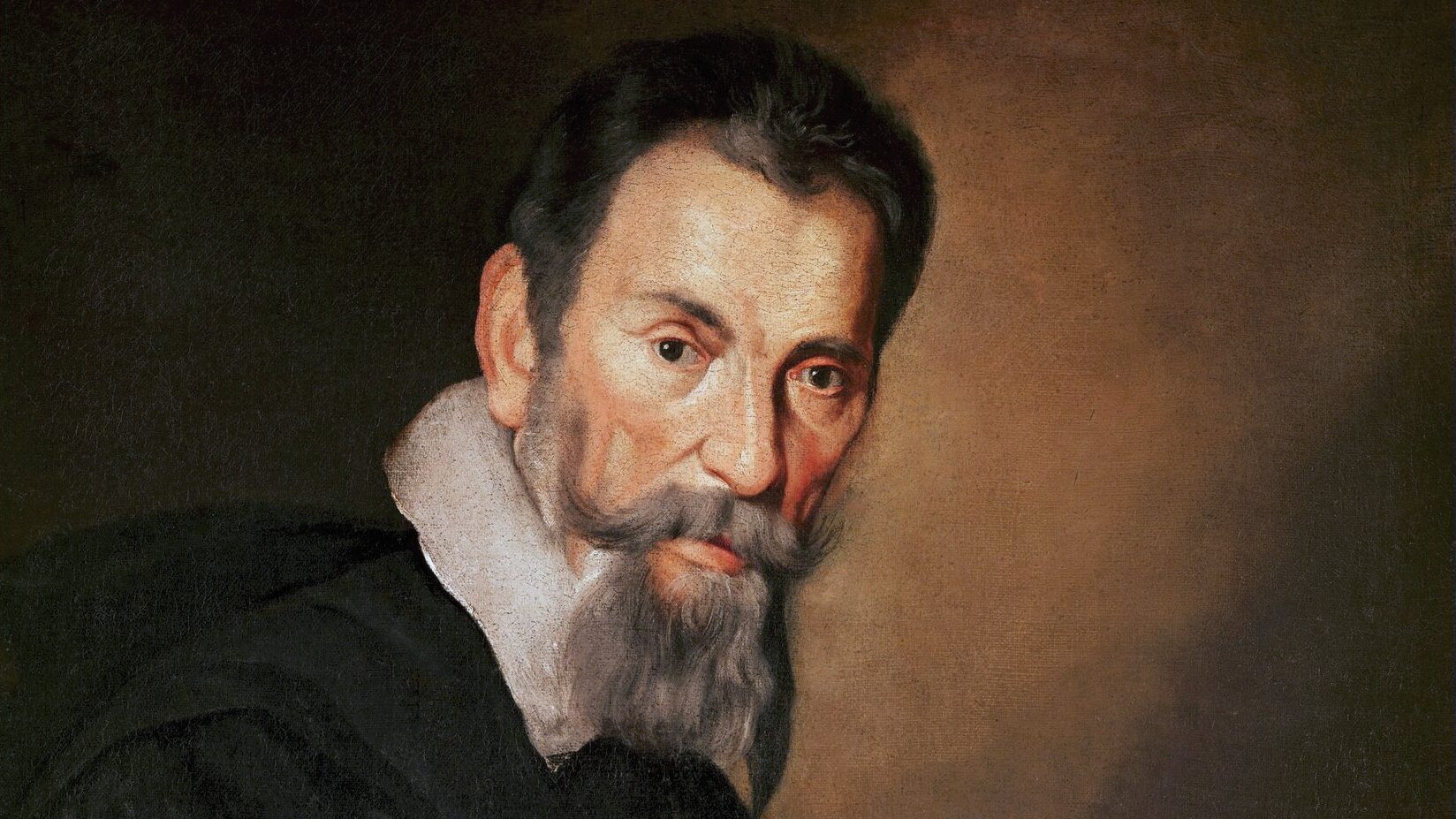
Composer Claudio Monteverdi
We begin at the beginning of opera: Claudio Monteverdi composed Il ritorno d’Ulisse in patria (The Return of Ulysses to his Homeland) for the Teatro Santi Giovanni e Paolo in Venice in 1640. Its initial run was ten performances, a blockbuster for the seventeenth century. He had written his groundbreaking L’Orfeo over thirty years before. He was seventy-three years old, positively ancient in that era, and in the midst of a late-career creative resurgence that would be later duplicated by his spiritual descendent Giuseppe Verdi.
A complete version of Il ritorno does not survive. An eighteenth-century copy of the musical score in three Acts and at least nine versions of the libretto in five Acts by Giacomo Badoaro do survive. Badoaro faced the same issue as Nolan in terms of compression, and he chose to adhere faithfully-ish to Books XIII through XXIII which recount the hero’s return to Ithaca disguised as a beggar, his gradual recognition first by his old dog Argos, then by his servants, and finally by his ever-faithful wife Penelope. Ulysses (the Latinized version of the Greek Odysseus) slays the suitors who have been urging Penelope to remarry in his absence. Thus the story of Ulysses’s ten years of wandering and the adversity he encountered during that time—his escapes from the one-eyed Cyclops, the witch Circe, and the monsters Scylla and Charybdis—is omitted. Badoaro added the characters of Human Frailty, Time, Fortune, and Love that reinforce the opera’s theme of the rewards of virtue and provide some moral and ethical motivation that Wilson found lacking from Nolan’s film.
Il ritorno was “lost” for over two hundred years. The disconnect between the rediscovered three-Act score and the multiplicity of librettos mandate even more choices to make a performable version of Monteverdi’s masterpiece. Twentieth-century composers tried their hands at reconstructing Monteverdi’s work for performance: Vincent d’Indy in Paris, 1926; Luigi Dallapiccola in Florence, 1942; and Hans Werner Henze in Salzburg, 1985 amongst others. Meanwhile, the conductor/scholars we credit for the Baroque revival pressed their prodigious talents in service to Monteverdi. Nikolaus Harnoncourt, Raymond Leppard, John Eliot Gardiner, and William Christie all performed and recorded Il ritorno.
After the opening prologue, the long-suffering faithful Penelope sings an intense lament “De misera regina,” here from Gardiner’s 2017 recording:
When I hear the crisp articulation of every syllable by this cast, in this example by soprano Lucile Richardot, I am transformed into a Venetian native. She sings convincingly that she believes the cause of the Trojan War was a righteous one (“A ragion arse Troia, poiché l’Amor impuro”–Troy burned justly, for impure love), yet she is incredulous that it has taken Ulysses so long to return to her and indeed doubts that he will return (“Ogni partenza attende desiato ritorno tu sol del tuo tornar perdesti il giorno.”–Every departure longingly awaits a return, you alone have lost your day of returning.)
The complexity of Penelope’s emotions rings true and provides the basis for her skepticism that it is Ulysses who returns and slays the suitors (offstage). Her disbelief gives way only gradually, building toward their final sensuous love duet with Furio Zanasi as Ulysses:
The trauma suffered by Monteverdi’s principals is to be forgotten–we might say repressed. The time for happiness and rejoicing has come. In Il ritorno, then, we have a portion of The Odyssey that tracks fairly closely to the original, but with a commitment to exploring the emotions of the human characters through words and music that reveal both the power and the contradictions inherent in each.
One scene from Nolan’s movie that has been near-universally praised is when the witch Circe turns Odysseus’s men into pigs as they gluttonously devour the hospitality she provides them. In Book X of The Odyssey, Odysseus persuades Circe to change them back into men. Circe and Odysseus become lovers, and he and his men remain on her island (Aeaea) for a year, further delaying his return to Ithaca.
It is curious, then, that Christoph Willibald Gluck chose to loosely base his 1765 opera Telemaco, ossia L’isola di Circe on this brief adulterous episode as it was written to celebrate the marriage of the future Emperor Joseph II. “Loosely” is doing some heavy lifting here; the librettist Marco Coltellini borrowed material from an earlier opera by Alessandro Scarlatti, and that work was likely influenced by an even earlier piece of “fan-fiction” written by the French courtier François Fénelon. As the title suggests, Odysseus’s son Telemachus is a major character. He helps rescue his father from a jealous but chaste Circe and marries Circe’s slave Asteria. Of course, none of this is in Homer.
Madeline Miller recently reshaped the this episode in her bestselling novel Circe from 2018. Alas Gluck’s Telemaco was not a success: it received just two performances, was lost for many years, and it remains a rarity. However, it is Gluck, and so it can’t be all bad. Here is Circe’s Act I aria passionately sung by Valentina Farcas in Vienna in 2012:
Musicologists categorize Telemaco as a transitional opera, a way station in between Gluck’s more famous Orfeo ed Euridice (1762) and Alceste (1767). Timing and the inappropriateness of the material for a wedding likely doomed Telemaco from the start. This would not dissuade future composers from taking up the Homeric material and reshaping it to fit their artistic vision. But it would be a while.
It is notable that the great nineteenth-century composers avoided Homer’s Odyssey. At the risk of indulging in uninformed speculation and broad generalization, perhaps they found The Odyssey insufficiently dramatic. Odysseus’s numerous adventures would be difficult to stage and might not hold an opera audience’s attention. The reunification of Odysseus and Penelope ends happily—so there is no opportunity for the soprano to die. This, coupled with the mood of the age–the death or dying of God or the gods and the trend towards realism that would find its expression in verismo–surely contributed to the absence of Homeric operas. One exception-ish: Berlioz famously explored the destruction of Troy in Les Troyens, but his source was Virgil’s Aeneid, not Homer.

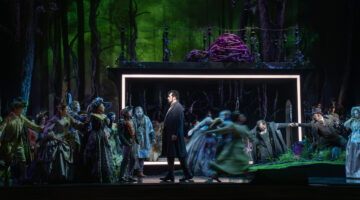
A scene from Fauré’s Pénélope at the Bayerische Staatsoper in 2025 / Photo: Bernd Uhlig
Then, somewhat surprisingly, Gabriel Fauré presented his only opera, Pénélope, in Monte Carlo in 1913. He had already written some sublime music for the human voice in his Requiem (1900) and in dozens of exquisitely crafted art songs. Like Monteverdi, Fauré was nearing the end of his storied career. Like Monteverdi, too, he and his librettist René Fauchois focused on the reunion of Ulysses and Penelope, but from Penelope’s perspective. Musically innovative, Fauré composed in a “song-opera” style, eschewing both the traditional recitative-aria structure and the Wagnerian continuous melody. I hear the debt to Debussy’s Pelléas, as Montagu James did in his review of the Bayerische Staatsoper production from last year.
Here is Penelope’s lament from Act I with the incandescent Jessye Norman conducted by Charles Dutoit from 1982. Regal queen indeed!
As in Monteverdi, the emotion and motivation missing from Nolan’s movie is present here in abundance.
Ulysses! Proud husband! Light in which my beauty has fully blossomed!
Ulysses! Gentle warrior! Voice constantly heard yet always unheard!
Ulysses! Tender heart! Master to whom I have given the treasures of my grace!
Here is the final thrilling love duet with tenor Alain Vanzo as Ulysse:
In my view this opera is vastly underappreciated. Clocking in at just over two hours, and full of gorgeous music for both orchestra and voice, it should have been an enduring hit. Some speculate that timing prevented it from entering the repertory; its Paris premiere would be overshadowed by the earthquake that was Stravinsky’s Rite of Spring; and by the time it was revived after the war, the public had moved on. Perhaps riding on the popularity of the film, surely an enterprising company can conceive a compelling production to enshrine this masterpiece in its rightful place?
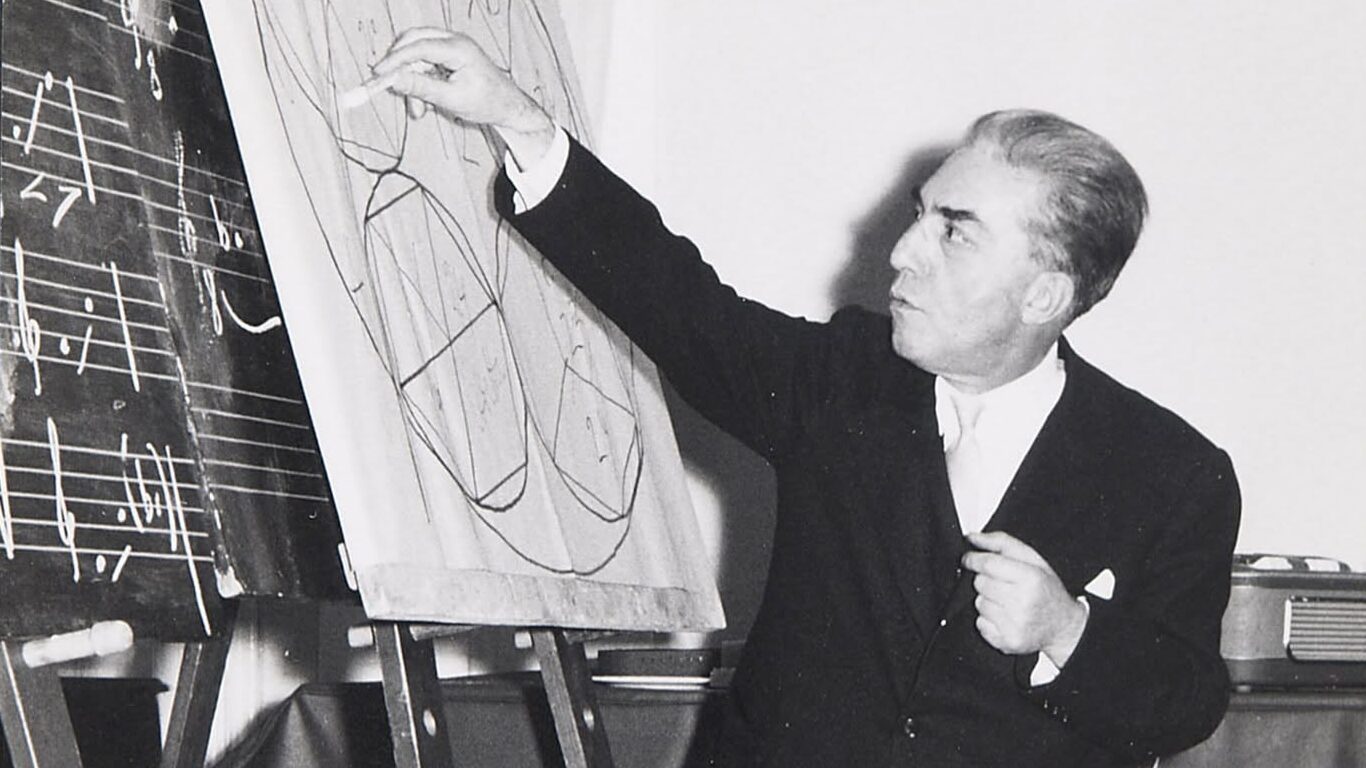
Composer Luigi Dallapiccola
The Odyssey would become a metaphor for modern man’s futile search for meaning in Luigi Dallapiccola’s only full-length opera Ulisse (1968), written in strict twelve-tone series. Ben Earle has written authoritatively about this opera in his review of an Oper Frankfurt production from 2022. I mentioned earlier that Dallapiccola had produced a performing version of Monteverdi’s Il Ritorno in 1942, and he worked obsessively on Ulisse for over a decade. He alone among the composers discussed compressed almost all of The Odyssey into a prologue and two Acts.
His take is bleak: the female roles are doubled, so that Calypso, with whom Odysseus spends seven years enjoying drugs and sex, and Penelope are sung by the same soprano, implying that there’s no difference between them. I can’t give a sample of Penelope’s lament or a rapturous reunion aria because there are none; Ulisse and Penelope don’t acknowledge one another. The music meanders around as Odysseus did on the wine-dark sea and lacks resolution.
Interestingly, Dallapiccola chose to depart from Homer for the ending. Following Dante’s creative reimagining in Inferno Canto 26, Odysseus does not end his journey on Ithaca. He instead sails west, toward what was the end of the earth:
neither my fondness for my son nor pity
for my old father nor the love I owed
Penelope, which would have gladdened her,was able to defeat in me the longing
I had to gain experience of the world
and of the vices and the worth of men.
Here is the epilogue of Dallapiccola’s Ulisse from a 1975 recording with Claudio Desderi in the title role:
Perhaps not easy listening, but a compelling final coda to a modernist take on Homer: you can never go home again.
And so we end where we began: Christopher Nolan, too, relies on Dante’s remorseful ending for his film. Odysseus, in this case with his regal wife Penelope, boards a ship to sail away from Ithaca. So, too, does Nolan opt for permanent exile.
Composers have for over four hundred years molded Homer’s timeless story of a long journey home. With varying degrees of success, they provided emotional depth and motivation for the characters of The Odyssey, something perhaps missing from Nolan’s film. What can be said for certain is that the composers and librettists who continue to engage creatively with Homer’s ancient text will undoubtedly also be saying something about their own times.
John Danaher
John Danaher lives in Naples, FL, where he has retired to read all of the books he was supposed to read in college. He attended a performance of Rigoletto at the New York City Opera when he was ten years old and was hooked: “Why are they putting that lady in a bag,” he asked as Gilda was being abducted. John’s live opera highlight was seeing the legendary Leonie Rysanek at the Metropolitan Opera in the role of Kostelnicka in Janacek’s Jenufa—the house almost literally was brought down. He enjoys tennis and traveling, catching opera performances on the road whenever he can.
-
Topics: feature, the odyssey
-
People: Christoph Willbald Gluck, Claudio Monteverdi, Gabriel Fauré, Luigi Dallapiccola
-
Works: ossia L’isola di Circe, Pénélope, Ulisse