Song matters
John Yohalem reviews pianist Steven Blier‘s warm, witty, and worldly autobiography, From Ear to Ear.
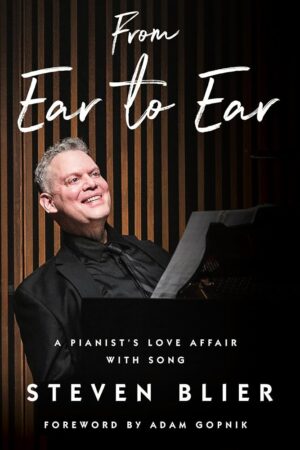
You will want to have YouTube or something like that close by when you read Steven Blier’s memoir, because he has accompanied several thousand songs, claims to remember all of them (to differing degree) and mentions a couple hundred of them, along with the singers he coached to sing them for his New York Festival of Song (NYFOS – about to begin its thirty-ninth year) or for some other recital, concert, occasion.
You will want to have been there when he got a huge mouthed “THANK YOU!” on TV from Jessye Norman or when he told Lorraine Hunt Lieberson, after a long private evening à trois, “A lifetime isn’t enough to make music with you,” or when Paul Appleby or Susan Graham got him through a rough patch or when he nearly strangled Martha Schlamme in the back of a taxi. But you can’t be there, except by reading this graceful memoir. You can, however, track down the songs, sometimes as performed by those very singers. Duparc, Granados, Weill, Sondheim, Schubert, Beatles, Mussorgsky.
And the concerts continue, and they remain charming, graceful, well-informed, jubilant – like the man. Blier began with a child’s passion for Gilbert & Sullivan and Broadway (just like me!), but he was also an early pianist with a terrific ear, a knack for picking out and picking up any tune at all. This made him very useful to anyone who wanted to sing them – or merely to produce singers, like Matthew Epstein, a friend since their teens. Steve was not sure how to apply his gifts, or what studies should direct and improve them, but Matthew’s strong opinions in the matter were helpful.
Eventually, after a scattershot academic career at Yale and elsewhere, Steve allowed several artists to make use of him, figuring out what to study and what to avoid (“Am I Too Loud?” as Gerald Moore would say) – or too rhythmic – or where to insert a ritard – and when not to do so – when they wanted him to follow and when they wanted him to lead. He picked up experience. It all seems far more obvious, more linear in the memoir than it felt while he was living through it, but even the awkward experiences are told gracefully and wittily, and the love notes – to Patricia Brooks, to Bernarda Fink, to William Bolcom and Joan Morris, to Martha Schlamme, to certain professors – are themselves charming.
If you’ve been to some of the four or five annual NYFOS concerts, you are familiar with the graceful Blier style of introducing rare repertory, as well as his accompanying, and his literate and readable program notes. The program notes will prepare you for this book. Blier, dubious on the question, was cornered by an editor from Norton who had read them and told him he could certainly write a book: “Just do it as a series of essays, in your program note style, on fifteen topics.” That the story is narrated with breezy charm, erudition worn lightly as a flower in the buttonhole, entertaining anecdotes and character sketches, will surprise no one familiar with the concerts. Music sends him into ecstasies, but he also thrills to a witty or poetic lyric, and tales of the composers who have put all this together, and his salutes to this or that national school or style.
The elephant in the wheelchair is his bodily health, and here too he is entertaining, beginning with his youthful fascination with Strephon the half-fairy shepherd in Iolanthe, whose top half is immortal while his mortal lower half ages. That leads him into a discussion of Muscular Dystrophy, the incurable and hereditary degenerative disease that also took his mother. Stephen devotes a chapter to facing the truth after years of denial and a lot of falls on the sidewalks of New York, and another to his experiments with canes, walkers, scooters and chairs, and how supportive and helpful friends, close and distant, have been – and on finding a handsome husband despite it all. These chapters are as witty and cheerful as the musical pilgrimage. Blier’s sunny natural temperament conquers all.
In his book, Blier presents his life as a series of interests (not to say passions) and a series of puzzles: how to present this or that, how to learn to be indispensable, how to relate to the singer who is nervous, distracted, shallow, grandiose, stuck in her or his ways, unfamiliar with the style or the language or the dramatic pose or the whole notion of poetry: how to seduce them into accepting his advice or how to hold himself back when he perceives their dramatic core. And with each step of his path, he describes the teachers (pianists, vocal coaches, singers, actors) who taught him, often simply by example, how to build a career on his skills.
“While I was initially put off by Dan Ferro’s Olympian hauteur…, I soon realized I had arrived at the inner sanctum of singing, an honor offered only to a select few. Dan taught me to hear, an aural education no normal curriculum could have supplied. … Over time I began to grasp how his spells worked – the subtle ways that sounds could be thinned, amplified, rounded, deepened, lightened, or darkened.”
“What I did not understand was how much I was learning from [accompanying] Martha. Even as I was trying to wriggle free, she was providing the greatest gifts a mentor can offer: a clear set of ideals and what amounted to a user’s manual for artistic intuition.”
“When Joan Morris told her audience, ‘That song premiered in 1924 – no, wait 1923 – yeah, ’23,’ that small correction set off an explosion in my brain. How amazing to know such a fact! And for one year to matter! In a single flash I realized that everything you can find out about a song matters. Each one – whether a Schubert Lied or a vaudeville strut – has a story that leads you to the heart of the song.”
“When interviewers ask who controls the ensemble, singer or pianist, the standard answer is, ‘Of course it’s a duet, and each person plays an equal part in the artistic process.’ Sure, that’s the Platonic ideal, but the real answer is more Marxist: the person who writes the checks has the last word. At NYFOS I was in charge of the payroll and the casting. As a result, I felt musically generous, released and confident. I couldn’t be fired.”
Real divas, the sort who hired him rather than the reverse, were a law unto themselves, a law he was obliged to practice as entirely as musical lore. “After the song, I stood up from the piano and [Evelyn Lear] took my hand in what I think of as ‘the diva-clutch,’ no doubt a move perfected to control overweening tenors at the Met. Squeezing my knuckles together with the force of a pair of pliers, she pulled me down in a joint bow. There I was, eyeballing the floor of Carnegie Hall with a seventy-four-year-old soprano at my side and no idea how I would get my body back to a standing position.”
So: This is a collection of pleasing anecdotes, but the anecdotes, like the items in a song cycle, are all crafted to appeal to us and to lead us in a particular direction, the artistic and sentimental education of a craftsman of producing and accompanying song.
John Yohalem
John Yohalem's critical writings have appeared in the New York Times Book Review, American Theater, Opera News, the Seattle Weekly, Christopher Street, Opera Today, Musical America and Enchanté: The Journal for the Urbane Pagan, among other publications. He claims to have attended 628 different operatic works (not to mention forty operettas), but others who were present are not sure they spotted him. What fascinates him, besides the links between operatic event and contemporary history, is how the operatic machine works: How voice and music and the ritual experience of theater interact to produce something beyond itself. He is writing a book on Shamanic Opera-Going.
-
Topics: book review, nyfos
-
People: Steven Blier