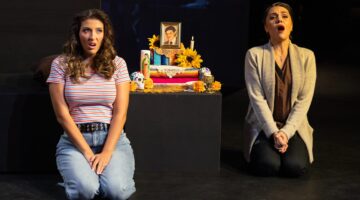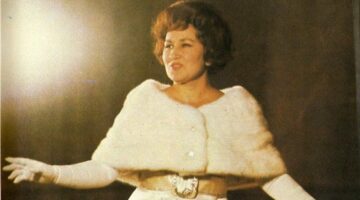
Here is who I am now
Julia Bullock on ten years of living with the life and artistry of Joséphine Baker before Paris performances of Perle Noire: Meditations for Joséphine
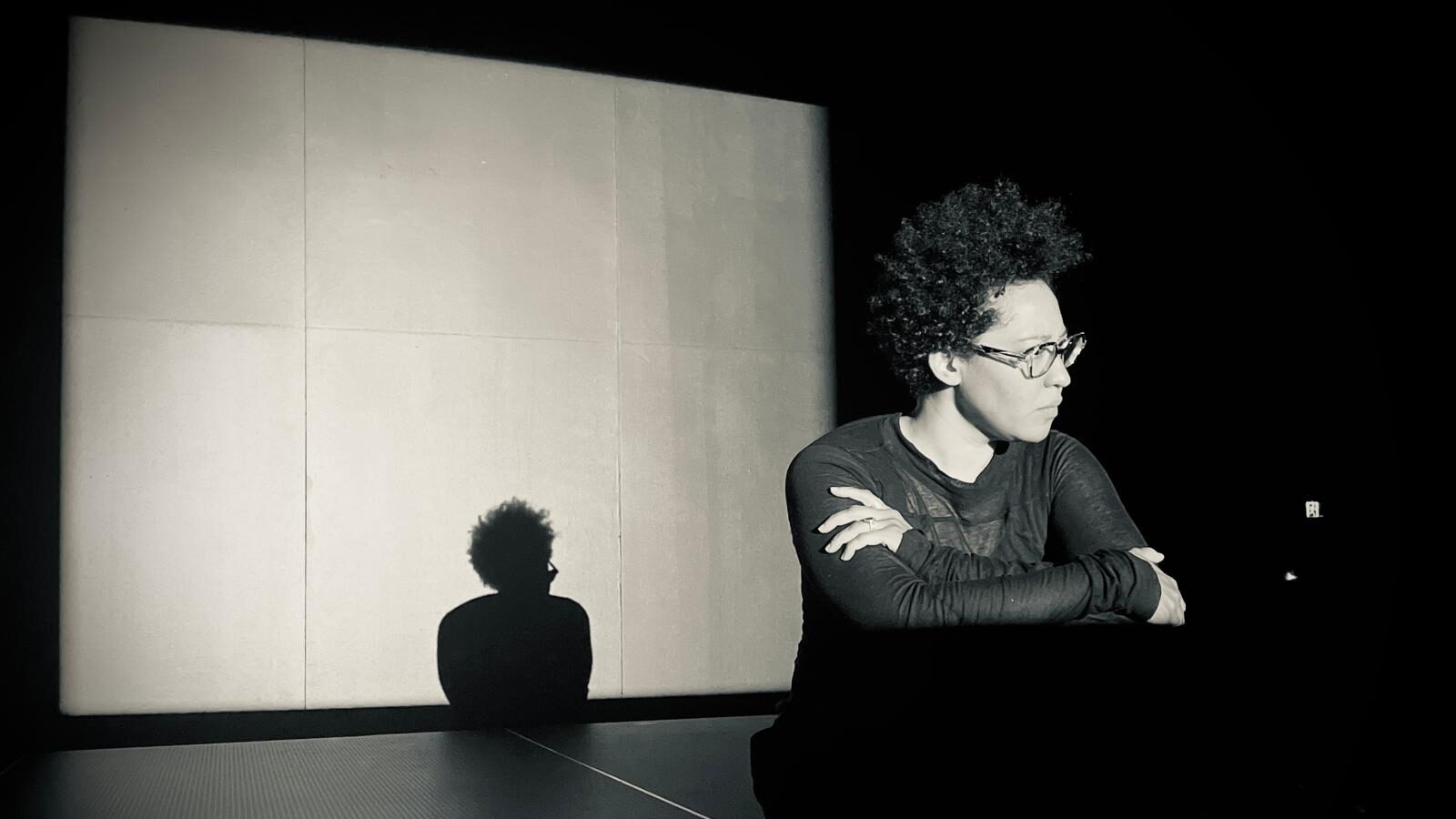
Soprano Julia Bullock in rehearsals for Perle noire: Meditations for Joséphine at the Adelaide Festival / Photo: Jennifer Curtis
The first time I sang publicly in Paris, I was still a student at Juilliard. Afterwards, an elegant woman in the audience raced up to me and gushed effusively, “Watching you sing classical French music is like watching a jaguar walk a fashion design runway.”
Despite the potentially dehumanizing nature of statements like this, I no longer fret after hearing these types of comparisons — I’ve been forced to process comments in this vein, and the people who deign to utter them, since childhood. But charging into the environment of Perle Noire: Meditations for Joséphine, like we have in Paris this month, is an acknowledgement of my complete intelligence as a human animal. I don’t deny myself the pleasure of that, nor shy away from it — just as the singer, dancer, actress, and activist Joséphine Baker never did.
Perle Noire: Meditations for Joséphine, which I’m currently rehearsing at Opéra de Paris with director Peter Sellars and composer Tyshawn Sorey, is based on shared realities like this, not private or theoretical experiences. And each time we have the opportunity to put this concert together again, it enables us to edit and re-edit elements of the piece that have evolved with us over the past decade — from the spoken text, to the instrumental and sung music, to the movement and dance. And while I’ve written about the general development of this piece in program notes available on my website, I feel compelled to share more.
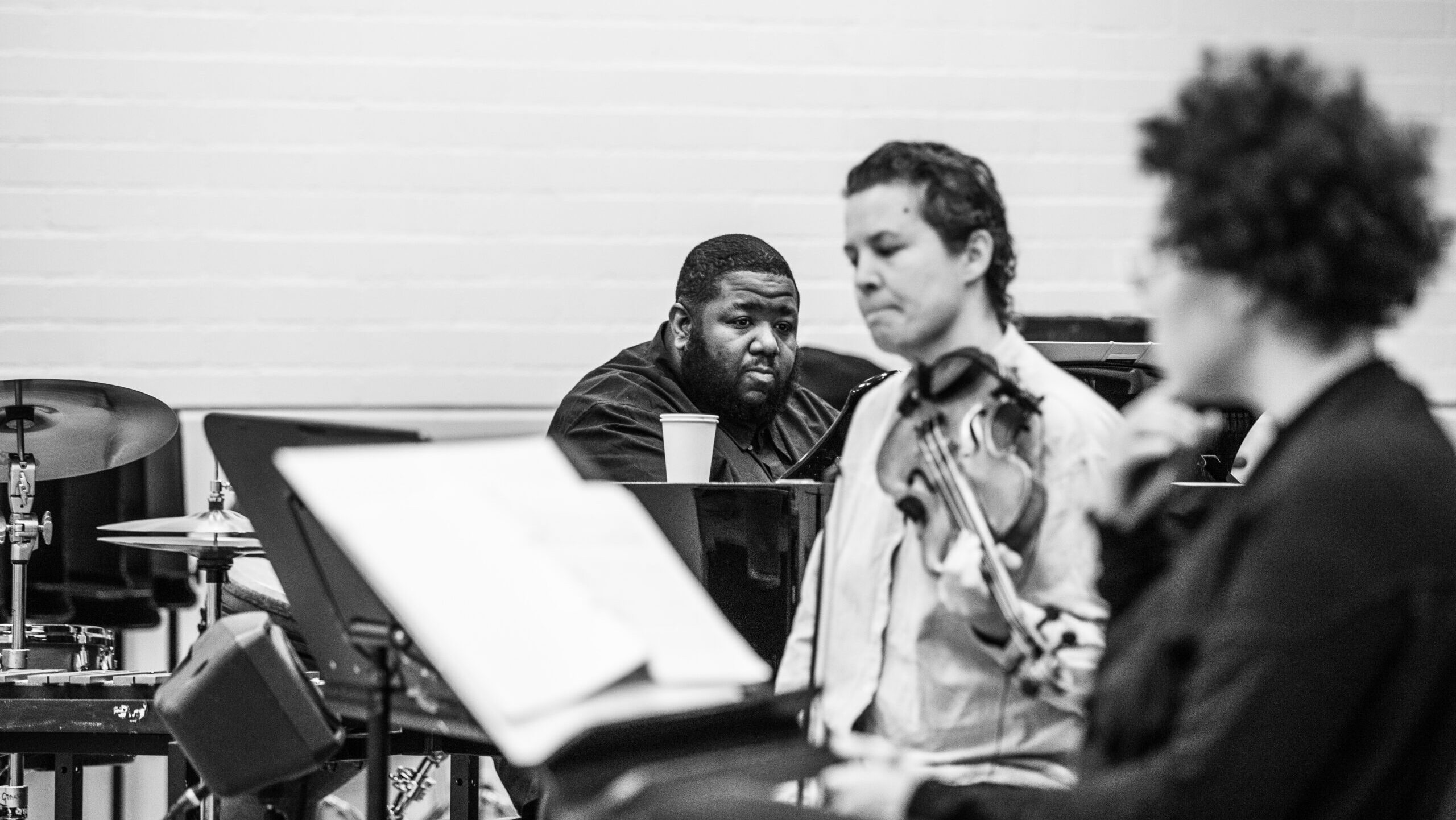
Tyshawn Sorey rehearsing Perle noire: Meditations for Joséphine in Amsterdam in 2023 / Photo: Melle Meivogel, courtesy of Julia Bullock
Tyshawn and I first met at a diner in New York City to discuss music. At the time, I had only sung Josephine Baker’s songs in a 2014 recital program, where the piano arrangements I commissioned were intended to harken back to Baker’s original style of singing — distinctly and irresistibly flirtatious, especially when singing words that were combative like “Si j’étais blanche” — “If only I were white!” I utilized the themes and stereotypes of Baker’s life and career as the vehicle to introduce artsong literature that dealt with the exoticism, hyper-sexualization, demoralization and ultimately self-liberation of B/black people.
To be more concrete: I stood onstage for 40 minutes without a break — linking tunes that Baker made famous, to selections from Xavier Montsalvatges Cinco canciones negras (here are two of my favorite recordings by Shirley Verrett and Teresa Berganza) to arrangements of civil rights songs and Black American spirituals.
Peter Sellars and I had already worked together by this time, and when he heard about this recital program from his producer, he offered to provide me with a platform to develop this subject matter, while focusing on Josephine. (The platform was quite literal and turned out to be the sole and central set piece.) Josephine Baker: A Portrait, was to be a part of Peter’s programming for the Ojai Music Festival in California. He invited the poet Claudia Rankine to write spoken text, and the International Contemporary Ensemble (which was playing another work I would sing during the Ojai Festival, La Passion de Simone by Kaija Saariaho) suggested that Tyshawn Sorey should write the music.
Fast forward a couple of months to my first meeting with Tyshawn at a New York diner. We sat opposite each other, and I slid my laptop across the table. I had organized Joséphine Baker’s recording history (and the songs I loved most) by ‘genre,’ topic, or character: the lover, the heartbreaker, the adventurer, the entertainer, the dancer, the exoticized being, the activator, the nurturer — these even included American classics that were translated into French, like Cole Porter’s “I’ve Got You Under My Skin.”
I provided rough French translations that Tyshawn glanced at as we listened for three hours, with shared earphones. There were a few “must have songs” for me, like “C’est lui,” which I envisioned as a blues tune, and “Tèrre Seche: Negro Spiritual,” which had poignant lyrics that I thought could serve as the apex of the night. But for the other song selections, I just let Tyshawn decide what turned him on.
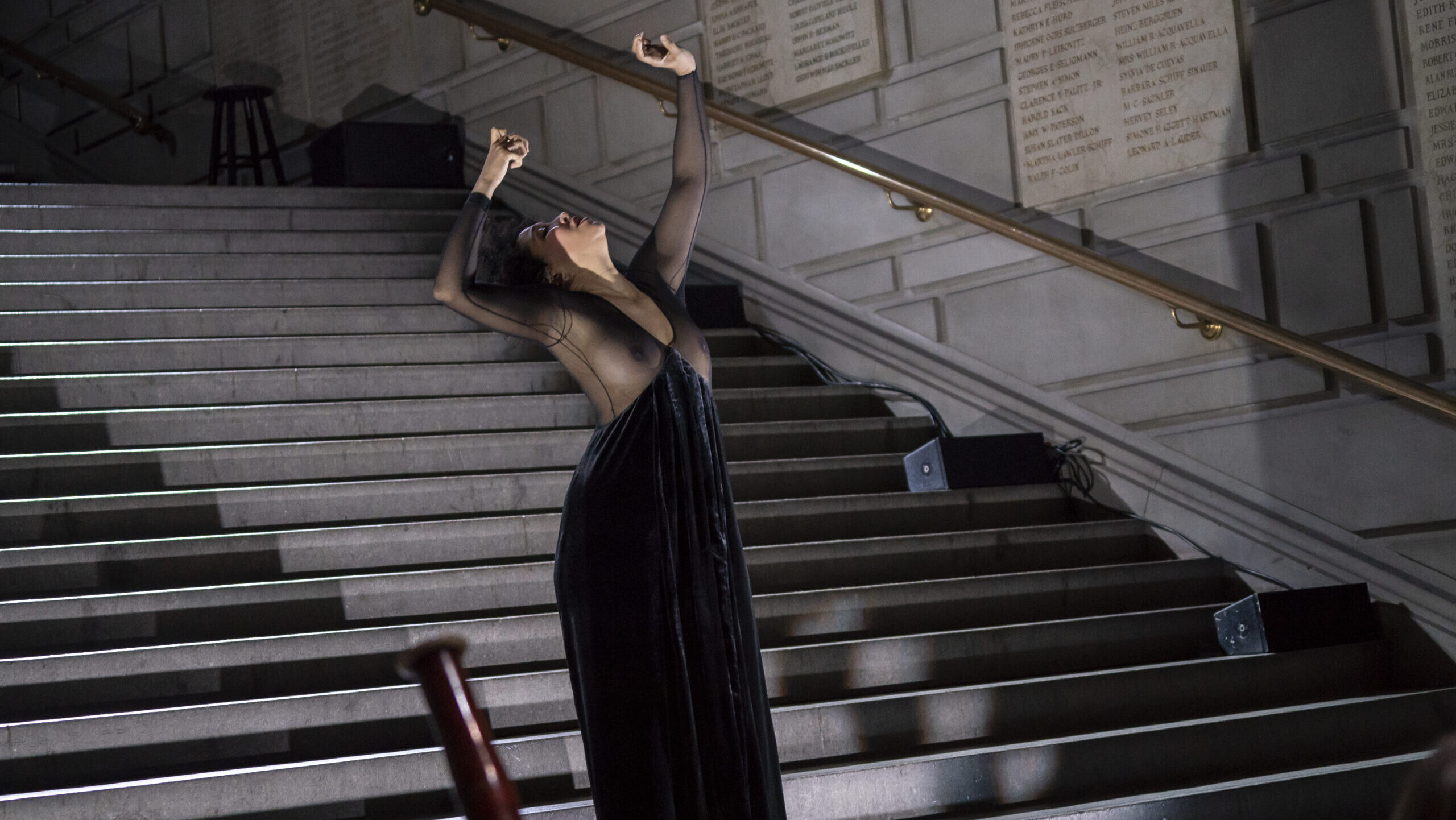
Julia Bullock in “Perle Noire: Meditations for Josephine” in The Great Hall at the Metropolitan Museum of Art in 2019 / Photo: Stephanie Berger, courtesy of Julia Bullock
After the initial public sharing of the source material at Ojai in 2016, the piece evolved during various performances and was retitled, but it wasn’t until my first-ever artist residency at The Metropolitan Museum of Art in 2018/19 that I took the time and space to reconsider the piece as a whole. I told Tyshawn that I wanted my vocal line released into the sonic world of the instrumentalists and not siphoned off alone on the plane of Baker’s original melodies. Without my having to say more, Tyshawn recomposed my vocal part, which in turn gave me increased freedom to riff and improvise.
Claudia Rankine had granted us permission to do whatever we wanted with her text, so I decided to go back through every draft with my beloved friend, and great director, Zack Winokur. What unlocked the editing process was when I realized that I wanted to open the entire piece by saying, “Here is who I am now.” There was no reason for me to say anything as Josephine Baker that I couldn’t also say as myself. The concise, biting statements, now sliced through hazy reflections, and punctuated the links between songs. It was also at this performance on the Grand Staircase of the Met Museum where we incorporated a staircase into the set design, and I commissioned a costume by Carlos Soto.
The most recent added element in this iteration of Perle Noire is the lullaby “Doudou.” Claudia Rankine had already written about Josephine Baker’s children, her desire to build a family, and also her dreams for a more equitable world that she could envision but not yet experience. Wanting to honor the depths of Baker‘s nurturing sensitivity, I decided in 2020 to include this lullaby, but it wasn’t until 2023, while rehearsing Perle Noire: Meditations for Joséphine at the Dutch National Opera in Amsterdam, that we could explore the song arrangement and Claudia‘s text — at the time, I was four months post-partum. The night before rehearsal, I found myself online for hours in the middle of the night, reading about the lynchings of B/black women in the United States around 1925 — the time Joséphine Baker decided to flee to France.
There were several cases archived, but many were not, because the lynchings across the United States of women and young children, unlike those of men, were often not held in public arenas. However, one of the most disturbing and infamous was the lynching of Mary Turner in Georgia (1918) — a woman who was eight months pregnant. And why? She spoke out publicly against her husband’s being lynched the day before…
I was told about this case in high school during my African American History class, in the context of it being one of several barbaric lynchings that urged the initial drafts of anti-lynching bills in the United States — laws that were not passed until 2018 — 100 years after Mary Turner. But I never read any primary source articles about it, that is, until the night before this rehearsal.
A summary about Mary Turner’s lynching can be read on the Equal Justice Initiative website, but I shared the following details with the cast and crew the next day:
A mob tracked Mary down, strung her up by her feet, lit her clothes on fire, and while still alive, a man cut the unborn fetus from her body using a butcher knife that was designed for slaughtering pigs, and let it fall to the ground. In an article published at the time, a man present was quoted saying that the baby cried out twice, so another man went over and stomped its head in twice, in order to silence it. They then shot her with bullets, cut Mary down where her body fell into a pre-dug grave. Someone kicked the fetus into the hole with her, and marked it with a broken whiskey bottle.
After a prolonged silence, director Peter Sellars then mentioned at this rehearsal (and I had forgotten, or hadn’t come across it in my reading) that Josephine Baker’s sister bled to death in St. Louis after giving herself an abortion.
News of almost daily lynchings, and the lack of reproductive justice, was the frightening environment and reality in which Baker grew up and decidedly attempted to escape, even if the pain was not something that could ever fully be released or abandoned. And she carried that pain and trauma in her own body, as well; she was subjected to marriage at age 13 or 14 (which is when she adopted the last name Baker). She divorced, which it can only be surmised contributed to her wanting to escape St. Louis, move to New York, and then ultimately abroad. Later in life, Baker struggled to conceive, and she suffered at least one reported (and life-threatening/altering) miscarriage in Morocco in the midst of her involvement during the 1940s French Resistance movement against fascism.
It saddens me a bit to realize how, before I gave birth, I used to posture a certain type of functioning in rehearsal and performance spaces, even while I was processing terrorizing realities that have targeted and plagued people who look like me and who speak out against unjustifiably violent behavior. But that day, I broke into tears many times relaying the circumstances of Mary Turner’s overwhelmingly brutal murder, and thinking about Joséphine Baker’s experiences and her almost desperate need to build safe spaces for herself — and for other precious, young lives. Tyshawn didn’t feel he could “rehearse” the music that day, but we decided on this shattered lullaby, which left space for an open well of feelings to flood, and an attempt to comfort.
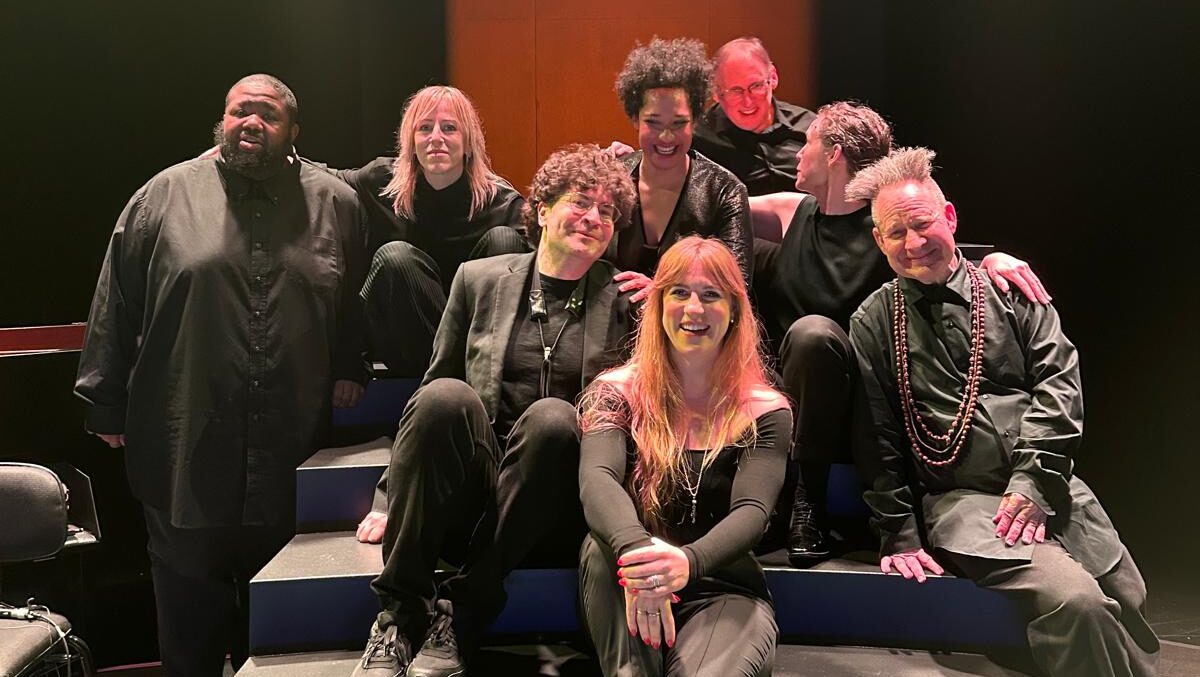
The company of Perle noire: Meditations for Joséphine in rehearsal in Adelaide, August 2026
There’s no longer a need to hold this tension within, or attempt to release it privately, or forcibly channel it in public performance. As the years have gone on, I feel more able to be honest about the emotional and physical landscape I carry with me in (pre-)performance space. The integration of “Doudou” is just one example of how Perle Noire has developed with time, and with me, and I think I can write on behalf of every person involved in Perle Noire that that one rehearsal day undoubtedly, and thankfully, impacted our approach to the material. Since then, we have all remained able to contemplate and hold challenging realities collectively — even if we can’t fully process them together. It creates a dynamic that is filled with welcomed volatility and trust. My hope is that all artists – well, really, everyone – will feel able to engage with an equal amount of openness, release, focus and clarity.
As a singer who often embodies historic music, a lot races through my mind while sharing a piece like Perle Noire in a public space. And I keep thinking (almost hoping) that Perle Noire will come off as dated, or even irrelevant, because it’s been ten years since we’ve been sharing iterations of this work. But, inevitably, there is always something conscious-altering, either personally or worldwide, that reignites the searing and devastatingly relevant themes that course through every aspect of Perle Noire.
But despite those pressures, I have never felt isolated as a B/black person, a woman, or a parent over the course of the rehearsal processes, or a run of performances. Not even during the most vulnerable moment of “Doudou.” Because there beside me, I have the gentle presence of our violinist Jennifer Curtis; the quiet support of Alice Tessiyer, our flutist, who is also a mother; Tyshawn, a parent himself; and the presence of my other close onstage colleagues, bassoonist Rebeka Heller, guitarist Dan Lippel, and saxophonist Travis Laplante.
Works operatic in scale are demanding, because of intensity and length, but because of the artistic community we have insisted upon and created — which in this instance was inspired by Joséphine — there is no sense of exhaustion while repeatedly touching the heated subject matter that remains volcanic in the context of this piece.
As we continue preparations for audience members in Paris, I’m just happy to share these meditations based on years of reflection, research and a rooted respect for Joséphine Baker.

Julia Bullock
Grammy-winning American classical singer Julia Bullock combines versatile artistry with a probing intellect and commanding stage presence. As well as headlining productions and concerts at preeminent arts institutions around the world including The Metropolitan Opera, Chicago Symphony Orcherstra, the Los Angeles and New York Philharmonics, the Baltimore, Boston, London, NHK, and San Francisco Symphonies, the Deutsches Symphonie-Orchester Berlin; and London’s Philharmonia Orchestra and Orchestra of the Age of Enlightenment, she has held positions as Artist-in-Residence of New York’s Metropolitan Museum of Art, London’s Guildhall School of Music and Drama, Berkeley’s Cal Performances, and the San Francisco Symphony and is a founding core member of the American Modern Opera Company. A prominent voice of social consciousness and activism, she is “a singer of enveloping tone, startlingly mature presence and unusually sophisticated insight into culture, society and history” (The New York Times).
Bullock has developed and launched three signature projects, all flourishing nationally and beyond. Her multimedia ensemble program “History’s Persistent Voice” addresses the transatlantic slave trade through songs by people enslaved in the U.S. and through visual art, poetry, and new music by B/black female composers. Devised with her husband, Christian Reif, El Niño: Nativity Reconsidered is a chamber orchestral arrangement of El Niño that amplifies the voices of women and Latin American poets. Perle Noire: Meditations for Joséphine, created with Tyshawn Sorey, Claudia Rankine, Michael Schumacher, and Peter Sellars, reexamines the life and legacy of Joséphine Baker. Recorded with Reif and the Philharmonia Orchestra for Nonesuch, Bullock’s solo album debut, Walking in the Dark, won the 2024 Grammy Award for Best Classical Solo Vocal, as well as Opus Klassik and Edison Klassiek awards.
-
Topics: feature, josephine baker, julia bullock
-
People: Alice Tessiyer, Carlos Soto, Claudia Rankine, Cole Porter, Dan Lippel, Jennifer Curtis, Josephine Baker, Julia Bullock, Kaija Saariaho, Peter Sellars, Rebeka Heller, Shirley Verrett, Teresa Berganza, Travis Laplante, Tyshawn Sorey, Xavier Montsalvatges, Zack Winokur
-
Works: La Passion de Simone, Perle noire: Meditations for Joséphine
-
Places & Organizations: Adelaide Festival, Dutch National Opera, International Contemporary Ensemble, Juilliard, Ojai Music Festival, Opéra de Paris, The Metropolitan Museum of Art