
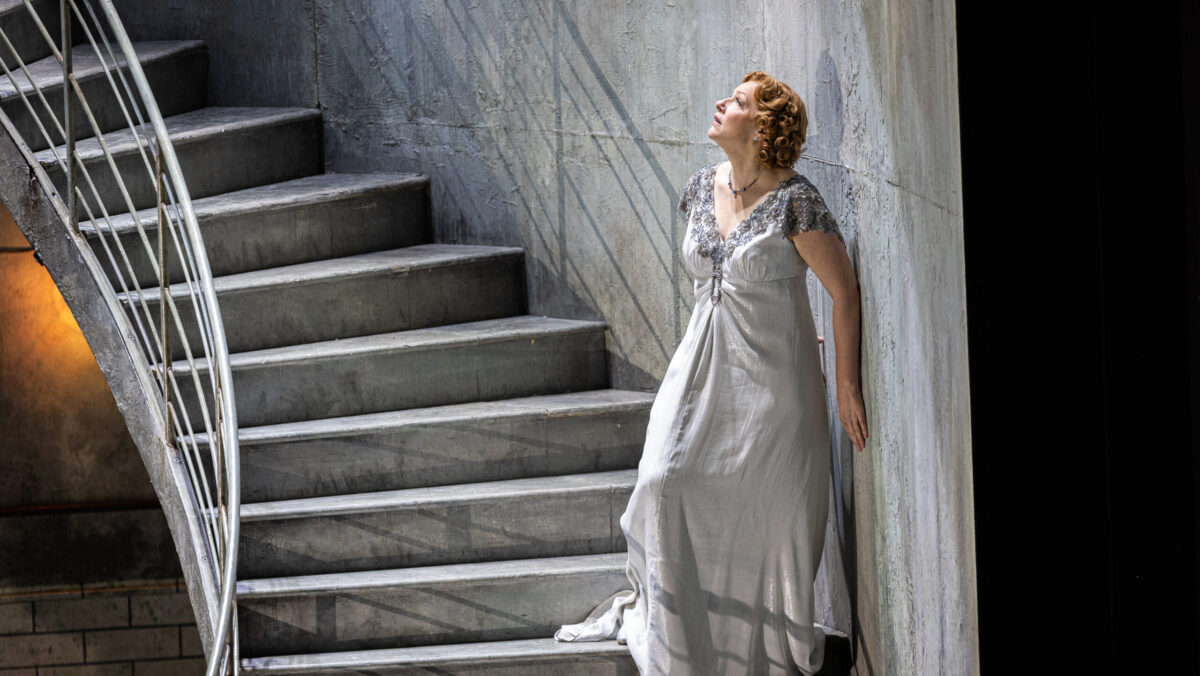
Jennifer Holloway as Salome / Photo: Andrew Cioffi – Lyric Opera of Chicago
When it comes to the professional operatic stage, you don’t hear about many transitions from euphonium player to Wagnerian soprano. But to hear it from American singer Jennifer Holloway, it almost seems like a natural development. When I spoke with her on a chilly -2 degree Friday afternoon just two days before her Lyric Opera debut as Richard Strauss’s infamous Salome–a role she’s come to dominate across Europe–I came to realize her arc from brass musician to established soprano is clearly less of a quirky career change than a shift of instrument for a performer fluent in orchestral weight and color. As Holloway put it, with a laugh, “Who doesn’t love a big old tuba chick?”
This run of Salome at the Lyric isn’t Holloway’s usual theatrical turf. Despite a recent set of performances as the secluded heroine of Samuel Barber’s Vanessa, Holloway performs almost exclusively in Europe. But before she was a professional singer, as a young musician she began playing the euphonium at the request of her middle school band teacher. By the time she enrolled as a music education major at the University of Georgia, all her work in musical theater and ensembles were directed towards a future in choral and band directing, with even a stint as a sousaphone player in the university marching band. As a self-professed band nerd, she met her husband who played on the drum line. Although she performed in musicals and theater growing up, becoming a travelling opera singer was never the plan. “I loved playing low brass,” Holloway reflected on her ensemble and recital preparation. “I loved the sort of support situation there and not being the sort of diva situation.”
Be that as it may, sidekick is not the impression one gets when in conversation with Holloway. Even her speaking voice crinkles with warmth and a substantial heft. It’s easy to imagine her making her way through Wagner or any other Jugendlich-dramatisher soprano role. That sense of irony isn’t lost on her. She continued, explaining, “I know that sounds like the opposite of an opera singer. But it’s kind of how I am. I enjoy being a part of something fabulous, not necessarily being the guy that everyone’s paying attention to. I think that’s why I like Strauss and Wagner so much — even the leading roles are simply weaving in and out of the story that the orchestra is telling.”

Photo: Simon Pauly
Perhaps Holloway’s most diva quality is her relationship to outside criticism. She is largely indifferent to the lippy feedback of the YouTube loggione. Social media and self-documentation have little place in her professional life: you won’t find her on Instagram live sharing her latest warmup or straw phonation exercises. She attributes this distance to her professional life being based in Europe. “It’s a funny thing,” she says. “The difference between Europe and here is that there seems to be less of an interest or necessity to post online.” When it comes to criticism, she’d prefer outright antagonism to performative niceties. “I think it’s kind of cool when somebody absolutely hates something that I do,” says Holloway, “because that’s better than ‘yeah, it was fine.’ Like, that’s the worst comment: Yeah, it was good. They didn’t get in the way.”
Although her husband and daughter live in the U.S., she finds herself most often in Europe—a situation she describes as a kind of operatic culture shock. “It’s a very different thing to work over in the U.S. I’ve really had a great experience over here too. It’s just very different.” The transatlantic divide hasn’t always been easy. For the greater part of her career, Holloway has worked across a six-hour difference from her family. As a mother and wife, she acknowledges opera has not always made room for motherhood. “I had a kiddo when I was 30 years old when my career was really just starting,” she says, at a moment when pregnancy could still feel taboo, and potentially devastating for emerging artists.
Within the international operatic circuit, Holloway’s prospects are more viable in Europe. In Germany, Holloway explains, opera is publicly funded—and in the case of German opera not only in the major cities but also in regional houses. There’s an opera house in basically every little city, she notes, with many of them producing ten or fifteen productions a year, and the repertory leans favorably towards German opera. By contrast, she would like to see more performances of Vanessa in America, but admits economic pressures and a weaker sense of concern over a national repertoire necessitate a different reality. American theaters need to supply their donors with the familiar titles they want and ones that management knows will fill seats.
Today Holloway sings with exquisite strength and an absorbing stage presence. In a recording of a recent Salome in Cologne, Germany she charges across the stage–from the upper choir to the main stage–enlisting even the chairs as dramatic props. Clean, crisp, diction helps explain her success in German houses. There’s a metallic edge to her voice that clings to her middle and lower registers which makes it hard to imagine the voice belonging to any other type of repertoire.
All the more surprising, then, is that Holloway’s early career was marked by triumphs as a mezzo-soprano. Her professional debut in 2006 as Le Prince Charmant in Massenet’s Cendrillon seemed to set her on a path towards trouser roles, despite occasional dissenting voices along the way. One such voice came from none other than the legendary mezzo-soprano Marilyn Horne, who, after hearing Holloway sing a selection of Samuel Barber songs in a masterclass, informed her, “That was beautiful honey, but you are a soprano.”
Holloway recalls the moment with her typical candor. “I was so offended,” she admits. “But the thing is, I was choosing certain colors that I thought made me sound like a mezzo, but my top was always easy.” Her trajectory complicates the familiar narrative of being “placed” in the wrong Fach. Perhaps drawing on a mindset more familiar to instrumentalists than singers, Holloway would take on whatever music was placed in front of her. She could vocalize high and low with palpable ease, capabilities that sometimes led to controversy.
As a student at the University of Georgia, Holloway was once asked by the casting directors of a production of Mozart’s Die Zauberflöte to sing the Queen of the Night. Alarmed by the mere idea of her twenty-year old student approaching this vocal feat, her teacher intervened and instead Holloway happily sang the Third Lady. Poetically–and with resonances that would reverberate in her later career–she moved from one of the highest roles in the opera to the lowest. Recounting the episode with a laugh, Holloway quipped, “If I had done the Queen of the Night? I think I probably would have choked and died.”
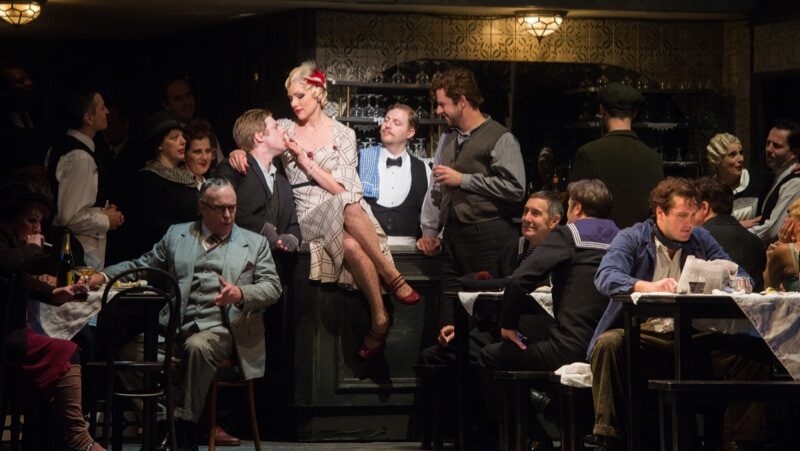
Jennifer Holloway as Musetta in La bohème at English National Opera in 2014 / Photo: Thomas Bowles
Holloway continued to comfortably sing mezzo roles until 2010, when an administrator at The Santa Fe Opera again raised the possibility that her voice would also support soprano repertoire. It was a simple proposition: Santa Fe would be staging Salome in the coming years, and he wanted to consider Holloway for the role–not as her first soprano debut, but only after she had sung smaller, more conventional soprano roles. Although Fach is often cloaked in a sense of destiny, imagined to be lodged in the dense ligaments of the glottis itself, Holloway was offered a choice: she could pursue either voice type, but she would have to make a decision soon, and it would affect her future casting.
Again, she resisted, insisting on her affinity with mezzo roles. As she put it, “I was like, I appreciate it. Thank you very much. I sing trouser rolls. They are right for me. I am good at them. I am special at them. I know that this is my voice type and I cannot sustain the tessitura required to sing Salome. It is not my voice type. I appreciate that I have an easy top. Why can’t that just be something that people continue to appreciate in my voice?”
Holloway went back to her teacher, who she insists taught her only “healthy” singing, not the vocal puppetry of impersonating a Fach. Later, onstage, she began to hear something different. After singing her first Octavian, she noticed a shift in how her upper register was taking place. Her top wasn’t only an extension, but a place where she could remain over the course of an entire role. Gradually she started to test that with some classic parts: Musetta, Donna Elvira. Looking back, Holloway stresses training over classification: “I’m very, again, very lucky that I had a voice teacher who just trained my voice for what my voice was,” she argues, even as she acknowledges the usefulness of Fach: “I think what we struggle with now is we get so caught up in Fach, which is this system of dividing up all of the different voice types, right? And I think that there is a super validity to that. You want to stay healthy, you want to be within something.” Her Salome debut followed in 2016, a role she has continued to inhabit ever since. In some ways, Salome was the perfect crossover role for a lyric mezzo. With over 100 instruments in the orchestra, Salome leaves little margin for technical evasions in the middle register. The tessitura lies low and there are wide, sweeping phrases that demand weight and continuity from the bottom of the voice upward.
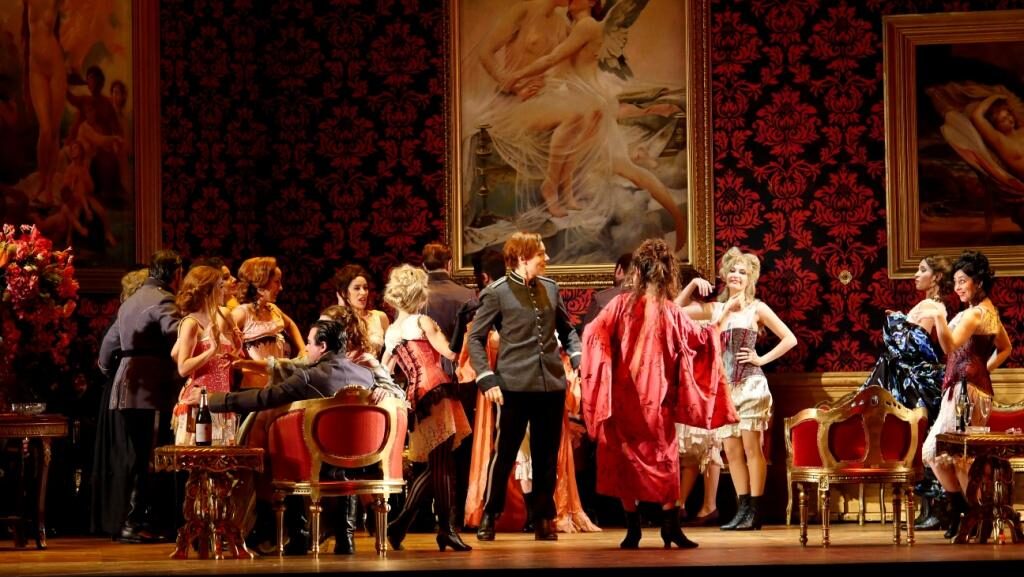
Jennifer Holloway as Octavian in Der Rosenkavalier at the Teatro Colón in 2017 / Photo: Martin Wullich
When it comes to young singers, at a certain point Holloway stresses that it becomes less about notes, and more about noticing what one does instinctively on stage. Rather than locking into the idea of a predetermined path, she recommends early-career artists who are just starting out identify what makes them special, whether that be a specific technical ability or affinity with certain character temperaments. With so many singers available at a moment’s notice, flexibility is needed. “I think it’s smart to find what you are special at,” she explains, “but to always have your eyes open and to never get set in something.”
Her own career offers a morality tale. As a student she never considered Wagner as a possibility. “I never thought I would sing Wagner,” she recalls. “It never occurred to me. People talked about it when I was in school, and I sort of just sort of turned off their conversations in my head because I was like, well, that is not something I will ever be doing. Thank you very much.” Years later, however, after first Wagner role–Sieglinde–Holloway remembers crying because for the first time her voice felt released. After being asked for years during her training and career if she was fully “singing out,” her voice suddenly opened.
While she’s committed to the art of inhabiting characters fully, she is adamant that not every role belongs in her voice. Some characters, she suggests, are simply incompatible with her approach on stage not because of range or tessitura, but because of who the character compels her to become. “There are a lot of roles where the characters are not something that will fit into my personality or body. There are things that I like to watch other people do that I have no intention of singing,” she explained. “And therefore, that means it is not my repertoire.”
Roles that hinge on restraint or qualify as a damsel in distress pose a particular challenge for her. “I don’t play somebody who is quiet and sweet very well,” she admits, adding that such characters make it “vocally very difficult to portray.” As an artist, what she hopes to step into are personalities with an edge, marked by a sense of inner torment to them. “Part of my choosing which roles are the right ones for me has to do with just a fieriness,” she explains, tracing that instinct back to her years singing trouser roles as a mezzo. Those parts allow her to tap into a type of masculine energy and “let loose” vocally. “I don’t play a wilting flower very well,” adds Holloway.
When it comes to Salome, that understanding of character has led her to an impassioned sense of protection over the often-misunderstood princess. “I almost feel like she is my daughter,” shares Holloway. “It is my mission to make sure that people understand because as women, we are often misunderstood in our daily lives. Because we’re just trying to be heard. We’re just trying to be seen.” Holloway resists readings of Salome as simply moody or bloodthirsty. Through her sustained engagement with the score, both textually and orchestrally, she has come to understand Salome as a young woman, or really a girl, taking stock of a world that has repeatedly failed her. Backed into a corner and stripped of protection against a stepfather that exploits her and a mother who either cannot or will not intervene, Salome is left painfully alone. “She has no friends,” Holloway explains. “When all power is taken away, Salome simply is just trying not to disappear under everybody else’s rule.”
It’s through Jochanaan that Holloway invites a compassionate reading of Salome. His voice, not only its prophetic message, but the very sound of it offers Salome something entirely different from what she knows. “She’s enamored of just the sound of his voice. The things that he’s saying are things that she has never heard before,” says Holloway. For a girl who has only known how to connect with others through her sexuality, Jochannan’s rejection of Salome curdles into a sense of shame. “His job as this prophet is to guide her, but instead he’s afraid because he’s afraid of the sexuality that she’s showing,” adds Holloway, “It’s all she knows how to show, it’s all she’s seen before. She is absolutely a victim.”
Holloway is equally empathetic about what follows. Salome’s demand for his head doesn’t come from a place of hatred, but from a need for love and control. “She asks for his head not because she hates him–she loves him. She wants more of him.” But that vulnerability is redirected towards violence when Herod leers at her, reducing her to a spectacle and reducing her to a passive plaything. Aware that Herod fears Jochannan, Salome begins to fantasize about possessing that power for herself. What follows after the dance, in Holloway’s reading, is not just about desire for Jochanaan, but also retaliation against Herod. As Holloway clarifies, “It is important to me, above all, no matter who is directing that we don’t see this trope that Salome is just a spoiled princess who wants everybody’s head on a platter.”
That resistance against caricature is following Holloway into the next phase of her career, as she turns to make her debut in another trouser role–this time as the soprano Adriano in Rienzi at the Bayreuth Festival this summer. It is, by her account, “a really a hard role,” but one that she hopes to demystify as she has with Salome.