Opera and drinking have always gone hand in hand—historically, culturally, and for some Parterre readers, longer than they prefer to quantify.
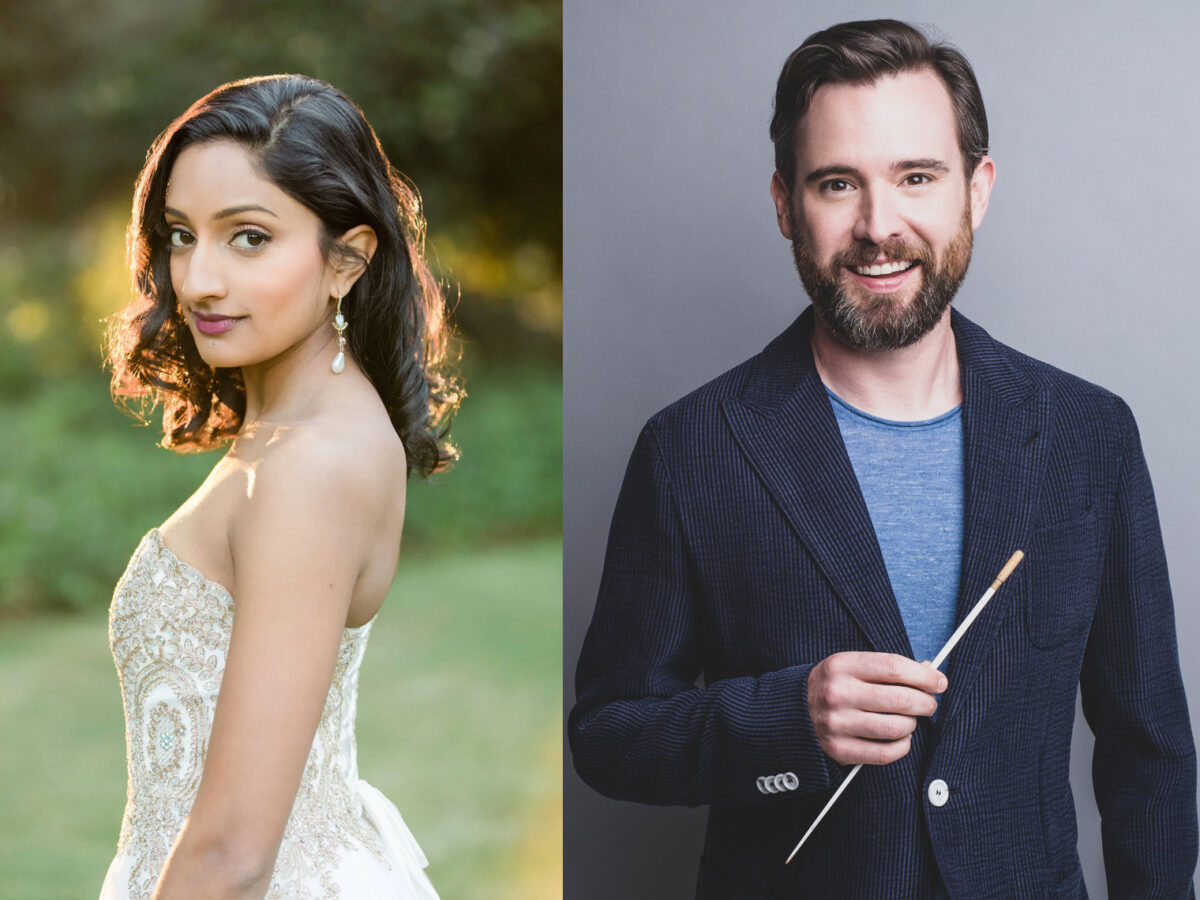
For Valentine’s Day, Opera Lafayette stages a revel of love in all its guises—tender, chaste, and… otherwise—led by Nic McGegan, with soprano Maya Kherani and tenor James Reese supplying the singing while Bacchus oversees matters of refreshment—in D.C., serious wine from Michelin Star Sommelier Sarah Thompson (Queen’s English), and in New York cocktails from noted NY mixologist Alex Dominguez (Lucky Tiger / Bar Calico).
Ahead of the festivities, Artistic Director Patrick Quigley spoke with Kherani about Baroque freedom, engineering instincts, and a repertoire that actually isn’t as sober as its reputation would suggest.
Patrick: What about Baroque music excites you? When did you first discover its beauty?
Maya: I fell in love with it very, very early in my singing journey. I didn’t actually study music in school. I went to college for engineering. But I did sing in a choir in high school and Baroque was the first music that took my fancy. I remember, we did B minor Mass and it was a gateway drug. I just fell in love with it instantly!
Patrick: That’s so interesting. So you didn’t start your musical studies until when?
Maya: When I was 22 I did my very first young artist program, if you could even call it that. It was with the Amherst Early Music Festival. It was just a week-long summer program for aspiring young singers. And I was very much out of my depth. Actually, Ryan Brown (founding Artistic Director of Opera Lafayette) conducted, so that was where we first met.
Patrick: Small world! Could you speak a bit more about how you experience the Baroque repertoire as a singer?
Maya: It’s always been very emotional for me. So pleasant, so beautiful. And what I particularly love about it is that the repertoire really allows for us artists to put our own stamp on it. Baroque allows for a sort of agency in the music that many standard repertoire pieces, I’m thinking bel canto or later, don’t really allow for a singer to do. You know, there are so many recordings of Romantic repertoire and there’s a lot of expectation to do things a certain way or to sound a certain way. But with Baroque, there’s a lot more freedom and individuality that can come through. I love being able to pick and choose what kind of ornaments I want to do. Or, I can even change a key if I want to change a key. There’s so much more flexibility and I love that.
Audience bootleg of Maya Kherani debuting the bravura showpiece “Tra le procelle assorto” from Cesare e Cleopatra by German composer and tenor, Carl Heinrich Graun (1704 – 1759) with American Bach Soloists, December 31, 2024.
Patrick: Well, the repertoire certainly likes you back.
Maya: Thank you. I think my voice just happens to fit the repertoire really well. It’s always something that’s felt easy for me vocally, and I’ve sort of treated that as a North Star. And it’s something I get hired for, which I love. You know, you can’t beat that!
Patrick: No, you can’t. You’re one of these people who are sort of defining what an American Baroque opera diva can be. And it’s not really a pathway that people had quite imagined much before now. So, who are people that you have admired and taken inspiration from over the time?
Maya: That’s a good question. I really love the golden age singers. Adelina Patti and Maria Malibran. I’m actually reading this fantastic book of interviews from the singers from the eighteen nineties to the nineteen twenties, and what they have to say is just absolute gold. I wish we all sang that way now. But I think there’s a lot of really wonderful modern singers as well. I’ve sung with Sherezade Panthaki quite a few times, and she has been a great role model for me. She’s South Asian and someone I really looked up to, a trailblazer in this career. Also, I think European singers have a bit more of a clearly defined path for Baroque singing over there. There’s too many to count, but I look to the career of Jeanine De Bique. She’s really forged this path of specializing in Baroque repertoire. She’s like a Baroque opera diva, which is really cool to see. I feel like there’s something to learn from every singer that I’ve ever worked with. I love singing with Jimmy [James Reese], so I’m very happy to be singing with him again for this program. He’s just such a mensch.
Patrick: Are there roles from the Baroque repertoire that you’ve particularly enjoyed or that you really would like to do?
Maya: I love singing Handel. My very first staged Handel role was Partenope, and that just fit me like a glove. That’s sort of where my career took off, after I sang that role. And I’d love to sing Cleopatra. I think that’s probably every Baroque soprano’s dream. And I love, love, love singing Monteverdi. I just love madrigals, any song. Monteverdi just speaks to me on a deep level. Anything from the Seicento Italian repertoire. I just love it. I could sing it all day, any day! It’s like the Italians knew. You know? They just knew how to do it right.
Patrick: You mentioned you went to school for engineering. I actually started in engineering as well, but you went through with your degree, didn’t you? How exactly did you go from an engineering degree to Partenope? I think that a lot of people would like to know how that happened for you.
Maya: Purely by accident. Growing up I was interested in choir and theater but I never considered a career in the arts. I really loved analytical things—math, physics, science. Those were my favorite subjects, so when I went to Princeton for undergrad, I decided to major in chemical engineering. I didn’t like chemistry though, so I changed to mechanical engineering, which I really loved!
Patrick: Did you do any singing in college?
Maya: Yes. I ended up joining the university choir. I sang alto, which is funny because I didn’t really have any low notes. Princeton is not a music school, but the music department put on an opera every year and anyone could audition. So my choir director suggested I do so. That was my sophomore year, and they were doing Marriage of Figaro, of course. And I had never sung an opera aria or anything like it. So I learned Dorabella’s aria from Così fan tutte. And I thought that I must be a mezzo, which is hilarious. But I auditioned and got the part of Barbarina, which was perfect. It was a small role, but it was in English, which was a good thing for my first operatic role. And I was hooked. I loved the synthesis of acting and drama and costumes combined with singing and classical music. I caught the bug.
Patrick: But you were still studying engineering?
Yes. That summer I was actually a research fellow at MIT. While on campus I went to the MIT Music Library, which had this extensive collection of CDs. I’m dating myself. I checked out every single opera CD they had and listened to them all. I don’t know how much research I did that summer, but I tore through the music library. It became an obsession for me. I came back from that summer, and I decided I wanted to start voice and minor in music and music performance. I was very late in the game, as I was a Junior, but I had a really wonderful teacher, and she got me ready for my senior recital. I decided to apply to music schools for my master’s degree. I thought, you know, I’ll just try this out, see how I like it, but I can always come back to engineering if I feel like this isn’t right for me.
I auditioned and got into a few places and ended up going to San Francisco Conservatory of Music for my master’s. And when I showed up there, I was indeed very behind. I had only taken one music theory class and one music history class, so I had to take everything. And I just loved it.
Patrick: Did you ever go back to engineering?
Maya: After my music degree, I ended up going back to engineering for one quarter. I started a PhD program in mechanical engineering at Stanford, and I dropped out after ten weeks to sing. So that’s as far as that went. And at that time, I was singing outreach for the San Francisco Opera. And we were singing Elixir of Love [L’elisir d’amore] or Pirates of Penzance or something, in elementary schools.
We’d show up, and we’d sing forty-five minutes of the English version of the opera, and the kids would be in the show with us. And I remember thinking to myself, I would much rather be singing at 9AM in this cafegymatorium than being an engineer. That was such a clarifying point for me. I was like, you know what? I’m getting work as a singer. And I just dropped out of my engineering program, and just went for it. That was fifteen, maybe sixteen years ago now.
Patrick: That’s incredible. Do you find there is overlap? For example, I am really glad I took Physics and Calculus because that actually helps me in my job now.
Maya: For sure. Maybe that’s why we both like Baroque music. It’s so analytical, so mathematical.
Patrick: Absolutely. I just have one more question for you, which is what are you looking forward to singing the most on this upcoming show? Or is there anything that’s speaking to you as you’re learning the music?
Maya: Oh my gosh, Nic [McGegan] has picked such a fun repertoire! Much of it is new to me. I don’t wanna give away anything, but it’s gonna be really fun! There are some very naughty songs. There are a couple of songs that with the text, I’m like, oh, this is from the seventeenth century!? I love it. And then, of course, I’m singing Monteverdi pieces with Jimmy, which will be beautiful and fun. And I love the personal selections. It’s going to be a really great program. Really varied and, I think, surprising for the audience.
Patrick: Well we are very much looking forward to having you at Opera Lafayette. And it will be a great way to celebrate Valentine’s Day.
Maya: I’m just thrilled. I’m really excited to be a part of this, and I think it’ll be a very fun Valentine’s Day for everybody!
Celebrate love in all its guises—sensual, humorous, chaste, and tragic—through tender ballads, amorous duets, cheeky verses, and bawdy drinking songs, all led by Nic McGegan, Music Director Laureate of the Philharmonia Baroque Orchestra, renowned for his musical wit. Savor food, craft cocktails, and wine in homage to Bacchus. In Washington DC, wine will be provided by 2023 Michelin-guide Washington, DC Sommelier of the Year Sarah Thompson (Queen’s English). In New York City, signature cocktails will be provided by noted NY mixologist Alex Dominguez (Bar Calico).
Washington, DC
Thurs, February 12, 2026
7:30pm
St. Francis Hall (1340 Quincy St NE)
New York City
Sat, February 14, 2026
7:30pm
Georgia Room (23 Lexington Ave)
Program
(Running Time: 75 minutes)
♥♥♥♥
WHAT IS THIS THING CALLED LOVE?
♥♥♥♥
Now winter nights | Thomas Campion (1567-1620)
Prelude from Suite in A | Nicola Matteis (c. 1650-1713)
If Music Be the Food of Love | Henry Purcell (1659-1695)
I attempt from love’s sickness | Henry Purcell (1659-1695)
Oh that I had a fine man | Pelham Humfrey (1647-1674)
Le doux Silence | Honoré d’Ambruis (c. 1660-1702)
To Virgins to make much of Time | William Lawes (1602-1645)
The Epicure | Thomas Jordan (c. 1612–1685)
Pourquoi, doux Rossignol | Jean-Baptiste Drouard de Bousset (1662-1725)
When cockleshells | British Folksong
Somebody | Anonymous
Aria Amorosa from Suite in e minor | Nicola Matteis (c. 1650-1713)
Dialogue upon a kiss | Henry Lawes (1596-1662)
♥♥♥♥
COURTSHIP
♥♥♥♥
Adagio from Suite in C | Nicola Matteis (c. 1650-1713)
Bel Pastor | Claudio Monteverdi (1667-1643)
Oh Mother, Roger with his Kisses | Thomas D’Urfey (c. 1653-1723)
Monsieur le Chien | William Mountfort (c.1664-1692)
Nel cor più non mi sento from ‘L’Amor Contrasto’ | Giovanni Paisiello (1740-1816)
Dear Pretty Youth from ‘The Tempest’ | Henry Purcell (1659-1695)
The Knotting Song | Henry Purcell (1659-1695)
Quel tuo visetto from ‘Orlando Paladino’ | Joseph Haydn (1732-1809)
♥♥♥♥
AMOR VINCIT OMNIA
♥♥♥♥
Broken Concert No. 6 Ayre | Matthew Locke (1621-1677)
When first I saw bright Aurelia’s eyes from Dioclesian | Henry Purcell (1659-1695)
Sweeter than Roses from ‘Pausanias’ | Henry Purcell (1659-1695)
Pur ti miro from ‘L’incoronazione di Poppea’ | Claudio Monteverdi (1667-1643)
Cupid’s Nightcap | Stanley J. Sharpless
Man is for the woman made from ‘The Mock Marriage’ | Henry Purcell (1659-1695)
