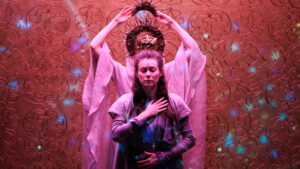

Photo by Anja Schütz
I almost forgot about the biographical link between Sarah Kirkland Snider and the subject of her new opera, Hildegard, currently playing at the Prototype Festival—but in its way, that link helped to draw Snider into her obsession with Hildegard von Bingen, the mystic visionary and composer at the center of the piece.
In a candid Instagram caption posted just a few days after the condition had happened to send her to the emergency room, Snider used the occasion of Chronic Migraine Awareness Day 2024 to come out as a lifelong sufferer from debilitating chronic migraine. But Hildegard, argues neurologist (and music-lover) Oliver Sacks in his own book on migraines, was herself a migraine sufferer—one whose visions could perhaps be attributed to the “aura” that precedes a migraine headache.
“I get these migraines that last for weeks and months, and years sometimes,” Snider said in our interview last month, “and so did Hildegard! I was reading about how she would have these six-month migraines, and it was so helpful and inspiring to me back in my 20s to see that somebody who had that kind of disability could still go on and do great things, especially in a world that didn’t allow women to do anything. Reading that she would be bed-bound for months like I was in high school and college was very hopeful for me, and inspiring, and that was initially what drew me into her story. And then there was so much more to her story, of course, that made her so much more fascinating.”
My own fascination with the music of Sarah Kirkland Snider began about 20 years ago, when she was getting a graduate degree from Yale, and I was working at the record store across the street. I became interested in the work she did with composers Judd Greenstein and William Brittelle as co-founders of New Amsterdam Records, an independent label the establishment of which marked, in retrospect, a generational shift in musical style.
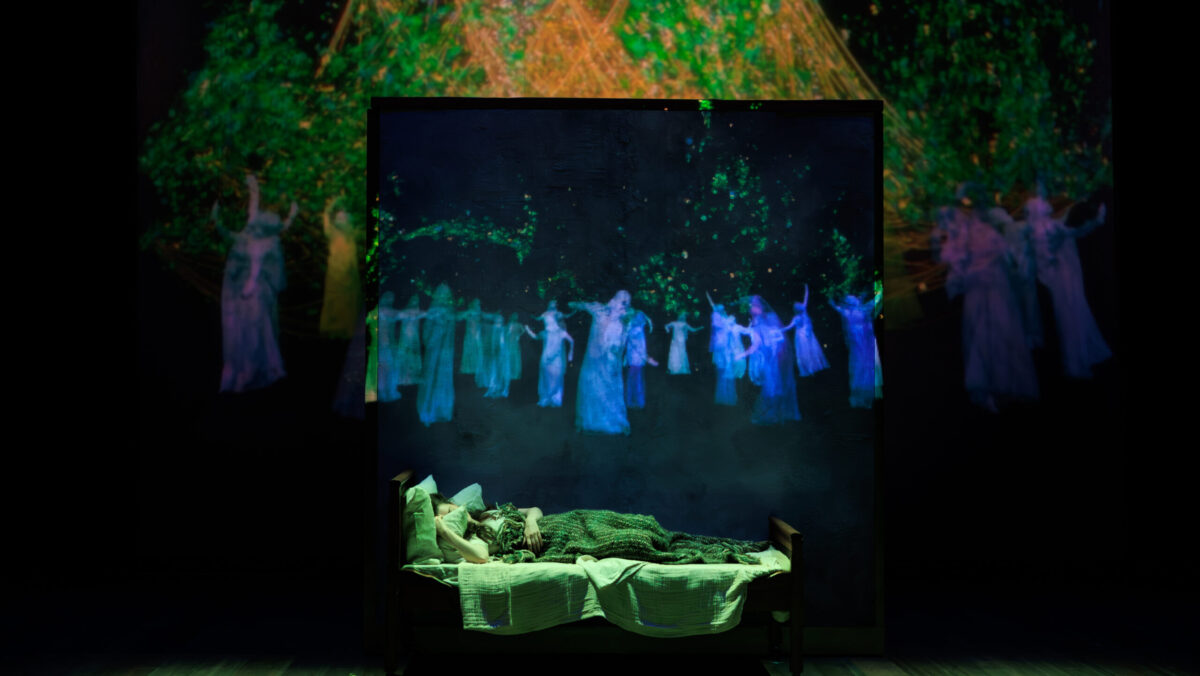
A scene from Hildegard / Production photos by Angel Origgi
The conventional dialectics of late 20th-century music history might tell the story of the minimalists warring with serialists, of the post-minimalists grafting minimalist textures and processes to accessible neo-Romanticism, or of the Bang on a Can composers grafting those same materials onto no-wave dissonance. By the time Snider and her cohort emerged in the 2000s, the dust from those style wars had largely settled: at a time when Alex Ross was writing in The New Yorker about the strange and sophisticated new musical languages of indie rock artists like Björk and Radiohead, modernist purism seemed as silly to the era’s young composers as did the idea that vernacular music existed on a lower cultural tier than classical. They weren’t so much driven by the urge to reject Romanticism or minimalism or complexity as they were to make music with ready appeal to the uninitiated listener. And they wanted to be cool.
And so, as had the Bang on a Can generation that inspired them (and in some cases, taught them), Snider and her peers built, in New Amsterdam, a little institution of their own to support this shared vision of musical culture and their own personal camaraderie. To my undying annoyance, somebody coined the term “indie-classical” for this scene, and it stuck, partly because NewAm was of course actually an independent record label, and partly because of an audible debt some of the composers they showcased owed to the aesthetics of indie rock—Snider especially.
Then in 2010, New Amsterdam put out her song cycle Penelope, and it knocked the wind out of me. Penelope brought together the young new music ensemble Signal with Shara Nova (then Shara Worden) of the indie rock project My Brightest Diamond, whose breathy tone and narrow vibrato make her sound more like a vintage jazz chanteuse than an operatic mezzo. Partly because of Nova’s extraordinary vocal performance, and partly because I first encountered the CD at an especially dark time in my life—remember, I was living in New Haven—but largely because of Snider’s brooding, insistently melodic songwriting and atmospheric arrangements, it became a recording I returned to not just as a favorite album but as a balm for my ears and soul.
Penelope has been followed by two more outstanding cycles for Nova, whose haunting and idiosyncratic delivery is matched by her musical intelligence and vocal range. Unremembered is an even more atmospheric collaboration with indie singers DM Stith and Padma Newsome, as well as an all-star orchestra, and The Blue Hour was jointly composed for Nova and strings by a handful of composers, including Snider and Nova herself.
None of these works feel like “classical music.” Throughout her oeuvre, even in her purely instrumental music—Forward into Light, a disc of her orchestral works coming out soon on NewAm, gives example after example—she works with the materials of popular song. She may be constructing this music with the training she learned at conservatory, the techniques she has borrowed from contemporary composers, but the melodies are diatonic, the harmonies are tonal, the phrasing seems to suggest a human breath. If you didn’t know better, you might think this music was written by an especially ambitious and painstaking rock songwriter, à la Joni Mitchell.
But of all her albums, Penelope is the one I’m always returning to, the one I’m always thinking of, and—look, I’m not sure if I’ve ever admitted this publicly, for the very good reason that it reeks of the most abhorrent kind of gender essentialism—but part of the cycle’s appeal to me is that it feels like a piece of music that could only have been written by a woman.
WAIT, WAIT, DON’T CLOSE THE TAB, I don’t mean that in any kind of stereotypical or biological or absolute sense! What I mean is that it feels, as an artistic statement, like a thematic and aesthetic exploration of womanhood written from a persuasively female point of view. Originally presented as a monodrama, the songs are loosely tied up in the story of a woman whose husband has returned home from the wars physically and psychologically damaged, and who keeps herself company with a copy of Homer’s Odyssey. Trapped in the socially feminized and deprecated role of nurse, nurturer, caregiver, she moves through a vast, rich inner world of aching emotions while tending to her broken war hero.
The timbres are often soft, the dissonances gentle, and the musical focus is on melody above all else, the composer actively cultivating the elements usually dismissed as feminine, superficial, “merely pretty” by critical discourse. Here, the feminine is valorized, and the (sorry, but this is what this much-abused catchphrase was invented for) emotional labor of this modern Penelope is recognized as its own kind of heroism.

Sarah Kirkland Snider / Photo: Anja Schütz
Well, as it turns out, I actually got this one right, maybe? In 2017, NewMusicBox would run an essay—“Candy Floss and Merry-Go-Rounds: Female Composers, Gendered Language, and Emotion”—in which Snider speaks candidly about her experiences feeling sidelined as a female composer, and even being pushed explicitly by her teachers towards writing in a more “masculine” style.
In our conversation, she suggests that even her embrace of vernacular idioms is itself gendered. But she pauses for a moment, unsure of what she wants to put on the record, before continuing: “I had a couple of supportive male teachers, but I also had a number of negative experiences with older male composers early on—not-so-subtly discouraging me from joining the field, or saying overtly sexist things, or sexually harassing me. I saw this happen to many other female composers, too. And so for a while I kind of hated classical music because of it. I was just a bit repulsed by the entire tradition for a while.
The commission for Penelope came along at exactly the right time for Snider. “Ellen McLaughlin—who wrote the text—did say, ‘I want this music to sound like it could be sung by an everywoman. It shouldn’t sound too high-arty, make it sound folk-inspired.’ And so that gave me this explicit directive to get in touch with a world of music that I loved as much as classical, which is to say indie rock and pop. But I also think that what appealed to me about that world was that it was a world where I had female role models, which I had not had in classical music. No teachers of mine had ever recommended music by a woman, not even Saariaho or Gubaidulina or anything like that, and so I came into this profession thinking that all the music I should listen to and study the scores of was written by men.
“But I had this world of music I loved so much with people like PJ Harvey and Joni Mitchell and Sleater-Kinney and Liz Phair, and other people who I’d grown up loving and idolizing, and I felt very at home in that world. I probably went to see more indie rock concerts in my 20s than I did classical music shows, I felt very at home reaching into that world and bringing it into this one. Penelope found me at this moment where I really needed it. I needed to have an outlet for that kind of rage and frustration that I’d felt with the classical world.”
But what about the music of Hildegard?
“I love her music,” says Snider, “I really revere it. I think it’s incredibly beautiful and emotional.” But then again, “All music has a relationship to emotion—that’s what I love about music, and what I find so fascinating about it.”
She starts to suggest that she is attracted to something “feminine” about Hildegard’s music, then immediately challenges her own binary. “What do I mean by that? The first ‘feminine’ descriptors of music that I encountered were all about music that had been written by men, and so I’m not sure what ‘feminine’ and ‘masculine’ means in music. We don’t know what a lot of women’s music would have sounded like back then—and is it because she was a woman that we consider the music she wrote to be more stereotypically feminine?
“But it is very different from the music of her time that was written by men, so it’s interesting to project a sort of female psyche onto it.”
Hildegard’s compositional style is audibly different from the plainchant with which modern listeners are familiar. “We’ll never know whether it was because she hadn’t studied music properly,” says Snider, echoing a long-held critical consensus, “and perhaps if she had, she would have been less of a rule-breaker.
“I think her music is incredibly shapely,” she muses, “and it has these fantastical discursive journeys that really fascinate me. When you compare it to the music of her time… it’s extraordinary that she wrote this music, but I do think it also reflects the popular vernacular music that she heard as a child. She was born to the high nobility, and so she was exposed to a lot of the vernacular music that they heard in court. So there were these romantic love songs that she heard, and she took a lot of that influence and combined it with the church music to create this sort of fantastical language of her own.”
While the actual uniqueness of Hildegard’s particular compositional voice is, of course, a matter of discussion amongst musicologists, part of what drew Snider to her subject was the notion of Hildegard not just as a composer, but as a female artist who struggled to achieve a position of power in a repressive social structure.
“Early in my career, I had a lot of experiences of older men telling me I didn’t belong in the field, or shouldn’t be doing this, or this or that. And so, in that sense, I found her story very interesting and sympathetic. You know, I think a lot of women feel that way. Most women today know the microaggressions of living in a patriarchal society, or of pushing back against older men with sexist views. So to look at this woman who lived, like, a thousand years ago, and how she battled all of that, when women were literally considered the property of men, and had no status, and were not allowed access to education—how did she deal with all that?” says Snider.
Melding the musical language of the patriarchal establishment with the elements of vernacular song? Writing a musical language that is tangibly distinct from what might have been expected by male-dominated institutions?
That sounds an awful lot, to me, like the music of a certain 21st-century composer.