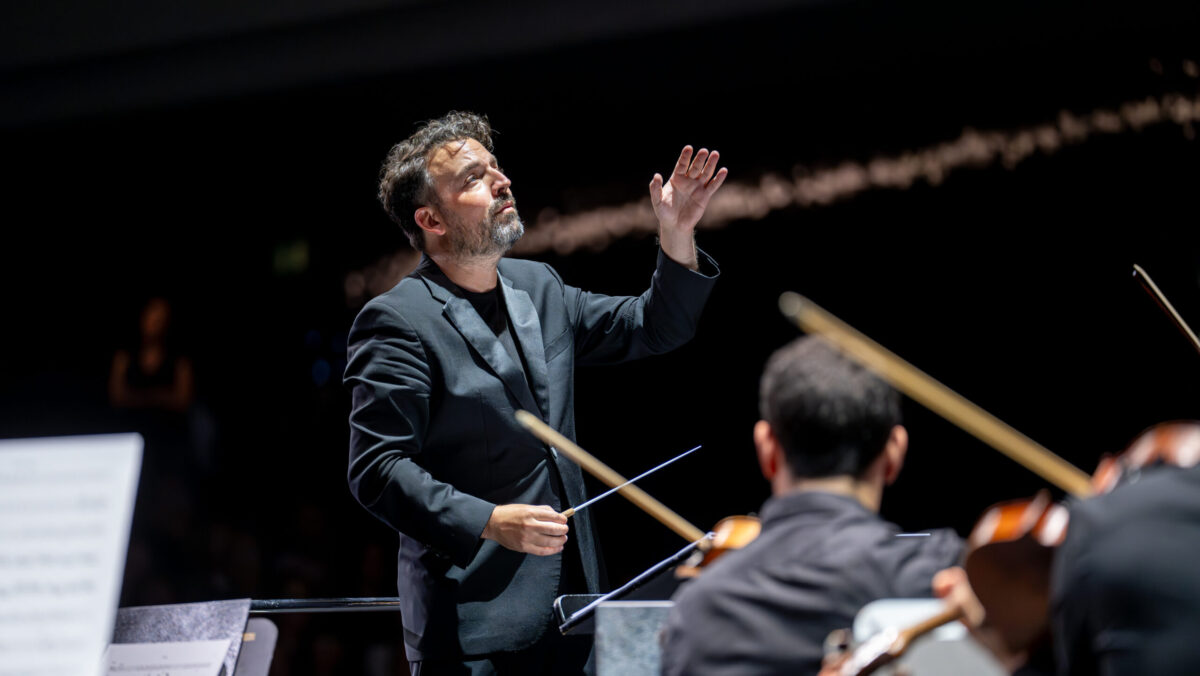
Photo: Mikel Ponce
James Gaffigan likes his wines like he likes his classical music: with the best of Europe meeting the best of America. He raves about Domaine Drouhin and Beaux Frères, Willamette Valley wineries that respect the traditions and expertise of Burgundy. “That’s what we should be doing in America,” he says of both winemaking and opera, “taking what they’ve done and making it better.”
As Houston Grand Opera’s incoming music director, Gaffigan is something of a rarity: an American in, well, America. OPERA America lists 10 U.S. members in the highest budget tier: of those, just two (HGO and Washington National Opera) boast U.S.-born music directors. Gaffigan explains this as a case of Europhilia: “Americans think what’s in Europe is always better – or ‘wow, he has an accent, so he must know what he’s talking about!’”
James Gaffigan becomes HGO’s fifth music director since the company was founded in 1955. He replaces Patrick Summers (also American), who announced in 2024 that he would retire at the conclusion of the 2025-26 season, after 15 years in the role. Gaffigan will be Music Director Designate for the 2026-27 season and begin an initial five-year appointment as Music Director in 2027.
I was caught by surprise when Gaffigan’s appointment was announced earlier this month. Opera houses usually “test run” potential music directors through repeated guest engagements in the years leading up to a transition. That way, they can see how the candidate works with the house orchestra and chorus, gets along with the administration, and connects with audiences. Not Gaffigan. He has conducted just two operas at HGO: his American professional opera debut in 2011 leading Le nozze di Figaro, and Porgy and Bess, which he’s in town for right now. It’s proving a triumph: his snappy, versatile conducting has garnered unanimous critical acclaim and contributed to sold-out performances and an extended run. HGO seems to have timed their announcement to take advantage of that enthusiasm for an otherwise unfamiliar name.
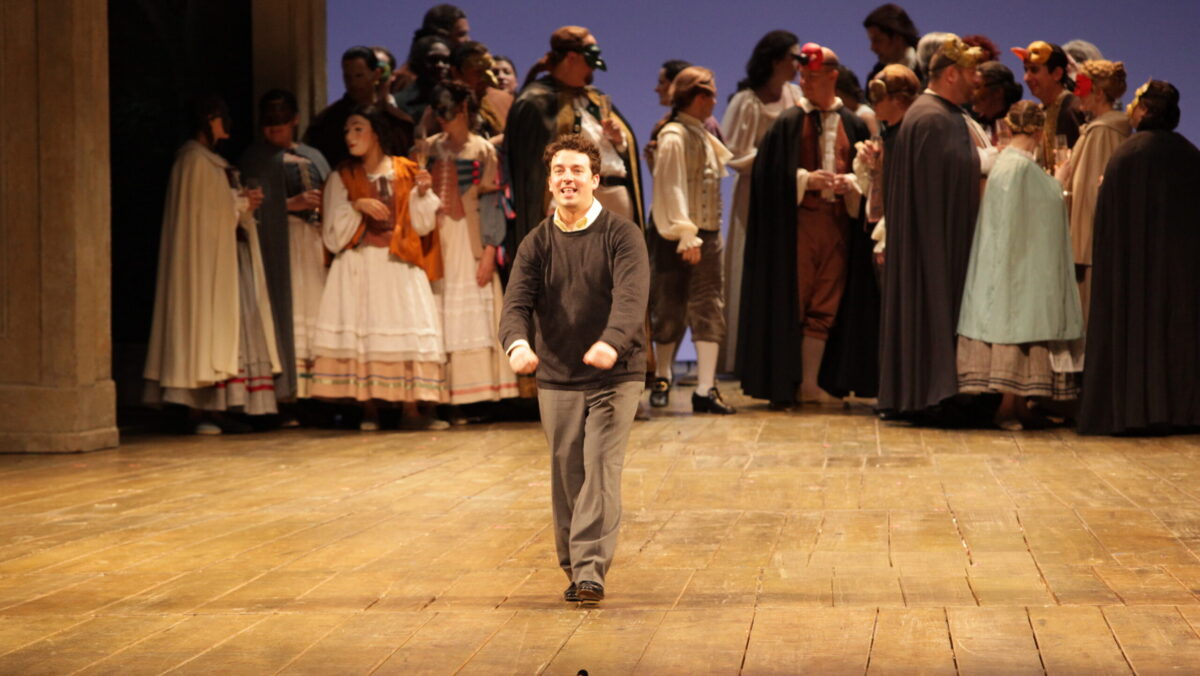
James Gaffigan at his operatic debut in 2011 / Photo: HGO
His 14-year absence is easily explained: Gaffigan has built much of his career in Europe. After assistant/associate conductor stints with the Cleveland Orchestra and San Francisco Symphony in the 2000s, he was named chief conductor of the Lucerne Symphony Orchestra in Switzerland beginning in 2011, a role he held for a decade. Posts at Palau de les Arts Reina Sofía in Spain, Radiofilharmonisch Orkest in the Netherlands, and Berlin’s Komische Oper (his current music directorship) followed.
He thinks it’s important for American musicians to spend time in Europe and understand how the culture of classical music there is different. Partly, it’s the audiences. Gaffigan sees a level of love and knowledge for symphony and opera in Europe that’s lacking in the U.S. It’s also the artistic approach. When he first began working in Europe, he says, “The biggest shock was how people first and foremost discussed phrasing and style before ensemble and precision. In America, we learn, ‘let’s get it together first, and let’s talk about all the magical musical stuff afterwards.’ I learned a lot being in Europe about how musicians prioritize the sound they make. And it was very different.”
Gaffigan maintains that neither approach is better than the other — he seeks to meld the two. “There’s no right way. I like to live in between somehow. I want to take what I’ve learned from the great European orchestras and the great European opera houses and apply them to the great American institutions.” He assures me he won’t be “aggressive” about bringing his European experience to HGO. (Nothing about Gaffigan makes me think he would; he exudes enthusiasm for collaboration, not stereotypical Continental dictatorialism.) He simply aims to combine a New World focus on precision with an Old World attention to “music and color and sound and style.”
Is there anything distinctively American about his conducting, even after all that time in Europe? The hallmark of American conductors, he responds, is their versatility. “If you look at this country, it’s made up of everyone. It’s made up of every type of person, every type of religion, every type of style. I can switch from Gershwin to Strauss or Wagner on a dime. I love these composers. I love Gershwin as much as I love Wagner. I love Sondheim as much as I love Strauss.” He’s also an avowed fan of rock and jazz, with a special love for Nirvana, Pearl Jam, Nine Inch Nails, Jane’s Addiction, and Duke Ellington. Great music exists across genres, and he strives to learn from all of it.
Still, opera holds a special appeal: “I have a big fascination with singers. I think they’re extraordinary because their instrument is their body, and there’s no hiding behind any violin or trumpet or percussion. It’s their voice, their body. I have deep respect for someone who can go on stage and basically be naked to the public.” He also marvels at how many different components must combine to make opera happen – “the carpentry of the set, the lighting, the sound, the human voice, the director, the text… It’s kind of a miracle that opera works when you think about how many pieces of the puzzle there are and how many things could go wrong in a production.”
He’s been part of that miracle at Europe’s and America’s top houses. He looks back fondly at the American operas he has led in Europe, particularly Porgy and Bess at Dutch National Opera in 2019, and cites Tristan und Isolde at Santa Fe Opera in 2022 as a turning point in his career as a Wagnerian. (He led that company’s first Die Walküre this past summer.) He particularly cherishes his experiences with the Mozart-Da Ponte operas, which he has conducted individually at houses across the world and closed a cycle of all three earlier this year in Berlin. That avant-garde production (by Russian dissident director Kirill Serebrennikov) transformed the score with a nonlinear approach and the inclusion of Mozart’s Requiem. Gaffigan was unfazed. As he told The New York Times, “I never would have taken this job at this house if I didn’t like these sorts of things.” He echoed that enthusiasm in our conversation, speaking proudly of “doing very traditional productions and also doing wildly insane productions… It would be a shame to do the same type of production all the time!”
Bringing that mindset to the United States’ more conservative (and donor-dependent) houses might be a challenge, but it’s one Gaffigan has long been preparing for. “I always had in the back of my mind that I would come back to the US for something important,” he told me. “And it needed to be something where I could have a legacy with a partner that I trusted.” In HGO’s General Director and CEO Khori Dastoor, he sees that partner. The pair have known each other since they were students together at New England Conservatory. Dastoor was hired to lead HGO in 2021, and Gaffigan immediately took notice because he “always knew Khori was brilliant.”
As Dastoor kept Gaffigan informed about HGO, he saw something special: a U.S. opera company in a unique position of strength. “There are a lot of exciting things going on in the U.S. There are also a lot of problems, financially and vision-wise,” he explained. HGO was different. “It became completely clear to me that this is the place I need to be, [to do] the work that I’ve always dreamt about doing – building something that is going to make a difference. It’s going to make a big difference in the cultural scene — not just in the community, but outside of Houston.” The country has indeed been looking to HGO as a model recently, especially after a laudatory profile in The New York Times earlier this year.
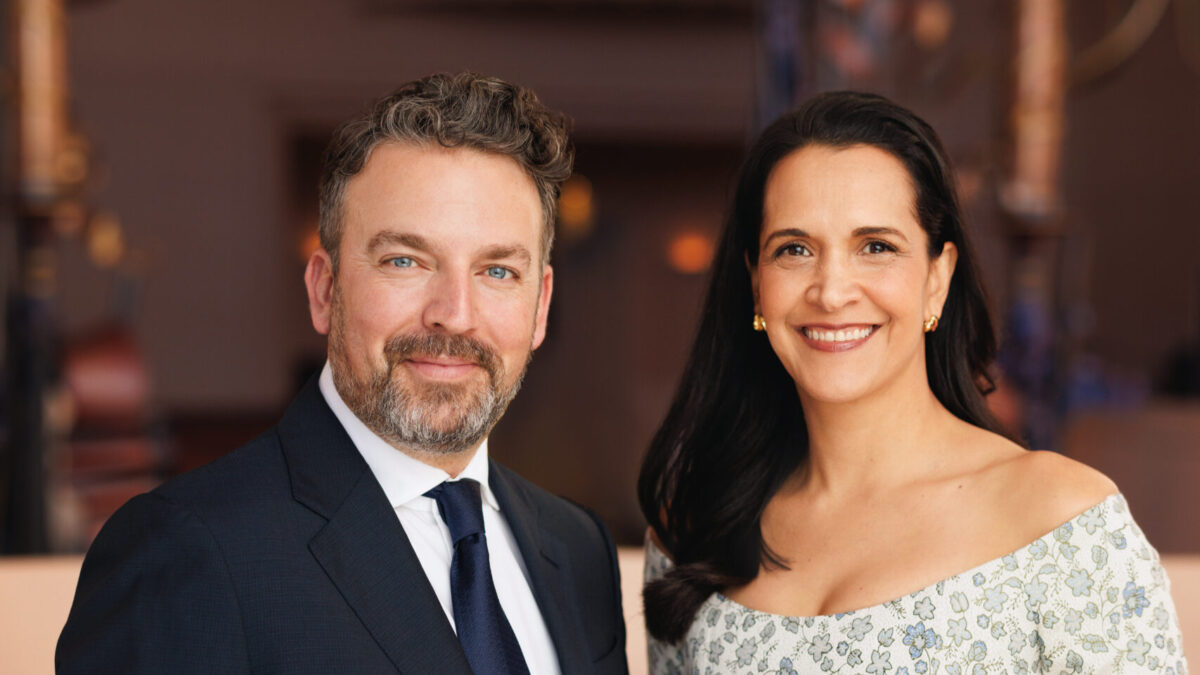
James Gaffigan and Khori Dastoor / Photo: Claire McAdams
To Gaffigan, operatic leadership requires not only a strong balance sheet, but a diverse audience base. “It’s our job now to educate people and share with people how incredible this art form is. And not just opera, but music in general,” Gaffigan muses over the new role of opera companies in making up for the deficit of music education programs in schools. “The key is bringing it to them first and then making them feel welcome in the house.”
During this run of Porgy and Bess, he has seen the fruits of HGO’s efforts to do just that. “The mix of people in the opera house makes me extremely emotional because that’s not what I’ve seen before in the United States. [If a city is] half African American, and you don’t see any African Americans at the performance — that, for me, is dangerous. It’s not because they’re excluding people. It’s just they’re not galvanizing the community behind them. HGO is a beacon for that.”
By accepting this post, Gaffigan didn’t just choose HGO, he chose Houston. That wasn’t a hard choice, either. It’s a city he already knows and loves – in fact, in the press surrounding his appointment, Houston has been claiming Gaffigan as something of a home-grown talent. While he was born in New York City, he earned his master’s degree studying with Larry Rachleff at the Shepherd School of Music at Houston’s own Rice University. He credits that stint with cementing his love of opera: “Going downtown and seeing the opera, especially rehearsals behind the scenes, it really woke me up to this extraordinary art form. Of course I liked opera, but I really fell in love with it when I was here.”
He “fell in love with the city” as well. He laughs as he explains that his “narrow-minded New Yorker” assumptions about Houston – “cowboy hats and oil” – were quickly dispelled by the vibrant cultural life he encountered. He reveled in the city’s top-notch museums, symphony, opera, and restaurants. He’s excited to experience Houston’s culinary highlights again, particularly barbecue and Japanese fusion. (In praising the latter, he proves himself a true Houstonian: locals know this is a star of our food scene, but it has been largely snubbed by the Michelin Guide.) On a night off, you might spot him enjoying sushi at Uchi or Katami, though he rightly warns that the later will “take your whole paycheck.”
What repertoire should Houston expect from our incoming Music Director? Gaffigan extols the virtues of a “balanced diet.” He certainly doesn’t intend to neglect classic masterpieces. He holds that La bohème is “perfect beginning to end” and Le nozze di Figaro is “one of the greatest things in Western culture.” A sprinkling of Carmens and Toscas is healthy for any company. He’s also a fan of musical theater, with a special love for Sondheim, so we probably shouldn’t anticipate an end to HGO’s trend of staging a musical every season or two.
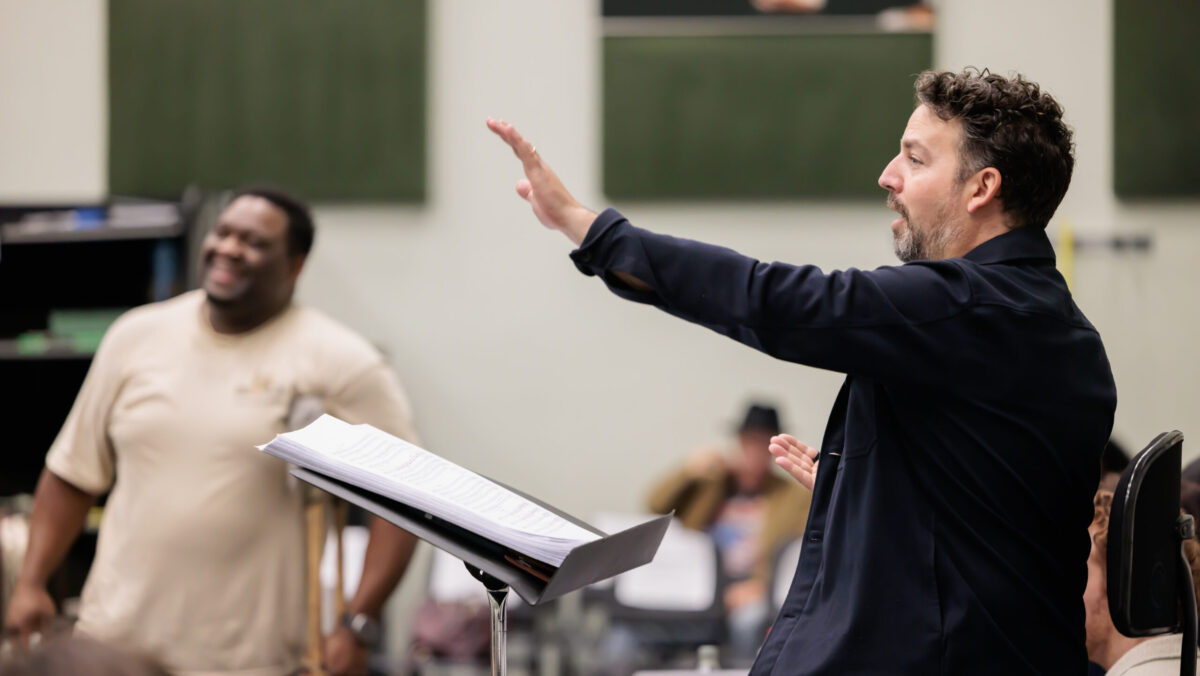
James Gaffigan rehearses Porgy and Bess in October 2025 / Photo: Katy Anderson
We can look forward to some changes from the path Summers has set, though; his “biggest goal is diversifying the repertoire.” He advocates a measured approach, starting with building Houstonians’ trust. Once the audience is persuaded that anything HGO mounts is “going to be extraordinary because of the director, because of the singers, because of the level of the orchestra and chorus,” he can program pieces that wouldn’t usually sell. He mentioned both lesser-performed titles by composers like Strauss and Wagner, and modern composers like Wolfgang Rihm. He also expressed enthusiasm for religious oratorios that lend themselves well to staging, such as Bach’s Passions or Mendelssohn’s Elijah.
The dream project he talked most about is fittingly Euro-American. He pointed out, almost incredulously, that Houston has not produced La fanciulla del West since 1976. He considers it Puccini’s masterpiece, “but it’s not known as a masterpiece because it doesn’t have arias. [It] is through composed, and it’s movie music before there was movie music. It was premiered in New York City in the early 1900s, and it is his greatest score. People think it’s just a strange Western opera. But this is the beginning of the golden era of Hollywood.” It’s also a love letter to America, by an Italian composer. And, Gaffigan says, “He does it better than most American composers that lived after him.”
Much of this won’t be new to HGO. (After all, if Gaffigan’s vision deviated too sharply from Dastoor’s philosophy, the role wouldn’t be a good fit.) Texans have seen several staged oratorios — Barrie Kosky’s striking Saul came to Houston in 2019, and Robert Wilson’s surreal Messiah will hit the stage in 2026. This season included a Puccini rarity in the entire Il trittico (a Patrick Summers dream project), and the company is historically known for championing world premieres and modern operas with Missy Mazzoli’s Breaking the Waves, Jake Heggie’s Intelligence, and Joel Thompson’s The Snowy Day in recent years. And HGO has hardly been averse to risking its donors’ comfort with taboo-laden stagings, like Negrín’s and Saroglou’s deeply uncomfortable take on Salome in 2023.
Gaffigan promises to continue – and accelerate – this commitment to boldness. His excitement is infectious. Despite my indifference to Puccini, I left our conversation eager to buy a (hypothetical) ticket to Fanciulla, and to other ambitious projects Gaffigan undertakes. I love that to him, everything is “and,” not “or.” European and American approaches to music, traditional and challenging productions, classic repertoire and underplayed titles. Would such a “balanced diet” save all US opera companies from financial and artistic woes? Probably not. But this Houstonian is hungry for it – preferably with a good glass of pinot from Domaine Drouhin.
Correction: A previous version of this article stated that Houston Grand Opera had never performed La fanciulla del West; it was last performed in 1976 with Carol Neblett as Minnie.