Twenty-six—I think. Or has it been twenty-eight? The number of different Donizetti operas I’ve seen in live performance. Not sure. But then, no one is quite sure how many he composed. Sixty-five or eighty. Something like that.
He was a speed demon from his earliest years—it was a joke among the other boys studying under the renowned Giovanni Simone Mayr in Bergamo in the 1810s. You haven’t finished your overture yet? Donizetti’s reached his finale. His manuscripts look like it too, which has been one of the problems in reviving them.
There are so many of them fluttering about like Monarch butterflies that Bergamo, his hometown, after years of eying Pesaro and its Rossini Festival with envy (Bergamo is a far handsomer city) has begun to stage Donizetti’s works. This year they’re doing Il Furioso nell’ isola di San Domingo—which I saw at BAM once, starring the beautiful and ill-fated Stephen Dickson—and Caterina Cornaro—which I saw with Leyla Gencer in, I believe, her only New York performance.
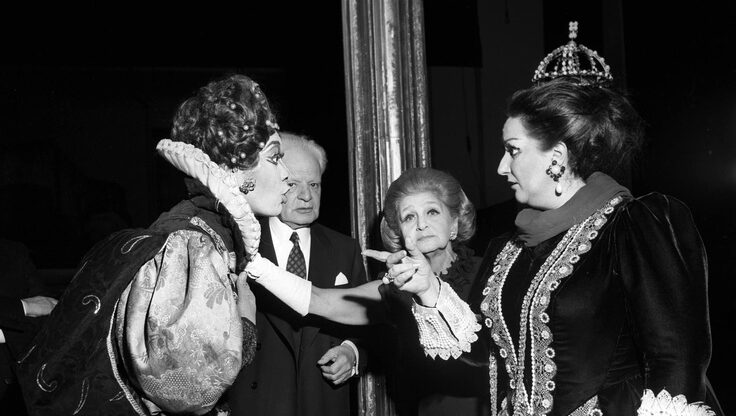
And parterre box wants me to write about Gemma di Vergy, because my very first Donizetti was Maria Stuarda, but they say they’ve got more accounts of Tudor operas than you could shake a royal mace at. Maria Stuarda was not only my first, back in 1967, with Caballé and Verrett, at Carnegie Hall, it is also the only opera in which I achieved the Bel Canto trifecta of Caballé, Sills, and Sutherland. (Caballé sang it best.)
I was eager, back then, to hear any Donizetti historical farrago because I had read in the Times a review of the new recording of Lucrezia Borgia. In those days, bel canto was just beginning to flood the air waves and record shops, and I was a teenager of slight sophistication. Much of my musical know-how focused on the melodies of Sir Arthur Sullivan, and as you all know—but I did not—Sullivan cribbed many of his tunes by parodying Verdi, Bellini and Donizetti.
It struck me (knowing history) that Lucrezia Borgia was a damned strange idea for an opera libretto, so I listened to the radio broadcast of this unknown piece and its little-known cast. Here were melodies as wonderful as Sullivan’s, far more intense in their dramatic froth and sung in a wonderfully melodious if incomprehensible foreign language. Let the rest of the world writhe to the delights of the beat and the screamy guitars and the rasping voice: I gave my heart to melody, and beautiful singing, and ornamental melodrama.
When Caballé and Verrett were announced for Maria Stuarda, I knew where I wanted to be. A thrill! At the climax (end of Act II) when they hurled jagged insults in each other’s teeth, all of Carnegie Hall was on the edge of their seats in excitement—and I caught the grin the two ladies exchanged: “We got ‘em going!”
So when Caballé announced she would sing Lucrezia once again, in Philadelphia, I purchased a ticket and gauged the railroad timetables. Just before the performance I received a message from the box office at the Academy of Music: Madame Caballé is unable to sing the performance, which is therefore called off, full reimbursement on request. What a blow! My first Caballé cancellation! As you may imagine, this is a very sentimental memory for me.
But you want to hear about Gemma di Vergy—or anyway my editor does.
If you want to know why Donizetti was so much admired, Lucrezia will demonstrate. Follow the action of the Prologue. Amid Venetian carousing, the condottiere Gennaro falls asleep. He is therefore unaware of the mysterious veiled lady who approaches and sings, over him, one of the loveliest of all Donizetti romanzas, “Com’è bello, quale incanto.” Two verses of it. Then he wakes and sees her. In the following aria and duet, he is chivalrous but not amorous—that would be too creepy. Because — though we do not learn this till the very end of the evening — she is his mother.
He tells her his life story and they are getting on splendidly, when his friends return, recognize Lucrezia Borgia, and proceed, one by one, to denounce her without naming her. Each of them in turn recounts his reason for hating her (all fictions—the real Lucrezia never harmed anybody in her life), and their repetitions raise the tension—all while Lucrezia entreats them not to tell Gennaro her name—climaxing in a long A-flat—held endlessly by Caballé—while the boys chime in, one by one. Only at the scene’s end do they name her to the appalled Gennaro. Vowing vengeance, Lucrezia departs. But it was that A-flat that made her a star. At the intermission, everyone in the hall raced for the pay phones in the lobby (remember pay phones?) and called every opera lover in New York: “Get over here!”
Quite as thrilling is the trio that ends Act I: Duke Alfonso (Lucrezia’s third husband) has forced her to give Gennaro a goblet of Borgia poison. She is in agonies as he drinks it—and Alfonso, cackling, departs. Gennaro starts to thank her—“You’ve been poisoned! Don’t speak, you’ll be stabbed”—change of tempo—and she pulls out a handy antidote. Does he trust her enough to drink it? At last he does. The crash brings down the curtain. There’s still another act to go.
Both Ashbrook (Donizetti and His Operas) and Osborne (The Bel Canto Operas) remark that in this opera, Donizetti uses melody for dramatic purpose, pushing the story to an intensity new to Italian opera—an excitement on which Verdi (who attended the premiere of Lucrezia as a student) would soon build.
But you want to hear about Gemma di Vergy, an opera with a diva role so difficult it is rarely staged. I saw it unstaged, by the American Opera Society, in 1977 at Carnegie Hall. The title role was taken, once again, by Caballé. You can easily find this performance on YouTube, but I remember it as the night in the top row of the Dress Circle when a strikingly handsome fellow from Nebraska—or was it Oklahoma?—turned to me and said, ecstatically, “New York is a pleasure palace!” which seemed, in those days, to be true. The rhythm was changing. The tempo was getting faster.
The proof is that I’d already seen two stagings of Lucrezia Borgia, one by the Bel Canto Opera, which gave an astonishing range of obscure operas in the back room of a church in the East 20s, often starring its frequent prima donna Mary Lynne Bird, a winsome blonde and a first-rate actress with a true coloratura instrument—she was also my first Philine, Queen Marguerite, Giuditta and La Jolie Fille de Perth. The other, in 1977, was at New York City Opera, where Beverly Sills, exhausted from her Tudor years, proved incapable of the serene flowing legato that had been Caballé’s glory.
I don’t even remember the name of the soprano or the company that presented my next Lucrezia, but it was a satisfying performance. Like a fool, I did not go to London to see Sutherland take it on—her video from an Australian performance shows her in fine fettle. I recommend that one. True, she looks old enough to be the tenor’s mother—but then, in the opera, she is. Eve Queler gave it for Renée Fleming, whose rather hectic performance did not delight me.
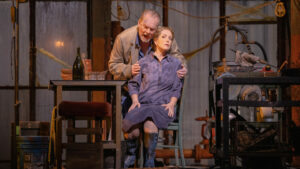
My sixth and, to date, last Lucrezia was given in Bushwick by Gotham Opera. The soprano was Joanna Parisi, and the conceit of the staging was a Mafia family in the present day. This worked perfectly with this opera! The staging was in the round, our seats close to the furniture. In Act I, the Duke was brooding in his saturnine way beside a grand dining table, when the infuriated Parisi entered the room in high heels and a short dress, seized the table, and turned it over, narrowly missing me. We jumped. Her singing was that thrilling, too.
This is an opera worthy of renewed attention. And Gemma? Perhaps—but who can sing it nowadays?
I have friends in Milan, and whenever they are uninterested in what’s going on at La Scala, they run off to Bergamo—or Parma—or Genoa—or any other town with a decent opera house, and check that out. “Have you heard Torquato Tasso?” they asked me—and no, I haven’t. They had. In Bergamo.
They had just taped a performance of Gemma di Vergy that they insisted on playing for me. As I’d forgotten all about it, I was happy to succumb. “Listen to the Act I finale—isn’t it sublime? Among his very best?” Of course, there are nearly as many superb concertati as there are Act-closings in Donizetti’s oeuvre, but I had to agree this one was especially fine. I could barely remember what Caballé and company did with it. But you should catch it yourself, and see if you don’t agree—also that Gemma is one of the most death-defying roles Donizetti ever presented to a soprano.
Donizetti’s career falls into three neat periods: the 1820s, when he was “discovering” himself, the 1830s, when he was on top of the world (his chief rivals were Bellini, who obligingly died, and Mercadante, who ran off to Spain for several years), and the 1840s, when he was working both Paris and Vienna and adopting the style and method of Parisian grand opera. And then he faltered, went mad from syphilis, and faded away.
Now, as for the finer qualities of Gemma di Vergy—but that was fifty years ago and I haven’t listened to it lately. Until tonight, on YouTube, interrupted by too many ads. The CD is around here somewhere—give me an hour to dig it up. You must pardon an ancient opera-goer. I’ll forget my own name next. Listening to the recording of the Queler performance of Gemma, it is marvelous to hear the (very much deserved) roar of the ecstatic hall fifty years ago–and remember that I was part of it. Back when I could still yell.