


Headshot of La Cieca

Cher Public

  • m. croche: For the record, the Lortzing Wildschuetz from the Wiener Volksoper was a good deal of fun from start to... 4:24 PM
  • RosinaLeckermaul: Our local station is playing the Chicago WERTHER with Polenzani and Koch. Very good performance.... 3:30 PM
  • Satisfied: A bit of an aside, but the exquisite Audra McDonald performing at Avery is being presented on PBS this... 2:11 PM
  • Quanto Painy Fakor: Holly Cats! httpv://www.youtub e.com/watch?v=d63j KihoYRg 1:15 PM
  • Batty Masetto: To celebrate Wagner’s birthday we finally got around to watching the Glyndebourne Meistersinger,... 12:37 PM
  • kashania: Marshie: That Böhm Bayreuth Walküre also features the best of Leonie’s screams. 11:56 AM
  • papopera: oH YES, wonderful great composer, rarely performed due to ignorance. 11:24 AM
  • MontyNostry: I thought there was some special French reference I wasn’t getting. 11:12 AM

A tsar is born

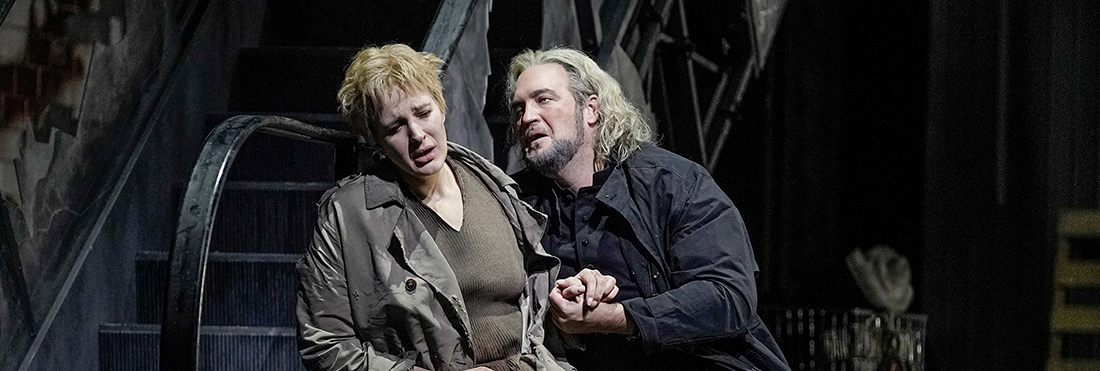
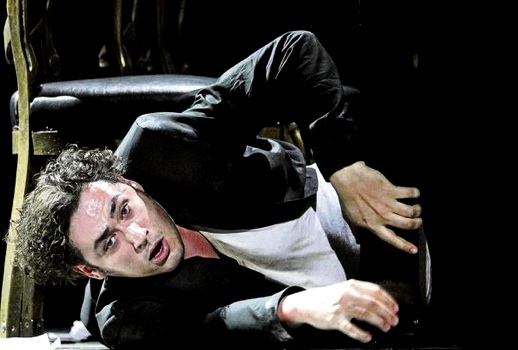
“Vot tsar’ vash!” Here is your Tsar, the 38-year-old Ukranian bass Alexander Tsymbalyuk—his role debut in Boris Godunov, in a new production conducted by Kent Nagano and directed by Calixto Bieito for the Bayerische Staatsoper. 

Tsymbalyuk will be heard next at the Met starting a week from tomorrow, as Montano in Otello.
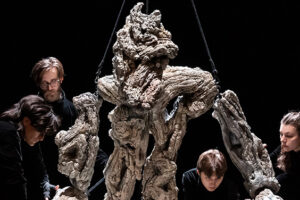
37 comments

  • lorenzo.venezia says:

    When I heard him in the Verdi requiem in the Boboli Gardens, it was like hearing a Rafaello angel sing. Smirnova was incredibly soulful that night. Very touching. The horrible tenor threw everything off. It was also the night I decided that Zubin Mehta has gone deaf.

  • papopera says:

    Wow, what a revelation that singer. Can’t the Met give him something more visible than Montano? The suffocation scene is fun. Tacky to have Feodor played by a soprano with a long braid. Well, perhaps she represents Xenya Godunova.

  • Tristan_und says:

    I can’t remember if Boris actually dies of something specific or is this the generic “death by opera” that seems to take so many characters like Isolde or Kundry. As far as we know, absolutely nothing is wrong with them physically. They just keel over conveniently at the end of the opera. My impression is that Boris was having some kind of seizures, exacerbated by his drinking, but I’m not sure. Anyone else? The Met’s schedule is what, at least 5-10 years in advance: the fact that they got him for a major role next year is incredible in itself.

    • m. croche says:

      From the Alfred Hayes translation of Pushkin’s verse-drama:

      (Alarum. Boyars and court-attendants run in
      disorder, meet each other and whisper.)

      ONE. Fetch a physician!

      ANOTHER. Quickly to the Patriarch!

      A THIRD. He calls for the tsarevich, the tsarevich!

      A FOURTH. A confessor!

      BASMANOV. What has happened?

      A FIFTH AND SIXTH. The tsar is ill,
      The tsar is dying.

      BASMANOV. Good God!

      A FIFTH. Upon the throne
      He sat, and suddenly he fell; blood gushed
      From his mouth and ears.

      (The TSAR is carried in on a chair. All the Tsar’s
      household; all the boyars.)

      Aneurysm? Divine punishment? You be the judge.

      • m. croche says:

        Which, it must be said, is a more discreet description than the one usually given in old Chinese action novels, where characters bleed from the nine orifices.

        • Batty Masetto says:

          Must be extremely difficult to stage in classical Chinese operas.

          • m. croche says:

            Chinese operas are not fluid-friendly. There are legends about singers able to keep their bodies from perspiring onstage, so that their wardrobe and -- most particularly -- their makeup stayed fresh.

            (Speaking of which, I learned an evocative Hokkien term for tears over the weekend: “mu niao” or “eye-piss”.)

    • kashania says:

      Isolde does not simply die!!! She is transfigured!!! Honestly, you ought to know your girlfriend better than that!

      (But yes, I too was going to ask that question about Boris).

      • Camille says:

        “Isolde sinkt, wie verklärt, in Brangänes Armen sanft auf Tristans Leiche.”

        “Kundry sinkt, mit dem Blicke zu ihm auf, langsam vor Parsifal entseelt zu Boden.”

        Isolde and Kundry both fall into sinkholes. Isolde is ‘verklärt’ and Kundry is ‘entseelt’.

        I believe that Elsa, also, is entseelt. I don’t know if she falls in a sinkhole.

        Tutto bello chiaro.

        • Batty Masetto says:

          Obviously the be-sinkholed Isolde is clarified (like butter? maybe she has a meltdown) and Kundry and Elsa are unsealed. (Unless they’ve been turned into seals. But that would be silly.)

          • Camille says:

            I do believe I’ve heard tell that Klarified-Isolden-Butterfat is the key ingredient in the success of a noteworthy Cornwallian shortbread.

            Elisabeth’s death is still a bit of a mystery other than that “Sie verbleibt eine Zeitlang wie in andächtiger Entrückheit” leads me to believe she drank one too many Bieren in an Oktoberfest and died of overexposure on her pathway back to the castle in Wartburg.

            Venus, that’s easy—”Sie versinkt: die Nebel verschwinden gänzlich. ”
            Damn! Another sinkhole.

          • kashania says:

            I always looked down on Elsa for dying the way she does. She shows such spunk earlier in the act and then feebly dies as soon as Lohegrin decides to leave her.

            But then again, Lohengrin is full of plot problems. For example, what exactly was he planning on doing with poor little Gottfried if Elsa hadn’t demanded to know his name? Just expect the boy to live out his days as a swan in the castle pool?

          • Batty Masetto says:

            Kashie, I think Lohengrin says somewhere that if Elsa had only been able to her trap zipped for a year, Gottfried would be demobilized from the Schwanenkorps because the spell would be broken.

            But I do think it’s hard for Elsa not to come off as a dimwitted dishrag.

          • kashania says:

            Batty: And what would Gottfried have to say about all this? He’s the heir apparent and he’s stuck in the body of a water fowl (albeit a very graceful and grand water fowl) for a whole year?

          • Batty Masetto says:

            Well, it’s all Ortrud’s doing, after all. I don’t imagine she would have a very happy time of it once Gottfried got back.

          • Camille says:

            The Trapzimmer period was “ein Jahr”.

            Karita Mattila, to whom I shall be ever grateful, pulled off the miraculous accomplishment of making Elsa not only credible but sympathetic.

            To this day I do not understand how she did it and I am forever indebted to her for making the Biggest Ninny in All Opera a real, breathing, living human person. Go Karita and mucho spasibo!

          • manou says:

            kashania -- no great hardship to spend your time swanning around.

        • Camille says:

          Aber nein! Elsa: “Sie sinkt entseelt in Gottfrieds Armen zu Boden.”

          So, another sinkhole and she drags armer kleiner Gottfried down her!

          A new regie could place them all in sinkholes in Florida, ah reckon.

          • Batty Masetto says:

            Nope, not enough seals in Florida. Maybe Alaska. Or Lower Slobbovia:

            http://tinyurl.com/brc2gmd

          • Benedetta Funghi-Trifolati says:

            I don’t know what Elisabeth actually died of but I do remember beloved Leonie exiting the Met stage into the wings in Act III in the s-l-o-w-e-s-t of almost cinematic SLOW motion where it was evident and dramatically clear by her body language, posture and dream-stricken but shattered visage that she was already more than half in the next world. Poor Wolfram was ready to launch into the ‘Abendstern’ but Leonie wasn’t quite into the wings. This was not deliberate scene-stealing, just Leonie being deeply in character. This exit was in complete contrast to her joyous, hyper entrance in Act II wherein she spontaneously yet methodically “greeted” every single square inch of the Hall: every pillar, every bench, every chair, every tapestry, every tilestone. Bless her!

          • Camille says:

            Leonie is so famous for that exit of hers—is it filmed anywhere at all? It would be wonderful to see. That is how I’ve always heard it described before, very very slo-mo.

            Leonie, wherever you still are, we still love you with all our hearts and thank you for what you gave us. I don’t know that there would ever be another one like her even allowed.

  • Erdgeist says:

    Velikolepnyi! More!!

  • deviafan says:

    I saw him last week in Munich, he was great! I was really impressed with his Boris. When I checked his schedule I see he is singing a lot of secondary roles. Hopefully this will change soon.

  • eric says:

    Why was the tsarevich dressed in a skirt? Just the normal eurotrash production? (It’s hardly an explanation to say that maybe it was a kilt, not a skirt.) Or is he leaving the throne to the tsarevna?

    But you’re right, it’s an interesting performance by Tsymbalyuk.

    • La Cieca says:

      The rest of the production makes it clear that Fyodor is a girl. I don’t know what the rationale is for this gender reassignment, but it doesn’t really damage the emotional impact of the story that much that I can see.

      • Jack Jikes says:

        Adult females usually play prepubescent Fyodor typically with awkward results. I thought the sex change was ingenious. Fyodor’s death by pillow smothering on the other hand seemed distracting and downright ludicrous. But the direction of Boris -- extraordinary.

        • eric says:

          I agree that it was distracting. But I don’t think it was ludicrous, in principle. It put Boris’s reign in context by graphically reminding people that his son was quickly deposed. From Wikipedia: “He left one son, Feodor II, who succeeded him and ruled for only a few months, until he and Boris’ widow were murdered by the enemies of the Godunovs in Moscow on 10/20 June 1605.” (http://en.wikipedia.org/wiki/Boris_Godunov )

          • Jack Jikes says:

            It wasn’t the fact of the murder that bothered me but the stagey awkwardness. The fine theater craft in Tsymbalyuk’s
            delirium made it seem even more so.

      • itrinkkeinwein says:

        Putin has two daughters?

        Bieito had the placards righted by the night of the Mezzo TV b’cast (versus the rehearsal and PR shots), so he was intent on making his point, I believe.

        • La Cieca says:

          Putin is only one of a number of heads of state pictured on the placards: Blair, Berlusconi and George W. Bush are among the others. My interpretation of this scene was that the folk, remnants of an Occupy movement, are bullied and coerced into demonstrating in favor of in international economic summit or some such high-profile confab held in the fictional “Russia” this Boris rules.

          • m. croche says:

            No Merkel, huh?

          • itrinkkeinwein says:

            Certainly the folk look like remnants of an Occupy movement. The goal of the coercion (which of course is legit, re. the libretto) has to be support for the face on the handed-out flags, no? The summit does take place, however, as Scene 7, with finance ministers as quasi-spectators, incl. one with a tell-tale red briefcase. As I wrote you-know-where, the gear and map sort of nail Putin, whose placard position and sequence was repeated last Saturday. Bieito can’t follow this through, for obvious reasons, and the result is a dramaturgical mess. Okay, a compromise. I think our interpreting Bieito’s “interpretation” is like a joke about a joke. At the same time, I refused to look at the mountain of press material offered in explanation. The work should speak for itself.

          • itrinkkeinwein says:

            Details such as Boris asking for the “czarevich” as he dies and then a girl showing up are the reasons Régie-Theater is disliked.

  • ohbeone says:

    He was a great Basilio in Barbiere at La Scala a few years ago. Very funny! He’s also a really fun guy. We went out for dinner afterward, and he asked me to take his picture with Joyce DiDonato because he only had pictures in costume, and he was a big fan!

  • kashania says:

    This guy is remarkable (and a looker!).

  • itrinkkeinwein says:

    ” … as Montano in Otello”?

    Gee, the Met casting department is right there on the cusp, ain’t it?

    This guy has been on Hamburg’s payroll for years. Don’t they have scouts? Judgment?

    Hearing him (Feb. 20 and, less stupendously, March 2), I am irked it took Munich this long. But at least they gave him a proper role, and Kotcherga to work with.