
Headshot of La Cieca

Cher Public

  • manou: The museum was wonderful, ant not too crowded (except for the Night Watch watchers and the Vermeer... 5:39 AM
  • Buster: Glad you enjoyed it Manou! Doris Soffel sang Fricka in an earlier run too, alternating with the very... 5:27 AM
  • Buster: Leider made the stupid mistake to die. Listening to zombies is so uncool. 5:10 AM
  • manou: Bianca – I think this is the La Scala Barenboim Ring. Buster – yes, Naglestad was the best... 5:08 AM
  • Buster: Thanks! She is doing a few Siegfried Brünnhildes here next season before Catherine Foster takes over. I... 5:08 AM
  • DeCaffarrelli: Rather than argue the effectiveness of the McVicar Giulio Cesare production, I’ll simply say... 5:05 AM
  • MontyNostry: I know there’s debate as to the true identity of Vinteuil, but I went to a concert of Fauré... 4:49 AM
  • Feldmarschallin: Yes Buster that was the first time ever that I heard someone say Leider sounded thin. Oh well to... 4:30 AM

Experiment in error

It is, as Noel Coward remarked, astonishing how potent cheap music is. According to Brockway and Weinstock’s World of Opera, Gounod’s Faust was performed, after a rather lackluster debut in 1859, a thousand times inParis at the Opera between 1869 and 1894—a gobsmacking average of once every nine days. 

It was the nineteenth-century opera equivalent of the “tired businessman” show. Moreover, it was selected as the first opera to be performed at the Metropolitan Opera onOctober 22, 1883(that’s the “Old Met,” if you’re keeping score); and it became so endemic there that by 1897, the waggish critic William J. Henderson dubbed the Met “Das Faustspielhaus.” Although Faust has hardly fallen out of the repertoire altogether, its performances always feel more like revivals than the returns of a classic.

I must confess that I have always felt a deficiency of sympathy and even perhaps of interest in Faust—Marlowe’s or Goethe’s, it hardly matters. The Faust of legend and play is an old pedant who longs either for more knowledge or more experience, depending on your reading, who, it seems, takes an inordinately long time to notice that everyone else is having more fun.

Barbier and Carré carefully excised every trace of intellectual distinction from Goethe’s drama, and the result was perfectly suited to Gounod’s facile style. Their Faust is a cad without any curiosity beyond what is under the heroine’s skirts—he seems, after all that learning, to be the guy who, if he had it to do all over again, would definitely nail that hot chick in Accounting. Their Mephistopheles—who is supposed to be, if not perhaps the supreme Devil, a high-ranking member of the infernal cabinet, is hardly more than a card-shark, parlor magician, and pimp.

Marguerite must be considered seriously for the position of opera’s stupidest heroine, although she faces stern competition from Donizetti’s Lucia and Meyerbeer’s Dinorah (“Stupidity is the real key-note of Marguerite’s character”—this, from one of the role’s greatest exponents in the 19th century, Clara Louise Kellogg).

Let us not deny Gounod his skill, and his way with a melody—but the work is essentially an operetta in a sour mood, complete with idiot hero and ingenue, and a rake for comedy effect. Gounod learned a great deal from Weber and Meyerbeer and even Beethoven, and then made a molehill out of their mountains; at his best, he sounds like mid-period Verdi at his laziest.

You recognize, almost against your will, half-a-dozen tunes and themes that have entered the cultural memory, and have been quoted, distorted, and parodied so many times that we have forgotten that they were once worshipfully received as components of—yes—Queen Victoria’s favorite opera.

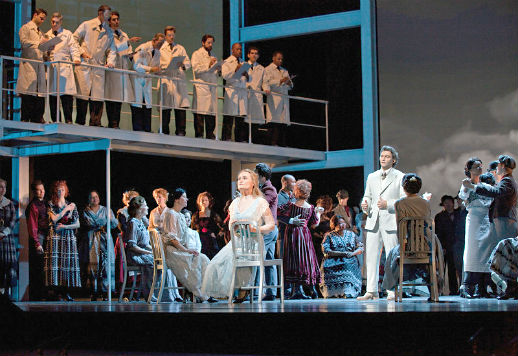
Des McAnuff’s controversial production, in this HD relay, relocates the opening action to c. 1945. During the overture, Faust (a not very much aged Jonas Kauffman) hobbles slowly through a crowd of grotesques, presumably victims of nuclear fallout. We are in a large scientific office/laboratory; Marina Poplavskaya turns up, silent, as a lab tech.– apparently that chick moved up from Accounting. Faust is a nuclear scientist, somewhere between von Braun and Oppenheimer, surrounded, early on, by the chorus in lab coats. Deep, huh?

McAnuff seems happily unaware that the A-Bomb is just as clichéd and superficial a gesture toward the discussion of evil as Nazism now—it’s just that nuclear warfare is “our” evil, while Nazism somehow remains the evil of the other.”

Speaking of evil, Rene Pape turns up as Mephisto in a fine white suit and Panama hat, looking a bit like George Raft. Rather than restoring Faust’s youth and whisking him off to a new place, this devil apparently moves him back in time, to something like World War I—the first of McAnuff’s decisions that defy sense. Surely, Faust regrets his lack of action, rather than his actions —how is bonking a village girl going to assuage genocidal guilt, exactly? At any rate, Marguerite’s village couldn’t be happier about global conflict; so happy are they that they launch a giant soldier puppet cavorting around the stage (I didn’t get it either).

Michelle Losier, whose lovely mezzo was somewhat lost in the unrewarding role of Siebel, was apparently dressed by the designer of Newsies. Marguerite is, in any production, the kind of girl who simultaneously doesn’t know how babies are made, and is totally impressed by diamonds (Bernstein’s Cunegonde, at least, knows what she is about; her cynicism and hypocrisy are part of her charm). I did not mind the French-bourgeois look of the villagers’ costumes, but drab 1915 made an odd match for the 1985-style water cooler that dominated center stage for much of the action, and was the location of Mephistopheles’ wine-making parlor trick. Where are we, Mr McAnuff? 1910, 1985, 1945, 1530?

For the bulk of the action, Faust proceeded business-as-usual; it is very hard to re-flavor the Gounod-Barbier-Carre religio-erotic treacle. McAnuff made a brave try, with the sudden appearance of a second giant puppet, this one representing the Ghost of Christmas Yet to Come, at the close of the fourth act—but the curtain spared us from dwelling on that absurdity. The ballet was cut down to a brief mime by those lab assistants shielding their eyes from, you guessed, a Los Alamos-style blast (deep, huh?).

The McAnuff frame returned in force at the end of the opera, and showed his confusion and discomfort. Marguerite’s soul is spared, but in this production clambered bodily up a large steel staircase at the back, while the chorus—back in the lab coats of the overture—assured us of her salvation. How the agents of the nuclear Faust’s destruction of the world—his lab assistants—can be understood as celestial voices, Heaven only knows. Methinks McAnuff faintly remembered that angels wear white too, and thought it would be cool if they could be equated with scientists. It might be cool, if it made any sense.

The action closed with Faust’s completion of the suicide he threatened in Act I—it was all, apparently, like St. Elsewhere, a dream. McAnuff seems to share the simplistic disapproval of many “creative types” for science, and mixes that with an equal and equally typical disapproval of revealed religion. The sticky, false theology that Gounod and his librettists shared with much of the 19th century lies at the heart of the opera’s old success and more dicey recent fortunes—but you can’t just ignore it for three hours and then put a lab coat around it.

There were a few modestly interesting touches—we were treated (I use the word advisedly) to enormous rear-screen projections of Poplavskaya between acts, looking either wistful or doleful; and, during the quartet, more techno-magic made giant roses bloom in rear-projection, and then, a la Mary Zimmerman at her artsy-craftiest, large fabric roses rose from the stage to the fly-space.

Yannick Nézet-Séguin gave Gounod’s score an energy and focus that made you wish you were hearing Berlioz. As Marguerite, Poplavskaya exhibited her usual troubles. She can’t decide where to focus her sound—straight out the top of my head? The “mask”? The teeth? The chin? The balcony? As a result, her performance was exciting in the wrong way—suspenseful. We never know what we are about to hear—will it be pseudo-Bumbry now? Or pseudo-Dessay? As Faust, Kauffman—arguably the world’s leading tenor now—was fine, if understandably baffled by his character and the production. He is not a French stylist, and does not really execute a ligne de chant, but it is harder to think of a more intelligent or conscientious singer going. As Mephistopheles, Pape was commanding, but did little to diminish the cheap-comedy elements of the character.

Russell Braun was quite competent as Valentin, Marguerite’s brother, who in the absence of a father figure, acts as the dull enforcer of the status quo. The production’s Marthe, who has a key role to play in the aforementioned quartet, was shockingly uncredited—there is no sign of Wendy White’s name in any publicity.

The Met’s HD relay version included an interview with Kauffman, in which he deftly spoke of his intellectual investment in the role, without once mentioning the director or the production, as well as an interview with Pape, which had even less content than the role he played. Hostess Joyce DiDonato also spoke to Danielle de Niese, David Daniels, and Jeremy Sams, who went a long way toward making The Enchanted Island seem in prospect like something more than musical mashed potatoes.

McAnuff’s production suggests very strongly that, where Faust is concerned, you can’t go home again. After Tristan and Pelléas and Peter Grimes—not to mention Busoni’s Faust—it’s too hard to embrace this soufflé as living art; either we must give it up, or take it on the terms of its own times, prurience, piety, and all. McAnuff’s production, which seems to glance enviously in the direction of Adams’ Doctor Atomic is neither gleefully old nor truly new.

Photo: Ken Howard/Metropolitan Opera.
87 comments

  • manou says:

    There is comment elsewhere on the blog about the wisdom of asking someone to review music he does not care for.

    The reviewer here acknowledges “a deficiency of sympathy and even perhaps of interest in Faust, so one is immediately aware that his comments may not be entirely impartial. Indeed, he pours scorn on the music, which is “cheap” and even and even “religio-erotic treacle”, the opera (the “equivalent of the “tired businessman” show”) and the libretto, where “Barbier and Carré carefully excised every trace of intellectual distinction from Goethe’s drama”. He will however allow Gounod to have “his way with a melody”, although he is not very happy that “you recognize, almost against your will, half-a-dozen tunes and themes that have entered the cultural memory” -- quelle horreur!

    So yes -- “Gounod has (still has) ardent defenders. It was both elegant and gracious of the reviewer to answer some of the points made by other posters, and very much appreciated. However, his antipathy for the piece should maybe not have made him the ideal choice for this assignment.

    A brief note about Marguerite -- maybe it would be more apt to describe her as innocent (or better still “une âme innocente et divine”). After all, Mephistopheles has already “bought” Faust -- what he really wants is Marguerite’s soul, and he can only obtain it if he can manipulate her downfall through the good offices of Faust.

    Apart from that, it seems that the production has been discussed ad nauseam, and in fact I am quite certain that some of the posters have attributed to McAnuff all kinds of clever concepts which may never have crossed his mind. So I am sure that silence on my part will be highly appreciated.

    • manou says:

      One “and even” is quite enough.

    • oedipe says:

      But manou, it is chic, intello, bobo to hate plebeian Gounod, don’t you know?

      • ianw2 says:

        Yay! I’m chic, intello and a bit bobo. BCBG on, bitches.

      • manou says:

        I must be content with my status as an uncouth and reactionary Neanderthal then. Sob.

        • brooklynpunk says:

          Manou:

          THAT being the case….

          Did you go to the Veronique Gens recital, last week, at the Wigmore Hall?

          I just saw that it was broadcast on the BBC-- and am hoping it is still available for listening!

          • manou says:

            I did not go brooklyn -- but it is still available

            http://www.bbc.co.uk/iplayer/episode/b018090k/Radio_3_Lunchtime_Concert_Veronique_Gens_Susan_Manoff/

            Programme : Massenet: Chant provençal; Rondel de la belle au bois; L’âme des oiseaux; La mort de la cigale; Soleil couchant; Nuit d’Espagne Gounod: O ma belle rebelle; Prends garde; Lamento; Où voulez-vous aller?; Sérénade Hahn: Quand je fus pris au pavillon; Trois jours de vendange; Lydé from ‘Études latines’; Tyndaris from ‘Études latines’; Pholoé from ‘Études latines’ ; A Chloris; Le printemps.

            To compound my lowbrow status, I also love Massenet and even…..dare I say it…..am quite fond of Hahn.

            I have now lost all my street cred forever.

          • brooklynpunk says:

            Thanks, Manou!

            I really am fond of Hahn’s songs , as well.

            And- while I find his Operas not ALWAYS to be my “cuppa”-- I do like Massenet’s songs, as well..

            AND-- I really love Gens!

          • armerjacquino says:

            Speaking of Gens (and regie-haters, look away) has there ever been an ‘Ah, chi mi dice mai’ which more precisely made its decision as to what kind of woman Elvira might be? The boho top, the hoodie, the shopping- I’ve MET this woman.

        • armerjacquino says:

          John Waters said that if you pick someone up in a bar, go home with him, and there are no books in his apartment, don’t fuck him.

          There is a similar bon mot waiting to be written about people who don’t love the final trio from FAUST.

          • Batty Masetto says:

            Uh-oh, AJ -- does it have to be *love*? Would *like* still do?

          • armerjacquino says:

            *updates Excel spreadsheet*

          • ianw2 says:

            I can assure you AJ, that my intense dislike of Gounod has no bearing whatsoever on my abilities to perform horizontally, vertically, perpendicular and sometimes even suspended from the ceiling.

            I will concede that Je veux vivre is catchy, and Leve-toi soleil has a certain charm, but until the day they’re interpolated into Faust, it holds nothing for me!

          • armerjacquino says:

            As I’m sure Mr. Waters meant, Ian, it’s not how good they are, it’s whether one would *want* to…

          • Batty Masetto says:

            Why am I now haunted by the image of AJ singing “Anges purs, anges radieux” while suspended from the ceiling? …

  • BillyBoy says:

    Rather surprised no one has commented on this:

    “It is, as Noel Coward remarked, astonishing how potent cheap music is.”

    It’s not a Coward remark. It’s a line from “Private Lives”, spoken by Amanda. I believe (but I’m prepared to be corrected by someone who has the text at hand):

    “Extraordinary how potent cheap music is.”

    • manou says:

      Well -- as Coward wrote “Private Lives”…

    • La Cieca says:

      You’re right, it’s Amanda, and I should have caught the paraphrase. In the writer’s defense, though, it should be noted that it was an indirect quotation, which allows for more latitude in reproducting the spirit rather than the word of the original.

    • The Vicar of John Wakefield says:

      “Don’t quibble, Sybil” seems an apt response.

  • poisonivy says:

    I just wanted to thank metipandar for this excellent review. I’m an avowed Faust hater myself and I’ve never been able to express why exactly that is so. This review took the words right out of my mouth.

  • metapindar says:

    Thank you for the correction of “astonishing” to “extraodinary.” I will recommend, however, that in future, we allot every quotation to its character: not Trollope, but Dolly Longstaffe; not Milton, but Lucifer; not Shakespeare (NEVER, NEVER Shakespeare), but Prince Henry, or Imogen, or Puck, and so forth. Infractions will be followed by canings.
    As for my reservations about Gounod--reviews are not love-fests. As a reviewer, you take what is given you, and try to make the best of it, on its merits. You all may or may not have noticed that by no means--by NO means--do all of La Cieca’s reviewers give good reviews, or like the material. La Cieca’s reviewer for, e.g., the DVD of Prokofiev’s *Three Oranges* gives every evidence of loathing the material, and (if memory serves) casts doubt on whether any production would be worthwhile. I did not write in and say, “Ooooh, you hater!”; I murmured to myself, “Well, I certainly like that charming score better than s/he does! Ah well.” I cannot imagine that La Cieca, or any editor, would stop someone in his or her tracks and say, “Wait, do you LOVE this? Before you go/see/hear? …because we can only print raves here.”
    It is clear that Gounod still has his effects, although not so much on me (for French 19th-century confections, I’ll take Delibes and Offenbach); I hope a different production will serve Gounod better, and explain part of his appeal to those of us who are not already fans.

    • Tristan_und says:

      I tend to agree with the reviewer on his estimation of the music of Faust (and I would MUCH rather hear Berlioz, thank you, which does leave in some intellectual content), but music is littered with trashy beer-hall tunes that are elevated by their various contexts and variations (La donna e mobile -- fluffy tune is bitter irony as we watch Gilda listen to her faithless lover/rapist; last movement to Beethoven’s 9th, anyone? and is there any opera queen who loves “Salome” that can’t admit how trashy and over-the-top it is???). And what is my point, you may ask? I guess, just that it’s a FINE LINE, my friends, between cheap music and glorious music, and maybe if we opened our ears a little we would hear more glorious and less cheap. Just a thought.

  • La Valkyrietta says:

    Coward also said, “Television is for appearing on, not for looking at.” He was witty, but his name was not above the stage of the old Met. Gounod is not Wagner, Verdi or Mozart, but I would probably see ‘Faust’ again, with Kaufmann and Pape, rather than ‘Jersey Boys’, which I have not bothered seeing. The real problem with ‘Faust’ is not that the music is not at the level of Goethe, but that vile production! Horror! Those spiral stairs! Ghastly! I wish they had casted someone like Caballé who would just say, “No, no, no, no. I don’t go up those stairs, I come here to stage, I stand, I sing.”