
Headshot of La Cieca

Cher Public

  • CarlottaBorromeo: The Dove reduction was for 18 players (and 12 singers). But it was intended for performance in... 7:58 AM
  • Cocky Kurwenal: Point is, I don’t think the curiosity factor impacts much on ticket sales (if anything I... 7:18 AM
  • Hippolyte: Your Penelope, Anna Caterina Antonacci, will be returning to NYC, it was announced yesterday. She will... 6:56 AM
  • Feldmarschallin: Now a few more pics of the Trovatore especially for FragendeFrau: http://www.baye... 6:54 AM
  • Henry Holland: Wow, when two Pasatieri pieces, La Roi de Lahore, the simplified version of Levy’s Mourning... 5:05 AM
  • Bosah: The problem is that, more often than not, “classical music” on PBS means “popera.R 21;... 4:12 AM
  • Buster: Opera South did the first Bieito opera staging ever: Il Monde delle Luna – really bad, not becasue... 2:24 AM
  • m. croche: Let’s just say that Lang was being a bit diplomatic. 2:15 AM

Rodelinda, regina del primo piano

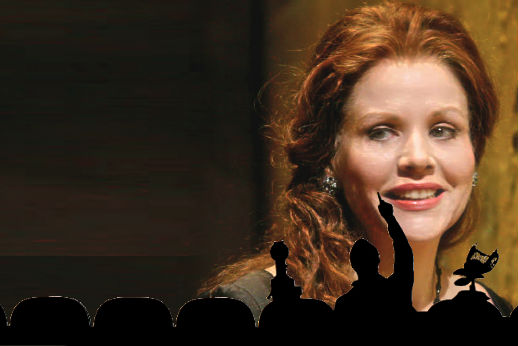
I half-wanted to dislike it; my expectations were very low. Renée Fleming in the Baroque, after her very uncertain recent outings in bel canto! Let’s face it; this year, her Rossini (Armida) and Donizetti (Lucrezia Borgia) did not cover her in glory. How, at this HD relay on December 3, would she cope with Handel’s stitchery, hardly less complex for the voice than that of Rossini?  Stephanie Blythe, reliable as rain, but again, not a Baroque singer! And then, there is the Met itself, whose ambivalence toward the eighteenth century is well displayed by their production of Gluck’s Iphigenie (hire modern-style voices and bury them in darkness), and the upcoming Enchanted Island (remind everyone why pastiche was so meretricious).  Moreover, there is the Met’s broad conservatism, punctuated by insane risks, exhibited this season by the intellectual timidity of their Anna Bolena on the one hand, and the admittedly innovative if perhaps ineffectual experimentalism of the new Faust on the other.

Rodelinda itself has a rather unusual history. It was Handel’s third hit in a row for the Academy of Music at Haymarket in 1725; following Giulio Cesare and Tamerlano; it was arguably the best thing he ever did for that company. He blurred and dampened the achievement in his 1731 revival by importing bits from other operas—but let that pass, let that pass. Rodelinda marks the initial point of the 20th-century Handel revival; produced in 1920 at Gottingen, and again in the United States in 1931. Despite several notable productions in our era, beginning with the 1959 Handel Opera Society’s staging in 1959 with Joan Sutherland, the Metropolitan Opera did not get around to it until 2004, and it is a revival of that production, which they staged at the urging of Fleming herself, that we see now.

Rodelinda was one of the roles Handel created for the flexible, expressive, and ugly superstar, Francesca Cuzzoni. At 52, Fleming is fairer far than Cuzzoni was at 25, and doubtless a better and more responsible singing actress. Although the accuracy of her passagework will never satisfy the purist, it was a relief to hear that, as evidenced by the very first aria (“Ho perduto”), Fleming has found her trill again, and she is as lithe and convincing a stage presence as the Met has now.

As Grimoaldo, the usurper with a conscience, one of the first major tenor roles Handel wrote, Joseph Kaiser acquitted himself very well, and made a striking stage presence, although it is possible to hear the creep of a wobble in the sound that may trouble him later; Blythe was dramatically handsome in carriage and vocal delivery as Eduige. Shenyang, as the unrepenting villain Garibaldo, sang well enough, but fell flat as a stage presence; he was surrounded by singers who gave dimension to their parts, but his portrayal was almost cartoonish in its simplicity.

And then, there were the countertenors—in this revival, Andreas Scholl and Iestyn Davies. Countertenors were never Handel’s choice—if a castrato were not available, he preferred women en travesti or recasting for the tenor range; and, truth to tell, he seems to have had little patience for the castrato voice, temperament, or fan-culture. Given, however, that we are not about to create new castrati, and blithely dropping an entire role down an octave is not an entirely satisfactory solution either, there has arisen a new breed of countertenor, ready to take on the challenges once given to opera’s geldings.

Bertarido was one of the great Senesino roles, and it can be argued that Handel gave him, as befitted his star status, all the best tunes—“Dove sei,” which perhaps rivals “Ombra mai fu” in beauty, is only the first of many beauties; Handel gave the trusty Unulfo, first played by Andrea Pacini, a succession of sparkling and difficult arias. There is some question about the suitability of the countertenor voice to the cavernous Met spaces—hence, no doubt, the Met’s reluctance to invest heavily in the Baroque, which relies so much on male characters in the treble registers—and, no matter how deftly Scholl and Davies work, they are, in effect, singing falsetto, and there will always be a heft lacking.

Nevertheless, Scholl was an effective and affecting Bertarido, albeit  a tad underpowered; Davies, in contrast, had enough squillo to make his arias seem louder than they perhaps were.  A salute should be given to ten-year-old Moritz Linn in the silent role of Flavio—he was wonderfully striking and expressive, despite the impossible task of emoting without a word to say or sing.

The plot is based, quite loosely, on the unpromising theme of 7th –century north Italian history, and it was just as well that no effort was expended to recreate the Dark Ages.Wadsworth’s conception gives us a kind of tempered 1725—hair and apparel that “feel” period, without quite being accurate to the button. Gone are the cypress groves of Haym’s libretto; instead, we see a chastened and peeling grand 18th-century house, with its reception rooms, stables, gardens, library, and, of course, dungeon.  Wadsworthand Lynch took every advantage of the Met’s resources to suggest an almost infinitely wide and deep royal demesne, albeit one of decayed grandeur.

The great downfall of this sort of opera seria is that is consists, in effect , one aria after another , a phenomenon that makes Rodelinda and Bertarido’s duet, “Io t’abbracio,” almost inadvertently moving (and the closing refrain of the opera, for five actual voices, makes you feel faint!), but Wadsworth understood how to vary and deepen the movements of the characters to propel a (for the period) remarkably human and touching story. Even more, perhaps, than in his staging of Gluck’s Iphigenie en Tauride, he elevated an 18th century work to something well beyond the staged concert. We can only hope that Jeremy Sams and Phelim McDermott do as well with Enchanted Island.

Rodelinda is a piece that thrives and perhaps even benefits from HD broadcast; for the very reason that it, like most Baroque operas, was originally offered in much smaller houses, the close attention of the camera parallels 18th-century audience experience. There were–to answer recent parterrian questions–without doubt little microphones stashed here and there in the wigs, but, so far as one could tell, only to secure HD audio transmission.

HD, like Peter Gelb, favors the toothsome, but while it certainly reminded us how attractive Fleming is, even a large creature like Blythe looked good. The intermissions, hosted rather a bit stiffly by Deborah Voigt, featured the fatuities that are already the stock-in-trade of the HD broadcasts (Standard Question One: “What makes this role so difficult?” Standard Answer One: “Well, I just want to give it my best shot, and God willing, we’ll win the pennant this year.” No, that’s Bull Durham; sorry! All the directors and conductors are The. Best. Ever! also–got that?)  The novelty this time around was watching the stage crew wheel the immense set pieces in, around, and out, like a game of what used to be called Chinese Checkers (now to be called Our Overlords’ Game).

129 comments

  • The Unrepentant Pelleastrian says:

    Hi Marshie,

    Why go so far as Die Schoepfung

    Because by listing more than one work or string of works I’d risk coming across as a snob or “know it all” so instead I simply mentioned Haydn’s most celebrated masterpiece.

    (Besides, I actually see eye to eye with Henry on many other topics)

    :-)

    • marshiemarkII says:

      Pellie, are you by any chance suggesting or implying that sweet, retiring MarshieMarkII is a snob or a pedantic little bitch? My salts please, orrore :-)

      You know I saw Die Schoepfung in a live concert, at age 8, and there was no going back. Shorlty after I had turned into one of the youngest opera queens in existence at the time….. and in another couple of years I was a Wagnerian queen, and the rest as they say….. but it’s all Papa Haydn’s fault, really.

      Psst, do you even know what is an “opera queen”?

      • The Unrepentant Pelleastrian says:

        Marshie,

        Are you by any chance suggesting or implying that sweet, retiring MarshieMarkII is a snob or a pedantic little bitch?

        No at all my friend!! I didn’t express my point very clearly! :-)

        Anyway, I’m just not sure if Haydn makes it as a first tier composer in my book. The only works I really really love are Die Schopfung, Die Jahreszeiten and The ‘London’ symphonies.

        Psst, do you even know what is an “opera queen”?

        Well I’m slowly learning. I’ve just started reading a book by a man with some peculiar notions named Wayne Kostenbaum.

        • marshiemarkII says:

          Well listen to the String Quartets and the Middle Symphonies (Fire, Lamentation, Mercury and countless other nameless ones between 45 and 75) and you will change your mind about first-rateness. And the Paris also. All of which I love more than the London, for my taste.

          Forget about that odious poseur fraud Kostenbaum, you really want to know what an opera queen is, just hang out HERE long enough. You are in the world’s epicenter!!!!!

        • m. croche says:

          Anyway, I’m just not sure if Haydn makes it as a first tier composer in my book.

          I’m hard pressed to think of a composer who has brought me more joy than Haydn. He is the one composer whose works I would take with me to that desert island. His symphonies and quartets, all of them, have a permanent spot on my Ipod. Even his earliest compositions sparkle with intelligence. In each successive decade he incorporated new ideas, feelings and moods into his work.

          Things are better than they once were, but his work is still too often treated with condescension. Perhaps some clever playwright will devise a biopic for him. Perhaps the team that managed to bring “Tristram Shandy” to the screen could create a sex romp at Eszterházy…

          • Henry Holland says:

            Things are better than they once were, but his work is still too often treated with condescension

            Could part of that be that even Haydn himself admitted that he was a note factory (my term) at times, churning out stuff for his benefactors at the expense of more personal creations?

            Despite my antipathy towards actually hearing his music, it’s clear that Haydn was a giant in his place and time. The high regard in which Mozart and Beethoven held his music speaks volumes.

          • m. croche says:

            And just because I’m under an irresistible compulsion to append a video:

            The winsome slow movement (beginning here around the 3:50 mark) of Haydn’s Symphony #16 has long been a favorite. It’s mostly two part counterpoint throughout (compare with the ingenious opening of the first movement!), but it’s the sonority that really makes this movement special. A solo cello doubles the violins at the octave, violas double the bass at the octave. Melodies in octaves were considered in dubious taste at the time -- the sort of thing associated with light and frivolous music. The melody halts after the first two bars, as though one had temporarily lost a train of thought -- no one before Haydn understood so well how to make silence speak volumes. After this initial hesitation, the tune, against all expectations, spins out unpredictably in a meandering melodic stroll The overall effect here is magical, containing haunting echoes of a moonlight serenade, yet (and with Haydn there’s always a “yet”) achieving these effects with “simple” two-part counterpoint…

          • m. croche says:

            “Could part of that be that even Haydn himself admitted that he was a note factory (my term) at times, churning out stuff for his benefactors at the expense of more personal creations?

            I think “my term” is about the only part of this sentence I can agree with. Haydn’s works, even many of the early ones, were widely circulated in manuscript by other musicians and collectors -- fairly early on he was aware of his worth and of his reputation. Haydn wrote not only to please his patrons, but to please his musicians, himself and his god. It seems to me that the staggering volume of his work has blinded some to its quality.

          • m. croche says:

            (checking my memory against the recording, I find I somewhat overstated the amount of strict two-part counterpoint -- sometimes the violas and basses play together at the tenth, and of course they often split for the cadences…)

            And while I’m gushing, note at the beginning of the 3rd movement how Haydn manages -- in a single unison melodic line -- to incorporate suggestion a hemiola 3/4 against the time signature of 6/8. It’s only after a few bars that our ears are able to deduce the “correct” time signature of the piece…

          • marshiemarkII says:

            croche good to see there is another Haydn lover. When I go on vacation, to my ancestral home, all I take with me are the Pinock recordings of the middle symphonies and some Bach and I am in heaven for two weeks. No opera!!!

            That Symphony No 16 is gorgeous!!!! I wasn’t familiar with it (tough I have the complete set with Dorati) so I will start listening to it this weekend, thanks for the intro.

          • ACD says:

            Henry Holland wrote:

            Despite my antipathy towards actually hearing [Haydn's] music, it’s clear that Haydn was a giant in his place and time. The high regard in which Mozart and Beethoven held his music speaks volumes.
            ——————————————————————

            Indeed it does.

            I confess to a certain antipathy toward Haydn’s music as well, but that doesn’t prevent me from recognizing his clear genius. I could say the same about Debussy whose music I find limp-wristed and diffuse to the point of repugnance. I some years ago wrote a brief piece on Haydn and Mozart comparing the music of the two masters in non-technical terms. For those interested, it can be read at the following URL:

            http://www.soundsandfury.com/soundsandfury/2005/01/a_brief_ruminat.html

            --
            ACD
            http://www.soundsandfury.com/

  • Henry Holland says:

    no one before Haydn understood so well how to make silence speak volumes

    Right, Tallis, Palestrina, Byrd and especially Monteverdi, they were just pikers when it came to using silence for dramatic effects.

    • m. croche says:

      “Not a piker” does not equal “as well as” or “better than”. Either you are indifferent to logic or you are not arguing in good faith. I’m not sure I care which happens to be the case.

      Anyway, the first 3 names on that list were very wtf. Surely you could have chosen better exemplars of the more rhetorically vibrant “second prattica”, e.g. Cipriano de Rore or Giaches de Wert. Monteverdi, of course, made outstanding use of dramatic pauses in madrigals and operas. This is comparing apples and oranges, of course, but I’d still rate Haydn’s achievement higher in this respect. The effect of silence in Monteverdi is usually aided by the syntax or content of the poetry or drama. Absent these, the musical silences would more closely resemble, say, a moment in a Castello sonata -- momentarily arresting, but only moderately effective in terms of musical rhetoric. Rather like Wagner’s “effects without causes”. Thus, for me, Haydn was the more skilled at weaving silence into the very fabric of his music.

      This is not, I think, some little quirk of mine, but part of the general understanding of the significance of Haydn’s achievement.

      • Henry Holland says:

        “Not a piker” does not equal “as well as” or “better than”. Either you are indifferent to logic or you are not arguing in good faith. I’m not sure I care which happens to be the case

        Oh for god’s sake, you dreary old pedantic bore, it’s just your opinion, nothing more or nothing less. Try to wrap it up in talk about logic or good faith debate and adding garnishes of tedious, fusty, obscure English-style musicology, it’s still….wait for it….just your opinion.

        Congratulations, though, you’ve made me even less interested in Haydn’s music than I was before.

        • Dan Johnson says:

          If it’s “just his opinion,” why did you bother contradicting it? And why are you so annoyed that he defended his opinion with substantial argument, while you wave it away with a sentence? Isn’t an opinion worth holding worth defending?

          Never pegged you as anti-intellectual, HH. Disappointed.

          • Henry Holland says:

            If it’s “just his opinion,” why did you bother contradicting it?

            Because I didn’t realize that a discussion on an opera message board, a board normally filled with comments about whether Renee Fleming is a shitty singer or not, debates about which ultra-obscure Bulgarian soprano from the 1920′s has the best trill and YouTube clips had suddenly became the equivalent to the Cambridge Union Society, bound by strict rules of logic and good faith argument, that I had to be rigorously academic when typing a one-sentence response while sitting at work, sipping coffee, checking my online news sources and opening the office mail.

            Of course, m. croche’s subtle hypocrisy was a factor. While be lectured me about logic and good faith argument, his every post on Haydn starts with the premise that Haydn’s music is supreme, nearly beyond criticism and that if we don’t acknowledge that “it seems to me that the staggering volume of his work has blinded some to its quality”. Wow, condescending much?

            It can’t possibly be that out of nearly 800 works, Haydn wrote some stinkers, can it? Hell, even Beethoven had Wellington’s Victory! :-)

            It’s a trait I’ve noticed in some classical music lovers. The best example is Mozart, who some people claim with a straight face was a just a human vessel so that God could shower us with His divine musical thoughts. I actually heard someone claim that at a party and after we all stopped laughing, he wouldn’t back down. m. croche’s posts about Haydn are similar to me.

            And why are you so annoyed that he defended his opinion with substantial argument, while you wave it away with a sentence

            I’m not annoyed “that he defended his opinion with substantial argument”, I’m just got fed up with The Pronouncements From On High style that brooks no dissent, no matter how politely stated, from m. croche’s point of view.

            Isn’t an opinion worth holding worth defending?

            Why bother with m. croche on the subject of Haydn, it’s like trying to discuss Wagner with marshiemarkII, any detailed, considered retort will just get swatted away with the equivalent of “Well nuh uh, Haydn still rules”.

            Plus, I just thought that the Vicar would appreciate me standing up for England’s finest! :-)

          • Henry Holland says:

            Woops, sorry about the HTML goof on the paragraph starting “It’s a trait…”

          • marshiemarkII says:

            Mr Holland, the wordsmith of untrammeled elegance spoke thusly:
            “it’s like trying to discuss Wagner with marshiemarkII, any detailed, considered retort….”
            So please see below some direct quotations as examples of that DETAILED and CONSIDERED retorts, referring to one of the greatest human beings and the greatest musician to have ever lived:

            “Oh for fuck’s sake, it’s just music, often reminiscent of other composers (von Weber, Mendelssohn and especially Liszt), written by an appallingly horrible human being”

            “easily the equal of anything the hideous man from Leipzig wrote.”

            “Liar. Just like the man you idolize, a liar. You Wagner Windbags can’t let anyone else get the last word, it’s not in your DNA. The honor of The Master must be defended at all costs!”

            I’ll let you cher public judge how CONSIDERED those retorts are.
            RES IPSA LOQUITUR
            Marshie who has to always have the last word because she is a really bad gurl :-0

          • kashania says:

            debates about which ultra-obscure Bulgarian soprano from the 1920?s has the best trill

            This sounds like a challenge!! Some initial googling did not yield any results. I suppose that a teenage Ljuba Welitsch might very well have had a good trill. Any other suggestions?

          • m. croche says:

            Kashania, would you settle for Best Bear Growl by Georgi Stanev, a soloist from the Varna Theater from the 20s & 30s?

          • kashania says:

            m. croche: I suppose I’ll have to settle…

        • m. croche says:

          Oh for god’s sake, you dreary old pedantic bore…

          Many thanks for your characteristically thoughtful and intelligent response!

          • La Cieca says:

            I think we can do a bit better than “dreary old pedantic bore” or to reacting to so feeble a gambit.

          • Henry Holland says:

            La Cieca, see my response to Dan Johnson at 12:40 am for a more detailed response. And for the record, it wasn’t a gambit, it was annoyance, there’s a difference.

          • Henry Holland says:

            That’s what I get for being in three message board discussions at once, I just contradicted myself with my “no annoyance” claim. “Frustration” was what I meant.

            Can we get a delete post or edit function? Please?

  • The Unrepentant Pelleastrian says:

    Clita, hi:

    I don’t quite understand the simmering hostility you have towards ACD. Yes, he can come across as pompous and close-minded at times but he has always treated me respectfully.

    • Henry Holland says:

      Pompous and close-minded are one thing, advocating for the murder of Gerard Mortier is quite another.

      • ACD says:

        Henry Holland wrote [speaking of ACD]:

        Pompous and close-minded are one thing, advocating for the murder of Gerard Mortier is quite another.
        ———————————————————

        You mean no one’s done it yet(!)?

        Quel dommage.

        --
        ACD
        http://www.soundsandfury.com/

    • Clita del Toro says:

      ACD can be very nice, usually where his website is concerned. But he also can be extremely condescending and nasty and obstinate. I was on his site more or less when it first began, but had to leave because of his nastiness. He ALWAYS has to be in the right, especially when it comes to discussions of Wagner. He quite often accuses people of “misreading? his posts when they make a good point.

      And he constantly puts down italian opera and singing, which he does to gain attention and controversy.

      Here is a recent post on opera-l from La Cieca concerning ACD:

      La Cieca writes:

      “The answer to that question is obviously “no, it is not.

      La Cieca

      Ron Magnuson wrote:

      >Is it at all in the realm of possibility that you can discuss these matters
      without employing condescension to such an absurd extent that you virtually
      negate on its face whatever argument you are attempting to make?”

      • Clita del Toro says:

        To clarify: when I say ACD is nice where his website is concerned, I mean only when there are questions of navigating through or actually using the site itself.

      • luvtennis says:

        Clita:

        DO you remember the EPIC battles you (and many others) had with Mr. “RIcky is my dreamboat loverboy swooner” on the NY times forum?

        Wow, it seems so long ago.

        (I know, I know, that was mean, but really he does have a posthumous man-crush on Herr Ricky.)

      • ACD says:

        Clita del Toro wrote:

        ACD is an ASSHOLE (and not a pretty one)! [...] And he constantly puts down italian [sic] opera and singing, which he does to gain attention and controversy.
        ———————————————————————————

        Oh dear. How unkind.

        Well, dear lady (I hope I’ve gotten the gender right), you’re perfectly welcome to consider me an asshole, but you’ve got my putdown of Italian opera (N.B., but NOT Italian singing) quite wrong, I assure you. My putdown of Italian opera, and bel canto opera in particular, is grounded in its failure as genuine dramma per musica and is quite honestly felt (and, in my eyes, thoroughly justified) and is in no way an attempt on my part to “gain attention and controversy”. I suspect that won’t alter your opinion of me as an asshole, but there it is.

        The above, just for the record.

        --
        ACD
        http://www.soundsandfury.com/

        • poisonivy says:

          Oh ew, ACD’s here. But ACD, we actually discuss live performances that we’ve attended and recordings/videos we’ve listened to/watched, so this might not be your place.

        • ACD says:

          A.C. Douglas wrote:

          …you’ve got my putdown of Italian opera (N.B., but NOT Italian singing) quite wrong….
          ———————————--

          A bit of unintentional ambiguity in my above.

          My above parenthetical disclaimer should have read: “N.B., but NOT Italian singing which I don’t recall ever putting down”.

          ACD
          http://www.soundsandfury.com/

          • ACD says:

            La Cieca wrote:

            Well, ACD, that was a quick hop to moderation.
            ——————————————————

            You bloody hypocrite! On a blog rife with personal insult, much of it directed at me, you put me on moderation for (justifiably) calling someone a “poisonous twit”!?

            Well, that’s it, you little shit. You’ve no need to put me on moderation, sonny. I’ll not be back. But perhaps that was your intention as you knew I’d never permit you (or anyone else, for that matter) to moderate anything I write.

            Have a nice life, little man.

            ACD

          • Nerva Nelli says:

            “On a blog rife with personal insult, much of it directed at me…”

            LOL.

            Does Big Man ACD confuse himself with America’s Soprano?

  • parpignol says:

    if you saw Faust on Tuesday and Rodelinda on Wednesday, you realize what a difference a good production makes: and with all their noted issues, Fleming and Scholl both had pretty good nights tonight, and Blythe and Kaiser were wonderful, Shenyang very good, and a brilliant debut for Anthony Costanzo as Unulfo: totally at home on the Met stage, a wonderful Handelian, beautiful countertenor sound, and so lively that you could easily imagine him making history as the male Cherubino in some upcoming Met production of the Marriage of Figaro. . .

    • Krunoslav says:

      I was at RODELINDA last night too- an excellent evening. Like Iestyn Davies before him, Roth Costanzo was in full control, acting and singing beautifully and with great stylistic insight that should have given America’s Soprano [sic] pause at offering her scoop-a-rama jazz stylings. She was in better voice than at the prima but the style was inexcusable; not one word emerged from the cantilena parts. Scholl sounded healthier too and at least he sings in lines, not toothpaste squeeezes. I did wish Stephanie/Eduige could have handled “Vivi, tiranno” for him, since-- as you note-- she and Kaiser were rocking. Kudos to Bicket above all.

    • Jack Jikes says:

      Costanzo had a triumph -- THAT voice coming out of that lovely slip of a thing. Cherubino? -- yes. The page in Salome? certainly. Octavian? maybe.
      I’m thinking Fidelio -- stop me!

      • armerjacquino says:

        Angels and ministers of grace preserve us from a male Cherubino or Octavian.

        • A. Poggia Turra says:

          Although a female Oscar definitely does work. I’ve seen two -- Inger Dam-Jensen in the Bieito ‘Ballo’ in Copenhagen, and Anna Prohaska in the Wieler-Morabito ‘Ballo’ in Berlin. In both cases, IMO, the charactrer’s female gender fit the concept much better than a male page would have.

          • Jack Jikes says:

            I agree. Oscar’s bubbly vocal line is not countertenor stuff.
            But the page in Salome -- the inherent homoeroticism would bloom with Costanzo.

        • Krunoslav says:

          Too late, Armer!

          Michael Maniaci sang Cherubino in Pittsburgh in 2004.

          And men now regularly perform Handelian roles written for women, such as Sesto in CESARE and Arsamene in SERSE.

        • Buster says:

          This Octavian is a guy -- does not sing, though:

          • CarlottaBorromeo says:

            The only singer (I think) in Robert Wiene’s 1925 silent film was Michael Bohnen (Ochs) who was of course a very distinguished exponent of the role in the opera house (including the Met from 1927). Hoffmansthal (and to a much lesser extent Strauss) was involved in the making of the film so Bohnen’s performance perhaps gives us some idea of how the creators conceived the character…

  • CwbyLA says:

  • MontyNostry says:

    Renee was interviewed on BBC Radio 3 today. Dontcha just love this blurb from the Radio 3 website?

    Renée Fleming: “I wish I were more of a diva”

    Suzy Klein talks to soprano Renee Fleming who is currently performing the title role in Handel’s Rodelinda at the Met and can be heard singing Strauss’ Four Last Songs with the LPO in Radio 3 Live In Concert from the Royal Festival Hall this Wednesday. She is famed for her limpid voice, beautiful diction and stagecraft. But more than that, she has crossed over from the operatic stage, forging a wider kind of stardom as America’s favourite soprano -- even appearing on the David Letterman show! She sang at President Obama’s inauguration and was the voice of America’s commemoration of 9/11 at Ground Zero. In our exclusive interview Fleming talks about her determination and single-mindedness, and how singing for her is a ‘personal form of validation’. She speaks frankly about coping with the pressure of performance and how she wishes she were ‘more of a diva’.