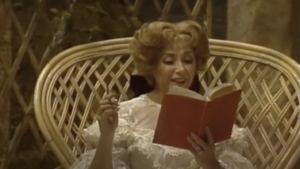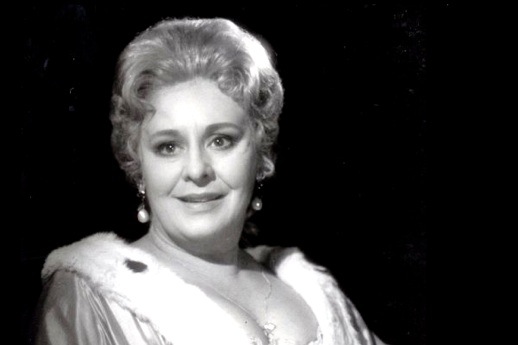
Sena Jurinac 1921-2011
Legendary soprano Sena Jurinac, one of the most beloved artists at the Vienna State Opera, died yesterday. She was 90. [via AP]
Copyright © 2012 parterre box - All Rights Reserved
Powered by WordPress · Parterror Theme by Nick Scholl for DIS Magazine
And the live performances of these glorious voices keep turning up to remind us of what they were and the pleasure they brought us.
ORF is broadcasting a tribute at 19.30 MEZ, 13.30 EST:
http://oe1.orf.at/programm/289191
A program, “In memoriam Sena Jurinac” will be broadcast today from Austria on “Stimmen Hören” at 1:30 EST.
HAPPY THANKSGIVING TO ALL
not a great opera star but a great singer and explorer of the renaissance and baroque: RIP Montserrat Figueras
From the TELEGRAPH’s Sena Jurinac obituary:
“It was her appearances in Mozart at Glyndebourne in the 1950s, however, that propelled her to the top of the profession. It has been suggested that Vienna, where she sang regularly with Herbert von Karajan, saw her in a fresh light after her triumphs in East Sussex.”
Quite right! Same proved true for Simoenau, Berganza and Soederstroem, all artistic nullities before paying their dues at Lewes. It was old Johnnie Pritchard–not the denominationally suspect foreigner Krips–that created the post-war Mozart style.
My dear Vicar – Jurinac was first in England
in 1947 singing Dorabella and Cherubino when
the Vienna Opera made its celebrated guest
appearance showing the Londoners what ensemble opera was all about. Jurinac was in Glyndebourne I think only first in 1949 but only through 1956 – of course she was beloved in Glyndebourne – was there another comparable Mozart soprano coming out of England at the time ?
Krips indeed did not create the post-war Nozart style – he nourished and added to its development.
Probably the first performances of this Viennese style were begun during the war in Sept 1943 under
Karl Boehm with his celebrated Cosi production in
Vienna with Seefried, Rohs, Noni, Dermota, Kunz, Schoeffler. Shortly later some of the same
singers were in his Figaro (with Reining) – after the war neither Boehm nor Karajan were allowed at
first to conduct at the Vienna Opera but Krips was.
We must remember that it was Boehm who brought
Schwarzkopf, Seefried, Jurinac, Welitsch, Christa Ludwig and numerous others such as Hoengen to the Staatsoper after auditioning them – and della Casa to Salzburg which led to Vienna immediately thereafter. Boehm apparently was not an easy man to work with for singers but looking at all his casts he had throughout his decades at the Staatsoper he had very few weakly cast performances in Vienna and Salzburg. Glyndebourne of course
has always been celebrated for brilliantly rehearsed ensemble productions even when, sometimes, the casts available to them were not as illustrious as in
Salzburg. And Glyndebourne was fortunate to
have Jurinac during some of her best years when
her voice was at its absolute freshest.
“…was there another comparable Mozart soprano coming out of England at the time ?”
Of course: Una Hale.
Vicar, are you daft???
Bill – bigotry and ignorance are best mates, so none of this should surprise any of us. If indeed there was a single creator of the post-war Viennese Mozart style, it ultimately derived from the trailblazing Mozart style established by Fritz Busch at Glyndebourne in the 1930s and his influential recordings of Figaro, Don Giovanni and Cosi fan tutte which have rarely been out of the catalogue since then, and still repay repeated listnening. “Johnnie” Pritchard was Busch’s assistant, which is why he got to do the HMV-Glyndebourne recording of Idomeneo with Jurinac as Ilia, which must have been planned for Busch. Pritchard’s regime at Glyndebourne followed that of Vittorio Gui, whose style in Mozart was far more Italianate, something reflected in the casting of his Figaro recording with Jurinac’s Countess which has Italians as Figaro, Susanna and the Count (Risë Stevens was the Cherubino). In the 1950s and 1960s, Glyndebourne was a truly international company, in which British or British-based singers were the exception (Evans as Falstaff, Sutherland as Countess, Donna Anna and Elvira in Puritani) rather than the rule. Jurinac was clearly regarded as Glyndebourne’s biggest star during the years in which she sang both at the festival and on tour to Edinburgh (even singing rare performances as Leonora in La Forza del destino). After Jurinac’s departure in the mid-fifties, Elisabeth Söderström soon became Glyndebourne’s favourite soprano, and it wasn’t until the 1980s, after Pritchard’s regime, that a British singer Felicity Lott enjoyed similar status at the festival. Personally I’d swap ten Flotts for one Jurinac or Söderström. Who – apart from the Vicar of Nervanelli – gives a monkey’s fart about Una Hale? I’d be surprised if many Parterrians have ever heard of her. She is all-but-forgotten in the UK today. At least by anyone under 80 years old.
And Una Hale was an Australian, by the way, born in Adelaide, so yet another of the Vicar’s “Fucking Brits” who wasn’t.
“Una Hale… was particularly noted for her portrayals of Ellen Orford in Britten’s Peter Grimes, Eva in Wagner’s Die Meistersinger von Nürnberg, The Marschallin in Richard Strauss’s Der Rosenkavalier, and Liu in Puccini’s Turandot. In 1956 she portrayed Naomi in the world première of Lennox Berkeley’s opera, Ruth. The production was mounted by the English Opera Group with Anna Pollak singing the title role and Peter Pears portraying Boaz.
In 1962, Hale sang the title role in the Australian première of Strauss’s Ariadne auf Naxos. During that same season she also portrayed Donna Anna in Mozart’s Don Giovanni and Alice Ford in Verdi’s Falstaff. In 1963-64 she sang Ellen Orford and Tosca with the Sadler’s Wells Opera Company, and Tosca and The Marshallin in Romania with the Romanian National Opera.”
So not really a Mozart soprano, either!
Great Jurinac quote from the obituary in The Guardian:
‘Of Schwarzkopf’s somewhat obtrusive technique, she remarked: “Dear Elisabeth – she gets one note from her elbow, another from the back of her neck.” She then jumped up to demonstrate. We fell about.’
“It was old Johnnie Pritchard …that created the post-war Mozart style.” My dear Vicar, a true Brit would never use ‘that’ as a relative pronoun for a person (as opposed to a thing). I fear you are a Yankee impostor, sir!
It’s NERVA (“I am not now nor ever have been HERVA NELLI”) in her Anglo-Eulenspiegel guise, mon cher Monsieur Monty Nostry.
Good day to you, my dear Sir.
We figured that out months ago. Some sort of neocolonial revenge syndrome?
“all artistic nullities before paying their dues at Lewes.”
Lewes is pronounced “Lewis”.
No attempt at a rhyme was made. I engage in charity work with colleagues from Alfriston Church and know how to pronounce “Lewes”.
……….
Further variants along class and regional lines:
“It was old Johnnie Pritchard what created the post-war Mozart style.”
“It was old Johnnie Pritchard created the post-war Mozart style.”
“It was old Johnnie Pritchard who created the post-war Mozart style.”
One must say: the current chatelaine of Glyndebourne does not readily evoke “Home Counties”.
Sussex is not one of the Home Counties, however.
1908: The Home Counties Division of the Territorial Force comprised units recruiting in Middlesex, Kent, Surrey and Sussex.
1948: The Home Counties Brigade was formed to administer the infantry regiments of the City and County of London, Kent, Middlesex, Surrey and Sussex.
The Vicar isn’t just hateful, layzgennelmun. The Vicar googles in order to be hateful.
The Vicar is however not wrong in this instance; why shouldn’t he Google for quick confirmation?
I fail to see your point as accomplishing anything other than revealing the snarky self-righteousness you ofttimes manage to conceal.
Roflmao at the Vicar calling Armerj snarky and self-righteous. Pots and kettles, pots and kettles.
The person in question characterised me as “hateful”, I would point out.
As for pots and kettles: a highly respectable local widow, Mrs. Markby, occupies herself with kitchen duties hereabouts. Not in my line I fear.
Oh no, I’ve offended someone who doesn’t exist!
Just weird.
Had I mentioned having been offended? I don’t think so.
Don’t you have any shackles to polish or something?
I am grateful to the Vicar for his knowledge on the Home Counties issue. I was convinced the term only applied to counties literally bordering London. I first learned the term from the lamented TV show Come Dancing, which featured teams from Home Counties North and Home Counties South. Maybe Sussex was among the latter. And as someone who read Opera magazine in the late 70s and early 80s, I can appreciate where he is coming from satirically.
“as someone who read Opera magazine in the late 70s and early 80s, I can appreciate where he is coming from satirically.”
I read Opera magazine back then too but it took me a long time to appreciate the Vicar’s satire, in fact it had to be spelt out for me that it was a parody of the late Harold Rosenthal’s style, editor of that publication from 1953 – 86. Quite why anyone would want to devote so much time and energy to satirizing a deceased opera critic from a country other than their own who has been dead for twenty-five years continues to elude me, but hey, whatever floats your boat.
It’s his shtick. The joke might have worn rather thin by now, but at least it’s based in a knowledge of the genre and its particular mythology. And Harold Rosenthal could be surprisingly Little Englander-ish at times. I certainly used to notice it.
Dagmar Hermann died in 1997.
Laurence Dutoit first sang at the Staatsoper
in 1960 so she was not really a member of the
lengendary post-war ensemble. Her last performance there was in 1981 and she seems never to have sung a major role – just Tebaldos, the Modisten, Frasquita and Flora – things like that and smaller roles.
Lotte Rysanek made her debut at the Staatsoper in 1955 as Butterfly with her last performance there as the Priestess in Aida in 1988. She sang a variety of major and smaller roles – I remember the Dalibor (Jitka) she sang in with Leonie -(Milada) but the two sisters shared
practically no roles except Agathe which Leonie only sang once at the Staatsoper back in 1950.
There’s a Lotte Rysanek Elvira on Opera Depot- Gwyneth Jones is the Anna so I suspect that CK will be able to tell you what Rysanek Minor was like.
I heard Lotte Rysanek in Vienna as the Fifth Maid opposite the great Leonie and and the great Christa; Mastilovic, Helm and Hopferweiser were also onstage.
Lotte can also be herd on some operetta recordings, and on the Staatsoper’s live DALIBOR with Leonie and Speiss. She sounds like a lyric Leonie on a not great night.
wasn’t she also on the Bohm Frosch when big sis sang Kaiserin, and was the whateveritis in Act 3 – the voice of the fountain, huter der schweller (!) (can’t remember)
Every time I see the “Boy and his Diva” rubric, I think of Jurinac. May I?
I was 13 when the Furtwängler RAI Ring came out, and I knew nothing about Wagner or singers beyond the Milanov Tosca and the Callas Carmen my parents had given me. I just liked complete sets of stuff– and I begged my father to get the Ring set for me. He obliged (it cost all of $30) and I went through it one act at a time over a period of months. Although Jurinac’s voice is actually the first one to be heard, it didn’t mean much to me yet when I started off with Rheingold. It wasn’t until I got to Götterdämmerung later on, after months of Mödl, Suthaus, Frantz, and Konetzni, that I heard her again.., and I still haven’t recovered. As I listened to that incredible “Loges Heer lodert feurig um den Fels”, a shiver went up my spine. Who was THAT? I looked at the front of the libretto where the cast was listed and saw that, whoever this unpronounceable person was, she sang three parts. For the rest of the opera, each time I turned a libretto page, I’d look first to see if she had anything coming up.
Back then (1972) there were no live performance pirates yet, and most of her recordings were out of print in the US. I did manage to find her Ariadne with Leinsdorf at the Boston Public Library, and the Kleiber Rosenkavalier. That was about all you could get then, and nobody that I knew at that age had ever heard of her. A year or two later, the library showed the film of “Wozzeck” from Hamburg. Later I found that the foreign language section of the library also actually had the 1971 Austrian bio, which had photos on every other page. Jurinac was my private obsession for years (and still is). Although she is so much better known today in the US, still I feel proprietary about her– but I think that is true for all who love her. She had a warmth and humanity that were so unique, as well as that voice that was like no other. On a couple of occasions I found myself in places where she had just been, or was about to be, and even got to hear her once (the SF Jenufa), but I wouldn’t have wanted to meet her– what could I say that she wouldn’t have heard a million times before, and why should I be any different than thousands of other smitten fans? Still, I do wish I could have expressed how grateful I am to her for so many moments of transport, consolation and sheer delight. I’m a musician by profession, and I learned much from her by example. Even though I didn’t know her, I am so saddened to know she is gone. In my estimation, she is is one of the very greatest artists who have ever graced the stage.
Thanks for letting my get on my soapbox for a moment.
Thank YOU. That was lovely.