A generation later
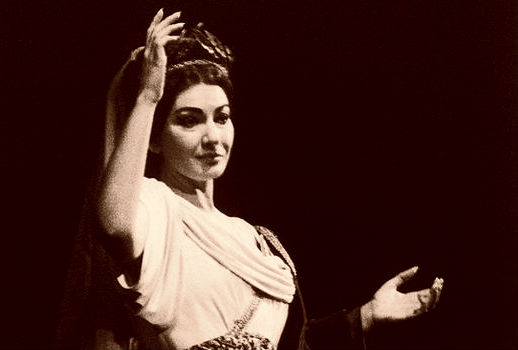
On this day 34 years ago, Maria Callas died in her apartment in Paris. Since then the iconic diva has been recollected, documented, analyzed, digitized and portrayed by Tyne Daly. La Cieca invites you, the cher public, to keep her mind today by sharing your favorite Callas performances in the comments section.
For me, as a passive ‘home listener’ (never having seen her live), there are in fact, three ‘Callases’
1. The pre-diet Callas. The ‘original’ voice -- very rich and ductile, with an infinite variety of colours at her disposal. The legato is stupefying, the security impressive most of the time. She would occasionally go for an ‘effect’ (the famous bringing up of the chest voice, the ‘coupe de glotte’. This is true chiaroscuro singing. The voice ‘speaks’, there’s always a face, the affect is immediately palpable.
2. The post-diet Callas. Ups and downs. The voice thinner, fragile. The chest is forced (mostly), the vowel sounds got more and more distorted (by 1962 the A’s and O’s were completely unrecognizable and indistinguishable). Some good years -- 1954, 1955, 1957-1958. Sometimes the recording studio catches the voice in appalling condition (the Lucia stereo remake is a vocal horror). The pretty fast deterioration.
However, so much has been gained. There is a new sense of intimacy, which the grander (and bigger) Callas never had. There’s the eternally winning combination of charisma and vulnerability. The legato is as fine as ever (the Lucia live 1955 mad scene with Karajan has to be heared to be believed : no singer has ever managed such smooth diatonic runs, as smooth and accurate as Heifetz. I marginally prefer the studio post-diet Callas, as I think something about the art of communication has deepend.
3. Pitted against her studio work, Callas captured live is again a completely different animal. It’s a grander scale, yet she is able to deliver astonishing moments of rare intimacy (the Guilini Traviata final act, of course). Up until the major deterioration (around 1959) it’s sometimes very difficult to distinguish pre and post diet Callas live. Yet the Torino live recital, the live La Scala Trovatore are vocally on a very different plane than the Scala Ballo, or Chenier, or the Amsterdam and Hamburg recitals.
Personally (and controversially), I very much prefer the studio Callas. It presents a labour of love between Callas, Legge and the various conductors assigned for the jobs. Callas live is a major, major artist caught ‘in fire’ (or very often so). Callas in the studio is a fascinating gallery of vocal portraits, each subtly different, human, instantly memorable. Being an OCD perfectionist, in the studio she was able to fine-tune her interpretations (sometimes recording things she has never, or rarely, sung in public) and project her views about the music. Heck, why mince words, these are Interpretations, as opposed to good / bad / sublime singing of the notes, which we are treated to in most other singer’s recordings. So studio Callas for me is more important than live Callas.
Undoubtedly, her major contribution to the musical world was her bel-canto revolution. So I’ll nudge towards her Puritani recording, a most beautiful prsentation of a fine, fine opera. A complete must. The remaining ‘desert island’ Callas documents are probably, for me, the Dallas rehearsal (absolutely essential and jaw-dropping), the Turin and Amsterdam live recitals, the Rigoletto master-class (for the ages) and, controversially perhaps, her first mono Gioconda, which, I think, and despite of my former dissertation, is her major contribution to opera in the studio. The singing is completely magnificent in all respects. The voice has lustre, poise, there is danger but it is balanced with immaculate vocalism. It is not, perhaps, very subtle, but immensely compelling and vivid.
Compare and contrast her mono Gioconda (1951?) with the 1959 (?) studio remake. The voice is a shadow of its former glory. But not just that -- the sense of occasion, the uniqueness, are gone.
One phrase suffices to demonstrate Callas’ supremacy as a musician, as a vocal manipulator. The phrase starting in 2:18 (the older recording) -- Ascolta di questa sapiente sirena l’ardente canzon.
No other singer in my memory has managed to vocally define the harmonic ambiguity here, the major-minor interplay around the E flat. Not only does that little phrase sound more ‘musically fulfilling’ than in other singers’ performances, it directly goes to serve the purpose of projecting to us poor Gioconda’s wavering mind and her self pity. Needless to say, the strangely apt coloratura writing is magnificently deployed here to suggest the character’s scorn towards Barnaba.
This wealth of expression, the fearless vocalism, does not happen on the older recording. Nobody could have capped that first Gioconda. Pity about the surrounding cast (Barbieri not bad, the rest dull to atrocious) and the very dull conducting from Votto. But there it is, warts and all, and to me it is still irrepleceable.
Weh’s mir. Just read through the spelling errors, if you will. It’s 4:45 AM here for God’s sake
Dear CerquettiFarrell,
Thank you very much such a magnificent analysis. If I remember correctly, you had won the best example of bel canto singing contest a while back by analyzing a few youtube clips. I have learned so much from that analysis as well as this one. Thank you once again.
Don’t worry about that at all, dear Cerquetti/Farrell! I’m so happy you’ve posted this as I, too, love that mono Gioconda (it was a Warner Fonit Cetra),
and in fact, only found it again in Italy a couple years ago. It revealed, more than anything else to me, what she was about. Thanks for sharing my love for this very greatest interpretation.
XxxOoo- C.
This is an armerjacquino ‘tin hat’ moment, but am I alone in that I see what all the fuss is about with Callas, but find her quite hard to listen to and not so easy to love?
I would give up the tin hat and opt for the nuclear bunker instead.
Well, you’ve got a point there. I have my on and off periods with her, as I have with Bach, Dostoevsky, Beethoven. I flinch before the high notes (post 1953) like everyone else. Some portraits in the gallery I don’t like – her Ballo Amelia – whether studio or live – I find I have a problem to relate to. The Gilda is not really convincing in the 1st act. The Mozart is way, way out of what I perceive as good style. But this is not a perfect world, and somehow the faults make her more accessible and more interesting, to me.
I don’t think she had a non-aesthetic timbre (ugly or beautiful are very subjective terms). If anythintg, I think it was extremely ‘phonogenic’, despite its oddities. But at the end of the day, you either ‘respond’ to a timbre or you don’t. With her, I find I am compelled to listen.
I definitely like her timbre better when she was young and stately, but I think my main problem is that she doesn’t give me any joy. Even if one didn’t know her sad end, one would always sense the tragedy in her voice, though — as I’ve said here before — I do rather like her ‘Una voce poco fa’! I know tragedy is just slightly important in opera, but it’s nice if there is sheer joy to juxtapose with it. By the same token, Sutherland’s singing can make me happy, but she can never move me with her tragic accents!
One other thing – just a passing thought. what an Ottavia Callas would have made. Just think of the range, the colour, the Disprezzata regina, the Addio Roma. Ach!
Agree about the cetra gioconda. But Good Lord, she drives the voice so recklessly. She carries the chest so high and takes so much weight into the passagio and beyond… Stunning without a doubt, but I would gladly trade a little less blood on the recording room floor for few more years of prime voice. We were denied so much. It is testament to her greatness one feels like an ingrate for pointing out that she was a shadow of herself by the time she was thirty seven.
LT I know what you mean. But sometimes singing, especially in opera, is not a scientific lab. You want to convey a particular affect and if you’re completely sincere, the body follows. So you can’t always step back and analyse what it is that you’re doing. Sometimes it may be harmful for the mechanism. It’s not always done by stages, where you accomodate the role into your technique and voice, and then apply the emotion.
In her masterclasses Callas often uses the term ‘warm the voice’ for certain phrases. I think this term, which I haven’t really heard from other singers or teachers, is a key to what went on inside that mind and body. And that might help to explain the extra weight on the passagio and beyond.
Fascinating stuff CF. As for pushing and doing damage to the voice one can never be sure how these things work out. I know next to nothing about singing and vocal production (although I’m always interested in learning when the opportunity presents itself) but I’ve been to a good 300+ (probably over 400 at this point) opera performances several hundred recitals and concerts and done a decent amount of listening in various recording media and the one thing I’ve ascertained is that there is simply no way to predict what will happen to the voice and if one is especially gifted it might in some respects be better to take advantage of those gifts fully while one has the chance.
Examples of the variability of operatic careers are legion but I’m thinking of one particular singer whose vocal technique in her early 30s was described as impeccable, who sang roles where much within her vocal range and weight (the odd slightly heavy part notwithstanding). In my inexpert opinion I thought the evaluations of her technique correct and, much more importantly, found her to be a breathtakingly compelling performer. I heard her pretty frequently over a 6 or 7 year period but after not hearing her for about a year attended a series of performances where various signs of vocal deterioration were pronounced to the point of being almost horrifying. She was almost exactly 37 at the time.
I hoped that this was simply a bad vocal patch but, while that was an especially disturbing instance, in fact , this deterioration continued and her career has regrettably suffered since that time
I say regrettably because having heard her recently I was glad to learn that she is still capable of very beautiful singing (if by no means on a consistent basis) and even in her current vocal estate is preferable to some of the “competition” which seems to find more favor with current management at A houses.
By contrast another singer with the exact same voice type who came on the scene at just about the exact same time, was widely praised for her technique and sang essentially the same repertoire (indeed perhaps tended to more frequently take the heavier roles in that repertoire) has preserved her voice to a much greater extent and, in her case, has continued to sustain a very prominent career.
Trying to get back on topic, and it varies from singer to singer, its very difficult to argue that Calls should have “held back”. Perhaps she could have had another half decade of success but perhaps her legacy would have been so much less. I have some of the same difficulties with her story that MN mentions above, but that only partially diminishes the power of her performances.
Naturally bad technique and heavy roles can take their toll on a voice. If Fleming had started singing Isolde, or even Sieglinde at 40 her voice would be in much worse shape now and Mattila could certainly have preserved more of her vocal luster had she abstained from Salome and sang somewhat differently (although in her case a 25+ year career on the greatest stages is to be envied by most) but I doubt that she would have been a more important or interesting artists had she done so.
CF:
I agree that Maria’s use of verismo techniques came from a very deep place in her expressive persona. As I said, the trade-off is fair and in fact, could not have turned out any other way.
That said, I really do think that the practice of carrying all that weight into the upper middle and top shortens the vocal prime of most sopranos who use (or overuse) it. How many verismo trained sopranos had reliable tops after the age of 40? (The one who most prominently did, Olivero, used an entirely different vocal technique based on a classic legato based support.)
Now, I appreciate that this technique did not come out of nowhere, it came in response to the music that seemed to demand it. Who new that right after it achieved supremacy in the performance of italian operatic music, oper would turn into a museum of glorious artifacts most of which PREDATE verismo.
THink of the irony.
Anyway, I don’t think Maria’s problems were just due to forcing. I don’t think the top started to go until she began taking the voice off the support to make her Lucia and Amina (and eventually Violetta) capable of the pastel pathos that she believed most appropriate the parts.
That’s when the b flat and b went – she couldn’t rely on them to be steady at any dynamic other than forte, and she was too much the artist and musician to ignore the demands of the score. So wobbles. It was steady decline after that, and the tension took a toll on her apparently.