
She Dodon him wrong

Our Doyenne demonstrated her omniscience once again by sending me a DVD
of Rimsky Korsakov’s Le Coq d’Or (Zolotoy Petushok) to review. I’m with musicologist Richard Taruskin who stated that Rimsky Korsakov was “perhaps the most underrated composer of all time” (and I’m sure his editor insisted on including the “perhaps”).
Nothing quite matches his operas for their folk-music inflected, pantheistic ecstasy, the way the vocal lines float over his luminous orchestral writing and the way he treats myths like historical dramas and treats historical dramas like myths.
Outside of Russia, Le Coq d”Or is perhaps his best known opera, even if it is not his best one – that honor should go to The Legend of the Invisible City of Kitezh and the Maiden Fevroniya, This work’s popularity may be due to its superficial similarity to “Scheherazade” as another of Rimsky-Korsakov’s bravura exotic entertainments, but this could not be farther from the composer’s intentions. He wrote this piece, based on Pushkin, as a vicious political satire of Russia’s military incompetence.
When it first came to the US (on a double bill with Cavalleria Rusticana!), it was right after the Bolshevik revolution, the indictment of the Russian tsarist government was hard to miss. Over time, however, this opera seems to have been robbed its satiric edge in performance, with this production filmed at the Chatelet in Paris as a case in point.
This production by noted Kabuki actor Ennosuke Ichikawa, travelled widely before arriving in Paris for the performances filmed here. As Isao Takashima receives director’s credit for these performances, it’s impossible to tell if this is only a partial realization of the original conception.
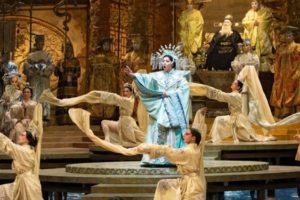
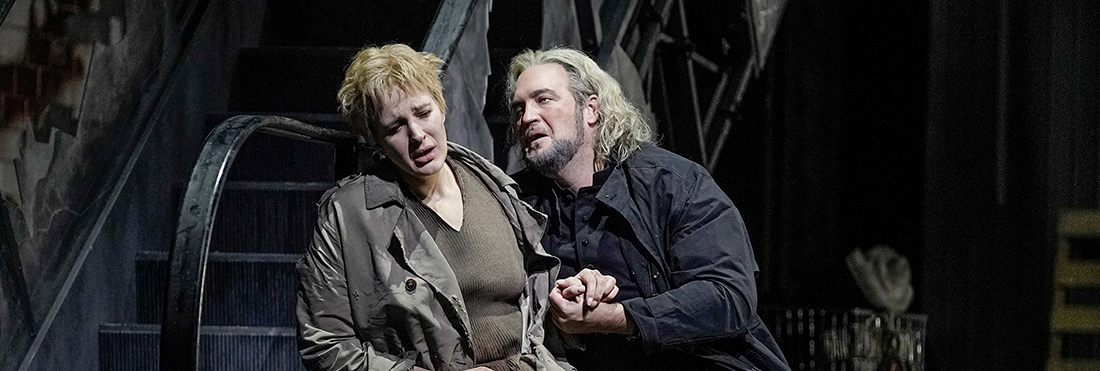
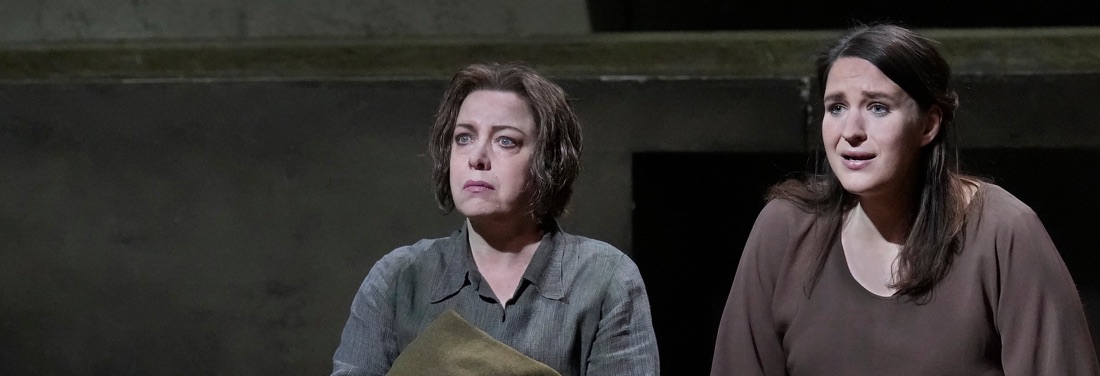
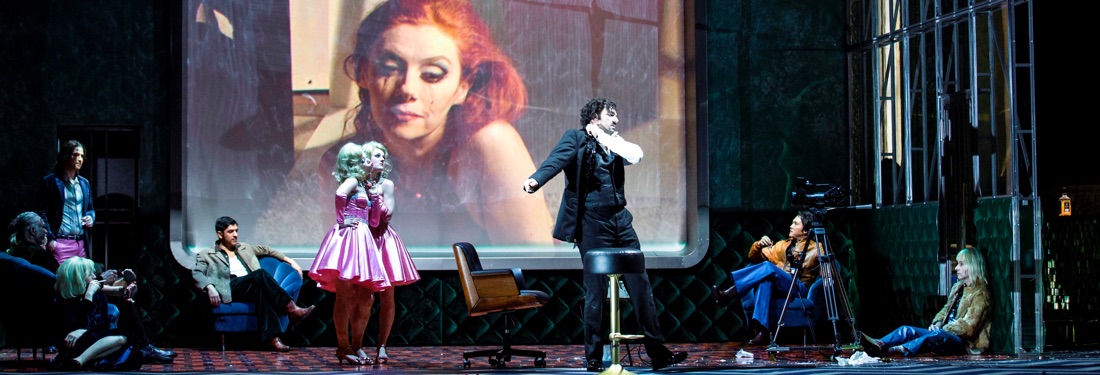
As presented, it combines both Western and Japanese theatrical techniques and cultural references to create an elusive syncretic exoticism. The set is a large staircase decorated with only a few simple scenic elements. They are set against a plain backdrop that shifts in color of the course of the performance. In contrast to the austere set, the cast is done up in fantastical costumes that blend Slavic, samurai, and Lady Gaga in a giddy mix, that give the show most of its theatrical oomph.
The performers are made up to look as if they are wearing kabuki masks and wield Japanese fans for dramatic emphasis. They move in a highly stylized fashion that is mesmerizing to watch and some stunning tableaux are created over the course of the performance. However, this approach creates a tragic, somber tone that is at odds with the material. It gives risible king Dodon an unearned nobility and seriously dulls the piece’s cutting edge.
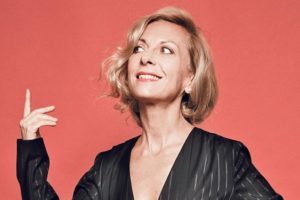
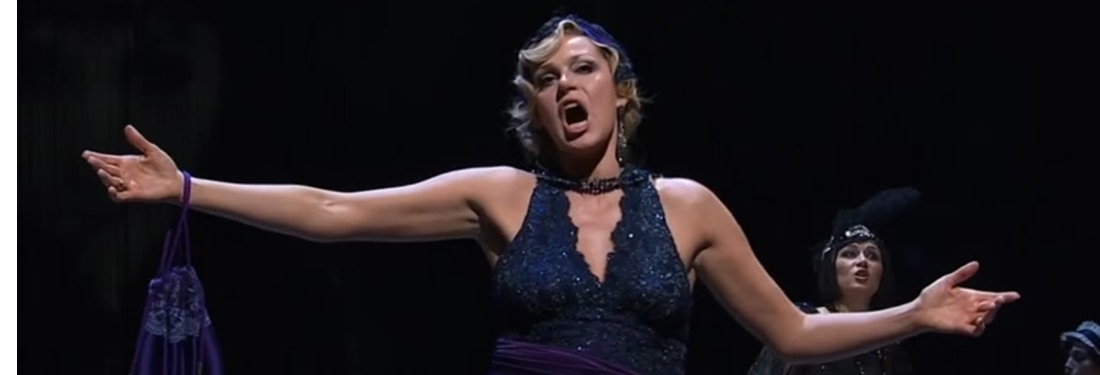
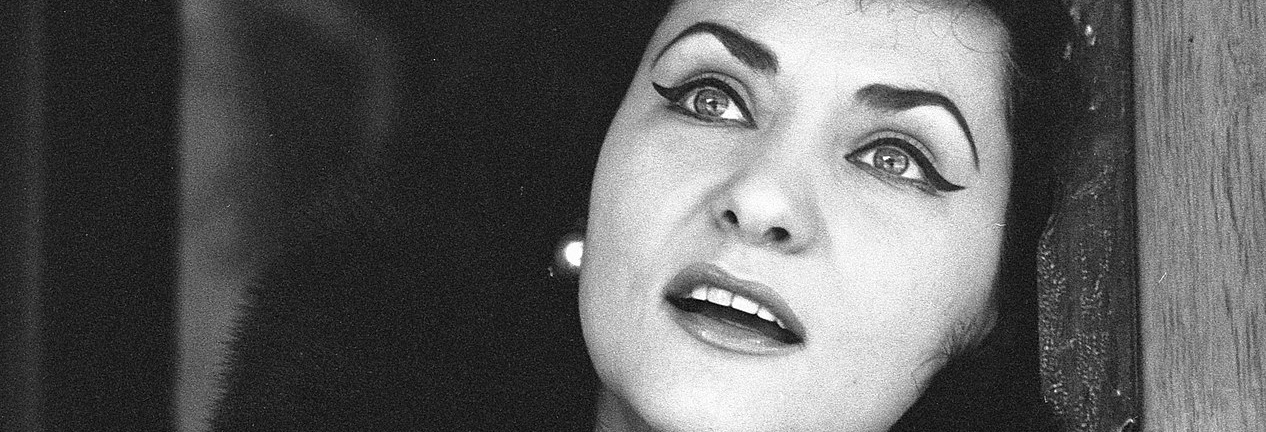
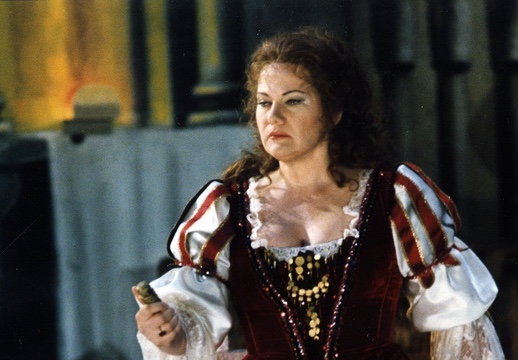
Also, the performers struggle to put across their characters, given the constraints of the production. Only soprano Olga Trifonova manages to offer a compelling portrayal as the scheming Queen of Shemakha. but she does this by largely breaking the rules, vamping it up onstage and playing directly to the audience. It’s unclear whether this was her idea or the director’s, but the effect is that of Zerbinetta ending up in Kurosawa’s Ran on her way to Naxos. She is also the star musically, even if she lacks the ideal vocal glamour for the part and sounds less than beguiling on climatic high notes.
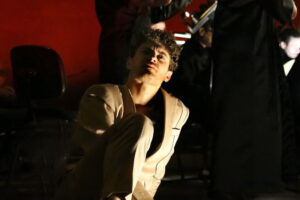
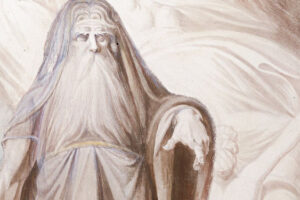
Barry Banks is the Astrologer. He handles this high-lying, challenging part with ease, but doesn’t quite catch the character’s ambiguously malevolent nature. Albert Schagidullin is rather blustery as doomed King Dodon and tends to be overshadowed on stage by the others in the cast. Yuri Maria Saenz dispatches the cockerel’s music and King Dodon’s fate with equally vehement abandon. Kent Nagano leads the Orchestre de Paris and Mariinsky Chorus in a performance that is technically impressive if overly subdued.
This Arthaus Musik DVD is a re-issue of a 2002 performance originally published on the TDK label. This work certainly merits an alternative version on DVD. Still, we Coq lovers will take what we can get.
Well thank goodness it wasn’t a worse recording. We wouldn’t want any quips about “Coq” sucking.
Anyway this review has done what record companies hope reviews will do: it’s made me curious enough to see the reviewed recording that I may actually buy the damned thing.
-- I got this Coq d’Or DVD when it first came out several years ago, but I didn’t keep it for very long … Kent Nagano (IMO, of course) succeeded in ruining Coq d’Or just as he ruined Dialogues des Carmelites, Fliegende Hollander, etc. Therefore I have learned to avoid him when possible (but alas, it is not always possible).
-- I shouldn’t have even got into it again, particularly since I had already been disappointed by the Rimski-Korsakov operas I saw in the old Soviet Union as well as Gergiev’s one-dimensional interpretations here, there and everywhere. I bought this DVD initially because at that time it was the most modern ‘live’ performance available of Coq d’Or on commercial recordings AND I was seeking a deja-vu (unfulfilled) of my extremely youthful fond memories of the opera seeing Beverly Sills sing Queen of Shemaka conducted by Julius Rudel in the late 1960′s-early 1970′s at NYCO. The work had so fired up my imagination that when I visited Azerbajian in Central Asia I made it a point to visit the ancient capital city of Shemaka. Nobody told me before I got there, but all I found were fragments of stone; an earthquake had destroyed the place a long time ago and the palace was in ruins, overgrown by a forest.
-- To contradict Dawn (no meteorological offence intended), for my tastes Kitezh is not as exciting an opera as Coq d’Or, but I do admit that Kitezh, which is supported by an easier to follow libretto, succeeds in sustaining a dramatically effective mood of foreboding thoughout the opera, thus achieving a cohesive unity as a work of art that few of Rimski-Korsakov’s other works do… albeit personally I find Kitezh umrettingly dull and depressing — but the opera does successfully play out with a dead-weight sense of true tragedy.
-- Coq d’Or, as Dawn notes above, is: ‘based on Pushkin, as a vicious political satire of Russia’s military incompetence.’ Perhaps I am barking up the wrong tree again, but I always wondered whether the original idea behind this Japanese Kaubuki inspired production was originally sort of an attempt to bring some valid historical element into the proceedings. One of Rimski-Korsakov’s major inspirations was Russia’s defeat in a publicly unpopular Naval conflict with Japan (the Russo-Japanese War of 1904-1905). This seemed to particuarly irritate Rimski-Korsakov, who had been a Naval officer in his younger years. In Coq d’Or, the King declares war on the territory of the Queen of Shemaka but suffers a terrible defeat on the battlefield, losing the support of his constituency and eventually his own life.
-- Unlike most operas, the libretto of Coq d’Or always fascinated me. Sometimes I foolishly think i can even solve the riddle of the final lines of the opera:
Astrologer (to the audience):
‘There! My story’s ended; but the bloody conclusion, however sad it may be, need not disturb you. Perhaps the Queen [of Shemaka] and I were the only living people in it. The rest were — a delirium, a dream; a pale spectre. Nothing more….’
Astrologer (disappears)
END OF OPERA
[img]http://parterre.com/wp-content/uploads/2011/08/SillsShemaka.JPG[/img]
phoenix, it interests me that you say this about Nagano, as I was just listening to his recording of “L’amour des trois oranges” this past week and, if he did not ruin it, I thoroughly did not enjoy it. As I have heard the Oranges before and not had this reaction, perhaps it is his interpretation? I don’t know.
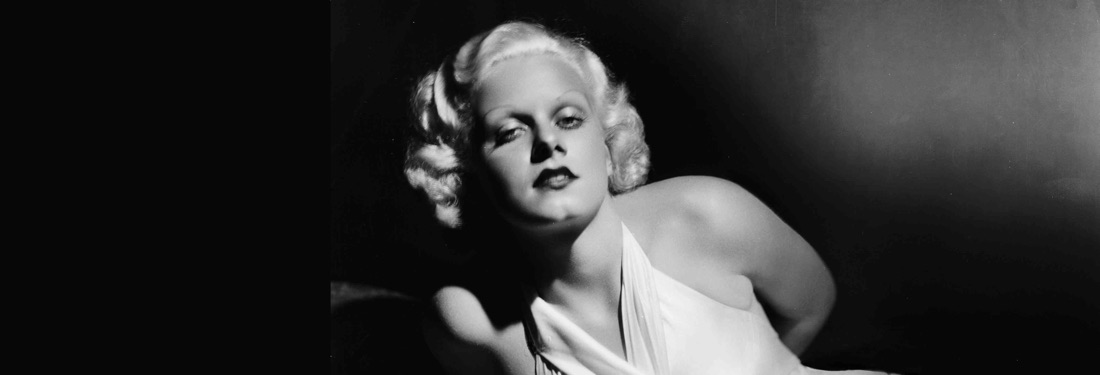
Anyhoo, I wondered how long before a picture of Bubbles showed up. It’s a nice way to remember her.
I did see Kitezh in 2003 at the MET with the travellin’ Mariinsky Bankand was so elated at having the opportunity. It was therefore a little disappointing as I somehow was expecting something god knows what other than what I heard, but then, I ascribed that feeling to my lack of knowledge. However, its reputation as the Russian ‘Parsifal’ seems to me to be quite a far reach.
To hear Borodina again I am contemplating breaking my ban on Khovancshina, next spring.
If i were polite, I would refrain from discussing artists & works of art I don’t like. But I’m not polite, so I had to say what I had to say about Kitezh. Khovanschina, however, is one of my favorite operas. I feel that the music is so sublime in Khovanschina that it overcomes the horribly realistic depressing plot. Even Gergiev couldn’t strangle it, as hard as he tried. Here is a copy of what I commented to you, Camille, on 10 November last year:
‘— I will admit Khovanschina is sort of like a Russian Parsifal … i guess in the traditional sense, it’s not much of an opera, it is more like a Russian Orthodox religious pageant. But i heard what i heard & i saw what i saw & i was always blown away by it even in Gergiev’s understatement at Edinburgh (1991) … i don’t save old programs, but i think it was Olga Borodina as Marfa & she had a beautiful & youthful voice compared to the more eh… “mature?” Marfas I saw at the Met. +++ But it is Dosifei who is next only to God … the role is incredible & so is his music. I just can’t explain it because nobody else i ever knew felt the same way about it i do. Bye the way, Helga Dernesch (Marfa) & Matti Talvela (Dosifei) were try unforgettable in it.’
oh yes, I remember speaking with you regarding Khovanschina at that time, and I appreciate your bothering about this again.
Be of good cheer, you have converted the heathen Camille. I’m going, if nothing else for my Olga. Even if that once incredible voice may or may not now be fresh, her Pauline in Pique Dame was one of those rare sublime moments I’ve ever experienced at the Met, and I am grateful for it, and accordingly will try to hear Khovanschina anew because of her, with open ears and heart.
Spasibo, phoenix. That’s all I know in russo, except Ya lublyu.
Camille, Borodina will be well worth it. I heard her in December, like many of my fucking Brit compatriots on here, as the Princesse de Bouillon, and then in the spring as Amneris, and despite a certain lack of ease shall we say at the top, she was quite incredible- one of the more memorable singers I’ve been lucky enough to see over the past few years. Marta, from memory, has a much lower tessitura certainly than Amneris, and rest assured that in the middle and lower reaches she was absolutely thrilling, gliding about like a battle ship and drowning everybody else out.
I’ve only seen Khovanchina once, at ENO, but I was really swept away by it. I also heard it on a Met broadcast years ago, and very unusually for me when it comes to opera on the radio, I listened right to the end. I’d love to see it somewhere in Russian.
Why thank you for letting me know news of Olga, upon whom I set such great store. The last times I’ve heard her in house she had a great deal of trouble with her A in alt. It was very perturbing and disturbing as her high notes had always been fine before.
No matter, however, as the part of Marfa does sit in the lower part of the voice and should suit her to perfection. I would only brave Khovanschina again, which I heard in San Francisco in 1984 with God knows who singing, BECAUSE of Borodina. I was so terribly mortified AND depressed by it all I swore to never see it again.
Then I was young: now I am old, and mortification is the order of my days.
Anyways, CK, good luck to you With your singing--it takes guts.
Why thank you, Monty -- much appreciated. There’s a fabulous cast-list in the much earlier ‘Mlada’ -- so I could be a fish-seller or a minor Slavonic Deity……!
Actually, the best Coq d’Or is a broadcast in English from ROH in the late 40′s, conducted by the amazing Igor Markevitch, with snappy tempi and cut diamond textures, and a bewitching Shemakhan queen from Mattiwilda Dobbs, and a brilliant Astrologer of Hugues Cuenod -- alas, the sound is not state of the art…….
I will admit Khovanschina is sort of like a Russian Parsifal … i guess in the traditional sense, it’s not much of an opera, it is more like a Russian Orthodox religious pageant
To my mind, a closer approximation would be a Shakespearean History play transposed to Russia (obviously with a strong dose of German and French historicism thrown in -- history as the product of sweeping social forces in conflict). Seems to me that it’s less of a pageant than an appeal for a Revolution from the far far Right.
mcroche: I hear the Russian Orthdox relgious pageantry in the sound world of Khovanschina.
-- Agree with you about the libretto’s similarity to a Shakespeare history tragedy with it’s ‘sweeping social forces in conflict’.
-- Perhaps the same could be said of Boris Godunov, but personally I find that most of the vocal line in Khovanschina has distinctive melody, thus it is freed-up from the speech-like style that dominates most of Boris Godunov.
-- I’m not a good historian, but it is in Khovanschina’s music, with it’s more traditional set pieces & distinctive legato line that I hear French and German influences.
m. croche,
An appeal for a Revolution from the far far Right? How about an appeal to a trip to a Virtual Parallel World? “The inscrutable Russian soul”, maybe, as the unforgettable writers Ilf & Petrov used to say…
Have you seen Tarkovsky’s movie “Andrei Rublev”? It says a lot about this subject.
Oedipe -- the Raskolniki consign themselves to the flames, I’m not sure whether that’s to be considered a “virtual parallel world”. They’d rather kill themselves than Westernize or modernize. I read Musorgsky as posing the question: are we really better off for having had Peter I? In Soviet times the answer was of course “YES!!!”, but nowadays Musorgsky’s sympathies seem a lot more ambiguous. There is a small-but-discernible component of religiously-based right-wing ideology, both in America and in Western Europe, which argues that the Renaissance was a bad idea, that the Renaissance led to many social, political, and spiritual ills. There have been Russian Orthodox equivalents to this idea. I see Khovanshchina as falling within that discourse.
I hear you loud and clear, m. croche.
What I am trying to say (and this is a hugely complex subject, and I am nowhere near doing it justice with my little comment here), is that Russian culture has always been more or less “self contained” and ambivalent about Western values, but this has not prevented it from becoming one of the world’s greatest cultures. And orthodox religion, or -more exactly- orthodox spirituality is an absolutely essential part of this culture, whether we like it or not.
Now, within this framework of the Russian culture, ideas run the gamut from grass roots fanaticism à la Musorgsky to the abstract (humanist?) religiosity of someone like Tarkovski. Lumping everyone together and assuming we can analyze the whole phenomenon with the same concepts we employ to analyze, say, the American extreme right, is IMO reductionist. All the more so since, nowadays (as you have astutely noticed), Russian and East European intellectuals, deeply concerned with (re)defining value systems they can relate to, have become VERY scheptical about Western values.
Hi there Oedipe -- Perhaps I wasn’t clear. In responding to your previous post, I didn’t say anything at all about Tarkovski. I was not lumping him together with Musorgsky. I was merely (perhaps unnecessarily) explaining what I meant by “revolution from the right” in the context of Khovanshchina. For the purposes of chat comments, I don’t think it too much of a stretch to note contemporary analogues. Michelle Bachmann has just given us a high-profile example:
http://latimesblogs.latimes.com/culturemonster/2011/08/michele-bachmann-is-worried-about-the-renaissance.html
(In this context, by the way, I can recommend a thought-provoking essay-book by Ian Buruma and Avishai Margalit: “Occidentalism: The West in the Eyes of its Enemies.”)
I have read the Buruma/Margalit little book. Thought-provoking indeed!
I agree that Khovanshchina is more like a history play than a standard opera plot, but I’m not sure it works as an appeal for revolution from the far far right. With the exception of Prince Golitsin, all of the major characters are right wing, but I don’t think any of them are held up as ideals of how to do things correclty. Khovansky father and son are both selfish opportunists. Dosefei and Marfa are sympathetic characters and capable of acts of kindness, but they also encourage hundreds of people to commit mass suicide. And they force martyrdom on Andrei (not that he really has better options by then). You can’t really say that any one is right (in the sense of correct) in the opera. Khovanshchina strikes me as a requiem for the people that Peter crushed. An appeal to remember them and to remember Russia’s non-western heritage. I saw the 1984 Khovanshchina in SF (sorry you didn’t enjoy it Camille). The cast included Matti Salminen as Ivan Khovansky, Gwynne Howell as Dosefei, and Helga Dernesch in her role debut as Marfa. The sets were designed by Nicola Benois, showing how to do old fashioned painted drops well. Dernesch was amazing. The production was one of the highlights of my opera going life and made Khovanshchina one of my favorite operas.
Khovanchina is the Russian Parsifal? I am really confused now. Someone told me that the Russian Parsifal was Kitezh…and now I don’t know who told me or where I read it. Does anyone know unequivocally which it would be? Just wondering.
Derschatzgrabber: Dosifei and Marfa do encourage the mass suicide, but they all die “beautifully”. Jim Jones would have called it a “revolutionary suicide”. It seems to me that Musorgsky’s sympathies lie with them. The “tell” is in the music.
I’m perhaps overstating the case just a little bit, but the problem is that the context for Musorgsky’s opera has changed quite a bit since the 1870s. It’s no longer possible to contain all the resonances caused by romanticizing the Raskolniki’s self-immolation. For an opera written about the 17th century featuring historical figures unfamiliar to non-Russians, its concerns remain quite contemporary.
Kitezh has traditionally been dubbed ‘The Russian Parsifal’, for no better reason than there is a cadence figure in the music that reminds people of the ‘Dresden Amen’ used in Parsifal (and in Mendelssohn’s ‘Reformation’ symphony. And musically, Rimsky’s score has some overtly Wagnerian influences, such as Siegfried’s ‘Forest Murmurs’ in the Prelude and a few harmonies here and there. Actually, probably more of the musical material comes from a little known oratorio by Liszt, ‘Die Legende von der heilige Elisabeth’.
The subject matter is not really related, except there is a numinous feeling to the work as a whole. It is an odd piece in Rimsky’s oeuvre, hard to perform as it is oddly restrained, a little four-square, and maybe some of the big moments in the libretto are not matched in the music -- possibly Rimsky was striving for an experience that was outside his abilities. He was consciously attempting to write a piece that summed up his life’s work, and maybe even the whole 19th century Russian nationalist tradition, and as a US musico-Russophile, Simon Morrison, has written ‘feels like a piece more compiled than composed’. Yet, another writer, Marina Frolova-Walker has observed, that for an opera dependent on bell sounds, these sounds are resolutely non-Russian, as the bells in ‘Boris’ or ‘Igor’, and closer to ‘Parsifal’. Her interpretation is that Rimsky was exhausted by the narrow confines of a Nationalist tradition and felt confined to a rut.
Which makes sense of the ‘Cockerel’, a scathing satire and send-up, not just of the end of Tsarist Russia, but of Russian Nationalist cliches as well. I’m not sure people in the West, or even at home in Russia, are sure of how to play it -- the Sills and Treigle performance at NYCO seemed to be a glitzy burlesque, and several performances make it rather lumbering and weighty, or take the rather gorgeous Queen of Shemakhan music at face value, very languorous and beautiful, but lacking bite -- in my inner ear I hear it as a very nasty corrosive opera-buffa -- closer to the acerbic farmyard Stravinsky than anything else…..
I don’t think there is a recommendable recording, not even this DVD, the Japonaiserie seems very misplaced…..- closest is a c. late 1980′s Melodiya recording c. Kitaenko, which has a quicksilver approach and plays up the grotesquerie………though Nesterenko is a faceless Dodon, and the Astrologer fakes the tessitura -- good Queen though (I forget the name!)
Moy droog Belfagor, I knew you would have something sage to contribute on Rimsky. Which character in a Rimsky opera comes closest to being the Russian equivalent of the Allwissende Muschel? That character is you!
Sir Belfgor!
Spasibo!
Ya lyublyu!!!
Means so much to me that you clarified my questions. I owe you one!
Gratefully,
Camille
One of Rimski-Korsakov’s major inspirations was Russia’s defeat in a publicly unpopular Naval conflict with Japan (the Russo-Japanese War of 1904-1905). This seemed to particuarly irritate Rimski-Korsakov, who had been a Naval officer in his younger years.
Bingo. That is one of the most delightfully perverse things about this production. History as written by the winners.
I enjoyed Ichikawa’s Frau ohne Schatten for Munich, though I haven’t yet revisited it on DVD.
With thanks to J. Clement
I could sing the Pskovityanka *tomorrow*; it’s a question of color and tessitura.
And age, my dear.
*Balderdash*. They said I was too young for FIDELIO-- but Maestro Walter told me that eve if I looked like Peter Pan I had the heart and throat of Leonore.
With a technique like mine wedded to phenomenal intelligence there is no need for the instrument to suffer decay.
Wasn’t that Mary Martin, Mme. Quickly?
No matter, your Klytemnestra was FAB.
And I DO know you got your Quickly act from Chloe Elmo, too, so let’s give credit where it is due, eh Maestra?
That proto-pazza Italian frump sang one Met Santuzza to *my* fifteen; and I often appeared in the role in the company of Tucker, del Monaco and dear Jussi
Did she really sing a Santuzza, the graveyard of many a mezzo, not to mention CONTRALTO, as Signora Elmo rightly was.
No one, and this is for sure, could drag on a cigarette when dolled as Carmen, like YOU. Certainly NOT that fudge-baking Fraud!!
Pacem et ‘Buona Sera’ to you, too, Mistress Quickly!
Metropolitan Opera House
December 19, 1947
CAVALLERIA RUSTICANA {333}
Mascagni-Targioni-Tozzetti/Menasci
Santuzza…………….Cloe Elmo
Turiddu……………..Frederick Jagel
Lola………………..Martha Lipton
Alfio……………….Frank Valentino
Mamma Lucia………….Claramae Turner
Conductor……………Giuseppe Antonicelli
One time and one time ONLY! Jagel apologized to me personally.
Of course, try as Johnson might, he could not have the great stars like me, Traubel, Sayao and Steber headline EVERY night…
Frankly, Quickly, I cannot choose whom between the two unlikeliest candidates, Turner as Mamma Lucia or Elmo as Santuzza, which strikes me as the funniest.
I DO hope that Johnson knew what a Dick he was to cast ANYONE ELSE but you and was properly repentant.
Good morroW, Madame, and until next we meet, I remain
Your Humble Schleptraegerin,
Camille la Courtisane
Thanks for another great review, Dawn. Whenever anyone mentions ‘Coq;, I’m always mystified by the knowledge that the Queen of Shemaka was, actually, Eva Marton’s debut role ‘lo those many years ago. Kinda like finding out Guleghina once sang Rosina- it’s just one of those things I can’t get my head around!!
I;m very sorry, Dawn Fatale, thank you so much for providing the link to Mr. Tarushkin. He is one of the best, if not the best in English, for this music and I so appreciate the link and your review, as always.
M.Croche: I agree with you that the music makes it clear that Musorgsky was very sympathetic to Marfa and Dosifei. In an opera full of beautiful music, they get a lot of the most moving music. And I cede your point about the differing perspective we have now on mass suicide in our post-Jonestown world. I guess it’s odd that an opera lover would find one suicidal Butterfly noble, but 100 suicidal Raskolniki troubling.
Living under a Romanov Tsar, Musorgsky probably couldn’t be too hard on Peter in a work for the stage. Do you have any idea why Musorgsky’s Peter pardons the Streltsy, when he knew that real Peter exterminated them. Was this political expediency, or an alteration made to the text after Musorgsky’s death? My first recordings (vinyl of course) of Khovanshchina were imports from the soviet bloc, so the liner notes claimed that it was a pro-Peter opera. According to one of the liner notes, the dawn theme in the prelude represented the dawn of the glorious reign of Peter. In some completions of the opera, the scene in Golitsin’s home ends with that theme after Ivan learns that Peter has ordered his arrest. But I’m pretty sure that Musorgsky didn’t complete that scene. And the same is true of the final scene. I assume it was Rimsky Korsakov’s idea to end the opera with the marching music for Peter’s guard, which tends to give the finale a pro-Peter aspect that I don’t think Musorgsky had in mind. I prefer Gergiev’s ending, without the reprise of the march music, since it keeps the musical focus on the Raskolniki. Since you seem to know a lot about the subject, I’d be very interested in your take on the various completions of Khovanshchina and the ways in which politics may have influenced them.
Hey there, Schatzgrabber -- so far as I know, you’ve already answered most of the questions you pose. The so-called “Dawn” theme from the overture to the opera has at times been interposed at the end of act II, after the announcement carried from the Tsar: “Khovanshchina, investigate this!” In the Pavel Lamm score, I remember, the music ends there. It seems abrupt, but it’s the kind of effect from the spoken theater that Musorgsky was interested in transferring to the operatic stage. I understand the Musorgsky was convinced by friends to follow that moment with an ensemble of reflection, but he never got around to it -- possibly because the idea was uncongenial to him.
In old Soviet versions, the “Dawn” theme was placed at the end of the opera, so that the dark world of the Old Believers clearly gives way to the (comparatively) Enlightened reign of Peter I.
I’m on the road at the moment and away from my library, so I can’t give you great answers to your other questions. I suspect you’re right that portraying even an offstage Romanov as vindictive and bloodthirsty was a non-starter in Imperial Russia. Also: how many massacres can you have in an opera?
Wow! That postlude to the death of the Raskolniki is completely new to me. When you have a chance, please let me know what is happening at the end of this version of the opera. I hope your time on the road goes well. P.S. Yes, you make an excellent point -- the opera doesn’t need another massacre.
There are a few other DVDs of “Zolotoy petushok” if Nagano is too flat-footed: Rudel/Young/Sills/di Giuseppe/Glaze/Smith/Treigle (1971, New York), Lewis-H/Slorach/Gale/Winfield/Robertson/Maxwell/McCue (1979, Glasgow), and Katanian/Martirosian/Chakhoyan/Aivazian/Kubelian/Shushardjian/Gondjian (1986, Yerevan).
Best Queen of Shemakha on YouTube:
Also the least glamorous…
I just watched this and was entranced. She’s really telling a story, and her diction is amazing…something about sung Russian that just fascinates me. She handles the technical challenges effortlessly and is one of the only sopranos to handle that killer, out of the blue C# gracefully (Sills, being the other notable example). And as for glamour, well, it was 1979 Russia…give the gal a break
At least she painted her nails.
She is fabulous and yes, one of the best things about it is how she just gets on with it with zero fuss.
And just to make sure we’re not understating the achievement, the note plucked out of nowhere in the final cadenza is a d. Glad you liked her.
No matter the lack of glamour, and an excellent example, so I am glad you have posted Irina, Cocky K. What a beautifully liquid line she possessed, sung so assuredly and with such self-possession.
I wish I might hear the Mattiwilda Dobbs account, mentioned above, as well.
While I admire Rimsky’s operas as much as Dawn and many others, I have to put in a word for my personal favorite — Sadko.
It’s a bear to produce — loads of singers, oodles of dancers, lotsa special effects…but wondrous to see and hear.
(Not to mention the chance to do “special” casting in roles like the Venetian, Varangian and Viking guests — whom would you like to see appear in those roles — a la a Gedda or Pavarotti doing the Italian Tenor in Rosenk.?)
Oops..I just mistyped. Make that the Venetian, Indian and Viking (Varangian) guests
Now back to my coffee..which I apparently sorely need