The long matinee
Here’s your discussion thread for this morning/afternoon’s webcast of Lohengrin from Bayreuth, cher public. La Cieca herself is grabbing a bite of lunch and will join you later!
Copyright © 2012 parterre box - All Rights Reserved
Powered by WordPress · Parterror Theme by Nick Scholl for DIS Magazine
MANY MANY MANY THANKS for posting this link, La C…..!!
…I can’t wait to watch the whole thing, later today…!
DAMN…DAMN…DAMN….!!!
The videos have been–pulled off youtube, JUST as I was sitting down to watch……
..did anyone make a “back-up” plan, by chance…….???
BP, there’s still the option of buying a ticket for €14.90 (http://live.bfmedien.de/live.html?lang=en). It says the webcast is available till Aug. 30.
Speaking just for myself, I’d say it’s worth it.
Thanks for the info, Batty….I have no doubt that it is ..”worth it”…now..if I can only raise the euros, I will do it…..lol!
…thanks again, though!!!
I’ve only ever heard the Lohengrins of Heppner and Kaufman before… Vogt sounds very young and almost boyish in comparison.
Well, there’s regie for you.
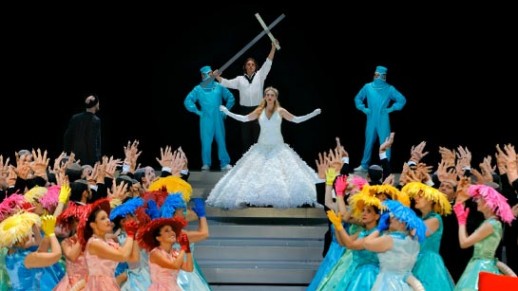
The chorus seemed to be used to undercut or mock the main action in a lot of places.
There was a lot of misplaced swan imagery. In the first Elsa/Ortrud duet, the model swan had no use except for Ortrud to attack. And the Odette/Odile bit at the end of the second act was distracting. And, yes, the discovery of Gottfried was appalling.
How come the entourage of the Ruler of Brabant wore “L” badges when no-one knew his name was Lohengrin?
Both Ortrud and Telramund overacted (no doubt under direction). I didn’t realize that the ends of a mouth could turn down that far.
I did like the singing. That has to be close to the softest possible In Fernem Land. Ortud’s curse was very well done. King Henry was good (when not cowering at shadows).
I managed to watch them all after work before they disappeared. I stopped saving them, because it was too time consuming and I decided I would buy the DVD if available anyway.
Although, I hate to say this, by the end I was bored by KFV’s voice/interpretation. Hard to say how much of it was him, and how much was direction he received.
Why did Elsa come out carrying her heels, which she never put on? Oh why am I asking such a question–it’s Regie!
These productions do make me wish the houses would put up PDFs of the program notes on their websites–or at least text files.
Why did Elsa come out carrying her heels, which she never put on?
Going barefoot is part of a grieving ritual in many cultures, e.g., “And David went up by the ascent of mount Olivet, and wept as he went up, and had his head covered, and he went barefoot…” 2 Samuel 15:30
I assumed that the director wanted her on the floor (she positioned herself very carefully) with her shoes to one side to echo the dead horse and carriage at the opening of Act 2. She had come to the end of her road. And it cohered with the Odette/Odile towards the end of Act 2 to emphasis the Ortrud/Elsa pairing.
My thought about the shoes was more along the lines of Elsa beginning to (try to) transform into one of the rats (who are always seen with bare feet, even with costumes removed). It would be a response to her earlier attemt to transform into the swan.
Why? Because she has lost control of her fate (as the rats do at birth in the laboratory). After Lohengrin exits, what does she face? Serving as a regent until her “brother” reaches the age when he can rule? (and then what after that)? Will the weak king win the war with the Hungarians? Will there be a revolt (the rats pissed at her for making Lohengrin take a hike)? Not too rosy a future.
Also, the coach is a self-reference by Neuenfels and von der Thannen to their 2001 Salzburg Fledermaus, in which four coaches (horse-less, but looking uncannily like the Bayreuth coach) appear in the fore-stage area of the Felsenreitschule throughout the opera.
You all think too much. Thinking is painful and I don’t like it. ;=(
Wasn’t the coach derailed along with the dead horse? I didn’t see the whole thing but didn’t Ortrud and Telramund have hoods on their heads? I thought that maybe they tried to get out of the rat maze with money but were derailed by the rat banditi and then after the rats collected their money (Unless my memory is really bad) the hoods came off and the plotting commenced, “It’s back to the lab now.” I am going to watch it again, put all my ideas in writing, and then see how it all turns out. Though Clita you have a point about thinking too much:)
I like all of these readings, and want to add another: Matters always keep moving faster than poor traumatized Elsa can keep up with. She’s unready for the funereal event, and stays that way.
There’s so much I’d like to say about this production, but I have no time to really write it up, so a few scattered thoughts are going to have to make do.
Neuenfels quite simply rescued Lohengrin for me. I’ve loved most Wagner since I was about 15, but had decided years ago that the blue-and-white fairy tale just did not speak to me. Some beautiful music, but the musty, dated fantasy of a German Middle Ages, with its waxworks knight, dimwit heroine, and brain-dead chorus, just left me cold. It turns out the last full-length version I saw was in 1982, with Peter Hofmann, Pilar Lorengar and Leonie, and all I can remember of it is that everybody was wrapped up in endless yards of gorgeous, pointless heavy silk. A pretty good metaphor for what the whole work added up to for me. (I even had to look up the cast list to recall everyone who was in it. I had actually forgotten Leonie!)
If a cast like that – on balance, stronger than Neuenfels’ – couldn’t sell me on the piece, I figured then it was something I would just have to let go. Youtube clips of the Met’s penultimate production just reinforced the feeling. I wanted to go shake some sense into these silly people. The ponderous Disneyfied nineteenth-century medievalism of the production only intensified the sense of kitsch.
But Neuenfels addressed all of that stuff head-on. He accounted for it, and proved that it’s still interesting – politically, psychologically and even poetically. The rat-chorus, which I never found repellent but actually rather cute in its weird way, highlighted the stereotypical responses written into the score: these people are running on instinct – or conditioned reflex, but in any case not thought – and their instinct says to go with the crowd (incidentally, probably a whole lot closer to what real medieval society was like). Neuenfels in the intermission interview focused on how Wagner was being critical of German culture, but the parallels with what’s happening in U.S. and world politics these days are too obvious to go into.
Instead of a noble mannequin who makes Superman look complicated by comparison, Lohengrin is a tormented figure that we first see in isolation, a guy who’s tried to take on moving the apparently immovable. And it actually does move… for a while. Elsa, instead of being a cluelessly pure female of the type rampant in 19th-century literature, is shell-shocked and unable to keep up emotionally with what’s happening to her. Lohengrin doesn’t have the knowledge or understanding that’s needed to rescue her – assuming she can be rescued at all – and the relationship fails. So does his attempt to lift society into a new awareness.
And so on. I won’t claim to have a reading for everything in the production, and I can see the possibility that some choices might turn out on repeated viewing to be mistakes. Not sure about some of the animated projections, for one thing. But the webcast never really showed them in relation to the overall stage picture so I can’t say what they might have added up to in the house. Also the mysterious treatment of Gottfried at the end: I can see at least a couple of meaningful ways to read it, but am not sure whether I buy it or not. One thing I do like about it is that it rigorously avoids false promises. The future remains as unclear as ever.
Those are quibbles. For elegance, this production totally outshone old Beni Montresor’s miles of silk. As was pointed out by my hubby – whose first fully staged encounter this was – stripping away the faux medievalism, rather than undermining the mythic, magical quality of the piece, actually strengthened it. Lohengrin is not inseparably dependent on buying into some muzzy version of the Middle Ages that never was. Thank goodness.
P.S. I thought the conducting was magnificent, and so was the chorus.
Batty, YES! I want to see it again and again!!!
This is beautiful, Batty. Now I want to see it again too.
Apart from Leonie, the best part of the old MET Lohengrin (the one before the boring production with the blinding blue ray across the stage) was the scene change in the second act that brought the entire company in all it’s midieval splendor and castle on the wagon moving ever so slowly into view from the darkness with the huge crescendo of sound from the pit. For me it was as successful a coup de théâtre as Everding’s having Birgit Nilsson’s Isolde rising imperceptibly high above mid point in the proscenium during the Liebestod, ultimately transforming her into a twinkling star with a pinspot focused only on her large diamond broach. Yes, I loved the rats the rest of the Bayreuth telecast and was rather proud of myself that I was not disgusted by it.
Batty was talking about the San Fran 1982 production , not the Met’s.
Lorengar and Mignon opened the Met’s show in 1976 and then the 1986 revival featured Marton and Leonie.
Your scattered thoughts are terrifc. I am going to write some not so scattered thoughts that will pale but this way I will remember and learn!.
I propose we have, with Cieca’s blessing, a separate discussion thread for all these broadcast videos Well, I guess we sort of do actually, thank you. It would great fun. Or even some new releases coming out on DVD. We might come up with something really super cohesive and interesting. Maybe just stick to the Regieperson versions. For instance, I would love to make write a mash-up between Herheim’s opening of his Die Entführing with the black and white brides-bridegrooms and the black and white mice in this production during the Bridal Chorus, which, BTW was terrific with their toe tapping and letting us listen to the FANTASTIC chorus sing the and the little ones in pink who I thought kind of precious. I just love it and want to see it again and again.
I would also love to see discussions on the streaming videos here. Much as I’ve loved sitting in on the chats when I am able, all that knowledge is lost in the ether after.
This way (I hope) I can search parterre and find this discussion again when I have the DVD.
I use a free application called Evernote to save web pages for later.
In that case, do you have the chat about the Beito Fidelio saved? Would you consider sending it to me at fragendefrau82 at gmail dot com? (I know, I have a one-track mind and I need to just get over the fact that there won’t be a DVD and no one seems to have the complete opera saved…)
I have evernote myself but haven’t thought to save any of the chats.
and of course, the magic word: Please…
and thank you.
Is there a DVD of this Lohengrin with Kaufmann? I couldn’t find one on amazon.
No they did not film it when he did it at Bayreuth last year. The only one available is the Munich version, which is also interesting but not nearly as beautiful as this one.
That is, I’m sure it WAS filmed, everything is filmed now, but the DVD I am sure will be of this year’s cast, from all I’ve heard. If there is a DVD.
After seeing it yesterday and after reading the review of last year’s performance above, I’m really sorry that we won’t be able to see Kaufmann in this production.
No, there is not, unfortunately. Under the sponsored deal with Siemens, it was already known in 2010 that the following two production would be filmed for live transmission and eventual DVD/Blu-Ray distribution in their second year. Thus, Lohengrin in 2011, and this year’ new Baumgartner Tannhauser will he filmed and streamed in August 2012.
I read the following somewhere (can’t remember where): supposedly, Kaufmann didn’t want to commit to Bayreuth for more than a single season, due to the major time commitment needed for the Bayreuth rehearsal process. With him already slotted for the Richard Jones Lohengrin in July 2009 (with a DVD promised) and with the Bieito Fidelio scheduled for July 2011, Kaufmann chose the prestige of the Bayreuth premier over the possibility of appearing in a second DVD (so shortly after the Munich DVD – as it turns out, Vogt will have been in two consecutive Lohengrin DVDs, the Baden-Baden production from ’06 and this new Bayreuth production).
APT, here is the quote from Kaufmann’s biography which came out in 2010 (my translation, please excuse): “In July you’ll be onstage in Bayreuth for the first time…but it looks like only this one time. JK: ‘Yes, it turned out a little unlucky; because of the long rehearsal period next year I would have had to give up many other things. But there are other attractive Wagner roles, and I’m sure both Bayreuth and I will be around for a long time.’ Do you have any idea what the production will be like? JK (sings):’Nie sollst du mich fragen.’”