The long matinee
Here’s your discussion thread for this morning/afternoon’s webcast of Lohengrin from Bayreuth, cher public. La Cieca herself is grabbing a bite of lunch and will join you later!
Copyright © 2012 parterre box - All Rights Reserved
Powered by WordPress · Parterror Theme by Nick Scholl for DIS Magazine
I didn’t like the ideas of the director -ridiculous
The King was very strong
Elsa vocally not secure
and Lohengrin his timbre is a question of taste
Regarding Elsa’s arrows in Act I, in this review/preview, the idea of being related to St. Sebastian is mentioned.
http://berkshirereview.net/2011/08/neuenfels-lohengrin-bayreuth-2010-2011/
That’s an interesting review, louannd. But I think even though the St. Sebastian is a ready association, it’s pretty much a red herring in this situation – I really doubt Neuenfels meant any Christian connotations. Doesn’t it just signify that she’s profoundly traumatized? Which makes Elsa’s psychology a whole lot more interesting all the way through. She’s not dumb, she’s got PTSD!
I agree totally – they were attempts perhaps at contamination and they give Lohengrin something to do to get closer to her….lots and lots to think about.
I was also struck by the translation during the intermission about “Sebastian’s arrows’, and wasn’t sure how ‘Germanic’ a kind of phrase it was. Of course, Sebastian and Roche were the two patron saints to protect against Bubonic plague, which implicates rats (at least theoretically – there is some scientific question, but that’s a different matter). I brought this up in the parterre chatroom yesterday.
Wasn’t it the stripey-suit interviewer who used that phrase (or the German equivalent)? That particular association might be one that occurred to him privately, not any “official” interpretation.
I think that’s right, La Cieca. Also, I seem to remember hearing (through the obnoxious “English” voiceover, so I could be wrong) that he said “Sebastianspfeile” = “Sebastian’s arrows” (NB: no “Saint”). The way German works, that would tend to generalize the image away from any focused religious-metaphorical intent and more toward just a shorthand way of identifying for the audience how she looks: “She looks kind of like those statues of St. Sebastian.”
Also also: The rats all looked pretty healthy to me, so I can’t see how a plague metaphor would fit in.
La Cieca needs to get out more. She missed a good one: http://www.operatoday.com/content/2011/08/ariadne_auf_nax.php
“Dell’Arte Opera Ensemble is one of a number of organizations, such as Wolf Trap Opera Company, that is dedicated to providing young singers with the tools they need to succeed in the extremely competitive world of opera.” Since one of the principals in the review linked here first auditioned for me in 1992, we might be stretching the young singers needing a break line…..
I loved it except that “abortion” at the end.
I found that a lot of current directors have difficulties with this final scene. For them, Lohengrin represents the true hope of a new world that is open to love and human vulnerability. If that is true, then the end of Lohengrin is essentially sad and Gottfried, although disguised as a kid, only represents the old (and ugly) world from before Lohengrins arrival. However, this outlook is somewhat contradicted (at least to my mind) by the music Wagner wrote for the transformation of the swan.
What Neuenfels tries to do here, I think, is to make this contradiction visible. At least that’s how I read the scene. I don’t think it is in any way an abortion reference. In an even less subtle manner, in the Konwitschny Lohengrin Gottfried is elevated from below while carrying a gigantic gun.
Shocked German: I didn’t think it was an abortion either; but I did think that the image itself was pretty ugly and gross–more important, it did not seem to fit in stylistically with the rest of the opera’s sets, costumes and visual concept. If he had used a cartoon on a screen (as with the rats) or a more abstracted image (as with the swan in a kind of case) it would have worked better for me.
PS I would have liked it better if Lady Gaga were in the egg!
All we need now is for Lady Gaga to sing Lohengrin and all the cool “with-it” people will become Wagner fans!
Louannd—LOL Love Gaga’s egg.
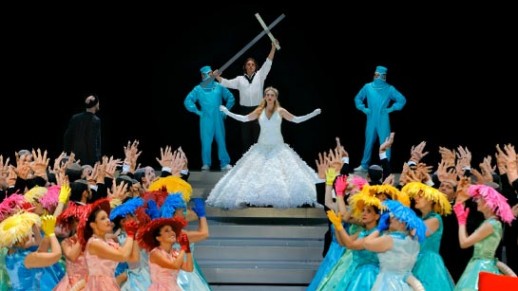
From a plebian’s point of view: a black and white Mickey mouse production, with ALCOA aluminum-sheeth backdrops with either holes or vertical cuts, and a Don King- boxing promoter- haircut thrown in! Singing was uneven but chorus was good.
Thank you so much for the links! I can’t watch it all before work–hope it will still be up this evening. First thoughts on what I did see (from a complete neophyte’s point of view):
Love, love, love this production. Not because of anything intellectual–I just think it is incredibly beautiful, and the stellar craftsmanship to create it–wow! The Met’s “machine” looks crude and silly in comparison. Not to mention that there is actual personenregie evident here.
It was really well filmed too–the film director took advantage of the set design–I wonder if Neuenfels had input in the film direction. I’ll definitely buy this if it comes out on DVD.
As for the singers, I’m still a newbie so I don’t feel knowledgeable enough to comment, except to say that I liked KFV much, much more than I thought I would after hearing the live radio broadcast. My heart belongs to JK but it’s not a case of “there can be only one” Lohengrin, right?
(Now if only the Bieito Fidelio would magically appear in full on YouTube…)
Thank you La Cieca!!
I did think the orchestra and chorus sounded phenomenal and much better than the Munich version…
TRASH!
My favorite singer in the cast was Petra Lang, just loved her Ortrud!
I have been waiting impatiently for this TT review. Hiring Daniel Okulich is like an insurance policy where TT is concerned!
“the appealing bass-baritone Daniel Okulitch, best known to New Yorkers for his brooding, sexy Don Giovanni with the New York City Opera”
“Abdul (Mr. Okulitch), a decent and handsome country man”
“The only sympathetic character is Abdul, at least as played by Mr. Okulitch, whose earnestness and robust, warm singing lent a little depth to this conceit of a character, a self-aware man pretending to be the noble savage. And with his fit physique, Mr. Okulitch looked just right walking around the jungle like Tarzan in a leopard-skin loincloth and carrying a spear”
Throw in the routinely over-the-top praise for David Robertson, who hear did “fine” but not exceptional work, and you have a TT double-dipped cone!
What in the world is WRONG…about commenting on a performer’s physical…as well as vocal..charms, in the course of a review….?…if memory serves me, I’ve noticed the same in other papers (The NYPost, for example), from time to time, as well….
What is wrong is dilating on male pulchritude and strappingness for paragraphs when it 1) takes up space from commentaing on other leading performers– not a word here was said about the singres doing the Flagello and Chookasian roles, who were fine (Jamie Barton and Thomas Hammons) and when it obscures the reviewer to the fact that the handsome lithe strapping hardy male in question found the more heavily orchestrated music very tough to sing; he was largely inaudible in the heavier passages.
Glory and honor to whoever uploaded these clips. Mind-blowing!
About the ending: “All is spoiled.” The deep flaws of our nature resist and finally abort all hopes of transformation, whether it be in the individual or the species.
We remain rats.
Optimistic American rats, of course.
A lab experiment in Schopenhauer pessimism, as if what might have been if Wagner discovered Schopenhauer a little earlier?
hope you saw them all, they’re GONE!
Amazing coincidence – I was downloading the first to last one (3 Akt 4, with In Fermen Land) – it took a long time, then when I went to get the last one (3 Akt 5), the account was gone-zo!