


Headshot of La Cieca

Cher Public

  • MrGuy1804: You are right on the money. I was not terribly impressed with any of the singing. There were a few... 12:29 AM
  • Camille: That was fun, thanks! I had completely forgotten Eastern Airlines, the Wings of Man. With a name like... 12:22 AM
  • Henry Holland: Thanks! Too bad they didn’t do Der Zwerg instead of the (wonderful) Puccini. The LA Opera... 12:09 AM
  • Camille: Thanks Blue, for the review. Lord, what are “earthy colorings”? 12:06 AM
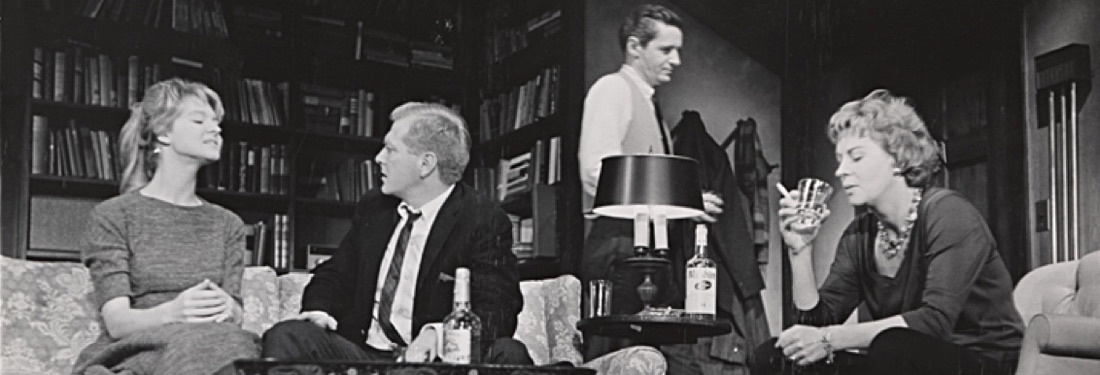
  • Gualtier M: Here is Carmelita Pope in the actual 70′s era Pam commercial at 2:36 in: httpv://www.you... 12:03 AM
  • CruzSF: kashania, please tell us more about these performances. Who? How presented? And don’t neglect the... 12:03 AM
  • bluecabochon: Lucky you, Bob! I;d see it again if I could. Here’s TT’s New York Times review:... 11:53 PM
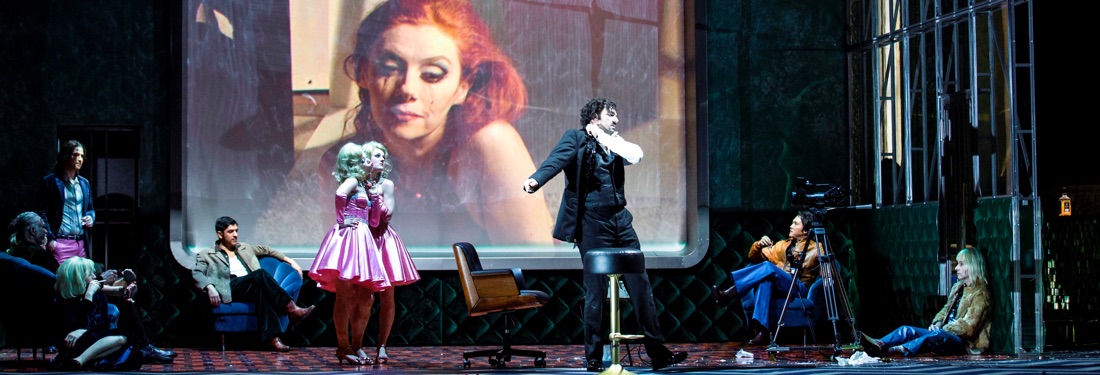
  • kashania: HH: I thought of you tonight while watching the COC’s double of Florentine Tragedy and Gianni... 11:28 PM

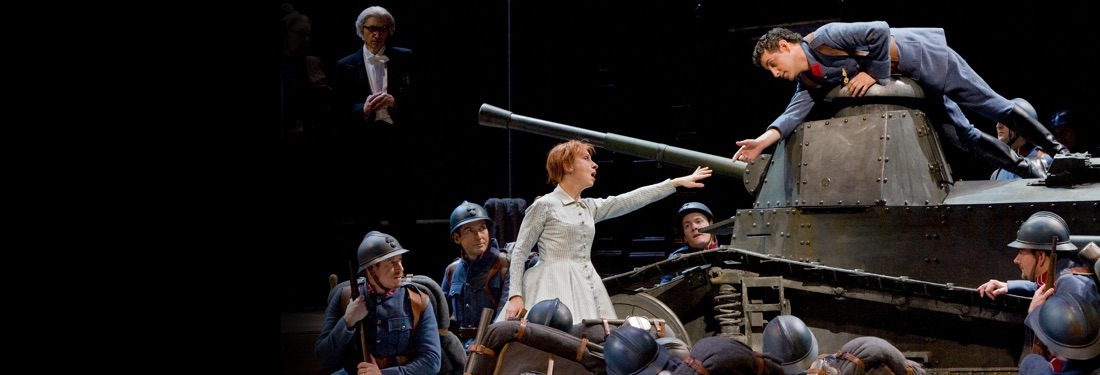
Nehmt meinen Tank, daß Ihr zurückgekehrt!

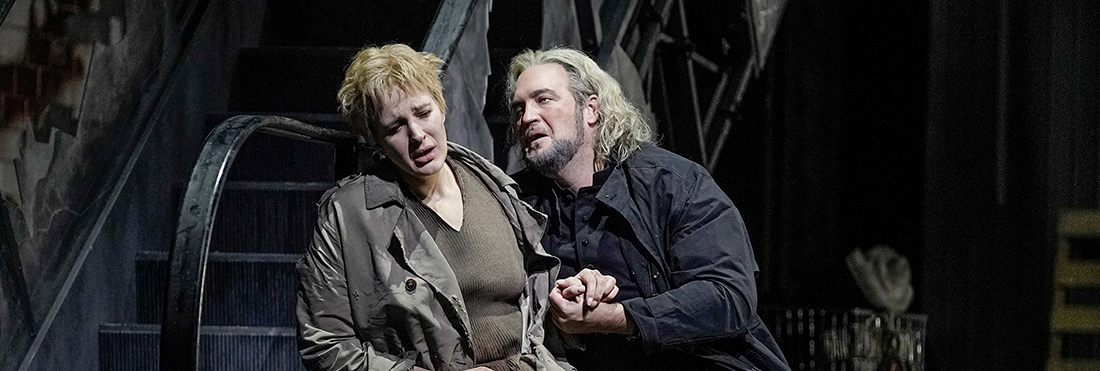
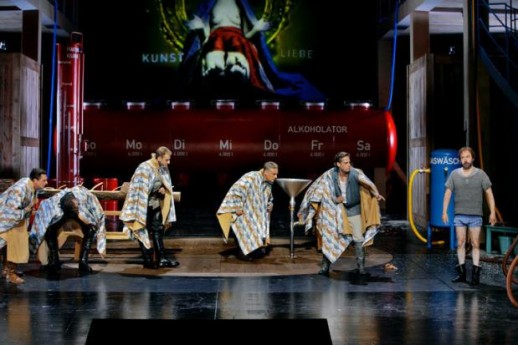
This morning, live from the Bayreuth Festival, you can hear the premiere of the Thomas Hengelbrock/Sebastian Baumgarten production of Tannhäuser. The broadcast proper begins at 10:00 AM EDT. For a list of web stations offering this program, go to Operacast, and naturally La Casa della Cieca will be open for the Chat Contest.  (Photo © Bayreuther Festspiele/Enrico Nawrath.)

45 comments

  • Clita del Toro says:

    What an exciting week of Wagner! I especially want to hear Parsifal and Vogt’s Lohengrin. See you at Tannhäuser today–not that Meistersinger is chopped livah!

  • Baltsamic Vinaigrette says:

    Just started picking it up on Bayerischer Rundfunk, which I’d simply dipped into from habit. This prompted me to come on here and give an OT alert – but no need, as I see. Danke, Cieca!

    The show starts right… now.

  • Quanto Painy Fakor says:

    Frank Castorf to direct 2013 bicentennial RING – let’s hope that’s not a RONG decision.

    • Jack Jikes says:

      My single worst night in the theater – a Castorf ‘King Lear ‘ at the Volkbuhne.

    • davidzalden says:

      I have seen many Castorp productions at Berlin’s Volksbuhne over the last 15 years or more — this company, under his leadership, has presented some of the most brilliant and daring theater imaginable in our age. He has supported and repeatedly hosted directors such as Marthaler, Jurgen Gosch, Dimiter Gotscheff, and the late lamented Schlingensief, making the Volksbuhne the central axis of Berlin theater (on any given night in Berlin you can see cutting-edge productions at the Deutsches Theater, the Berliner Ensemble, the Schaubuhne, the Gorki Theater, and the Volksbuhne, not to mention the three opera companies and many smaller theaters). His own productions have greatly influenced a generation of European directors, actors and designers. When he stages plays by Tennessee Williams, Maxim Gorki, Shakespeare, Ibsen etc. he takes the texts only as a starting point — he has assembled a floating company of brilliant actors who improvise, riff on texts, and push physical and emotional energy to unheard-of extremes. He often builds productions around famous works of literature — his adaptations of novels by Dostoyevski, some of his greatest successes, have had running times of 4 or 5 or 6 hours — testing the stamina of audiences to the limit — but if you break through the pain barrier the experience can be cathartic and hilarious and riveting. His work with his main designer Bert Neumann has transformed the whole idea of stage design — their use of live-camera video and their creation of buildings, cities and and hyper-real spaces on the gigantic Volksbuhne stage is amazing and has had a transformative effect on European theater. So when we talk of Castorp we are talking about a brilliant, disruptive creative giant of the stage.

      • Quanto Painy Fakor says:

        Is the p key where the f should be on a European keyboard?

        • davidzalden says:

          Sorry for my misspelling, I always confuse his name with Hans Castorp (the main character in Mann’s The Magic Mountain). I hope my post above sheds some light on who CastorF is. Of course whether this great theater director can work his black magic for the lyric stage remains to be seen — I think he has done only one opera before (Otello in Basel some years ago). How this man, whose modus operandi is deconstructing texts, improvisation and completely transforming material, will get along in a medium where textual fidelity and musical precision are the rule, is the question. Or will he break all the old rules and create his own response to the tetrology? Yikes.

          • Quanto Painy Fakor says:

            If I am not mistaken, Castorf has also staged one of the Bach Passions, but perhaps that project never came to fruition.

      • Andrew Powell says:

        DZ, you write as if this were a good thing. When Castorp stages plays by “Shakespeare, Ibsen, etc.,” he takes the texts ONLY AS A STARTING POINT? He has transformed the “whole idea of stage design” with LIVE-CAMERA VIDEO?

        These are the two missteps of Regietheater, my friend. Distorting the text distorts character, which quickly causes illogic in the story. Camerawork in place of stagecraft violates the physical premise of theater.

        Such stagings do not rise to the level of “non-traditional,” as argued. They are non-truthful. They are invalid. They waste resources and disserve the actors and singers. Their DVD “products” are alien to the audience’s experience.

        If Castorp wants to write his own stuff, let him do so. If he hungers to work in a film or TV studio, let him go there. But don’t hire him for opera!

        After the saddening jumble left by Tankred Dorst and his lady friend, one would expect Eva and Katharina to exert every effort to ensure a coherent and professional 2013 Bayreuth Ring. This hiring decision points firmly in the opposite direction.

        • davidzalden says:

          I find it difficult to respond to such categorical statements. I don’t really like or understand the term “regietheater” — it implies that you can lump the work of many very different artists over decades of change and exploration into a convenient niche. There is no such thing as “such stagings” — every staging and every director is a separate entity. When you say that “distorting the text distorts character, which quickly causes illogic in the story” I would respond that Castorf is not really interested in character in the traditional sense and his theater has very little to do with logic or a clear story — rather it is associative, critical, and non- linear, at least in the conventional sense, and courts illogic and chaos. What exactly do you mean by “non-truthful”? Do you have the definitive truth? If so, I would love to add this app to my computer. As to comparing Castorf to Tankred Dorst, who directed the last Bayreuth Ring — well, Dorst is essentially a writer, who I think had never actually directed any stage production before his Bayreuth engagement, whereas Castorf is an acknowledged master stage director. Whether it is a good idea to engage a theater director to direct an
          opera, or rather 4 operas, in the limited time available at Bayreuth, and under such intense pressure and scrutiny, is another another question entirely.

          • Andrew Powell says:

            Stage directors have a job to do. It is not to write. It is to bring the writing of others to life on a stage.

            Whether tackling Shakespeare or Wagner, there are problems inherent. How do you bring an oddball character like Hamlet to credible life? How do you make the audience care about Wotan’s quandary? How, physically, do you set up a rainbow bridge or show the Rhine inundating a hall?

            In the “Ring,” how do you match and support the unity Wagner worked so hard for over a span of a weeklong stage festival?

            Audiences are not interested in the ideas and “concepts” of stage directors except insofar as these serve and solve the problems thrown down by the writer.

            Regietheater is a mongrel and derisive label — part French, part German — used to imply that the régisseur has placed his own thoughts above and ahead of those written into the theater work he is purporting to stage.

            As such, it attaches to hundreds of stagings a year, both in legitimate theater and (more harmfully) in opera, where a delicate fusion of minds between the writers of the words and music has already occurred.

            Castorf is just one among dozens of Regietheater practitioners, each trying to build his brandname by applying certain traits to every work he stages, the way a great painter applies a certain palette. And the way a neighborhood dog applies a certain urine.

            Castorf’s disinterest, as you say, in “character in the traditional sense,” and “his theater,” whatever that is, are not the reasons people go to Bayreuth.

          • La Cieca says:

            Andrew Powell, can you please scan the Sinai tablets upon which these rules are engraved? I’d love to post a photo of the word of the Lord God.

          • Quanto Painy Fakor says:

          • Andrew Powell says:

            The rules, La Cieca, are in a less mythical place than Mount Sinai.

            They are in the libretto and score, and they vary, unlike commandments, from piece to piece.

            So, hold the religious rhetoric, okay? Argue on the merits.

  • DonCarloFanatic says:

    I did not realize they had loggione in Bayreuth. Whom did they boo so vociferously?

  • rysanekfreak says:

    It sounded to me as if the boos started for Venus. Then for the director and his production team. I couldn’t tell if the conductor escaped unscathed.

  • Baltsamic Vinaigrette says:

    Exactly so, Rysanekfreak – they didn’t like Stephanie Friede much (the booing was by no means universal, but neither did I hear any compensatory cheering) and then of course the Baumgartner regie-team got, shall we say, one-point-something barrels.

  • Clita del Toro says:

    Tannhäuser was okay, and I hope the operas to follow will be an improvement.

  • the other leonora says:

    Well, Venus really deserved it. Stephanie Friede is one of the most scandalous things I’ve ever heard during the last years of systematically bad singing in Bayreuth.
    On the other hand, I don’t understand the enthusiasm for Groissbrock and Nylund, especially Nylund who was in permament difficulty – although she didn’t scream like Friede.
    I found that Hengelbrock and the chorus did a splendid job, the conductor didn’t merit the boos. But I guess he got sacrified because of Baumgarten.
    Now the Eurotrash critics from German journals are philosophizing about this Eurotrash production. Ridiculous.

    • MontyNostry says:

      Shame. I saw Friede as the Faerberin a few months ago and she was really very good indeed – and able to sing softly.

      • Buster says:

        Monty: I heard her in that too, in Antwerp – same production? I was much more impressed by the Amme of Tanja Ariane Baumgartner. Friede was screechy and loud the afternoon I heard her. Baumgartner sang her part like a Schubert song – bewitching.

  • MontyNostry says:

    Yes indeed, Baumgartner’s Amme was the most beautiful I’ve heard — and she even looked sort of sexy. Friede was loud, certainly, but not screechy the evening I heard her. The whole performance was excellent, I thought.

    • Buster says:

      Yes, I loved it too – had not heard the orchestra in better form for ages. They need more Alexander Joel!

  • MontyNostry says:

    It was indeed beautiful and refined — Mr Joel could have taught Solti a thing or two about how not to make Strauss sound like a steamroller!