

Nixon in preview
There were a disproportionate number of young people at the Met today—even younger than me, which is really young. That made me happy and smile while filing in line to enter the auditorium. Hopefully this is the next generation of undying fans and queens about to plunge into a “new” world of opera spearheaded by John Adams‘ Nixon in China from the 80s: a MET premiere no less!
But let’s get to the dish of this dress.
Adams’ entrance was greeted by a loud ovation, true to the spirit of the work, welcoming an member of American mythos into the podium of America’s Opera house.
Immediately there was a faux pas: the curtain was raised and it immediately began to lurch. Up and down, up and down. It then remained, I would say, about 3/5 of the way to the top of the proscenium, exposing the grim-looking chorus. I didn’t know, at least until later, whether this position of the curtain was a malfunction or an actual part of the production. The chorus was good in its command of the language–I had little need to look at the Titles in English, which was an accomplishment, though there were still parts where I had to sneak a peek.
The singing was uniformly good coming from all of the principals. James Maddalena had a vibrant and warm baritone that did not feel too pointy or barky for me; it felt strong and secure, with a jitteriness that I have always associated with Nixon’s political and personal character from contemporary American lore. Richard Paul Fink‘s Kissinger was also a pleasure to watch and listen to, giving a lot of himself into his acting and singing. God knows he was never inaudible, plus he wasn’t shy about girating on a Chinese dancer during the Act 2 dance sequence where he played “Henry Kissinger playing the part of sexually-abusive Chinese landowner.”
Janis Kelly, I thought, was adorable and perhaps one of the best parts of this production, as Pat Nixon. From where I was sitting, not far from the stage, she looked like Cloris Leachman mixed in with Debbie Reynolds, with that coiffed, blond wig and stature. She was able to mix the “housewife” persona of the mid-20th century and the persona of America’s First Lady: neurotic, romantic, wistful, dignified, and pill-popping. Her “This is prophetic” was moving and well-sung.
Robert Brubaker‘s Mao was a surprise. A heldentenor singing the role of this crippled man—more on this “cripple”-ness later—in such a high tessitura was a little ringing in the ear, but he carried it off. Loud, loud, loud!
Now, Kathleen Kim was also in the same league as Kelly as one of the stars of the show. Her coloratura and pointed delivery for “I am the wife of Mao Ze Dong” was one of two highlights of the show for me–the first one being Pat Nixon’s aria—culminating in a final moving tableau of the Chinese revolting. Her voice and acting all got the point across: The ways in which women during the Communist revolution in China had very few ways of climbing the political echelon, and she found out how. Nice high D’s coming from Kim.
The worrisome part of the production seemed to be the direction, which is difficult to judge on a dress rehearsal, but still. There were moments when I thought that the movements were just pointless, like at the beginning when the chorus is singing about their discipline with everyone facing the audience. Then some members of the chorus move off, and just walk to the back, then walk back to the front, at the same position, with little to no point, I thought.
The big red curtain became a huge part of the production, becoming a mode of focusing the attention of the audience to certain parts of the stage. For now, due to the mishaps that happened at the beginning with the curtain, I can’t help but associate the curtain with “tacky” but I am so willing to be corrected on that by members of the cher public.
The production relied on backdrops ala Ravenswood Castle from the Zimmerman Lucia which I thought could have worked had they fixed the blocking. There was one point where the Summer Palace backdrop placed the palace on top of the tree branches.
The scene with the dance for the Red Detachment of Women was a joy, though confusing for me. The members of the chorus, Pat, Henry, Dick, and Madame Mao were seated facing the audience. The background behind them changed regularly with more drop-downs that were evident as fabric. It took me a while to realize that the backdrop was meant to be viewed as the backdrop for the show within the show.
Mao’s disability also vanished come Act 3, though not after coming down from an opening in his iconic portrait’s mouth via the same tarmac staircase that was used for the Air Force One landing in Act 1—which received laughs by the way, because of the lightness of the plane compared to the heaviness of the stairs. After that walk down the stairs, Mao was suddenly cured of his disability and started walking normally.
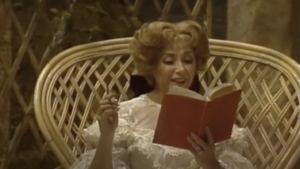
Sorry, I meant consistently.
I saw John Adams in conversation at the Edinburgh Festival around 10 or 12 years ago and he said he wishes all opera singers used microphones. He even went so far as to say that he doesn’t like the conventionally produced operatic voice and he would prefer singers with more ‘ordinary’ voices using microphones. In any case, he was pretty clear that he considers microphones necessary in order to realise his scores properly, and writes them envisaging that microphones will be used.
I can’t speak for what the Met is doing in this regard, but it would be pretty silly for them not to use microphones if the composer thinks of them as integral to the way he wrote the work. One only wishes they would be up front about it if they are using them, and simply say these singers are amplified in accordance with the composer’s wishes.
I guess the next step is opera without singing.
Opera really died when they dropped recit. HOW ARE WE SUPPOSED TO UNDERSTAND THE STORY?
ROTFLMAO.
Cool, I owe myself a fiver.
*updates ‘comments bingo’*
“I guess the next step is opera without singing.”
Well, with Dancin’ Danielle and some of the other talent already on the roster…
i have no problem with the miking, especially if that is the composer’s intent.
I completely agree with you that the MET should be upfront and it should be noted in the program book etc that the opera uses miking. Otherwise it looks deceptive, even if that is not the intent.
I don’t disagree about the program note, which I think would be really useful for audiences who are confused about this. (I *think* I saw a Nixon once that actually said something in the program like “microphones used per the instructions of the composer” or some such thing, but I may be wrong.) But: I doubt companies performing, say, Traviata, with even a single cut would be expected to advertise the opera as “abridged,” even if maybe they should. There’s a lot of talk on this site about respecting composers’ intentions, so I think we have to respect Adams’ choices as well, even if we don’t agree with them. He writes most of his vocal music with the intention that it be miked, as was the world premiere of Nixon. It wasn’t a mistake he made, it was his choice, for better or worse. I think he just prefers the sound of a more relaxed, word-oriented delivery from the singers, and that some degree of electronic mixing is just part of his compositional sound world. That doesn’t mean we all have to like it. But performing Nixon without microphones would at least be as wrong as Don Carlo without the Fontainbleau scene – or, to many, sung in Italian.
I mean, Don Carlos – of course!
Superb point.
Really? Why bother getting Gerald Finley to sing Batter My Heart I wonder.
Slippery slope, that.
Thanks for the preview – I’ll be there on Saturday, and will surely be among the crazy youngsters cheering for Adams as he enters the pit.
No mention of Zhou Enlai? He’s sort of the soul of the opera – I kinda think the team identifies with him more than anyone else on stage.
Not coincidentally, he also has the best aria at the very end. He’s also the only character who doesn’t come across as parody, and the one presented with the fiercest intellect (he’s the one in the banquet scene who recognises Pat Nixon’s reference to Washington’s birthday, not Nixon or Kissinger).
Perhaps our reviewer’s two cups of coffee had expired by that point.
exactly
“James Maddalena had a vibrant and warm baritone”
I’m sorry, I fail to comprehend this statement. Were they streaming the 1987 recording?
hehehe
I’m going to listen carefully to the Sirius broadcast this week, even though I have zero interest in the subject matter and I have always hated Nixon’s guts (at first viscerally, later with specific reason). Not a fan of ice-goddess Pat, either, who didn’t do anything to help women in their own Great Leap Forward.
Is it better than the original production? How is it different (other than it being a major outing at the MET?
I never noticed that this interesting Aria has roots in Ride of the Walkuere and various Hijotohos, both in the instrumentation, rhythms and repetitive forms!!!
Das bemerkt ja schon jeder Esel.
(j/k)
Actually, you can also add Elektra’s dance, with its major/minor mode switches. For all that, it also retains a bit of a gospel feel.
WARNING -- TRULY HORRIFYING
I have two family circle tickets for the opening night of Nixon in China (Wednesday, 3rd Feb) and I cannot attend. Anyone want them? Let me know quick as I will need to overnight them to you! They are 25 dollars each.
I wish. I’m ambivalent about the opera, but would love to see it at the Met to try and get off the fence.
Very OT.
But I hope you’ll allow me to vent for one moment. Just saw a press release from IMG announcing their representation for “symphonic concerts” of 11-year-old Jackie Evancho of America’s Got Talent classical crossover fame.
Fine. Okay… good luck to her then. Except….
They also announced that her new album would be supported by a Great Performances PBS special. Now, maybe I’m stuffy, maybe I have some sort of elitist tendency, but there are artists who can’t manage to get 30 seconds on tv and are doing amazing work. Fine, give her a pledge-drive friendly special – but one of the Great Performances slots?
Oh well… maybe I’m just a grumpy, awful person irritated by inconsequential things.
No you’re not. A little elitism is what we need now. Unfortunately, we live in a time when people are, as Kathy Griffin put it “aggressively proud of their own ignorance.” I love popular culture, and it is good that it has become more widely appreciated, but the pendulum has swung too far back in that direction. But what can you expect? When it comes to lack of interest in anything too complex or too challenging, when are being led by example.
Do you understand that Great Performances has a budget to purchase the rights to broadcast their various programming from vendors, and that the obvious reason that stuff like this young recording artist’s concert ends up on the schedule is that they can get it cheap? It’s subsidized in effect by the recording company.
Wake me when the fantasy world appears in which PBS has infinite resources and therefore can apportion its programming budget solely on the basis of who “deserves” to be seen on TV.
In the past year, “Great Performances” has telecast eight productions from the Met; the opera documentary “The Audition,” concerts with Fleming, Hvorostovsky, Dudamel, Florez and Boulez; three Shakepeare plays; dance documentaries about the Paris Opera Ballet and Jerome Robbins; plus several program devoted to American musical theater.
So if you don’t want to watch Jackie Evancho, perhaps you could just turn off the TV?
That’s why I am saying that the problem lays with our leadership. If it were up to a lot of the goons in Washington, you would need to live in places like New York or Boston to get decent programing. I did get all the performances you mentioned above (although some of them took a lot of hunting and staying up at an ungodly hour), but here in Mississippi you get a quality performance a month and an awful lot of filler. It’s not a problem for me, but we are not reaching a lot of the younger generations. Again, I am speaking from here in the boonies. Not as much as you think has changed since Leontyne price fled to New York and glory.
I agree perfidia. I, of course, am aware of the past programming of Great Performances. Often it is the only access those outside the main cities get to these performances.
I also am, of course, aware of the financial pressures facing not only PBS but our classical institutions (and recording companies focusing on them).
That doesn’t mean I can’t bemoan the fact that for reasons of money and ratings the greatest television conduit of classical music is making this choice.
Cieca, frankly, I didn’t deserve that snippy response. Perhaps we could discuss productive ways to support classical productions on PBS rather than condescending to me for bringing up the topic.