
Critical addition

Very few things intrigue me as much as analyzing belcanto operas, comparing their several versions and examining the composers’ second thoughts, modifications and revisions that, willingly or unwillingly, they made to their scores.
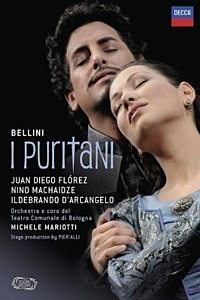
I was already salivating when I heard that the Teatro Comunale di Bologna was going to perform Vincenzo Bellini’s I Puritani in the new critical edition by Fabrizio Della Seta. DECCA, which has released this DVD documenting the 2009 Bologna performances, reports on its cover that this Puritani follows the above-mentioned critical edition, but unfortunately it is not telling the whole truth.
Or rather, while the original intention was to adhere to it, practical reality forced the Comunale to abandon its lofty ideals of performing the opera uncut. Rumor has it that a member of the cast was simply too tired to arrive at the end of the opera unscathed.
The cuts concern mostly the third act. A big chunk of Arturo’s act III romanza is chopped, but it is especially the duettone in the same act that suffers the injury of the scissors: about forty measures are left on the editing floor. To find another studio recording with this same drastic cut one has to go back to the 1952 Cetra release with Lina Pagliughi and Mario Filippeschi. Other smaller cuts affect Elvira’s “Polonaise” and the “duet of the two basses” at the end of Act II.
Compared to the standard Puritani, the only major differences are the reintroduction of a trio in the first act and the finale of the opera. By now everyone is familiar with the rondò “Ah, sento o mio bell’angelo” sung by the soprano, which Bellini wrote for Maria Malibran. In late 1834, while composing I Puritani for its premiere in Paris, Bellini was simultaneously preparing a version to be shipped to Naples, where the Spanish diva was scheduled to sing Elvira: as it happened, Malibran never sang this opera, as the score was halted in Marseille due to a cholera outbreak and reached Naples only after Malibran had left. Obviously this version gives much more space to Elvira.
For the Paris version, where Giulia Grisi and Giacomo Rubini had equal star power, Bellini first wrote the rondò for both soprano and tenor but eventually decided to cut it altogether. This Bologna production, where the main draw is undoubtedly the tenor, restores this finale “ a due”.
Another unfamiliar piece of music that found its way into the critical edition is a trio for Arturo, Riccardo and Enrichetta, to be placed right before Arturo flees with the Queen. This trio, which was excised immediately after the Paris premiere, and is still present in the Naples score, is simply gorgeous, one of the most haunting pieces of music Bellini ever wrote. Slightly reminiscent of another trio, the one for Elvino, Rodolfo and Teresa in La sonnambula, this composition is alone worth the price of the DVD. While the tenor sings one of the typical Bellinian cantilenas, sailing twice up to the high B natural, Enrichetta and Riccardo provide a phenomenal counterpoint, the first expressing joy for the unexpected turn of events, and the latter – in broken snarly phrases – gratified satisfaction.
The Bologna production is a mixed bag of shining jewels and missed opportunities.
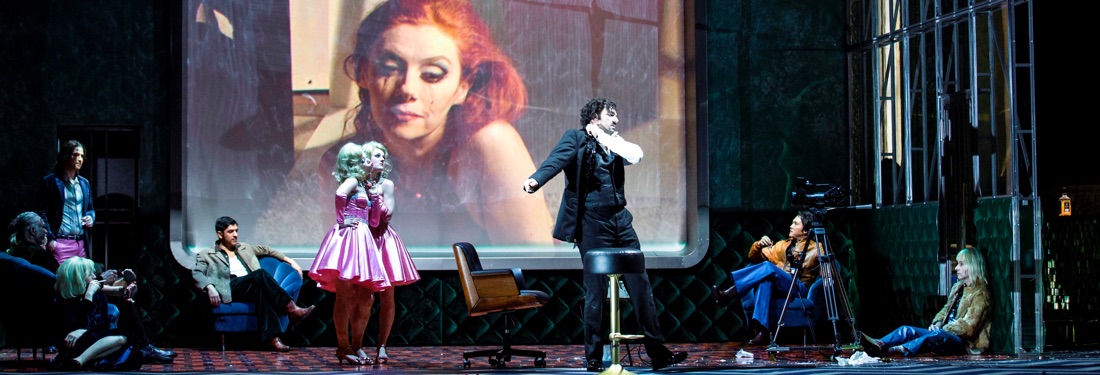
It is not one Pier’Alli’s most successful efforts. The producer/set and costume designer has created a mostly dull, only intermittently appealing mise-en-scène, where two colors, blue and grey, dominate, with the except of Elvira’s white bridal dress. The impression is that the leading singers are left to their own devices, while is Pier’Alli’s handling of the chorus is downright ridiculous. All throughout the opera, the female choristers engage in ritualistic gestures, raising their arms, then crossing them on their breasts, then turning their palms against the sky and so on, looking like traffic cops. Particularly execrable is Elvira’s mad scene, with the protagonist surrounded by dark-veiled female mourners holding oil lamps.
The video direction is clearly and inevitably influenced by the Met HD broadcasts, with weird zooming and camera movements on steroids. I personally like it, though it is reasonable to imagine how many viewers will find it utterly intrusive and distracting.
Michele Mariotti’s conducting is simply excellent. The young conductor (born in 1979) brings us in medias res right from the aulic, mysterious Prelude. Almost all the instrumental part is oriented in this direction. He portrays the bronze, gleaming, iridescent color of a civil war, with its sudden storms, its sunny flashes, and the changing mood of the chatelaines and warriors. He is equally adept at highlighting the lyric element of the opera with its ecstatic and dreamy tones as well as at sustaining the dramatic tension, bringing to the fore its epic and chivalric spirit.
In the above-mentioned reinstated trio, he creates a climate of suspension, thus disproving those who claim that this piece halts the action. Having graduated at the Rossini Conservatoire in Pesaro, he is quite familiar with the belcanto practices. All the daccapos are tastefully ornamented, and in one case (Riccardo’s cavatina) some variations are present already in the first exposition. With its malleable orchestra, Mariotti proves especially good at accompanying and supporting the singers, who, in a few occasions, would have not survived without his assistance.
Ildebrando d’Arcangelo (Sir Giorgio), unrecognizable in his white wig and old man make up, is vocally correct, but generally monotonous. With no gravitas, no trace of empathy, no grief, no emotional participation (there is no difference or sense of escalation among “piange”, “s’affanna” “invoca morte”) “Cinta di fiori” becomes an interminable singsong. He looks and sounds uninterested in the role.
The timbre of baritone Gabriele Viviani is rather generic; while he comes to grief in the low register (for instance, in his cavatina he ducks the low A flat in the phrase “per anni ed anni”), his top is easy, almost suspiciously tenorish: the high F on “nella speme” is produced open, whereas even a good tenor should already prepare for the passaggio on that note. His style lacks nobility and elegance. Riccardo may be the villain of the story, but Bellini entrusts him with some of his most melancholy and yearning melodies, where the singer is required to demonstrate his grief and loss through an enormous variety of dynamic signs, which Viviani largely ignores. The agility in the cabaletta is too aspirated and not very precise.
Nino Machaidze’s Elvira is a disappointment. In addition to a monochromatic timbre, she does not possess the technical requirements to sing Elvira. In the act I duet with Giorgio, characterized by a vocal writing heavily influenced by the Rossinian canto di forza, her voice sounds immediately acidulous and glassy in the middle and inaudible in the low register. Her first high notes tend to be shrill (and this duet with all its As flat and As natural hits constantly that area), with the consequence that the sovracuti are open, pinched, almost screamed because she is unable to float them: definitely not a good sign for a such a young soprano (she was born in 1983).
The Georgian soprano does the best she can (which is not much) in the agilità di forza, while her agilità di grazia (the Polonaise) is acceptable. She doesn’t however show much propensity for trills, which are all flattened out. The act I finale, though facilitated because performed without the unwritten but traditional puntaturas to the high Ds, still shows signs of strain above the staff. The voice itself has a certain volume, so much that in the third act Ms. Machaidze systematically covers her partner when they sing together. At the end of the duettone (which is no longer such with all the cuts), the only audible high C is hers.
One cannot shake the suspicion that Ms. Machaidze was largely cast because of her stage presence. Very attractive, with her full lips and perfect nose she has more than a passing resemblance to a younger Angelina Jolie.
Ça va sans dire, if DECCA has released this DVD, it is only because of Juan Diego Florez, whose performance proves why I Puritani has been so far marginal in his repertoire. Before this Bologna production, he had performed it only twice, in Las Palmas (2003) and Vienna (2004).
Florez, a proficient and accomplished technician like few others, is by his nature a few sizes too light for Arturo, a role he sings because it’s a part that the star system requires from those who aspire to be bona fide belcanto superstars, but his hunting ground is Rossini (the roles written for Giacomo David and especially the opere buffe) and some limited Donizetti. He has incredible facility in his upper register, and his delivery is elegant, clean and tasteful.
He gives his best in the cavatina “A te o cara” (unfortunately marred by the soprano’s pertichini, as she can’t quite float those long high As), with an impeccable legato and a secure high C sharp. When the situation gets less lyric and more heated, as in the recitative with Enrichetta and the confrontation with Riccardo, things become rougher. Phrases like “Non temo il tuo furor…ti sprezzo” take him to his limits: instead of showing defiance and courage, he risks sounding querulous.
The big act III romanza, albeit opportunely shortened, lies too low for him and he quickly tires. In the whole act (which, as mentioned before, has been considerably cut), Florez gives the impression of playing defense, mastering his resources for the big excursions to the top. In “Credeasi misera”, he omits the first written D flat along with a dozen measures, so as to jump directly to the next D flat, which replaces the famous, or infamous, F natural. Both tenor and soprano sing the rondò together, capping it with a high E flat, with Machaidze once again submerging Florez.
The overall impression is of a tenor who shows significant tiredness and survives only because of his iron-clad technique. Speaking of Luciano Pavarotti’s Radames, Mario Del Monaco said it was as if Nemorino had lost his way and somehow ended up in Thebes. In Florez’s case, one could say Lindoro is wandering around Plymouth.
I have huge admiration for both Florez and Brownlee. I must also add that Florez in his almost 15 years of career has been extremely wise in the choice of repertoire. The only faux pas he has done is Rigoletto, and partially Puritani. For the rest, he has not strayed a bit from his territory.
Where has this idea about Florez’s ego come from? He sang tenor in the opera, he wasn’t responsible for the cover design of the DVD box. Putting his name first makes perfect sense as he is the most famous singer involved. The title role is collective and somebody has to be first. But the idea that it was at his insistence is ridiculous.
Not as ridiculous as saying that Barry Banks has a more beautiful voice, mind you. I don’t hear any beauty at all in Banks’s voice.
Brownlee I find rather thin and bleaty, but no doubt others say that about Florez. To say that Florez is just fit for Fiorello in Barbiere is really not fair though. I’ve never heard him at the Met, but at the Royal Opera, which lets face it is a more representative and sensible size for an opera theatre, he comes across perfectly well. I’ve heard him there as Ernesto, Corradino, Tonio, Almaviva, Ramiro and I think the bloke in Sonnambula, and he has never been less that utterly convincing. I think his voice is unfailingly beautiful, and while I agree that the colour seldom varies, the phrasing and musicianship are so magical that he has one on the edge of one’s seat reagardless.
Cocky, i am not going to agree with everything you say, but i will agree with one thing:
You might have not heard JDF at the Met, but I have. I heard his Ernesto and Tonio at the Met plus his Prince Charming in Chicago. Add to that my friend Ronizetti having heard him at the Met in something else (can’t remember) and agreeing with me on the fact that JDF was never less than audible in both barns.
OT: I’m going to be in NYC the first week of January and plan on taking advantage of the opportunity to see my first Met performance! I thought why not go with tradition and see Traviata (Popsiklova or no). I’ve got about 150-200 bucks to work with, and am going alone, advice for best bang for my buck?
Rush tickets or Standing room. There is no sense in spending that much money on tickets at the met. You could also splurge and get yourself 2 balcony. The views are great and the sound even better than the expensive seats.
I refuse to pay the Met’s prices.
Standing room with $200 burning a hole in O Neo’s pocket? I refuse to stand for 3 hours in order to save $175.
And i would rather use that money on several operas on the same weekend
Judging from most of the comments on Parterre, there won’t be several operas worth seeing at the Met in a single weekend. Why not roll all or nothing on the one you want to see most?
Slight clarification, I am only in town from Jan 2-6 the weekend is devoted to the American Historical Association in Boston so Traviata is the one. But appreciate the advice on strategies for multiple performances on a budget.
I might not go for rush or standing, but with Op Neo’s budget he could certainly get seats in Fam Circ with excellent sightlines and acoustics for two or three operas. That would be the best use of the cash in my experience. I certainly had a better view, and heard more, from Fam Circ than I did from the orchestra seats.
Neo, if I may: You are wise to buy a seat for Traviata,
try for a rush seat and use the balance of your budget
to drink LOTS of Veuve Cliquot at intermission(s). I have
found that vastly improves any opera, esp. old chestnut
pieces like Trav. Have fun!!! First time is soooo exciting!
Mrmyster! If only Veuve Clicquot were dispensed from those Ezio Pinza fountains!
Well O-Neo: I think your chances of getting the rush tickets for any of those performances that week will be good. January is a “slow” period for theatre in NYC. It’s cold; the holiday season has just ended and tourism goes down. It is a pity that it is a lackluster week of operas. With the hype of the new Traviata production who knows what the availability will be like. But I guess it could be a good week for some. Personally I have no desire to see Fanciulla (with Voigt of all people) and if I never see another Carmen again it will be too soon. You may want to hold off for a better week of performances if that can be accomplished.
If it’s your first trip, I say you treat yourself. I personally can’t stand for a whole performance. I need to be comfortable to enjoy the show. Go see two productions and sit in the Balcony (not the Family Circle). That should come in your budget. And Lindoro is right about the quality of sound up there.
But if there’s really just one production that you really want to see, then splurge on a great orchestra/grand tier seat and have a ball.
But avoid the back of the orchestra under the canopy. Sound is no good back there.
Amen to that! Get the equivalent-priced seat in one of the balconies.
Oh yes indeed, the sound at the underhang is quite muted, the caveat with many of the Varis tickets.
One may move up, on occasion, if the audience is sparse. Much better to spend the money on going upstairs.
Also O-Neo January and February is the best time to take advantage of the TKTS booth for Broadway shows. The “slow period” means that pretty much everything on Broadway except for the mega-blockbuster-shows can be had anywhere from 25% to 50% off. From reading your postings I have a feeling that would enjoy Fela immensely. And one of my personal favorites on Broadway is Next To Normal – it is an emotionally devastating show. I can’t imagine that you will get that from anything at the Met that week. And finally that week is the last week of performances for A Little Night Music and Promises Promises. Between the Varis tickets and Broadway TKTS you could see 4 or 5 performances that week for $200. I have had excellent results the 2 times I went the Varis route so far this season. Also a New Yorker secret is going to http://www.playbill.com. On the upper right-hand side of the website just go to the Playbill Club discount ticket side. I order discounted tickets at the TKTS rates in advance (not standing in the Times Square line the same day for TKTS) all the time.
Good luck!!! And enjoy your first perfomances at the Met. I still get goosebumps thinking about my first trip up from DC in college to attend my first Met performance.
Agreed. For anyone who loves opera, the first Met trip is immensely special.
Something very special about your first visit to the Met, more than any other opera house for some reason. do book to get on a Met backstage tour, a great way to see how the house works for a first timer and its cheap.
Thanks so much for the advice
Though I should say that this isn’t my first time in NYC, I grew up in Brooklyn and lived there until I was 12, then off to dallas. My mom and I did many a TKTS musical, but never the opera. Ironically I didn’t start going to the opera until after we had moved to Dallas and I got a summer job at the Dallas Opera selling season subscriptions over the phone and in the late 90s they offered free tickets, which was 85% of the reason I even went for the job as I had since majorly caught the opera bug and had scoured tons of offerings from the Dallas public libraries. To finally go to the Met after all these years is the culmination of a major dream and I am so excited!! 
Make sure you check all the levels. Interesting memorabilia in exhibit in most of them.
Yay, decisions are about to be made re Traviata trip, quick question for anyone out there. Is there a real substantive (70 bucks worth) difference between row C and and the last row of the center-right grand tier? There is one seat in both rows. If you can see all of the stage well from that last row and there’s no sound difference I’ll probably spring for the 115, but I am feeling really picky and want to make sure I won’t be missing out on anything. Thanks for all the advice y’all.
I’d say there’s a difference, but not a substansive one, and probably not worth the 70 bucks. My two cents…
The last row of the Grand Tier? If I may respond to this, I fear the sound in the rear of the Grand Tier may actually be the worst in the house, much worse than the rear of the Orch. (where the orchestra is muted) because here the voices are dull and muffled. At least that was the case the first and last time I was there. (Well, I was actually in house standing room, which is a bit behind the last row, but close enough that I’ve avoided the whole area ever since! I’m definitely interested in other opinions on this.)
Dunque, is Nerva really the Vicar?
THAT is the question.
Hope so, because that would mean there’s a chance that the whole thing will now be dropped.
If it’s a shared login, of course, we’re still in the market for all kinds of snide, xenophobic ‘fun’.
I recently got hold of a second-hand copy of John Steane’s book The Grand Tradition, which makes perfect lavatory reading. He is wonderfully knowlegeable about singers, and is by no means Anglocentric, but when on the subject of British artists he does occasionally become vaguely Vicar-like.
This seems like a historic moment in the annals of parterre! Shouldn’t this thread be bronzed or something?
Well Nerva is NOT Vicar, for certain, but I’ve always wondered
who Nerva is! Not a clue.
Meanwhile, what is there to talk about with Berry Banks, Esq.?
I think he is a bad joke. He has sung a couple of times at
Santa Fe, where I heard him, and I find him ridiculous — a most
alarming sound, something like a female cat being fucked by
an English bantam rooster! NoooooThannnnnkYouuuuu!
Brilliant!
Well and good if Nerva is not the Vicar but how did the alleged “cookies” incident occur if that is not the case?
I know Nerva Nelli will go p.v. when she hears it but I do love her.
The Vicar thing I used to think was a joke and did not take so very seriously but armerjacquino has pointed, it does injury to some very fine artists and the joke runs stale.
I used to subscribe to Gramophone but concluded after a year’s subscription that it was okay for a little fun but not to take seriously and recycle bin material. Is there a decent magazine for recordings?
I’ve got a question for you bel canto scholars:
I recently bought a recording of Verdi’s early opera IL CORSARO. As I listened to it last night, I thought something seemed oddly familiar about Gulnara’s cabaletta in her first scene (the section beginning with “Ah conforto e sol la speme per quest’anima smarrita…”). Following a hunch, I popped in a different CD and found that the melody is extremely similar to that of Maria’s first act cabaletta (“Ah! non sai qual prestigio si cela…) in Donizetti’s MARIA PADILLA.
Now both of these are obscure operas. The Donizetti premiered in 1841, seven years before the Verdi. Both are written for the same type of dramatic coloratura soprano voice, though they weren’t premiered by the same singer. I’ve read some criticism on both operas but can’t find any mention of this odd similarity. If you listen to the two selections side by side, it’s inescapable. Were copyright infringement standards different in those days? I know composers of that period sometimes recycled tunes from their own earlier operas, but to borrow from a colleague seems inappropriate… Am I missing something here? Is there a story behind this that anyone is familiar with? Thanks in advance for any input!
More discussion like this, please.
The resemblance of Gulnara’s cabaletta to Maria Padilla’s has already been commented by several scholars. Maria Padilla was a popular opera for a while, and Verdi surely had the chance to listen to it. After all Verdi verdi was living in Milan in 1841, righer after the fiasco of Un giorno di regno and his triumph in Nabucco. He often got his inspiration from Donizetti. It has already said before in another thread that Amami Alfredo is basically the same melody from Pia de’ Tolomei. There was no copyright concept whatsoever in those days.
I bought a rather poor recording of Pia de’ Tolomei orecisely for that reason and just to confirm this. Thw phrase happens only once (if I remember correctly as I have only listened once) and is a fairly standard descending scale. Yes it does sound similar, but Verdi elaborates it in his way as to make it memorable.
Then, where would the great Verdi be without having the goldmines of povero Donizetti, already and inexorably headed for his sad end as Verdi’s star was ascendant, and of course, the great Bellini’s lunghe, lunghe melodie, to pour over and sift through to use as his own, newly formatted and rhythmically revitalized?
Thanks for the info; I thought you would know something about it.
By an odd coincidence, though both operas are rarities today, they have recently been revived with the same singer. Barbara Quintiliani sang Gulnara at Sarasota Opera and Maria Padilla at the Wexford Festival. She’s repeating Maria this season in Boston…
There’s a lot of this kind of thing all over if you’re listening for it – Jacques Barzun accused Wagner of plagiarizing the Tristan theme from Berlioz’s Romeo et Juliette, and the “Dona nobis pacem” of Beethoven’s Missa Solemnis starts out the same as “and he shall reign for ever and ever” from the Messiah. But as Camille says, it’s where things go afterwards that count.
Not the same as Lloyd Webber lifting a whole chunk of melody out of Fanciulla for Phantom of the Opera.
Listening to Wagner’s Flying Dutchman and at times I feel I am hearing pure Weber.
Listen to Shostakovich’s 5th Symphony -1st Movement and you hear Mahler loud and clear.