

Royal Hunt

Les Troyens is one of those things, or often two of those things, that should be a big event or it practically needn’t happen at all.*
The keynote is grandiosity in the best way, from the subject to the musical demands (let’s include the implicit challenge of one singer performing both Cassandre and Didon—not because it happens often, but because it’s hard not to think about it simply on account of its ever having happened.)
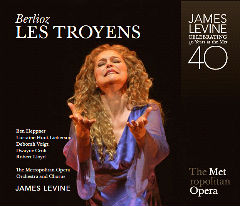
In 2004 the Met mounted a new production of Troyens and indeed it was an event, not least because of the participation of Lorraine Hunt-Lieberson. It’s hard, now, not to think of this as a grand farewell, though it simply wasn’t. LHL was scheduled to sing in Mark Morris’ resoundingly banal Orfeo a few years later, and might have saved it from itself. In any case, only those close to the artist may have known that chances were good that her farewell to Troy might have a terrible extra meaning.
LHL was, onstage, the spiritual anchor of the piece, and perhaps more so on record she’s the reason it still feels like an event. Among the principals, she’s the only one who wholly belongs in the role she’s been cast in.**
Listening, we can savor (or if you weren’t there, I can taunt you most unsympathetically with) the memory of how she only amplified the tragedy in the singing of the great farewell with an instinctive physicality that found the midpoint between nobility and utter defeat.
On record what I notice is how often she opts for understatement: the phrase “éternelle nuit” is not, école de Verrett, chested out, not a Bernhardt gesture; more of a sigh than a moan. I tend to think it’s bullshit when singers go on about trusting the music—everyone interprets—but there is a certain sense here of disengaging the actorly devices of deliberate pathos.
Others acquit themselves honorably but with mixed results. It was immediately clear onstage that Cassandre was one of those roles that had no reason to be less than a success for Deborah Voigt but was going to be anyway. Her French is fine, overenunciated if anything, and she’s in lustrous voice, but she doesn’t always connect with Cassandre and it doesn’t add up to much of an emotional listen though there’s certainly aural pleasure in it.
Ben Heppner’s Énée is one moment heroic, the next downright pedestrian. He doesn’t crack, but it seems to cost him a lot at times. I suppose he had sung the role before, but you might be forgiven for wondering. Some lyrical moments are quite stylish; others (“Nuit d’ivresse”) lacking in elegance. It isn’t amateurish but it isn’t complete. Dramatic parts of this admittedly murderous sing either knock it out of the park (as near the end of the Siege of Troy) or falter disappointingly. Missing C aside and forgiven, “Inutiles regrets” is marked by what sounds like nerves.
Heppner has always been a variable singer at the Met, though usually by the performance—you can tell a little while in if you’re getting good or not-so-good Heppner. He’ll always have work, because he fills a mostly empty niche in the roster, and because at his best he’s glorious. Énée is neither the triumph of Tristan on a night when it’s working nor the agony of an Otello on a night when it isn’t.
Smaller roles are similarly uneven. Matthew Polenzani delivers possibly the finest singing, per se, on the set in Iopas’ air, fearless and stylistically right. (The text of this aria, loosely translated: “why do I get such sloppy seconds in Met casting when I sing better than basically anyone else they hire?” You may have read different, but this is what it means.)
Gregory Turay, who briefly looked like he might have a bigger Met career, I remembered as quietly affecting, but credit may go to Francesa Zambello there for her striking staging of Hylas’ affecting little scene; on record, he comes off as a little too droopy in an aria with a high risk of that. And really, what were they doing putting Elena Zaremba in everything those few seasons? Yeesh.
It’s tough to write about the Met Orchestra under James Levine because it’s usually pretty much a cut and paste job. Accolades begin to look alike, and this is no exception. In terms of pacing, style, singer-responsiveness, there’s little room for betterment that I can hear. I will say that in some music the excellence of Levine is a passive thing, sometimes to the point of sounding too tasteful. Here it is an active participant.
*Oh hi. I just wanted to make sure it was clear that this is not the same as saying “nobody can sing Les Troyens these days so why don’t we just shelve it for fifty years.” I hate that shit. All I’m saying is, if you’re going to do it, don’t do it hemipygously.
**Ok yes. It is a tiny bit stretchy at the top during her entrance, but this is the nittiest nit that ever nat and I dismiss it.
Thanks for a lovely review that brought back memories of a night in the theater that was, well, memorable. LHL did indeed own Part II, and if I remember Voigt being more powerful in Part I it may be because she really caught fire dramatically at the very end as she drew a curtain (yes, literally) across the fall of Troy.
And not that it needs mentioning in a CD review, but does anyone know why Alexandra Deshorties was cast in the silent role of Andromache? It seems not a little perverse, though to be honest she was pretty riveting in that “I’m bat-shit crazy so you’d better get out of my way” kind of way. Maybe she was covering another role (Cassandre? mon dieu!) so they threw her a bone for coming to rehearsals.
Thanks, LMM. What’s funny is I started to mention the Deshorties thing but it seemed likely to come out at her expense, and despite her awful Entfuhrung, I feel like she kind of gets a bum rap. It did seem like an unkind gesture to give a singer who had sung a couple of starring roles, however variably, a silent walk-on.
I think that Deshorties’ star at the Met was very much in the ascendant at that time. Oddly, I think that someone in the artistic administration thought she was stunning onstage and would be dramatically effictive. So the idea was kind of a silent star cameo or star-to-be cameo.
I also remember that very early Deshorties assumptions were vocally not unpleasing – the first Elettra run with Domingo and a Tytania replacing Sylvia McNair. After the “Entfuhrung” it was a sharp downturn. Oddly, I really dislike the way she comports herself onstage – she looks slouchy and awkward and she is a tall, striking woman. All of her gestures look strange and artificial. The lower part of the voice is woolly and the top is metallic and shrill. However, there are credulous things out there who were posting Youtube clip and proclaiming a great singing-actress in the school of Elena Souliotis et al.
I knew Deshorties (not terribly well) during her short conservatory career, and if I’m not mistaken she dropped out after winning the Council Auditions. That was obviously a mistake, but clearly someone thought she had a lot of potential. She did two short (duh) Webern cycles with the Met Chamber Ensemble, which I would have guessed was totally Levine’s doing, and probably very good experience for her. Her Elettras were fine, and her Titania was far better than McNair’s (faint praise, perhaps).
And then there was the Entführung debacle, which was maybe 15% an overparted singer, and 85% a single severely disruptive audience member at opening night. I don’t know she even finished the run.
I’m not saying she was a full-fledged star, but she’s an extreme case of a young singer pushed too far and too fast.
Pushed too far and too fast is perhaps right on the money. I’d experienced her in several major roles away from the Met where she absolutely shined, but this was (I believe) in part to being less under the microscope than her Met performances might have allowed. She was a memorable Countess (Nozze) and a mesmerizing Lucia for us here in sleepy little northern New England.
Indeed a wonderful review – I was at the matinee where the usual restless crowd sat transfixed – and justly so.
Imagine coming to hear this opera, only knowing a few (if exquisite) bits – Marilyn Horne’s Cassandra from a compilation CD, the ballet music, and of course, the Royal Hunt and Storm. Then being presented with a singer I knew nothing about – LHL. It’s hard to beat that for an opera experience. It’s just a shame it wasn’t filmed.
Thanks for a terrifically insightful review, as always—I ? LHL (duh) and was very, very interested to hear how this disc turned out.
hahaha, that should read “I [heart] LHL”
Oh, how I wish they had broadcast this on TV! It was one of the greatest nights at the opera for me.
As for Deshorties, I detest her in anything she touches. I vowed never to attend anything with her in it again. Andromache was her greatest role ever–she didn’t sing a note!
My guess is they gave it to her because the MET had a contract to fulfill. There was a lot of talk about audiences disliking DeShorties, so this was a quick way to get her off the roster. Has she sung there since?
Offhand, I only know that she sang “D’Oreste, d’Ajace” while the votes were tallied at the auditions two or three seasons back. I’ve always gotten the feeling this is not a highly desirable assignment, maybe something they toss to covers (it occurs to me since some other singers I’ve heard do it were pretty surely covering roles.) The applause was polite at best, which is one reason I say she gets a bum rap. It’s a weird voice but she was pretty good in the piece and anyway it’s not exactly opening night, so I figured people would be good sports…
Thanks for the fine review, Maury. I saw one of these performances and it was one of my greatest night at the opera. LHL was extraordinarily moving. I loved how she underplayed certain moments. I have said before that I prefer a grander interpretation for Didon (like Norman or Verrett) but LHL made a profound case for understatement.
I recall liking Heppner more than this review. I think that singing this role with so much ease alone was worth a gold medal. But I do agree that there was some careful singing going on there. This was his comeback after all the cracking he was doing a year before and apparently, he had a single (but spectacular) crack on the prima of the production. That probably caused him to be more hesitant in the following performances.
It’s so nice to see that someone else enjoys Levine’s Troyens as much as I do. In the past, I saw nothing but negative comments about his so-called “galacial” tempi in this opera. I think he has complete command of the score and brings out all the drama and majesty. And he makes his tempi work, whatever one’s personal preferences.
“hemipygously” ???
Hemi- as in hemisphere: half.
-pygous as in callipygous, meaning “like Gene Kelly, or Robert from this season of So You Think You Can Dance.”
Oh I am just so loathesome when I’m trying to be clever, but I can’t do a thing about it!
Callipygian = having shapely buttocks
calli being the beautiful part and pygian being the buttocky bit
perhaps hemipygiously?
So, he means “half-assed” !
Spesking of examples of the callipygous, Rafeal Nadal is playing a US Open Match as I write this. Nothing “hemi” about it, in his case.
Yes, a great review. Indeed for many it was one of the greatest nights ( or afternoons at the opera) Even the much-mocked TT was moved to write In his Times review of February 12,2003( I think Maury’s date(2004)above, is wrong) :
“For 100 years after its 1858 completion, this opera was considered great in parts but ill conceived and impossibly long. In this production and this performance it seemed an inexorable work of genius. Since 9/11 no New Yorker has taken for granted feeling safe in a public space, especially now, with the country on high alert. But nothing will take you out of yourself like hearing the enchanted septet of Act IV, when Dido, Aeneas and their coterie sing Berlioz’s blissfully subdued music. I didn’t want it to stop.”
Many of us there felt the same way.
Thanks for a wonderful review. I can’t wait to get this (and the entire sets on DVD and CD)! I attended the third performance of this run (the now legendary “Blizzard of 2003 Troyens”). The experience remains one of the greatest nights I ever spent at Lincoln Center. I’ve posted a memory of that night (and Lorraine’s historic performance) at my blog:
http://sharkonarts.blogspot.com/
I tend to get a bit foamy perhaps, but that night is so full of wonderful memories, I just can’t help myself! So happy this is finally being released – but regret it wasn’t filmed for broadcast. One of the great missed opportunities!
It is tragic that LHL died so young, and I mourn her passing. However, I think that her premature death has given rise to a cult of admirers who paint her performances as Didon as somehow extraordinary and ones for the history books. In the house, however, they were “OK”, nothing more and nothing less. While Ms. Hunt Liberson was an excellent musician and sincere artist, the voice was limited in tonal quality and volume and the interpretation was so intimate that any personality – hers or Didon’s – barely projected into the orchestra, less alone the upper tears. It was a lovely performance, but if you compared it with Jessye Norman, Shirley Verrett, Christa Ludwig, Regine Crespin or Janet Baker, she wasn’t even in the same league with these ladies. I’m sure it will be fine for the camera, but LHL was not an “opera singer” in the grand tradition, and an examination of her career will point out that it was neither her forte nor her claim-to-fame.
I have trouble forming words to react to this. You are entitled to your opinion of LHL and this Didon, but it is definitely a minority one. As for her “cult” having arisen after her death, nothing could be further from the truth. She was revered among knowledgeable music lovers. (Alex Ross wrote a profile of her, around the time of this Troyens, comparing her to Callas.) We worshipped her, which is why her death registered as such a profound loss.
She certainly did not forge a traditional operatic career, performing standard rep on the world’s great stages. Instead, one always had the sense that she sang the music she was most interested in, whether it was J.S. Bach or John Adams. Nonetheless, she sang a LOT of opera–Pelleas, Serse, Giulio Cesare, Don Giovanni, Great Gatsby, even a Carmen (I think) in Boston. By any reasonable standard, an “opera singer.”
I may live to regret this, as I find dead-diva defensiveness to be really tedious. Usually.
I listened to the matinee broadcast of this production and was completely overcome. I’m no serious student of this piece, and I only got the back-story after the fact (LHL says she could hardly sleep the night before). But the *honesty* and the *intensity* of it threw me against a wall. I really couldn’t quite believe what I was hearing.
I had long admired her Medee, losing a copy in a break-up, which I replaced. I kick myself for failing to drive down to Boston for her concert Pelleas. What the hell was I thinking?
It just was…an astoundingly beautiful voice, and to me, a unique and potent theatrical imagination. But maybe not for all listeners. Oh well.
Maybe it’s the viola thing.
LPR
You didn’t hear it here, Rudiger, but there are documents of the Pelleas to be found, if you know where to look. (Sound, I mean. Not film. But it was in concert, anyway.)
FWIW, I felt the same about her Didon at the time as I do now, so though I’m sure her death amplified people’s feelings about her, I just don’t think it’s fair to say that, were she still alive, her singing of the role wouldn’t be a big deal to folks like us.
OT: The button when one logs in that says “remember me” really ought to say “but, ah! forget my fate.”
LHL most certainly projected very well to the top of the MET, her Didon had great profile. Because she didn’t flail about in the manner some feel is appropriate operatic acting doesn’t mean her depth of feeling and involvement didn’t register.
And I’ll have to disagree here. Her “star” was shining long before her death, and while not everyone took to her unique brand of musicmaking, a great many of us did and did so early on. The voice was definitely NOT one borne of the “grand operatic tradition” but what she did within (and outside of) that tradition cannot be dismissed (except, perhaps by “pure voice” fanciers, who are, of course, absolutely entitled to not feel she belonged in the league of Norman, Crespin, Troyanos, et al.) The voice was more medium sized than “small,” and, the Met’s acoustic allowed for far smaller voices than LHL’s to be easily heard as well as to great effect in that house.
For some there is that “something extra” – which can only arise out of excellent musicianship, but also goes beyond just “that.” Obviously, we all don’t – or even can – respond the same way to the same artists, but I think it’s a mistake to categorize her Didon as “less than” some of the greats of the past. Yes, it was different, but not certainly not less. Personally, I wouldn’t want to be without the documents of LHL or other great interpreters of the role, and feel neither choice (except that perhaps depending upon what I’m in the mood for) nor comparisons need be made in relation to greatness. Each brought something unique, and was special and, for some, entirely treasurable.
I was at the 2nd performance of that run. The fact that LHL didn’t have the kind of voice that Norman, Verrett, Ludwig, etc. had doesn’t take away from the fact that her performance was quite moving. Maybe because she was not an opera singer in the grand tradition, she brough a unique perspective to this role and to the other roles she sang. I get tired of the phrase “not in the same league with”. LHL was a substitute for Olga Borodina, who vocally was probably more suited to Didon, but I can’t imagine her bringing the same kind of depth to this role. I love the opera and have numerous recordings of it and each of the singers you name have legitimate claims to the role but just because their voices are larger doesn’t make LHL’s assumption of the role any less legitimate.
The ovations that LHL received on the broadcast and on the night I saw her were huge and not the result of some post-death cult worship. And personally, I remember being utterly moved by her performance while it was happening, not just in hindsight after her passing.
Though reputed as being a bit of a cynical bastard, I have to say with LHL one hears that voice……all criticism is silenced. If ever a voice was a perfect musical instrument, her voice was. No arch ‘histrionics’…. just pure music.
I have really mixed feelings about her. . .
I had the privileged of knowing her (very slightly) back when I was a student in Cambridge. She had already begun to outgrow the local music scene and was absolutely adored by all and sundry. I bought the harmonia mundi Messiah for her and found her tremendous. In fact all of her Handel was extraordinary. Ditto, Charpentier.
BUT, I was disappointed by her Idamante on the EMI recording. I had expected revelatory. Instead, I heard a lovely, well-schooled mezzo voice used musically. The acting was apt.
Personally, I think that LHL was a tremendous musician with a lovely voice. Her personal dedication to art and music and her seeming GOODNESS as a person was an inseparable part, apparently, of her overall appeal. The early music folks in Boston ADORED her as a person.
As a singer, she was lovely, superb, terrific, etc.
But was my life changed by that voice – as it was with La Norman, Frau Christa, Sexy Crespy, or the evil school marm from outer space?
No. I just wasn’t that calibre of voice.
Sorry, dear Lorraine.