
Headshot of La Cieca

Cher Public

  • kashania: HH: I thought of you tonight while watching the COC’s double of Florentine Tragedy and Gianni... 11:28 PM
  • Camille: I hope one day……e tc. 9:47 PM
  • Camille: Nerva, you are the funniest. TY for the word pn Carmelita Pope. Supposing I know her from PAM. I am one... 9:46 PM
  • Nerva Nelli: Surely it must be Christopher Alden’s ENO restaging of THE ENCHANTED ISLAND . 9:19 PM
  • actfive: Also saw this at LOC…Zajick looked totally bored, occasionally annoyed (maybe she was pissed at... 7:56 PM
  • phoenix: Fanciulla is primetime Puccini – I find Voigt about as italianate as Niamh Parsons – still,... 7:23 PM
  • Henry Holland: Good Dame Gwyneth as Minnie, Domingo as Jack Rance, LA Opera, 90′s sometime. At the end of... 7:16 PM
  • PushedUpMezzo: Well of course the mike’s the clue. She famously had no need of such things. The lady... 6:25 PM

Mad about the boy

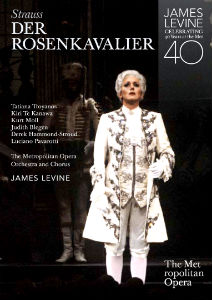
Rosenkavalier DVD CoverIt’s easy to see why the Met has chosen to include this 1982 performance of Der Rosenkavalier in their James Levine: Celebrating 40 Years at the Met – DVD Box Set: the marathon evening is a triumph for Levine from the frenzied blend of waltz melodies in the overture to the final, birdsong-like notes of hope at the end of Act III.

Levine is confident and animated throughout the performance, which is spread out over two DVDs. Of course, Levine is always an excellent musician, but this Rosenkavalier reminded me how exciting he and the Met orchestra can be when they throw themselves wholeheartedly into a piece as rich and moving as this one. 

It’s entirely possible that the reason Levine appears so excited throughout the performance is that he’s directing one of his favorites, Tatiana Troyanos, in a role that is an absolute triumph for her. She meets the vocal demands of the punishing role of Octavian with conviction and style, performing every line of the score – in which she must appear almost continuously – with total, in-the-moment investment and inspiring musical intelligence.

Her acting is flawless, boyish or heartbroken or flirtatious or resigned as appropriate, always in service of the music and the story, and always with a gorgeous, innate dignity. (OK, she does have one unfortunate lapse in craft, in the scene that you and I both know you’ll be skipping every time you re-watch this DVD: the twenty-seven hour Mrs. Doubtfire homage between Octavian and Baron Ochs that Misters Strauss and Hofmannsthal sadistically included at the beginning of the otherwise sublime third act.)

The Marschallin is the ostensible star part of Der Rosenkavalier, and Dame Kiri Te Kanawa is excellent in the role without ever quite being exciting. Her singing is beautiful and exact; unfortunately, so is her acting.  She plays one note throughout the opera (tragic inevitability, with excellent manners) that is dramatically satisfying but missing that element of the unexpected that infuses a truly legendary diva interpretation. The Monologue in Act I is perhaps her best moment, with an infusion of what looks like genuine emotion adding to a musically excellent performance.

Judith Blegen as the ingénue Sophie (who is, awkwardly, a year older than Te Kanawa as the middle-aged Marschallin) is somewhat undone by close-ups that make her girlish affectations—fluttering eyelids, poetry-recital handclasps—suggest prissiness rather than naivete. Her singing is radiant and youthful, however, and she shines in Sophie’s big moments – the presentation of the rose, the final, bemused love duet, and the spectacular trio with Te Kanawa and Troyanos.

Kurt Moll lumbers through the thankless role of Baron Ochs in the typical fashion, singing his waltz music with power and humor but never suggesting that the character has anything to add to the opera beyond the most obvious sort of comic relief. The production also features Luciano Pavarotti as the Italian Singer, who delivers his aria beautifully without once looking up from his songbook, giving the whole cameo the feeling of a contractual obligation.  The production, by Nathaniel Merrill, is tasteful and adequate, perhaps a bit less musty-looking on the DVD than when seen at the Met in recent seasons.

Quibbles and cross-dressing comedy aside, this DVD has enough glorious moments to recommend it to those who are passionate about Troyanos, Levine, or the opera itself (if you’re the world’s biggest Blegen fan, I assume you’ve already pre-ordered your copy).

One moment in each act is absolutely perfect: the Marschallin and Octavian’s mournful Act 1 exchanges about the passage of time, with Troyanos’s deep-set eyes adding a layer of sad wisdom to Octavian’s youthful fears; the unexpected flowering of passion between young lovers during the presentation of the rose in Act 2; and the perfect Act 3 trio, where all three women stand before us in a line – the one with her whole life ahead of her, the one with her best years behind her, and the one torn between them.  We know, looking at them and listening, that if we haven’t been all three of those people yet, we just need to give it some time.
107 comments

  • MontyNostry says:

    Who originally came up with the term ‘note-spinning’ for Strauss?

  • Harry says:

    ‘Note spinning’ is a loaded term in any case, where Strauss is concerned. For what reason, benefit, or achievement did he embark on using such florid complex orchestral textures that he did, culminating in the finale to Die Frau ohne Schatten, is the big question to be asked,
    What I would find curious is of the opinions about this or that opera of Strauss, how many people are just as familiar with all his other works, those not necessarily operatic. Part of his Symphonia Domestica is greatly more vulgar and explicitly protracted in representing ‘nooky’ than anything between the Marschallin & Octavian in Rosenkavalier’s opening music… the depiction of whooshing winds either in Don Quixote or say the storm on the Mountain in An Alpine Symphony…. reminds of one scene with Herod in Salome. There are so many textural cross references to be enjoyed if people listen to Strauss in things beside… just the vocal material.

    • Salomanda says:

      Thanks for reminding me of Die Frau Ohne Schatten, how on earth did I leave that one out?? It’s a favorite.

      As for the original question re note spinning, I’m no musicologist and can’t even venture a guess. I am reasonably well acquainted with his orchestral works and more so with his lieder, and there is a definite “strauss sound” even if it was refined and/or expounded upon later in life.

      One of my favorite “textural references” as you put it is in Elektra’s monologue, when she says they will slaughter the horses and dogs – when each animal is mentioned, there are very definite references to each animal in the orchestra, horses neighing and dogs whimpering.

    • Straussmonster says:

      “Note spinning” usually means “I don’t like this passage and so I don’t see and don’t want to even try to make an argument for what it’s doing here”, in my experience. It’s not even a backhanded compliment–the most prominent of those is “Oh, he’s such a great orchestrator!”

      • Henry Holland says:

        For me, “note spinning” in the context of Strauss was always written about to mean “padding”, which of course is how I meant it in my original post. My example is Die Schweigsame Frau, which is a fairly slight one-joke comedy plot-wise that lasts just short of 3 hours when done complete (if anyone does that outside of Munich). There’s some excellent set pieces but to me, there’s also acres of that Straussian parlando where I sit there thinking “Oh for fuck’s sake, GET ON WITH IT”.

        My friends Jon and Patrick once sat down with a piano/vocal score of Der Rosenkavalier and cut what they considered to be longueurs –hint: the third act lasted about 25 minutes– and they then made some CD’s based on the Solti recording but incorporating their cuts. It lasted about 100 minutes. Mileage varies widely, obviously.

        • Regina delle fate says:

          Henry – they just did in Munich with cuts, but it still lasted three and a half hours with two intervals! That said, Barrie Kosky’s production is the best I’ve ever seen (only four others) and the only one that made me think the opera wasn’t a tiresome bore. A heavily pregnant Damrau was fabulous and Toby Spence was surprisingly good as Henry. Only Hawlata was a bit of a let-down.

      • LeperEllo says:

        Rather like Puccini, who, after his first perusal of the score to “Frau,” remarked “It’s all logarithms!”

        • Henry Holland says:

          Henry – they just did in Munich with cuts, but it still lasted three and a half hours with two intervals!

          Blasphemers! Cutting Strauss in Munich?!?! :-)

          One thing I’ve always admired about Puccini is that he doesn’t usually dawdle, his operas are so tightly constructed.

  • Harry says:

    The most derogatory form of ‘note spinning’ par excellence : The winner…. Phillip Glass! Or perhahps Eric Siegmeister….’that’s if the piano is still standing after seeing one of his piano bashing compositions.

  • Clita del Toro says:

    Spinning- schminning! I have seen many great performances of Salome and Elektra since the 50′s, but those two operas have never really, totally got to me. Don’t know why. I like them a lot and find parts very moving; but, I prefer the schmaltzier Rosenkavaliers and Arabellas, where Strauss’ “note spinning” better fits the subject, imo.

    I don’t know FroSch that well–saw it when Met first did it in the 60′s and more recently at LOC with Voigt, Brewer and Robert Dean Smith (is that his name?). Smith was absolutely wonderful in the role of the Emperor; the three girls were very good, but I was blown away by Smith. Can’t say what I think of the opera–maybe that says it all?

  • Clita del Toro says:

    I have to admit that I absolutely adore the VLL and have many recording of them.

  • Clita del Toro says:

    Harry, just read your Jones/Parsifal post. I agree–love her Kundry and LOVE King’s Parsifal as well!!!

    • parpignol says:

      there was a performance of Kundry that Jones sang at the Met in the 1990s, with Levine and Domingo I think, and she (and we in the audience) realized very quickly that her voice was wobbly beyond wobbly for that performance, at least, and she very strategically decided to sing the rest of the performance half-voice, and it was beautiful, mesmerizing, steady, plenty loud enough, and quite weird: huge ovation for her at the end (no problems vocalizing the last act) . . .

      • peter says:

        I was fortunate to have heard Jones in great voice on numerous occasions. The Ring Cycle at the Met in 1989 and her Elektra in SF in 1991 found her in spectacular voice. I did not see her less than stellar Isolde at the Met but there are tapes of her Isolde from Vienna where she was wonderful. I get tired of hearing about how wobbly her voice was. There is absolutely no one today who can generate that kind of excitement and commitment in that repertory.

      • quoth the maven says:

        I was on the road during the broadcast of that Parsifal. I remember losing the signal toward the bottom of one of Gwyneth’s huge, slow wobbles, finding another station, and tuning in just in time to hear the top of the very same wobble!

    • Cocky Kurwenal says:

      That Parsifal does find her in particularly clean and fresh voice, far more so than the generally available recordings of her Bayreuth Brunnhilde (which I also love).

      In terms of her readily available recordings, I think the Salome with Bohm and Fischer-Diskau represents the apex of her achievements from a purely vocal point of view for those who want excellent vocal production in the generally understood sense of the term – the vibrato is rich and consistent but never a wobble, and her voice just works incredibly well to allow her to give a really expressive, gripping account of the role. I think it’s from 1970.

      I love her 1960s work in Verdi (I love pretty much her every utterance, afterall) but they will never be my favourite Gwyneth recordings because I find she can come across as somehow rather passive in stretches of them. She just seems to have been better able to connect with the German language and the way Wagner and Strauss set text, meaning she was always inspired to give everything she had. So even if singing those composers’ music did cause her singing to be less reliable (a debateable point – I think it would have happened anyway, because as somebody else said, the fundamental way she used breath wasn’t ever quite solid enough), I’m so glad she went down the repertoire route she did, because I don’t think she’d have fulfilled her artistic potential if she hadn’t done the roles she did.

      • Regina delle fate says:

        You’re so young, Cocky! I remember when those 1970s recordings came out and got such bad reviews – “Jones spoils yet another DG recording…” etc etc. that when I eventually picked them up in bargain re-issues, I couldn’t understand what all the complaints were about. Sure, there is a certain unsteadiness, but her Salome, Fidelio, Kundry, Senta all find her in pretty healthy voice. She’s lustrous and exciting. Even as late as the taping of the Chéreau Ring, there are passages of thrilling singing. And the much later Isolde from Berlin is not half bad either. Maybe the Gywneth fans on parterre should all write to Opus Arte asking them to issue some of her live broadcasts from the Garden. I wonder if they have the Gwyneth/Vickers Tristan? But please not the Donna Anna with Peter Glossop – by 1973, her Donna Anna days were over. I’m sure she only sang it because Birgit did. I guess they can’t issue the Turandot because it has Domingo in it. Sadly.

        • Cocky Kurwenal says:

          I don’t think there is any unsteadiness whatsoever in that Salome or Kundry. For sure, there are bits of the Chereau Ring that aren’t as well sung as may be ideal, as I implied myself, but don’t get me wrong, I still think it’s a fabulous account of Brunnhilde, even if it isn’t as consistently good as the Salome.

          And while I’m not trying to be deliberately argumentative, I have a live recording of Don Giovanni from 1974 with a stonking Anna from Dame Gwyneth, opposite Siepi and Leonie’s younger sister, with a lovely Zerlina from Donath. I think her Anna is just wonderful on this, although as has been pointed out many times, she was not the most consistent singer in terms of quality of vocal output, and it is perfectly conceivable to me that an Anna in 1973 was inferior (perhaps to the point of being intollerable) to one a year later.

        • Tubsinger says:

          I think Opera Depot sold me the Jones/Vickers/Davis Tristan from Covent Garden, 1982 or 1983. (I just recall waiting 6 or 9 months for it, and vowed not to use them again–whichever of the internet opera pirate vendors it was.) The recording itself is pretty bad, probably not a broadcast or “house” recording, but one made with handheld equipment somewhere on the sides. The brass sounds prominent but the rest is all muddled and miserable.

          What does come through, however, is the ferocious yowl and wobble of Jones’ voice that night, and Vickers sounds really bad, out of tune and wavering all over the joint (which could also be the recording itself, of course). I had heard Jones in NY as the Walkuere Brunhilde from those years, and that part perhaps suited her better at that time. I heard Vickers in his last Met Grimes (wonderful, although with a lot of crooning) and I also heard his last Samson. Both were better than that Tristan. But, to my ears, neither Jones nor Vickers sounded very listenable in that Tristan from London. Very disappointing. I’m not sure I even got through the whole thing.

          Being a big Davis fan, I also bought his “studio” recording of Tristan, broadcast on the Beeb in the late 60s, with the proud Vicar’s cast of all-Brit Wagnerians. I stand prepared to withstand bravely the shower of radishes and cabbages hurled at me, but the recording is damned good compared to some others that might be made today…

        • armerjacquino says:

          A long wait usually means Premiere Opera, not Opera Depot.

        • Cocky Kurwenal says:

          Yep, ArmerJ is right, that’ll be Premiere Opera. Opera Depot, sadly, have never had a Tristan available with Gwyneth as far as I’m aware.

          To be quite honest, I just don’t think Isolde was really Gwyneth’s role, despite her Wagnerian credentials, and her own conviction that it was her favourite and best role. I’ve never really read an unequivocally good word from anybody about her Isolde and, although you may have gathered that she is pretty much my favourite artist ever, I felt that the only complete Isolde of hers that I’ve heard (the Berlin DVD with Kollo) highlighted her vocal issues and didn’t display as many of her positive qualities as I would have expected.

        • Arianna a Nasso says:

          “I guess they can’t issue the Turandot because it has Domingo in it.”

          I believe there was a complete telecast of Turandot at ROH with Bonisolli which could be reissued.

        • Lobby says:

          There was indeed a telecast of Turandot from Covent Garden with Gwyneth and Franco Bonisolli. It has never been released commercially, although I have a recording made from the original telecast.

          It would be great if it could be released because Gwyneth was great in it – a really dramatic Turandot (and in reasonably good voice). There are excerpts on Youtube.

        • Harry says:

          I support Regina delle fate and what he says about the strange reviews particularly from England, Jones got in the 70′s.
          The English review mags was the leading culprit. If anyone comes across old copies and re-reads some of their sniping reviews , the bias against certain singers, including Gwyneth Jones and Beverley Sills, were a consistent stand out.
          Virtually any release from the U.S continent also started with a similar review handicap as well. As for anything from ‘Sir Bennie and dearest Sir Peter’…that was another matter. One of raving dribbling praise. We are still seeing echos of this amongst their current ‘brood’ of colorless artists.

          The acid test for any recorded operatic performance….’ Is the performance you are out listening to, ‘VALID’? Does it have a degree of solidness, durability and acceptability within the concept, the framework of what was attempted? .Whilst for the moment – leaving aside the matter of personal preference opinion, that may differ from someone else about whether some other singer does this or that section of a work, better.This being: just a matter of sheer individual choice or emotional ‘likability’.
          I have found people like Jones always ‘valid’. I will always gladly listen to her.

          P.S The Gramophone magazine today is a complete laugh. Could it ever get over its editorial ‘record of the month’ capers with those ‘phantom pianist’ Joyce Hatto releases created by the said woman’s husband. The ‘performances’ either completely plagiarized or made up of digitally altered edited mixture of various current performing pianists. Their ‘expert reviewers’ of some of these travesties…still went on reviewing for the Gramophone. Mel Brooks could not have written a better scenario.

      • MontyNostry says:

        Gwyneth provided lots of thrills on a number of occasions over the years I saw her (above all as Faerberin in Paris in 1980), but has anyone heard her attempt at (assault on?) Norma towards the end of her career? I haven’t, but I just can’t imagine it.

        • Krunoslav says:

          I heard inspiring, well -sung performance by Gwyneth as Leonore, Elektra and the Dyer’s Wife. Also vocally uneven but gripping, well-imagined ones of Salome and the WALKUERE Bruennhilde. Herodias didn’t do much for her.

          That said, Gwyneth’s first Met Isolde was an unredeemed nightmare–she was dreadful and acted at calls as if she was Olive Fremstad reborn.
          Rarely if ever have I so wished for this to happen to a singer:

          http://www.youtube.com/watch?v=J4YjmwCs6H0

          The *only* person on good form that night was Matti Salminen, the debuting Marke.

      • hab mirs gelobt says:

        the only time i heard gwyneth live was as ortrud in 1997 and it was by far the most atrocious singing i have heard live (actually on a par with solveig kringelborns senta a few years later)! that has put me off her for such a long time.

        i still cant get her bruennhilde on audio only (doesnt do it for me) but the visual to go with it is a good one indeed. now i do like her fidelio (apart from a terrible yowl in the finale) and her early verdi is very good too, as is her kundry.

        but this awful ortrud will stay with me forever and really stained my hearing of gwyneth…

        • Cocky Kurwenal says:

          Where did she sing Ortrud in 1997?

        • Arianna a Nasso says:

          CK @ 16.2.3.1 Wasn’t that Covent Garden, having sung the role in Paris in 1996?

        • Cocky Kurwenal says:

          She did do Ortrud at Covent Garden in the ’90s – it was also the only time I heard her live (and it sort of met the description Hab mirs gives above, though it pains me to say so and I’m still very glad I went) – but I was sure it was 1995. I see from ROH Collections that you’re both quite right though – it was 1997, and my memory is off. To think that I saw Behrens as Elektra and Kiri in Boccanegra all in the same season – similar excitement doesn’t seem forthcoming in 2010-11.

        • Regina delle fate says:

          The truth about Gwyneth is that she was very variable – I saw every revival of the Turandots at Covent Garden. She virtually owned the role in the Serban production for the first ten years of its existence and none of her many replacements acted it better. There were occasions when she nailed every note in the middle and even managed a legato, but there were also nights when she wafted in and out of tune and the top notes were shrill and wobbly. She was never less than exciting and you couldn’t take your eyes off her in the Riddle scene. There was a run of Elektras in which I heard three performances – one was absolutely astonishing, but the other two were all over the place. I also heard her in the last two of the first Friedrich Ring cycles in 1980 and 1982. In 1980 she arrived having sung all three cycles at Bayreuth and sang like a drain. Then in 1982 she came having only done a couple of Marschallins in Munich during the summer and I don’t think I have ever her sing better. I gather it was the same in Bayreuth. It depended which cycle you booked. That said, Cocky is right that there is nothing as exciting as his 1997 season at Covent Garden in 10/11. The 1996/7 Lohengrins were another example – at the performance I went to in Paris, she was booed, but she was in great form for the London performances – well the one I attended – the following season.

        • hab mirs gelobt says:

          it was indeed at covent garden, i know that for sure as i queued for a student day seat out in the slushy snowy rain for two hours before the performance (those where the days when one had to wait outside!!!).

          saw behrens and kiri as well in the same season.

          one cannot say though that back then everything was better. having gheorghiu and kaufmann in adrina in november is not a bad thing surely? but it is true that the season 10/11 doesnt have anything really overwhelming in it. especially now that mattila decided not to sing tosca – i was looking forward to it (ok, she is not a tosca per se, but i have always been impressed with her on stage in everything i saw her do)…

  • LittleMasterMiles says:

    “Note spinning” is an English approximation of the German “Fortspinnung,” defined by Grove as:

    A term devised by Wilhelm Fischer (1915) to stand for the process of continuation or development of musical material, usually with reference to its melodic line, by which a short idea or motif is ‘spun out’ into an entire phrase or period by such techniques as sequential treatment, intervallic transformation and even mere repetition.

    This non-judgemental definition seems well suited to Glass or Vivaldi (to whose style it was first applied), but not, I think, to Strauss, whose more long-winded passages are possessed of a different kind of langour.

    • CruzSF says:

      Thanks for that clarification. I hadn’t heard “note-spinning” used in a derogatory way until this thread.

      • MontyNostry says:

        Thank you very much for that LittleMasterMiles … I’d thought the term might be ‘Tonspinnung’, but had never been able to find it anywhere. I’d rather have Strauss doing his kind of spinning than Vivaldi or Glass doing theirs, that’s for sure.

        • LittleMasterMiles says:

          Well, chacun a son quelque chose.

          I love Strauss to bits, but I’ll take ‘Agitata da due venti’ or ‘The Funeral of Amenhotep’ over the Lerchenau-Walzer any day!

  • grimoaldo says:

    Hello all -
    I saw Dame Gwyneth at the ROH in several Ring cycles in the ’80′s as both Brunnhilde and Sieglinde, as Turandot, and in the ’90s in a fabulous Lohengrin with Gosta Winbergh, Karita Mattila and Sergie Leiferkus conducted by Gergiev. Utterly fantastic.
    Sorry luvtennis but you had to be there to appreciate her and although I can well understand that you may not want to hear her on recordings, I think artists have to be given a pass for being great live but maybe not ideal for recordings. Live performance is what opera is all about, recordings are a sideline in my opinion.
    Dame Gwyneth was always utterly committed to her role, totally “there”, wonderfully intense and communicative. Vocal flaws were present of course but paled in comparison with what she achieved as a totality.

    • luvtennis says:

      I certainly understand your point and agree to an extent.

      But here’s the rub – we DO have recordings. We CAN’T go backwards and Jones has been paid to record music and is a professional musician. So, I feel perfectly justified in criticizing that singing, especially when it is soooo completely atrocious. Also, I fear that Jones, and (late) Behrens, and Silja, et al. have contributed to the general decline in singing quality started by Maria in decline. “She is so riveting. It doesn’t matter that her voice is in tatters or that it wobbles like a weeble.” Now it’s “she is thin and moves well onstage. It doesn’t matter that her voice is in tatters or that it wobbles like a weeble.”

      We are not talking about provincial performers bringing opera to the masses. We are talking about highly paid professionals. If a violinist came to town and missed as many notes during a recital as Jones did in about 15 minutes of singing, he or she would have shortly have no career.

      As for Margiono, I do not feel that her voice merited preservation on records. She strikes me as an ordinary lyric soprano with solid but unremarkable technique and a timbre that lingers in the mind’s ear for about 1.3 seconds after she stops singing. Sorry, those qualifications do not seem worthy of a major recording career.

      • Nerva Nelli says:

        Jones, like Malfitano, was a powerful stage figure who never seemed to care much about the specific words she was singing: it was in the movement, the sound of the voice and in a kind of generalized superchargedness.

        I almost never heard Jones or Malfitano utter a verbal phrase that stuck with me more than a few seconds. Whereas with other uneven “you had to be there” singers like Leonie and Stratas and Silja, I recall the contour and color of certain phrases decades later.

  • Regarding Strauss and the Four Last Songs --

    Here is a wonderful performance by a singer described in an earlier thread as Harnoncourt’s Singing Whore, who presumably got her gigs by blowing off.

    Now, I wonder.
    By my standards this is absolutely great singing, technically and musically. This lady is a musician and is concerned with communicating, not just with getting her voice across, and making as big a sound as possible.
    I do sincerely believe Ms Margiono is a great musician. People say things like “why don’t we have a Seefried nowadays” etc. Well I fear that if Seefried were born, lets say, around 1980 she wouldn’t have a chance. People would say she had no technique, the voice was too small, not thin enough etc. People only seem to care about the metal in the voice, the blending or registers, bigger the better, high notes etc. This is really depressing.
    IMHO Margiono is just such a musician-singer. Maybe not the most perfect technique or the purest instrument, but she has her own unique velvety timbre which immediately recognizable, and she certainly has / had a great deal to say through her singing.
    In this clip she is visibly moved by the end of the song. I’ll have this anytime over “THE STRAUSSIAN SOPRANO” of our times, Ms Fleming, butchering this music time and time again.

    Well, I always thought music is different from a circus act. I guess I’m at a minority.

      • Buster says:

        This concert I did hear – unforgettable! She kept refining her interpretation of these songs after this performance, and only retired them last year, when she sang September with piano, for the very last time.

        She is in my top three of great Dutch divas: together with Julia Culp and Gré Brouwenstijn.

    • armerjacquino says:

      There is a great deal of leeway afforded to singers of the past which is distinctly absent when it comes to singers of today (qv the Sciutti/de Niese debate elsewhere).

      I posted about this earlier in the year, after listening to a Barbieri/Del Monaco/Gueden Carmen on Met player which was bawled, vulgar, and sung in hideous French. In 20 years of operagoing I have never been unfortunate enough to see such a subpar performance- Del Monaco doesn’t even seem to know the part. The cultural necrophiles don’t want to know, though.

      • That’s very true, but not quite what I meant!

        Sometimes it’s a question of throwing the baby along with the water. Too much focus nowadays on questions of technique, to the detriment of “making music”. There should be a middle path.

      • PirateJenny says:

        “Cultural necrophiles” is my new favourite expression.

    • OpinionatedNeophyte says:

      Thanks for posting these! I don’t think any serious fan of the Four Last Songs could attack these performances, they are wonderful and made my morning.

    • Cocky Kurwenal says:

      This is extremely beautiful singing. I never knew Margiono was so good. I also don’t think there is any compromise or middle ground going on here – her voice is fabulous, so is her technique, and the fact that she is also a beautiful communicator and musician makes her a wonderful, complete package.

      Seefried is a different matter I think, because for all its remarkable intrinsic beauty, her voice as it comes across on record today lacks the kind of depth to the tone that one has come to expect from a famous opera/concert singer. But at the same time, to play along with your idea of what would have happened to her had she been born in 1980, she would more than likely have received a very different kind of training and would have been taught to produce her voice in a different way, with less emphasis on controlling the sound and more on making it as free as possible, and I’d bet that the unique beauty in the timbre would remain, making her a stand-out singer. Either that, or she’d be condemned to sing Bach cantatas with Emanuelle Haim for her whole career.

    • That concert had a beautiful rendition of the finale from Mahler’s fourth. The voice is consciously lightened, she manages to be both bright-eyed and slightly melancholic.

  • Buster says:

    Thanks for your review – this one interested me in particular, for the singers, and for James Levine and the Met Orchestra. I only heard them in Strauss together once, by the way, in the Four Last Songs, with Maragret Price. I also did hear James Levine as Kiri’s pianist once, and she was at her most relaxed and brilliant for him. They also hugged and kissed more than I have ever see a duo do on stage before or after. Looking forward seeing this in full.