
Headshot of La Cieca

Cher Public

  • kashania: HH: I thought of you tonight while watching the COC’s double of Florentine Tragedy and Gianni... 11:28 PM
  • Camille: I hope one day……e tc. 9:47 PM
  • Camille: Nerva, you are the funniest. TY for the word pn Carmelita Pope. Supposing I know her from PAM. I am one... 9:46 PM
  • Nerva Nelli: Surely it must be Christopher Alden’s ENO restaging of THE ENCHANTED ISLAND . 9:19 PM
  • actfive: Also saw this at LOC…Zajick looked totally bored, occasionally annoyed (maybe she was pissed at... 7:56 PM
  • phoenix: Fanciulla is primetime Puccini – I find Voigt about as italianate as Niamh Parsons – still,... 7:23 PM
  • Henry Holland: Good Dame Gwyneth as Minnie, Domingo as Jack Rance, LA Opera, 90′s sometime. At the end of... 7:16 PM
  • PushedUpMezzo: Well of course the mike’s the clue. She famously had no need of such things. The lady... 6:25 PM

Four saints in five acts

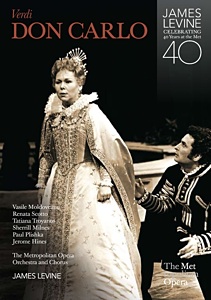
Don Carlo DVD CoverA quintessential theater man as well as a brilliant conductor, James Levine rightfully chose not only the five-act version of Don Carlo for this 1980 performance but begins the opera as Verdi had originally conceived it.

The Woodcutters chorus and the episode in which Elisabetta gives her necklace to a destitute woman are pages essential to the structure of the whole opera: they articulate around that plangent acciaccatura which, as a micro-Leitmotiv snaking through the entire course of the opera, will drill into Filippo’s aria.  The effect is greater at that later point if the numerous times it has played—especially at the very beginning—has been indelibly impressed into our minds, allowing us to recognize it in each of its appearances.

The Met edition is thus quite long, and if sometimes it appears to be dragging, it is because of the ineptitude of one crucial member of the cast.  Levine does all he can to keep it alive and animated with his superlative conducting, which can be described as dynamic, rich with intense and full-bodied sounds, jagged in its rhythms and colors.  The conductor seems more concerned with creating intense theatricality than a mere “beautiful” sound.  In his conception, an extremely contrasted dramatic power polarized on each single character clearly prevails on lyric abandon.

The DVD under review (part of James Levine: Celebrating 40 Years at the Met – DVD Box Set) immortalizes the first revival of John Dexter’s 1979 production, which is heading for the shelf this coming season after over 30 years of service.  His mise-en-scène is as simple as it can be.   Completely absent are the blunders and the painful lapses of taste so dear to the irremediably kitsch esthetics of a Zeffirelli or a Von Karajan (in his directorial attempts), substituted by a moderate opulence in the mass scenes, as well as very traditional movements reserved to each single character, to whom the widest gestural and mimic freedom is allowed.

The cast exploits this freedom to the best—or worst—of their individual abilities.

Sherrill Milnes is musical and has praiseworthy intentions, a pleasant timbre, as well as a broad range of colors.  On the negative side, the baritone never resolved the problem of a correct production around the register change, and the consequences are open, hard and often flat passaggio notes.  When he sings piano, “a fior di labbro”, (and Posa is very frequently required to do so), Milnes doesn’t always find the right support, and the result is an opaque sound that “goes back into the throat”.

The Grand Inquisitor was one of Jerome Hines’ signature roles; in 1950, he had sung it in the legendary  production that inaugurated Rudolf Bing’s reign.  Thirty years have taken their inevitable toll on his voice, but also refined his interpretation.

Paul Plishka (Filippo II) has been around for such a long time that it is difficult to imagine that at one point he was young, too.   In this performance he was only 39 years old, but his voice already presents clear signs of dryness and wear.  He does not seem to have particular insights to this formidable role, which is presented as a generic tyrant.

The Oscar for lack of personality however should be assigned to Vasile Moldoveanu, the protagonist.  The Romanian tenor maintains a single vocal color and an unvaried facial expression (a light frowning) throughout the opera, no matter what happens to the character he is supposedly impersonating.  This is unfortunate, because the role of Don Carlo, a bundle of neurotic sensitivity, demands—especially in the five-act version—an immense range of emotions.   It is a thinking tenor role.   Moldoveanu rushes through his music and seems to have no clue as to what he is singing.  And the singing is not so great to begin with: forced high notes abound, and the basic timbre is undistinguished and impersonal.

The ladies simply annihilate their male colleagues.  Tatiana Troyanos is superb.  The voice is warm, rich, vibrant.  Her Eboli is elegant, impetuous and passionate.  She translates the wide range of her inspired fraseggio into a singing splendid for its beauty , luminosity and its solid emission.  In the Veil Song she negotiates the Moresque ornaments with an almost ridiculous dexterity, with heavenly ascents to the high register.  She throws herself into “O don fatale” with impetus—too much perhaps, as she runs a bit out of steam at the very end, when she is forced to take two anticlimactic breaths, one right before and one immediately after the B flat on the word “salverò”, thus somewhat spoiling the effect.

Renata Scotto is in my opinion the Elisabetta who most closely adheres to the true nature of this great but elusive character.  Her round, compact and incisive timbre spontaneously suggest the character of  a young woman with vibrant communicativeness, and she does not strain for the magniloquent accents of a supposed regality (a myth pursued by lesser interpreters of this role, and an aspect thoroughly secondary, if not deleterious), but those of a true humanity.

This is the essential contrast of the opera:  gigantic surroundings where humanity is crushed under the weight of opportunism, ambition, or blind political necessity, which imprison a young but hardly inexperienced woman.  Elisabetta does not belong to that world, but knows it very well; she accepts her destiny with an austere and almost demure melancholy, refusing to sacrifice her human richness.  She may appear to be a victim, but never an unaware victim; on the contrary, she is always perfectly conscious of what is happening to and around her, and why.

The clash between Scotto’s terse, vibrant, extraordinarily expressive singing with the subtle but stunning “cupio dissolvi” of Levine’s orchestra on the one hand develops the character conferring it an authentic and palpitating tragic stature, on the other hand forms a formidably effective narrative contrast.

Even when an artist has the right ideas, he or she can give full life to a character only when the intentions or intuitions are backed by a good technique; Scotto, still in good vocal shape, is an adroit technician, an adept in the art of legato and tasteful portamentos.  The role of Elisabetta calls for a very strong middle register, which is where at this point in her career Scotto’s strength lies, enabling her to concentrate on the realization of a tremendous, ingenious characterization.

A video of the 1983 revival of this same staging has long been commercially available.  Levine is still the conductor, but the cast is completely different.  Louis Quilico is barely acceptable as Posa.  Ferruccio Furlanetto sounds obviously fresher than Jerome Hines.  Preferring Mirella Freni and Grace Bumbry to Scotto and Troyanos is a pure matter of taste, as each of these four ladies is excellent in her own way.  Placido Domingo and Nicolai Ghiaurov, on the other hand, are vast improvements over their 1980 counterparts.

Any true opera lover should own both.
109 comments

  • Camille says:

    Well, thank you, Richard for that tidbit. It did sound like a thid to my ear but it is so long ago.

    What would the other option for Eboli, as per Mr. Porter, be? I frankly do not understand as I have the exhaustive two volume critical edition and do not recall having seen that particular in any other key. There are several different scenes leading up to it, with that duettino with Elisabetta, sure enough, but I do not recall any transposition.

    At any rate, I am delighted to know this edition of Don Carlo is now available

    • richard says:

      Sorry, my memory is a bit hazy on this. I probably shouldn’t have mentioned it without finding some backup.

    • Orlando Furioso says:

      I think there are options for the Veil Song, about which there was some vacillation (there was a change in the singer scheduled for the role in the original production). But as far as I know, there is no Verdi-sanctioned option for “O don fatale.” Marilyn Horne tried to say that there was, in response to criticism of her transposition, but she was on nonexistent ground there. She should simply have said that that was the way she did it, period.

      Several of the high-extending dramatic mezzo roles (this, Amneris, Ortrud, etc.) were customarily sung by contraltos in the early 20th century (Homer, Matzenauer, et al), and there were various standard adjustments to allow them to do so — dropping down a chord tone in ensembles etc. — without requiring ensembles to be transposed which would inconvenience all the other singers. But for “O don fatale,” the custom was to drop it by a (minor) third to bring it within contralto compass.

      • Cocky Kurwenal says:

        There is a Fedora Barbieri recording of ‘O Don Fatale’ in which she sings one note lower in the same chord for the top notes – if I’m not mistaken, they should be top c-flats, so she sings g-flats instead.

        • Cocky Kurwenal says:

          I should have said that she does this instead of transposing the whole aria, as far as I’m aware.

  • rapt says:

    Hi Camille & Richard: I happen to have a Porter handy. he says that the Veil Song, “originally written in G, was lifted a tone” for Pauline Gueymard, who was scheduled for the role after he had already written the first 3 acts. But he adds that, though Verdi revised “O don fatale” as he wrote it, it was always in A flat: he “did not put it up; one early version of its final section reaches to the high C.”

    • Camille says:

      Thanks, rapt, for citing the quote. When I get hold of the score once more I will check the notes in the front.

      I wonder if that”C” mentioned was actually the C flat, as is written in the extant score.

      Pauline Gueymard-Lauters was a kind of interesting hybrid voice, having premiered Verdi’s Leonora(e) in ‘Le Trouvere’, some years before. Also the creatrix of Balkis in ‘La Reine de Saba’. Sort of a Falcon voice, one supposes and not just a short or ruined soprano. A Rachel voice. Probably what Eboli should be sung by rather than an out-and-out “mezzo”.

      • In deed Camille, Eboli is technically a Mezzo role, but a Falcon Soprano one. That is the reason why Verret, Urmana, Bumbry and so many Mezzos-turned-sopranos sang it so well. Dimitrova, apparently was not too shabby on it either.

        I have always thought that it would be better to cast it with a true dramatic soprano (someone who sings Brunnhilde, or Turandot) than with a mezzo or Cotralto (Podles should have never gone near it. She was horrid)

        • Camille says:

          Lindoro–did Podles sing Eboli!?!? I can’t quite imagine it and think a real contralto like her is wrong. She was just marvelous as La Cieca in the Gioconda I heard two years ago at the Met

          Yesterday I listened to a broadcast via SIRIUS of an old Met Barbiere. The tenor was so good, with such an unusually robust voice, I had to wait to the end (I tuned somewhere in Act II). It was George Shirley. Are you aware of him? I remember his name but had never heard him live, so it was a treat. A million miles away from what one hears these days in that role.

        • Tamerlano says:

        • Tamerlano says:

          oops.

        • Yes, Podles sang Eboli. i was there for opening night and at least that night she was having issues. In the opening night performance she couldn’t even get through the Veil Song (a she in, or so I thought, given her Rossini credenials) and the O don fatale was labored and the high notes clipped. Seems like she recovered, got some rest and apparently got marginally better in latter performances judging from the clip posted.

        • I will confess that my very favorite Eboli in all my years of opera-going was Giovanna Casolla, a true soprano. She sang the role very often in the 80s and no other Eboli gave me goose-bumps like she did. She was hair-rising and in the garden scene you truly feared for the safety and Posa.

        • marcello52 says:

          George Shirley, I believe is the first African American tenor to sing at the Met. He first sang in 1961-62 season if I am not mistaken. He won the Met Auditions the same year Shirley Verrett auditioned. She mentioned that “he sung the hell out of Nessum Dorma.” He gained for some fame with some of the greatest at the Met. Adolfo besides Caballé’s Violetta, Romeo to Moffo’s Juliet (I think he was filling in for Corelli) and Pinkerton to Scotto’s Butterfly. I think he made his debut as Pinkerton as the cover but I might be wrong on this account. I do know that his debut at the Met was not his scheduled debut. There are some recordings of his on Met’s Broadcast website. He also sang with Price on her Cosi Fan Tutte’s recording. I think he stuck around the Met until 1970′s. He did mainly lyric tenor roles though some claimed he a sorta baritonal quality to his voice. He is noted as being an excellent Pellas and there is a studio recording floating around.

        • Camille says:

          Egr. Sig.r Farnese —
          there was also the Eboli of Giuseppina Cobelli, by all accounts a grand scaligera Isolde in the 20′s.

          I heard Signora Casolla as Tosca at Caracalla at about the same time and I remember the voice as rather dark-timbred and probably would have been more apt for Eboli.

        • Camille says:

          Thanks a lot, marcello, for the information about Mr. Shirley as I remember his name well from my fledgling days but don’t recall ever actually having heard him sing. An excellent voice and singer! Lovely timbre.

      • stevey says:

        Interesting, Camille, that you mentioned Balkis in ‘La Reine de Saba’, as well as Rachel. It reminds me of a cherished CD that I acquired years back- an Erato disc of French arias by Francoise Pollet. I hardly recognized an aria (or even an opera) on the disc at the time but was absolutely delighted. All Gueymard-Lauters and ‘Falcon’ roles, and if anyone is interested I would HIGHLY recommend searching this disc out. Here’s what’s on it:

        Berlioz: LES TROYENS- Je vais mourir
        Gounod: CINQ MARS- Nuit resplendissante
        Gounod: LA REINE DE SABA- Plus grand dans son obscurité
        Halévy: LA JUIVE- Il va venir
        Massenet: LE CID- Pleurez, pleurez mes yeux Massenet: SAPHO- Pendant un anje fus ta femme. Reyer: SIGURD- Salut, splendeur du jour
        Rossini: GUILLAUME TELL- Sombre forêt
        Saint-Saëns: HENRY VIII- 0 cruel souvenir
        Verdi: DON CARLOS- Toi qui sais le néant des choses de ce monde.

        And Mme. Pollet is EXCELLENT!

        • Camille says:

          Stevey — thank you for mentioning that wonderful disc, which I absolutely love! A most accomplished and interesting artist, Mme. Pollet. Besides being a genuine doyenne of that genre, I heard her sing “Erwartung”(!!!), no score plopped in front of her, in Avery Fisher Hall a number of years ago.

          That Erato disc is near impossible to find now. As I borrowed it from Alliannce Francaise in NYC ten years ago, I’ve been searching for a while — Harry was kind enough to try and aid me but haven’t yet succeded.

          What has become of Francoise Pollet, I wonder?

    • richard says:

      Ah, ok, thanks for the clarification. So I wasn’t completely imagining things, I just had the wrong aria!

      Oh well, age takes it’s toll!

  • Cocky Kurwenal says:

    The revival with Domingo, Freni, Bumbry etc is a very dull DVD, but I contest the assertion that the Rodrigo is wholly inadequate – Quilico is perfectly adequate, if nothing more than that. But Freni seems somehow uncomfortable, and does an awful lot of it at a relentless forte, Domingo has some awful cracks and generally strains for much of the role, Ghiaurov sounds a shade too elderly to really be able to do the score justice, and Bumbry is rather shattered and over-wrought. Not to be recommended at all – to say any serious opera lover would not be without it is daft, when there really isn’t a whole hell of a lot to recommend it, other than the fact that it is so complete.

    • richard says:

      This revival had enormous anticipation associated with
      it. Freni hadn’t sung with the company for 15 years (although she had actually sung in the house with the visiting Paris Opera) and there was much holding of breath.

      Quite honestly I tend to agree with you. I sat through it and said huh?. I didn’t think either Freni or Domingo gave the blazing performance that people were expecting. Bumbry sounded brittle and very cautious like she was afraid of cracking. I had friends that just thought it was the greatest thing and I just said uh-huh.

      Actually the greatest amount of drama occurred when Freni did a photo shoot with her dogs (it was a big deal, as she had been away a long time) and Domingo through a bit of a hissy fit insisting he should have been in the photos rather than the canines.

      Fortunately Freni went on to sing many more years at the Met and most of her later performances I enjoyed quite a bit. And of course Domingo is still ensconced
      all these years later.

      • rapt says:

        Wasn’t another bit of drama some critical ado about Freni’s acknowledgment of the applause for Tu che le vanita?

        • Dawson says:

          Strangely enough, there is no applause whatsoever after Scotto’s aria in this performance. The poor woman sings one of the longest and most difficult soprano arias (and she sings it well) and gets no applause.

        • richard says:

          Could be, but honestly I don’t remember. I do really like the 5 act Don Carlo the MEt does (but it would be interesting to hear it in French, finally) but it is a long evening and on this particular occasion I was glad when it was over.

          But to be fair it was a big, big occasion for Freni and she got a very warm welcome having been away for so many years. Her 1968 Met appearances were before my time but I had seen her with the Berlin Philharmonic, the PAris Opera’s visit to NYC (Susanna and MArguerite), Scala’s visit to DC (Amelia Grimaldi) and a couple of roles with LOC so she wasn’t that much of a novelty for me. And actually she followed up her Elisabettas at the Met with a revival of Boheme some months later and I thought she was rather thick sounding. But she was much better a few years later when she sang Mimi again at the MEt under Kleiber.

        • rapt says:

          Dawson, I think the silence after Scotto’s aria was a sign of how moving her performance had been. Scotto is one of not too many singers, I think, who can achieve this effect, e.g., after “Senza mamma.” I love it myself, that silence that can follow a great performance before the spell is broken.

      • Cocky Kurwenal says:

        I was so disappointed when I first played the DVD – I thought it was going to be amazing, with that cast.

        I do absolutely love Freni, she is one of my very favourite artists. For whatever reason though, she just doesn’t move me in this performance. I saw her live only once, as Fedora at the Met in 1997, and it was pretty much the best thing I’ve ever seen.

        What breed were her dogs?

        • manou says:

          Scotties.

        • Bluessweet says:

          As pets, I prefer scotchies, myself.

          Sorry- at # 19, it makes no sense.

        • Cocky Kurwenal says:

          Feisty little things that could give Grace Anne’s salukis a run for their money, I’m sure.

        • Camille says:

          Cocky K. – you are not alone in that opinion. I have also adored Freni’s voice (and saw the same Fedora as you did) but the clip of she and Domingo singing the Fontainebleau duet, the only portion of the entirety I’ve seen, has always struck me as just plain Wrong.

    • Regina delle fate says:

      Couldn’t agree more – the Covent Garden performance of around the same time with Cotrubas and Lima is much more moving. I remember the reviews of the performances complaining about their lightweight voices but on the DVD you marvel at these two young people singing with their heart and soul. Domingo and Freni look like visiting grandees in the Met DVD.

      • Camille says:

        “Visiting grandees” — yes, Regina, very well put.

        There is a DVD with Cotrubas/Lima, not just a recording? I should look into that as I was enormously fond of Cotrubas recording of Traviata. Totally puts her countrywoman Gheorghiu, in the shade in comparison. I heard Lima sing Riccardo/Gustavus in Ballo and the voice seemed big enough, and traveled well in the house, albeit not a barn.

        No, I don’t expect a lot from Poplavskaya. Funny thing, the last two Elisabettas I’ve heard at the Met were also Russian, Mescheriakova (ok) and Gorchakova, in a tragic kind of Hindenberg helium meltdown. What I’m really worried about is Alagna turning the Verdian cantilena into Don Jose-type veristic yelps. I’m hoping for the best as Don Carlo is my very favorite Verdi and I hate to have it sullied.

        • MontyNostry says:

          Poplavskaya is too chilly (and light) for Elisabetta — and doesn’t Alagna turn nearly everything into veristic yelps? The Met would do better to get ‘house tenor’ Giordani in. I saw him do a fine Don Carlo in Turin a few years ago. His Elisabetta was Urmana, who certainly sang well, but wasn’t exactly touching …

        • manou says:

          Camille – you could always check this :

          http://www.amazon.com/Verdi-Original-Version-Pappano-Chatelet/dp/B00008DDRK/ref=sr_1_1?ie=UTF8&s=dvd&qid=1283191128&sr=8-1

          it is in French, probably Alagna’s forte, and of course it was a few years ago, but I saw it in London and it was pretty special.

        • Camille says:

          Oh thank you, Madame Manou and Monsieur Monty.

          I do believe that Alagna, at that time, sounded good in the role and he has always sounds far better in his native French, to my ear.

          I belive the big caveat on that one, however, would be the Eboli of Frau Meier. Ouch!

          M. Monty, yes, M. Giordani on a good day can be very fine. I have loved his Maurizio, but the Pirata I heard with Mme. Fleming screaming and voguing was a miserable experience

          At any rate, ANYONE sauf Villazon!!!! You must be thanked for giving me many a chuckle on a dark day with your definition of him as “sounding like Kermit the Frog with shades of Domingo”, I paraphrase a litle. …

        • oedipe says:

          Somewhat OT. Rumour has it that a new “opera festival” is being planned for the Nimes Arena: an Alagna Opera Extravaganza. First installment next year: Othello directed by David Alagna, with Bobby and Nathalie Manfrino as Desdemona, conducted by Myung-Whun Chung.
          Move over Verona and Zia Zeff!

        • Yes, there is a video of Cotrubas and Lima in don Carlos available through
          Amazon.com. (please make sure you go through la Cieca so she gets a cut of the proceeds)

          This is the classic Visconti production that established Don Carlos as a viable dramatic piece. Unfortunately, by the time it was revived and taped, Visconti had been dead for years and he could not re-freshen the staging; so while it is his production, the original stage effects and the staging apparently bears no resemblance to the original.

          here are a couple of clips:

          1. The couple meets:

          2. Dio che nell’alma infondere

          3. Io vengo domandar:

          4. O Carlo ascolta:

          5. Tu che la vanita

          6. Final duet

        • Regina delle fate says:

          Haha Monty re Urmana. You can say that again. I saw that Don. Carlo Giordani and Furlanetto were terrific and the sets were worth the trip if you like that sort of thing.

        • Dawson says:

          Mescheriakova and Gorkachova, talk about meteors. What happened to them? Are they still singing? I heard that Gorchakove fell out of favour with Gergeev in a spectacular way.

      • luvtennis says:

        Regina:

        I think you are noticing the same thing that bothers me about Freni in Verdi (other than Violetta, Desdemona and Amelia in SB) or heavy Puccini stuff.

        To put it bluntly, Freni’s legato tended to fall apart when asked to sing heavy, wide-ranging lines. Elisabetta also cruely tested her breath control, and Freni was a fairly short-breathed singer, as it were.

    • Krunoslav says:

      I was bored by Freni’s distant-sounding Elisabetta and frankly shocked when she took a bow after “Tu che le vanita”. Maybe the night of her return that could be understood, but this was later in the run–I had waited to hear one of the performances with Bianca Berini and Allan Monk, who were A LOT better than Bumbry (at that stage) and L. Quilico (at any stage) in the roles. Monk never got his proper due at the Met. I also found Ghaiurov a disappointment after hearing him on records: there was only middling dramatic artistry there I’d say, he always gave “as if” performances in the years I heard him (the 80s, late career).

      Freni redeemed herself later that year with a MAGNIFICENT Manon Lescaut in San Francisco, my favorite live performance memory of her.

      • peter says:

        I don’t remember much about the revival of Don Carlo at the Met but I do remember being very moved by the final duet between Freni and Domingo. They were both in superb voice the night I heard them and the effect was heartbreaking. Even though there’s a video of this revival, it still has not been played on a Sirius broadcast.

    • Dawson says:

      Quilico in that revival was almost unlistenable. His voice was heavy, murky and on stage he acted more like a Tonio in Pagliacci than a Spanish grandee.

  • Will says:

    Just a reminder that during the 18th and 19th centuries, transposition was common, practiced without shame, and allowed singers to do a wide variety of roles that struck their fancy. In some cases, composers rewrote whole roles (the Battistini Werther, the Maliban Puritani); in some cases powerful stars could dictate that an entire opera be played at a lower pitch.

    Were high notes TOO high? The storied Mary Garden had a simple solution: “Does that high note bother you? Don’t sing it.” End of problem.

    What was the turning point? Toscanini and “come scritto”? The desire of fans of one diva/divo to denigrate another by pointing out any flaw or compromise? When did transposition become a crime?

    • Cocky Kurwenal says:

      Don’t put ideas into Domingo’s head.

    • rapt says:

      Interestingly, Will, to continue quoting from Porter’s review of the 1980 Don Carlo with Horne’s transposition, he says that “Verdi regularly forbade any transpositions of his music which he himself had not made”–but that, in Porter’s view, they were forbidden only as part of “general insistence that no one should tamper with his scores.” Porter cites as evidence that Verdi himself “lifted the final duet of Don Carlos by a semitone,” and that in contractually specifying penalties for transpositions, Verdi mentioned the latter as part of a list including cuts and reductions of orchestration. So it seems that, if there were a historical turning point, Verdi might have been at its cusp (forgive my mixed metaphor!).

      • Will says:

        Thank you, rapt — I was not aware of Verdi’s strictures. Yet, some 40-50 years later, Rosa Ponselle’s famous and gorgeously sung Normas were facilitated by a whole raft of transpositions that affected not only her numbers but Adalgisa’s half of their duets as well. When Ponselle was contracted to present her Norma at Covent Garden, it was the MET, not Ponselle’s management that sent the list of transpositions to London.

        Re: Don Carlo, I understand that there are a number of transpositions that Verdi made in the shift from the French to the Italian version(s), as also with the different versions of La Forza del Destino.

        This issue interests me because there has been such abuse of Domingo for transposing — but I hear few if any complaints about the virtually universal downward transpositions of Che gelida manina and Di quella pira that go on nightly worldwide. One thing to keep in mind is that orchestras are now all tuned higher than they were in the 19th century (Vienna highest of all), so a huge number of operas sit higher in the voice for today’s singers than they did for the roles’ creators.

        • Camille says:

          The issue of transposition is a very interesting and thorny one. I am glad that you bring up the fact that the pitch is raised quite a bit higher from what it was in the days of the original composition of the work–say 1830′s to 1860′s, e.g.–for that makes the case for the transpositions a little more legitimate, it would seem to me.

          In the case of a vocal phenomenon like Rosa Ponselle, and in her absolute prime vocally, well one can certainly allow a little bit of cutting to size, but Domingo’s pilfering willy-nilly with scores gets to be a bit too much. I am not really against it and feel it should be done judiciously but the big caveat is that the orchestral parts have to be provided somehow, and it takes a lot of clout and geld to achieve this.

        • Another very famous instance when Verdi refused to give in to one singer’s demand for transposition was when Marianna Barbieri Nini’s husband asked him if his wife could transpose down parts of the role of Leonora in Il trovatore. Verdi refused and even suggested she should sing the other female role in the opera, Azucena. And Barbieri-Nini was an artist Verdi held in great esteem. She had been his first Lady Macbeth (and Gulnara in Il corsaro).

  • Arianna a Nasso says:

    Does anyone know how involved John Dexter was in rehearsing this cast? I’d be curious to know how much of the interpretations we see here where shaped by him. Scotto and Milnes were part of the premiere cast, so presumably their portrayals carry Dexter’s imprint.

    While I imagine this producition looked lavish next to a lot of the mid-70s low budget productions, I always found it rather cheap looking for an opera of this opulence. Then again, I didn’t see it until after the fancy 80s productions had come into play at the Met, and by then, a lot of Dexter’s direction must have been lost. Any thoughts on this from those who were there when the production was new?

  • CwbyLA says:

    would some be kind enough to explain the term “sound that goes back into the throat” to this poor soul? Perhaps with some examples. Thank you.

  • Tamerlano says:

    I think by “back in the throat” the reviewer is referring to (and I am obviously making an assumption here) the way Milnes covered the voice in the passagio. He had a brilliant upper register, but getting there could be rough going. He “hooked” into high notes…let’s see…


    Ok, it’s “Maria”, not opera, but it pretty much shows every mannerism Milnes was prone to. The unsupported soft high notes, the darkening of the A vowel in the word “Maria”, the clumsy way of getting into the upper register (which when he gets there is actually quite good and clear). I don’t know if that helps. I think when he covers in the passagio the voice slips back and it sounds like he is putting a damper on his voice. The sound loses vibrancy and clarity.

    In his prime, you can hear that most of these issues kind of disappear, or become irrelevent because the voice was so luxe. Still the way he sort of muscles his way into the top register (almost like he’s chewing the notes) is fairly evident.

    • Yes, Tamerlano, you expressed exactly what I meant by using that jargon expression. I should be more precise and explanatory when I use “voice teacher’s slang”.

    • CwbyLA says:

      Thank you very much for the explanations Tamerlano. I especially appreciate the examples. I understand the terminology better now.

    • Sanford says:

      And why, exactly, was he singing this in the first place? Maria is a tenor’s song. Although if I had to choose between Larry Kert and Sherrill Milnes, it would be Milnes all the way.

  • Troppo Primavera says:

    Amy Shuard,a celebrated Turandot,Brunnhilde and Elektra,sang Eboli early in her career at Sadlers Wells and had a big success.The great Wagnerian soprano Frida Leider recorded ‘O Don Fatale’.I’m not sure if she ever performed the role in the theatre,but it’s certainly a part that suits very well the dramatic soprano.

    • Cocky Kurwenal says:

      Here’s Eva Marton, demonstrating that actually, it isn’t really any easier for sopranos, because the temptation to hammer away at the middle and chest registers and carry all that vocal weight makes those top c-flats major danger spots for any singer who hasn’t got perfectly equalised registers and unencumbered support. I do love this performance though -- utterly savage:

      • MontyNostry says:

        Does anyone else find that Marton’s voice used to get a bit short at the top? Here, everything above about an A flat seems to sit under the note.

        Her top C in ‘In questa reggia’, even at that Met gala in 1983, where she was in peak voice, is not **quite** there.

        • luvtennis says:

          I am unaware of Marton EVER singing a real high C. They are all flat approximations.

        • luvtennis says:

          Monty:

          You are soooooo wrong! ;-)

          For years, I used to get on anyone who praised this performance due to Marton’s complete faking of the high C. Not that the performance as a whole doesn’t have merit, but the performance cannot be completely exemplary when the money note is missing.

    • Krunoslav says:

      Sopranos have sung Eboli at the Met, including most recently Giovanna Casolla (1986), who is still singing BTW!!

      Before that, in 1952, the still-billed-as-a-soprano Regina Resnik sang one performance alongside the sigh-inducing cast of Bjoerling, Steber, Merrill, Hines and Moscona, plus Lucine as the Celestial Voice.

    • Dawson says:

      Younh Eva Marton had incredible high Cs. There is a pirate tape of her doing Guglielom Tell with Muti in Florence in the mid 70s, where she is excellent

      • stevey says:

        Yes, high C… and beyond! Keep in mind that Marton was an excellent Empress earlier on in her career (and todoperaweb has a recording available for free download with a great cast that can attest to this- Marton, Nilsson, Hesse, Jess Thomas & Nimsgern with Marek Janowski conducting). Her debut with the Hungarian State Opera was as the Queen of Shemakha (a Sills role)!!

        • luvtennis says:

          Aural evidence, please.

          I have the Tell performance, and there are lovely sections, but clean high Cs? Don’t recall them at all. I will continue to believe that Marton used her vibrato to fake pitches on notes above bflat until clear aural evidence to the contrary is presented.

  • Bluessweet says:

    As pets, I prefer Scotchies, myself

  • iltenoredigrazia says:

    The Scotto clip is exactly the way I remember those performances. Her characterization of Elisabetta was orders of magnitude above everyone else’s.

    I saw Freni at the revival a few years later and, beautiful singer as she is, it just didn’t compare. At least once, she not only acknowledged applause after the big aria but she also threw a kiss to the audience. Scotto not getting applause was a conscious decision by her and Levine. The interpretation went on with no pause.

    Is the Porter article on Don Carlo available on the web? I remember a very long article on The New Yorker by him that I would love to reread.

    • Baltsamic Vinaigrette says:

      Wow. Did almost 4,000 souls really go along with this artistic decision, every show? I appreciate that a conductor can make a statement by keeping things moving without a pause, but it’s hard to subdue all of the paying customers, all of the time.

      There’s been a big debate about “inappropriate” applause at this year’s BBC Proms, e.g. at the end of the opening movement of a concerto or symphony, in London’s Royal Albert Hall. But it seems it is never inappropriate to raise the roof after any given aria, the debate generally being confined to whether it is tacky to shout “Bravo!” outside of an Italian house.

      I have read some classical programmes or heard an announcement where the audience is requested not to applaud until such-and-such a time. This happens in particular when a performance is going out live. Is it possible that the Met playbill contained such a request on this occasion? It is hard to imagine that nobody would want to whoop with the best/worst of them after that clip!