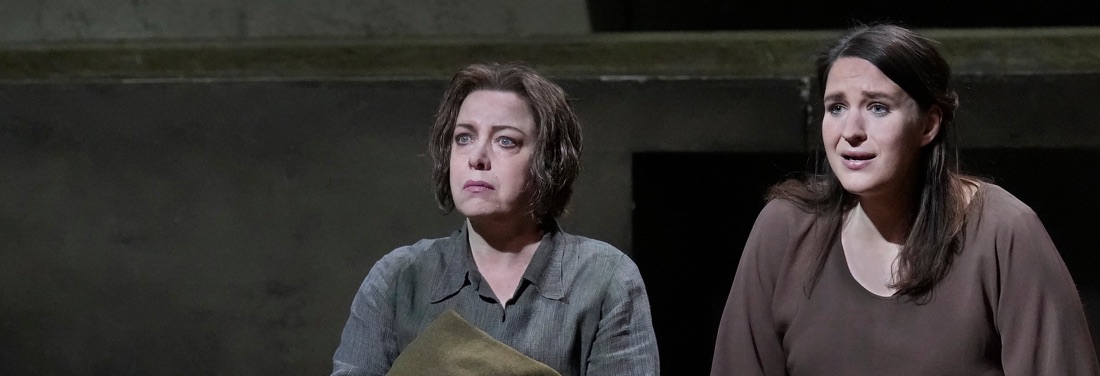

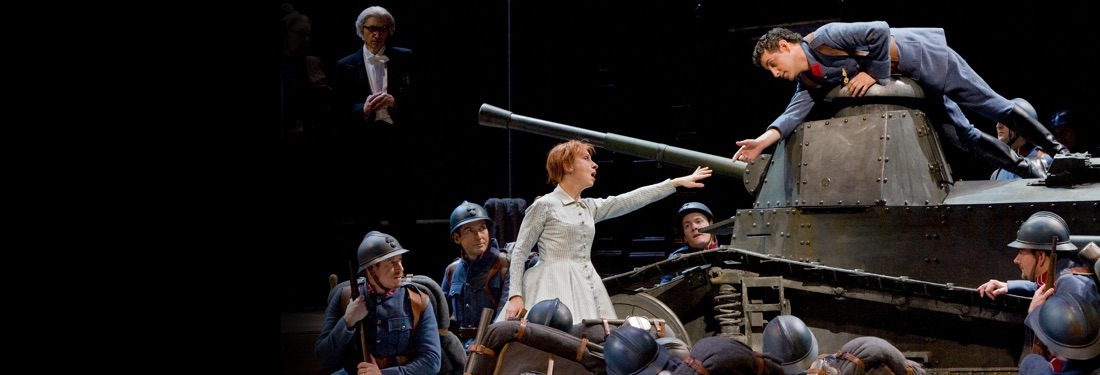
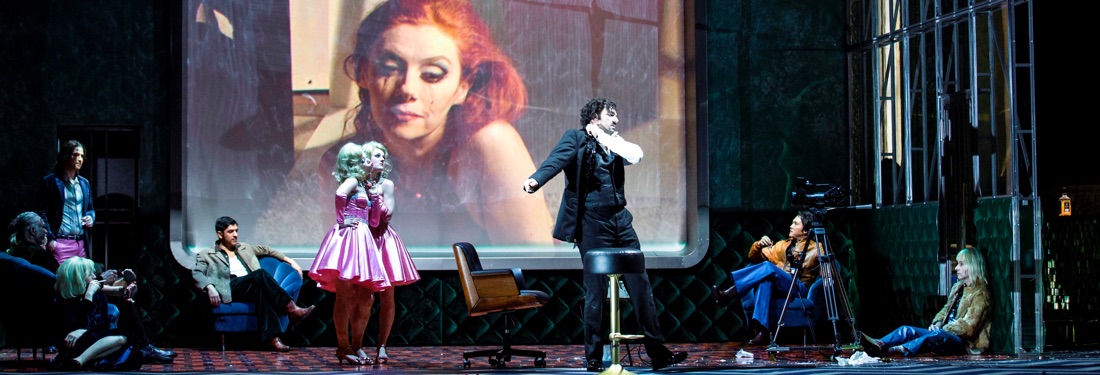
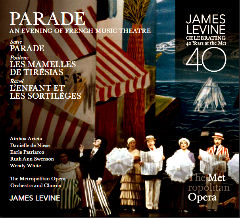
 “Parade” is defined simply by the Merriam-Webster Dictionary as “a pompous show.” Fitting enough, then, that the triple bill titled Parade: An Evening of French Music Theatre recorded at the Met on March 16, 2002 consists of Erik Satie’s ballet Parade, Francis Poulenc’s Les Mamelles de Tirésias, and Maurice Ravel’s L’Enfant et les Sortilèges. These three short works showcase some of the most pompous, magical, absurd and beautiful music and drama in early 20th century French writing. Fitting, also, that this CD will be included in the pompously large James Levine 40th anniversary box set to be released in September.
Satie’s short dance piece, Parade, isn’t the most musically gripping ballet ever written. It lacks the thick, beautiful orchestrations or elegant melodies of the great Russian ballet composers, and also doesn’t have the rhythmic appeal of a work like Le Sacre du Printemps. Levine does his best to draw out what interesting parts there are in the score, conducting a steady score with elegant phrasings of the mostly minimal score.
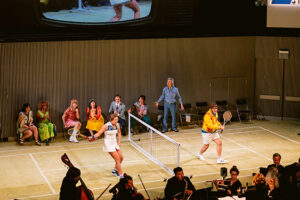
But give Levine a score a tune-filled and interesting as Les Mamelles de Tirésias, and what you get is a magical romp through the fictional French Riviera city of Zanzibar. The libretto, adapted from Apollinaire’s 1917 play of the same name, is absurdist humor at its finest. Including everything from re-incarnated drunks on roller skates, to a husband having 40,049 children overnight and several changes of gender and age in the course of the hour long, two act opera.
Levine shines with this music, elegantly caressing the French waltzes and loving adagios of the very sexual score. He also finds the sarcastic humor in the score, giving a jolly reading of the wonderfully sung scene between drunken gamblers Presto, played by Franco Pomponi, and Eduardo Valdes’ Lacouf.
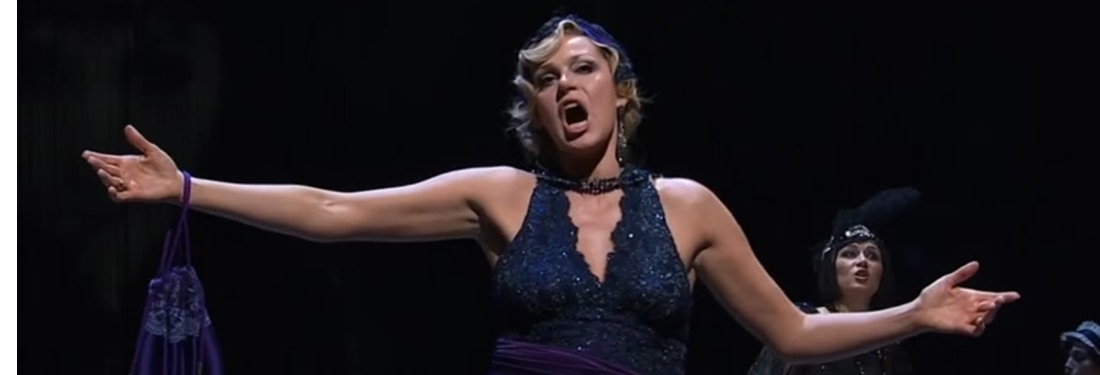
Ainhoa Arteta brings her full, luscious soprano to a role that doesn’t need one, Thérèse ,who becomes Tirésias after deciding she’s fed up with male chauvinism. Arteta does a fair amount of disservice to the role in her attempt to be sexy and casual. Effects quickly become affectations, and they overpower the beauty of her sustained voice when she has the opportunity to show it off. Ian Greenlaw, in his Met debut, gives a powerful and well shaped opening aria as the Theatre Manager, and John Hancock is an affable, bustling Gendarme with his dusky baritone.
There are two versions of Les Mamelles, one with a tenor as the spurned husband named in the score only as Le Mari, and the one Levine chose, for baritone. Earle Patriarco sings with a resounding, burnished timbre evenly throughout the very wide tessitura. His comic timing is excellent, and he plays with the diction in a way that highlights, but doesn’t over-do, the silly comedy.
Levine finds yet another level of excellence with the final part of the trilogy, L’Enfant et les Sortilèges. He draws out perfectly balanced, magically verdant colors from the always top notch Met Orchestra, supporting a fine showing by Danielle de Niese as The Child – a role usually cast as a mezzo. She sounds appropriately young and immature, but brings some sorrowful color to the end of the opera when the young boy begins to regret his domestic reign of terror.
Ruth Ann Swenson was in good voice the night of the original broadcast. Singing the small role of The Princess, her remarkably clear and powerful soprano cuts clearly from the wings where she does most of her singing. Other standouts of this part of the night are the agile Olga Makarina as The Fire, effortlessly tossing off the high coloratura, and Youngok Shin as The Nightingale, who deserves similar praise, as the roles of The Princess, The Fire and The Nightingale are often cast as the same singer and are thus very similar.
While each of the three parts to this whole evening don’t represent the best recording of the respective works available today, this night should stand as further evidence to the varying talents of Maestro Levine about as well as any other French works he has conducted. The uniquely French harmonies and timbres are expertly commanded, and the almost carefree sound of early and mid 20th century French opera abounds. This is a worthy addition to the set indeed.
Latest on Parterre

Sponsored
MET Opera Legend Leona Mitchell Live in Concert
Leona Mitchell, the MET Opera’s leading Verdi soprano for 18 seasons, is returning to the stage April 19th in New York City. Get Tickets →


parterre in your box?
Get our free weekly newsletter delivered to your email.



Comments