
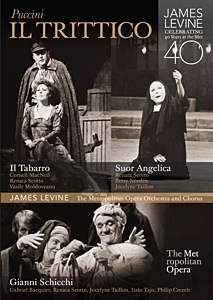
The three faces of Renata

To get straight to the point, the main attraction of this DVD is Renata Scotto.
The Italian soprano, the first to perform all three heroines of Il trittico at the Met, is simply superb. She has élan in the moments of tension and a powerful, in-depth delivery. There is not a single word in the entire work that Scotto lets go to waste. Hers is a play of colors and gradations prodded by an exceptional imagination and interpretative sensitivity.
Add to this an eloquent, aristocratic, full-relief pronunciation, which coalesces with the pliability of her sound and the refinements of the nuances and the result is nothing short of brilliant.
In Il tabarro, it is sufficient to listen to the subtle irony mixed with a hardly concealed resentful boredom that Scotto slips in a simple phrase like “Ti sembra un gran spettacolo?”, while in the duet with Luigi she successfully combines the feverish and desperate abandon with anxiety and bitterness. Even more outstanding is the scene with Michele, introduced by a “Com’è difficile esser felici” that in its own syllabic course on an orchestral void could be nothing more than a conversational phrase, but is here transformed into a pivotal moment by her suffocated, intense, tragic phrasing.
Scotto’s flawless legato and breath control allows her to spin and modulate the sound in long sentences. Her rare ability to “caress” a phrase makes Giorgetta’s sexual tension and frustration thoroughly palpable. In contrast, in the finale of Suor Angelica, the soprano purposely makes her vocal production threadlike and trembling, as if crossed by the electric discharges of a febrile and haunted overexcitement.
This Trittico (part of James Levine: Celebrating 40 Years at the Met – DVD Box Set) demonstrates that Scotto’s instrument in this period of her career was not as tattered and worn as legend (and her detractors) would have it. In Il tabarro the control of the voice is irreproachable, with a secure strong top, including a high C that shows no sign of stridency.
“Senza mamma” is remarkable for the length of her breaths and floating sounds. Only the climax in the phrase “Muoio per lui, e in ciel lo rivedrò” turns out a bit abruptly short. In general, she sounds in much better voice than in her 1976/77 recordings of Il tabarro and Suor Angelica under Lorin Maazel.
Her Lauretta in Gianni Schicchi is less convincing for a number of reasons: she tends to play grand diva in a role that demands extreme simplicity, and paradoxically, she sounds less at ease from a mere vocal point of view. Both she and her Rinuccio (Philip Creech) eschew the optional high note at the end of their duettino. Personally, I couldn’t care less about Lauretta, after such devastating, sublime portraits of Giorgetta and Angelica.
Cornell MacNeill, who had sung both Michele and Schicchi when this production was inaugurated in 1975, now appears only in the first panel of the triptych. He is not much of an actor, but he is still in good voice and delivers a solid performance. Gabriel Bacquier’s undoubtedly diminished vocal resources are still sufficient for a role like Gianni Schicchi, where he is able to display his histrionic talent.
Bianca Berini is exquisite as Frugola, with a dark, robust voice, true mezzo at ease in the difficult tessitura of “Ho sognato una casetta”. She is a throwback to the not so ancient times when true Italian mezzos were roaming the earth. She also sang the role of the Princess in Suor Angelica on opening night and in a few subsequent performances.
Regrettably, for the telecast the Met opted to assign the latter part to Jocelyn Taillon, whose voice sounds divided in three disconnected sections, with a booming chest register, a throaty middle and a short top. There is not a single interpretative idea; her fraseggio proceeds heavy, monotonous and unable to give shape to any kind of character.
Next to her, Scotto murmurs “Dopo sett’anni son davanti a voi”, and she makes you physically feel all the weight of her reclusion, which she has not been able to accept, but which she suffers with the firmness and dignity of an aristocratic woman accustomed to translate the flood of her feelings into a composed, self-possessed language: it is her noble lineage, as a matter of fact, the key to understand Angelica, the only leading character in the Puccini canon to belong to the European high aristocracy.
Vasile Moldoveanu is a solid Luigi. Although the color and timbre of his voice are not particularly memorable, he survives the role’s murderous tessitura with all its high G sharps and As, nailing the devilish acciaccatura on the B natural where most tenors strangle themselves.
With all the bad press he was receiving at the time, I was prepared to hear the worst from Philip Creech but I must say to the contrary that he gives quite a good rendition of the role of Rinuccio, another part often overlooked and taken for granted, but which is in fact presents its good share of traps.
Among the comprimari, only Charles Anthony as Tinca and Gherardo, and Italo Tajo as Talpa and Simone stand out.
James Levine’s conducting is impeccable in his choice of tempos and he successfully captures the atmosphere of each opera. His color palette is wide and rich, the rhythm of the narration unaffected and incisive. Only a very critical listener might observe that at times Levine confers to some orchestral expansions a magniloquence somewhat disproportionate to the events, which are not exactly those of Götterdämmerung.
Fabrizio Melano’s production is hyper-realistic, traditional, not infrequently dull and ultimately inoffensive, except for a blatant anachronism in Gianni Schicchi: in 1299 Palazzo Vecchio was just being built and Brunelleschi’s dome was 130 years in the future. One would thought have a stage director would know this.
I think the kind of anachronism you decry is forgivable because of audience expectation concern the glory of Florence at its height. A vista of the city with a shed roof over the Duomo’s transcept because nobody had figured out structurally how to finish the building off would be a big let down at the end of the opera as the lovers cry out at the city’s splendor.
Oh, how exciting! Thanks for the comprehensive review. I love (slash am a little addicted to) that Maazel recording, imperfections aside, especially for the conducting and for Scotto’s impassioned and nuanced rendering – so if this is even better… can’t wait!
Thanks for a very thorough review. Sorry to hear that most of the men merely get the job done. Even so, this video sounds like required viewing for those of us who came around after the Scotto era.
Are these releases available individually or exclusively as a package deal?
Currently the DVDs in the “James Levine: Celebrating 40 Years at the Met” are available only as a package. Though I have no information on later plans, it would seem likely that eventually the operas would be made available as individual releases.
if memory serves, this is what happened with the “Mozart 22″ collection (all the 2006 Mozart operas done in Salzburg that summer, for the 250th anniversary).
I think it was less than a year before most of the performances were available singly.
The Schicchi production was inaugurated in 1973-74 with Frank Guarrera in the title role. It was paired with Bluebeard’s Castle for the first two seasons before Tabarro and Angelica were added in 75-76.
Please include information about the video clarity of these new DVD’s.
Is this Scotto Trittico now in a really clear resolution or grainy?
It is not grainy. You’ll probably be disappointed if you expect the high definition of the recent Met releases, because after all it was taped 29 years ago. But to my eyes the quality of the video was more than satisfactory, and the resolution clear enough.
It would be interesting to know if people who have quality Betamax versions made from home recordings of this telecast are superior or equal to the new commercial release. No point to buy it if it’s that same quality, and this trittico has been circulating for years from other sources.
I am sure the quality is better than those old Betamaxes, QPF. I actually saw portions of old Betamax transfers of the Vickers/Scotto/MacNeil “Otello” and could compare them with the DVD remastered from the original tape. Obviously sound and picture are much better. Also remember that TV sound was still mono in the seventies – am I incorrect? I remember they used to have stereo simulcasts on the radio so you could get it in stereo.
The other point of interest is that there was a transmission drop out during the “Tabarro”. Evidently that has been corrected on DVD. Probably the tape done in house didn’t have the drop-out or the editors had footage from a dress rehearsal. Anyway, no interruptions in “Tabarro”.
I’m sort of flabbergasted that notre doyenne, as La Scottoiata numero uno would permit this to be reviewed by somebody else but her supreme self – even if the reviewer was of the quality of Signore Farnese!
I was there the day this was taped for broadcast. I cannot believe it was 29 years ago. Yes, the tenors were a little weak, and MacNeil was dry as dessicated Melba toast, but that was the sort of attention the casting department was giving to “secondary” attractions at the Met in those days. If memory serves, we were supposed to get a different tenor, and he canceled–at least in Schicchi.
I saw this production one more time, with Soviero as Angelica. She was even more moving in the role than La Scotto, and Soviero was a big audience favorite at the time. Truthfully, in the early 80s, Scotto began her steep vocal decline and, to my ears, she was not easy to listen to then. There was a big difference between the mid 70s, with a few acidic high notes, and the early 80s, when she may have realized the jig was up and was booking any- and everything the Met was offering.
I’m hoping that these DVDs are offered separately, as the Rosenkavalier with Troyanos and te Kanawa was fun. Dame Kiri had already agreed to have the Covent Garden/Solti Marschallin released on video, so this performance–which I think was better cast (despite the exhortations of our Vicar)–had no chance, at the time, of a wider release. And te Kanawa figures in another “house release,” I read; a 1981 Cosi from Covent Garden with Baltsa and Thomas Allen (a favorite of mine) will be released on the Royal Opera’s “Heritage” series. I enjoy Kiri’s first Fiordiligi on Erato despite the conducting, and feel that the Covent Garden house release could be fun as well. (And Davis is a sharper Mozart conductor than Lombard any day…)
I so agree with you about “steep vocal decline.” I found her unbearable in Macbeth–actually left early because I could not take the screeching anymore. That would have been early 1980s, I believe.
Scotto had two triumphs circa 1974-75 that cemented her position as prima donna assoluta della casa: the three heroines of “Il Trittico” and Elena in “Vespri”. These also signaled the “new” Scotto graduated from ingenues and coloratura.
What is interesting is that when she returned to both these assignments in the early eighties – she did a “Vespri” revival around 1982 – her vocal condition improved. It was like she was going back to the muscle memory and technique she was using when she first sang them. They were much better than the newer dramatic roles she was singing at the time.
I heard something similar recently with Sam Ramey. He went back to the role of Leporello which he sang in his early NYCO days. No the voice wasn’t fresh and juicy and there was more vibrato. But that mile wide tremolo was nowhere to be heard and the legato was better. He sounded closer to his old self.
Gualtier, I sat through some painful Scotto performances, which really colored my attitude about her. I did enjoy the 60s Liu and Butterfly recordings, but it was not until I was invited to lollygag around La Cieca’s porch that I was exposed to Scotto’s very finest recorded work, e.g. the Tokyo Traviata. I’ve given that CD to a few Traviata fans, and I’m continually impressed with how she had the chops to sing that so well and so “completely” in the 70s. We all know that it rather demands “different” voices for each act, and she really nailed those performances. The 60s DG recording is a little dull, and I’ve never even bothered to sit through the Kraus/Muti version. It’s too bad that Scotto didn’t record even more than she did in the early 70s; I’d have preferred her Vespri as the Caballe substitute to Arroyo.
I think I listened to a great deal of the Vespri on the Met broadcast, and thought that, at least in parts, Scotto sounded better than I would have expected her too…
I believe that the late Giuliano Ciannella was supposed to sing Rinuccio but canceled and Creech replaced him. The whispers were that the cancellation was arranged.
I think Giuliano Ciannella was supposed to be Rinuccio.
I am sure the cancellation was arranged. In any case, Creech looks very good in tights. Muscular legs and butt. Whatever happened to his career?
I saw this revival twice that season; once with a cast with three different sopranos and then the
Scotto triple play. Ciannella sang the earlier performances and Creech did the later ones with Scotto. I remember comparing the two tenors, both
cut a good figure on stage although Ciannella was taller but vocally they were very different. Ciannella struggled with Rinuccio’s top notes but his middle register was very classy sounding. Creech was the opposite, the top notes were easy but his middle register was slightly hoarse and a bit clumsy.
Creech definitely had some things going for him but I don’t think he was ever a really finished singer.
I have often wondered this myself. I remember being surprised to see Creech in this telecast, as he was indeed getting bad press and probably worse rumor mongering at the time — Dawson appears to know more about this than I (from a Time 1983 story on Levine: “Another charge is that Levine plays favorites with singers, overusing some voices while ignoring others. … Sometimes they are not up to major-house standards, as with Tenor Philip Creech, whom Levine has pushed beyond the limit of his modest gifts.”)
I actually went to school with Phil; I knew him but not well, and while I was not a voice major, I’m pretty sure that he kind of operated in the same way even back then. That said, he was a very nice guy with a pleasant and easy tenor voice, albeit with that rather unfocused tone.
As for Scotto, I remember her knocking my socks off in this telecast: luminescent is the word that springs to mind.
I actually don’t know much more than the average Met-centric opera lover. Rumor, loud rumor, had it at the time that Creech had an extra-professional relationship with Levine. Then all of a sudden he disappeared. Did he fall out of favor with the maestro? Did they have a fight? The gossiper in me would like to know why Levine, after shoving him down everybody’s throat for a long time, suddenly dumped him.