Headshot of La Cieca

Cher Public

  • Cocky Kurwenal: Ghena Dimitrova in Roberto Devereux – remarkable: httpv://www.youtub e.com/watch?v=P... 12:35 PM
  • Hans Lick: … p.s. Very Eurovision, that Tannhauser, eh what? 12:33 PM
  • willym: Bill: They just announced next year’s Whitsun Festival opera will be Norma and Ceci is also singing... 12:32 PM
  • Hans Lick: … unless it’s Tannhauser: 1) Landgraf Hermann judges the song contest. Tannhauser k.o. in... 12:32 PM
  • Hans Lick: So obvious: Parsifal! 1) As wounded Amfortas listens, Parsifal (or is it Gurnemanz?) looks over the... 12:30 PM
  • SilvestriWoman: Congrats, divina Cieca!!! Though it has nothing to do with the Kerfuffle, you can add Mom to your... 12:17 PM
  • operacat: Just curious. . .whose TROYENS do you own? 11:46 AM
  • Bill: Dear Camille – not to worry. Fischer-Dieskau has a treasure trove of recorded samples of his artistry... 11:43 AM

The three faces of Renata

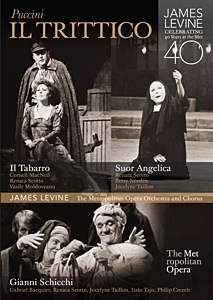
Il Trittico DVD CoverTo get straight to the point, the main attraction of this DVD is Renata Scotto.

The Italian soprano, the first to perform all three heroines of Il trittico at the Met, is simply superb. She has élan in the moments of tension and a powerful, in-depth delivery. There is not a single word in the entire work that Scotto lets go to waste. Hers is a play of colors and gradations prodded by an exceptional imagination and interpretative sensitivity.

Add to this an eloquent, aristocratic, full-relief pronunciation, which coalesces with the pliability of her sound and the refinements of the nuances and the result is nothing short of brilliant. 

In Il tabarro, it is sufficient to listen to the subtle irony mixed with a hardly concealed resentful boredom that Scotto slips in a simple phrase like “Ti sembra un gran spettacolo?”, while in the duet with Luigi she successfully combines the feverish and desperate abandon with anxiety and bitterness. Even more outstanding is the scene with Michele, introduced by a “Com’è difficile esser felici” that in its own syllabic course on an orchestral void could be nothing more than a conversational phrase, but is here transformed into a pivotal moment by her suffocated, intense, tragic phrasing.

Scotto’s flawless legato and breath control allows her to spin and modulate the sound in long sentences. Her rare ability to “caress” a phrase makes Giorgetta’s sexual tension and frustration thoroughly palpable. In contrast, in the finale of Suor Angelica, the soprano purposely makes her vocal production threadlike and trembling, as if crossed by the electric discharges of a febrile and haunted overexcitement.

This Trittico (part of James Levine: Celebrating 40 Years at the Met – DVD Box Set) demonstrates that Scotto’s instrument in this period of her career was not as tattered and worn as legend (and her detractors) would have it. In Il tabarro the control of the voice is irreproachable, with a secure strong top, including a high C that shows no sign of stridency.

“Senza mamma” is remarkable for the length of her breaths and floating sounds. Only the climax in the phrase “Muoio per lui, e in ciel lo rivedrò” turns out a bit abruptly short. In general, she sounds in much better voice than in her 1976/77 recordings of Il tabarro and Suor Angelica under Lorin Maazel.

Her Lauretta in Gianni Schicchi is less convincing for a number of reasons: she tends to play grand diva in a role that demands extreme simplicity, and paradoxically, she sounds less at ease from a mere vocal point of view. Both she and her Rinuccio (Philip Creech) eschew the optional high note at the end of their duettino. Personally, I couldn’t care less about Lauretta, after such devastating, sublime portraits of Giorgetta and Angelica.

Cornell MacNeill, who had sung both Michele and Schicchi when this production was inaugurated in 1975, now appears only in the first panel of the triptych. He is not much of an actor, but he is still in good voice and delivers a solid performance. Gabriel Bacquier’s undoubtedly diminished vocal resources are still sufficient for a role like Gianni Schicchi, where he is able to display his histrionic talent.

Bianca Berini is exquisite as Frugola, with a dark, robust voice, true mezzo at ease in the difficult tessitura of “Ho sognato una casetta”. She is a throwback to the not so ancient times when true Italian mezzos were roaming the earth. She also sang the role of the Princess in Suor Angelica on opening night and in a few subsequent performances.

Regrettably, for the telecast the Met opted to assign the latter part to Jocelyn Taillon, whose voice sounds divided in three disconnected sections, with a booming chest register, a throaty middle and a short top. There is not a single interpretative idea; her fraseggio proceeds heavy, monotonous and unable to give shape to any kind of character.

Next to her, Scotto murmurs “Dopo sett’anni son davanti a voi”, and she makes you physically feel all the weight of her reclusion, which she has not been able to accept, but which she suffers with the firmness and dignity of an aristocratic woman accustomed to translate the flood of her feelings into a composed, self-possessed language: it is her noble lineage, as a matter of fact, the key to understand Angelica, the only leading character in the Puccini canon to belong to the European high aristocracy.

Vasile Moldoveanu is a solid Luigi. Although the color and timbre of his voice are not particularly memorable, he survives the role’s murderous tessitura with all its high G sharps and As, nailing the devilish acciaccatura on the B natural where most tenors strangle themselves.

With all the bad press he was receiving at the time, I was prepared to hear the worst from Philip Creech but I must say to the contrary that he gives quite a good rendition of the role of Rinuccio, another part often overlooked and taken for granted, but which is in fact presents its good share of traps.

Among the comprimari, only Charles Anthony as Tinca and Gherardo, and Italo Tajo as Talpa and Simone stand out.

James Levine’s conducting is impeccable in his choice of tempos and he successfully captures the atmosphere of each opera. His color palette is wide and rich, the rhythm of the narration unaffected and incisive. Only a very critical listener might observe that at times Levine confers to some orchestral expansions a magniloquence somewhat disproportionate to the events, which are not exactly those of Götterdämmerung.

Fabrizio Melano’s production is hyper-realistic, traditional, not infrequently dull and ultimately inoffensive, except for a blatant anachronism in Gianni Schicchi: in 1299 Palazzo Vecchio was just being built and Brunelleschi’s dome was 130 years in the future. One would thought have a stage director would know this.

42 comments

  • Clita del Toro says:

    OT: BOCELLI AT THE MET
    From opera-l

    Andrea Bocelli to Make Met Recital Debut
    Popular Italian tenor to perform a selection of arias, lieder and art songs in
    recital with pianist Vincenzo Scalera
    New York, NY (August 23, 2010) – Andrea Bocelli will make his solo recital
    debut at the Metropolitan Opera House on Sunday, February 13, 2011 at 5:00 p.m.
    The performance will feature the celebrated Italian tenor singing a program of
    arias by Handel, and lieder and art songs by Beethoven, Wagner, Liszt, Richard
    Strauss, Fauré, and Tosti. Bocelli will be accompanied by pianist Vincenzo
    Scalera. Tickets go on sale to the general public on September 12th.

  • On completely unrelated news (and La Cieca said it first) Bocelli will debut at the Met, but apparently in a recital.

    You can read the details here

    • soubrettino says:

      Is he *really* going to sing Let the bright Seraphim? I hope it’s a joke, or it’s actually Scalera’s instrumental piece or something.

      • Cocky Kurwenal says:

        I think there are more disturbing things in prospect than Let The Bright Seraphim. Sure, it’s a soprano piece, but there is nothing in the text that will make him look ridiculous singing it. I’d be far more concerned about how he was going to get through the Wesendonk Lied and some of the Faure items, for instance, than a perky baroque number.

        • well, does he understand French (or speaks it)? If he does, at least he will be able to communicate the text as someone who understands what he is talking about; even if vocally they are less than the Elly Ameling standard. Some of the Faure might be passable if he chooses the rep wisely. The Maher, well, he is on his own there.

          I wouldn’t expect much from him, but I would not expect him to be so miserable as to be 100% unlisteanable. Look at Pavarotti, he was not a great recitalist and he certainly did not venture (or dared) into Mahler. I’ll give Bocelli the credit that with not even a 1/3 of Pavarotti’s vocal apparatus, he is at least trying to do something interesting beyond the same songs that Pavarotti did in his recitals.

          Some of the recital could be OK, some of it will raise brows; he could have taken the easy way out and yet he is not. That much he deserves credit for.

        • Cocky Kurwenal says:

          It’s Wagner. And as for the French stuff, whether he understands and/or speaks the language or not, I’m worried about it from a vocal point of view. In spite of Gualtier M saying he thinks crooning might work in Faure, for me this is just the kind of treatment Faure gets all too often, even from great singers, and I find it the biggest turn off. What I really want is beautiful breadth of line, hence my concern.

        • soubrettino says:

          @CK Among other things. I look at LtbS and the first thing that came to mind was ‘runs, trills and da capo variation’ and not, as you imply, ‘soprano’. Ditto the Partenope excerpt. Then again, surely we’re not expecting authentic Handeliana from Bocelli.

          I’d like to hear how he’ll do ‘O quand je dors’.

        • Cocky Kurwenal says:

          Fair enough, Soubrettino. I’m not personally alarmed by the fact that the piece moves, since it wouldn’t surprise me if he turns out to be able to do fairly accurate coloratura – voices produced with that much physical tension often can.

      • Gualtier M says:

        Tenors often sing the “Largo” or “Frondi Tenere” from “Serse” though it was written for soprano castrato. But “Let the Bright Seraphim” has coloratura runs.

        The French stuff really doesn’t worry me – a croony, soft pop sound might actually work okay there. The best stuff on Barbra Streisand’s “Classical” recital were the French chansons.

        • Pavarotti is a splendid recitalist! What’s wrong with Pavarotti as a recitalist? He tends toward songs that are in a style of which he is a master. He brings out the full nuanced brilliance and pathos of some under appreciated pieces with his incredible verve, rootedness and sensitivity! (I’m not attempting to compare him with Bocelli. Bocelli is a pop star and he’s lovely, really, and that’s great but I don’t wish to compare him to folks like Luciano Pavarotti.)

        • The problem with the Pav as a recitalist was that he stopped caring and he stopped trying. Yes, he could be magnificent in the stuff that he sang, but then loot at what he sang: Italian songs. Not much of a stretch there, isn’t it? I would have been surprised had he NOT been able to communicate in his own native tongue.

          Let’s not try to pretend that covering our eyes stops the sun from shinning. For starters, Pavarotti never ventured away from the Italian songs, even when he sang Beethoven, it was In questa tomba oscura. Yes, at the very beginning, it was marvelous, and the fact that there was an Italian, singing this music, I am sure did not hurt; but as time went on, he stopped exploring the repertoire and continued offering the same fare: Bellini and Donizetti songs, Neapolitan favorites (and those, no matter how much tenors sing them, are NOT art songs) and there was a time when he (not a criticism) just stopped giving recitals.

          Pavarotti’s true art was the fact that he sang this pieces without artifice, with a simplicity of delivery that was disarming and very true to the spirit of many of the songs. That being said, I doubt he would have been able to delve into Wagner, Schubert, Faure, Debussy other songs not in Italian. Call it being shrewd, call it being lazy, or lacking interest/imagination (I tend to think there is a little bit of the 3 in the totality), but the reality is that as a recitalist, he touched the surface, but never really got too deep into it…

        • Oh, come on we know a lot of people who can’t communicate a WHIT in ANY language. He was way beyond that in the communication department- way beyond some recitalists that do just such a range of repertory of which you are speaking. Yes, it’s great to have range of recital repertory, but Pavarotti was kind of a specialist in this regard, I suppose. But what’s wrong with that? Wasn’t Dieskau? Isn’t Bartoli? I’d call them great recitalists. And Pavarotti was nearly incomparable in his repertory. And there are huge differences between say Caldara and Verdi and Puccini, right? Yeah, maybe more exploration would have been even better. But I think the quality of his performances were consistently top notch and that’s what really matters. Maybe we’re having a semantic difference. I mean, I didn’t say he was a master of all recital repertory… if that’s what you want to call a great recitalist, I mean, ok…. But how many people really are? Basically, I feel that the greatness of a performer is measured not by how much they do but by how well they do it. I totally respect and enjoy exploration of a range of repertory, and risk taking, absolutely. But sometimes, it seems to me there is more beauty, that there are more colors and depths in one old Italian song from Pavarotti than in whole recitals from other singers spanning 200-300 years of repertory in 4 or 5 languages…. Of course, some other singers do all that and brilliantly, but many don’t and it can still be great in a different way….

        • Maybe we are talking semantics, but I have heard recordings of recitals through his career and while I agree the early stuff is amazing, I find that the latter stuff suffers from a sameness of approach and a been there done that aura that detracts from the whole experience.

          Again, when we are talking the Pav, I think sometimes we do need to separate the artist from the mogul. In the later years of his career, he treated his voice as a product and it showed. I do not think there is anything wrong with making a living (a great one) doing what you are good at; and I will add that the Pav’s worse will forever be much better than many singer’s very best, but judging by HIS standards, it did show.

        • Interesting – I haven’t listened to as much of the later work, so I’ll keep that in mind…

  • Dawson says:

    Thank you Ercole. I envy your writing skills.
    Now, regarding Scotto’s vocal conditions in the early 80s, it is true that in Macbeth she was often at the very limit of her possibilities, to say the least; but this Trittico finds her fresh and relaxed. This is even more amazing if one considers that this Trittico’s first performance (not the telecast) followed the last performance of her notorious Norma by just 3 weeks.

  • actfive says:

    I think it should be said that the Norma was really “notorious” only on the Opening Night performance. The later performances, while certainly not acclaimed, were workmanlike and absolutely competent.
    Scotto is simply brilliant in both Tabarro and Suor Angelica here, vocally and dramatically; though I agree that her voice was quite iffy by ’83. The Lady M’s were hard to listen to…

  • tiger1dk says:

    Taking about Norma, after reading a discussion either here or on Opera-L recently on the opening night Scotto Norma, I listened to it the other night. Frankly, I did not think it was bad at all. There was a somewhat off cadenza at the end of the first Norma-Adalgisa duet and some of the high notes were a bit squally but I enjoyed it very much. A bity that Ms Scotto cancelled the broadcast. I also like the recording I have of her as Lady M, it is from Ravinia, I believe. Well, maybe it is simply a case of my liking her voice, stridency and all.

  • uwsinnyc says:

    A bity that Ms Scotto cancelled the broadcast.

    Who sang the broadcast, I’m curious?

  • peter says:

    Adelaide Negri sang the broadcast of Norma replacing Scotto. Not very memorable, except she had the distinction of making her Met debut in a radio broadcast of Norma.