
Headshot of La Cieca

Cher Public

  • Camille: I hope one day……e tc. 9:47 PM
  • Camille: Nerva, you are the funniest. TY for the word pn Carmelita Pope. Supposing I know her from PAM. I am one... 9:46 PM
  • Nerva Nelli: Surely it must be Christopher Alden’s ENO restaging of THE ENCHANTED ISLAND . 9:19 PM
  • actfive: Also saw this at LOC…Zajick looked totally bored, occasionally annoyed (maybe she was pissed at... 7:56 PM
  • phoenix: Fanciulla is primetime Puccini – I find Voigt about as italianate as Niamh Parsons – still,... 7:23 PM
  • Henry Holland: Good Dame Gwyneth as Minnie, Domingo as Jack Rance, LA Opera, 90′s sometime. At the end of... 7:16 PM
  • PushedUpMezzo: Well of course the mike’s the clue. She famously had no need of such things. The lady... 6:25 PM
  • La Valkyrietta: I voted, but it was not easy. I mean, for example, how do you decide which was a lousier... 6:17 PM

From a distance

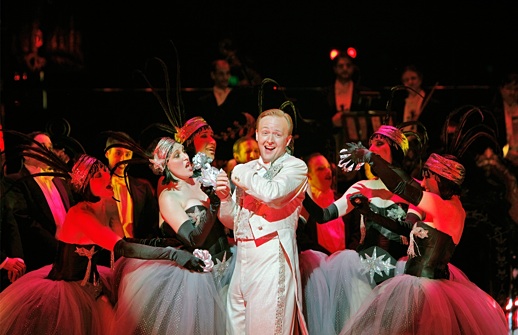
klang_1Asking New Yorkers to travel two hours to the remote but beautiful campus of Bard College in New York’s Hudson River Valley to see an opera can be like asking them to cross the Sahara. Yet if there is any opera I would put my life at risk to see again, it just might be the production of Der Ferne Klang by Franz Schreker that premiered last night as part of Bard’s 21st annual SummerScape. This potentially once-in-a-lifetime production showcased the vast genius of Schreker, as well as the growing skill of director Thaddeus Strassberger, making for a night of complex yet visceral beauty.

Arguably, 1912 was the worst possible time to premiere a sophisticated and controversial opera in Europe. Due, in part, to this unfortunate timing, Der Ferne Klang has only been heard once before in the US, in concert with the American Symphony Orchestra under Leon Botstein, who also conducted this evening. He leads this challenging score with aplomb and grace, drawing out the most delicate moments of the piece with careful command, only to unleash the almost uncontrollable energy of the party music in Act II. His effort this evening was nothing short of masterful, especially since even a workmanlike interpretation of this score would be a heroic feat.

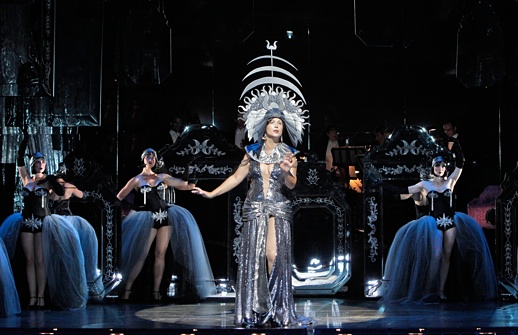
Schreker’s music is often described as “lush,” and indeed it is, but I found that mere adjective too pale a description for so vast a musical vocabulary. The wildly varying styles used in this opera, from superlative examples of early 20th century Germanic Romanticism to expressionist and atonal dramatic moments, create a vivid and engaging score. Act II is the musical (and for some, physical) climax of the piece, with three separate orchestras – the pit orchestra, an ensemble comprised of gypsy instruments, and a traditional Italian ensemble consisting of violins, mandolin, flute, guitar and other instruments – all playing for three different scenes within the scene, sometimes simultaneously. Moments in this sequence rival the greatest pages of Puccini or Verdi, with emotional power that is almost unsettling to be subjected to.
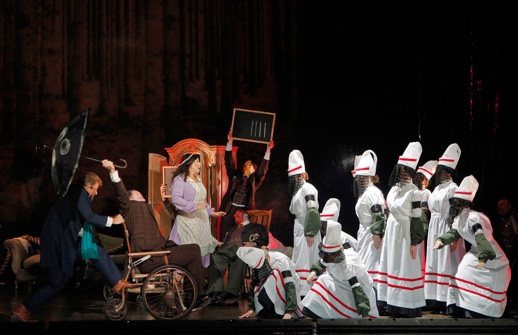
klang_3Schreker also wrote the libretto for Der Ferne Klang, which has its benefits and drawbacks; the text is beautifully set, but not as poetic and lyrical as some of the other operas written in this period, and tending heavily towards melodrama.

Strassberger returns to SummerScape for the second consecutive year, following last year’s very well received production of Les Huguenots.  With its several layers of complex emotional and psychological drama, Der Ferne Klang might force a director into some muddled amalgam of a story. Strassberger instead manages to find the beauty in the chaotic or confusing moments, emphasizing the simultaneous stories (and orchestras) in the Venetian house of ill repute of Act II to great effect. The set is covered in mirrors and bristling with action and can almost overwhelm at first; at least until it becomes clear this scene is meant to be overwhelming, and Mr. Strassberger doesn’t shrink from that depiction. There were also several wonderful uses of video projections, eerily tying together the two scenes in the first act into one cohesive dramatic moment.

As Grete, Yamina Maamar brings a sizable soprano voice with a richly developed middle register and an easy, clarion upper voice. Fritz, the composer who leaves his betrothed Grete to seek the unreachable sound he craves, is portrayed by Mathias Schulz. He’s convincingly loving and mad in his portrayal, but his throaty and shallow sound was at times difficult to listen to and didn’t fully serve the beauty of the music. Other standouts in the large cast were Matthew Burns as The Innkeeper, whose even and husky bass-baritone voice was supported by the best German diction of the evening, and baritone Corey McKern as The Count, who impressed with an alluring voice of considerable size which he used with deft command and dramatic effect.
klang_2Der Ferne Klang has three remaining performances, on August 1st, 4th and 6th, with an Opera Talk given by Mr. Botstein before the performance on August 1.

Photographs: Cory Weaver
28 comments

  • Camille says:

    It pleases me that Thaddeus Strassberger is back and has made another positive impression as he made a very strong one for me last year with the Huguenots. Also, relieved to hear that Mr. Botstein’s conducting has improved to such an extent. I regret not being able to hear this comparitive rarity. Pleased to know the interesting SummerScape programmes continue to hold sway.

  • Loge says:

    I am making the trek from Georgia to see it (and The Chocolate Soldier). Looking forward to it. I have a friend in the chorus and I have seen a picture of her in her “whore” costume. Hope to see many of you there.

  • Unfortunately, I couldn’t disagree more about the orchestra and conducting, it sounded like a total shapeless mess to me. But I agree that the singing was mostly good and the production was interesting. And it’s a treat to see a Schreker opera at all.

    • Camille says:

      Oh dear, Zerbinetta, your comment sounds much more like the reality I’ve always experienced with Botstein. It sounded too good to be treu. Oh well, at least he has the balls to put on the works that everyone else shuns and I’m thankful for that.

      • Yeah, though it ends up being a sad reminder that we have no equivalent to Salzburg or Aix or such here. I love Tanglewood, but for fully staged opera we have the Lincoln Center Festival, sometimes, for one or two first-class productions a year, usually imported. I’m always interested in seeing what Bard does, but there are significant artistic compromises.

        • Regina delle fate says:

          Aren’t Santa Fe, St Louis and Glimmerglass your equivalents of Aix, if not Salzburg. And of course you have the West Coast Bayreuth in Seattle. Aix is a bit edgier than the US summer opera companies. I don’t think you should bewail the lack of adventurous repertoire choices only in the US. Here in the UK only Opera North consistently, and ENO and RO occasionally, put on non-bread-and-butter pieces. Glyndebourne and Welsh National Opera have just given up on rarities as they can’t sell them. Salzburg is certainly interesting this year: only one Mozart production, and a much-disliked and a poorly reviewed one at that, then the Bart Sher “18th Century” Romeo and Juliet that looks more like a John Copley staging of Manon circa 1973 which will sell because of Netrebko. I’ve not seen reviews for the Petibon/Nemirova Lulu yet, but Dionysos (Rihm) has had raves, but will it sell? The other sure-fit box-office hit is the new Elektra with an on-paper fine cast (Theorin, Westbroek, W Meier, Pape) but conducted by Gatti in between Parsifals at Bayreuth. This is one of the most enterprising of recent Salzburg festivals but the ticket prices remain horrendous. The kind of audience that can pay them are not known for being Lulu fans, let alone Wolfgang Rihm.

        • Yeah, the grass is always greener, I probably have an idealized view of European festivals, most of which I have never been to. But I still get the impression they’re places you can hear challenging and unusual repertory performed on a level with major international opera houses (and see some good concerts, recitals, plays, etc. at the same event). I wouldn’t rank Glimmerglass anywhere near the Met, and they aren’t equipped to handle the bigger scores in the rep (like Schreker). Santa Fe is closer, I suppose.

  • m. croche says:

    Does Botstein conduct to save the festival money? Or does he draw a fee?

  • brooklynpunk says:

    I am so glad I was able to snag a ticket for the performance this upcoming Wednesday matinee.

    Very Very much eager to see and hear this…AND, while I have often found Botstein less then impressive on the podium , at Avery Fisher Hall programs…I was hoping he might feel more at home in the Bard locale…We shall see….

    BTW:

    Operacast lists a “Ferne Klang” on radioaustria/vienna..at 4pm edt.(saturday)..live ..FROM …CHINA…!?!? .Is this the OPERA… ?..or just “A Distance Sound…

  • brooklynpunk says:

    I am so glad I was able to snag a ticket for the up-coming performance next Wednesday matinee…!

    I am sooo very very eager to see and hear “Klang”..AND while I often find Botstein’s conducting at Avery Fisher Hall events less than inspiring…I’m hoping to hear him a little more at home, at Bard…….

    BTW:
    there’s a listing on operacast.com for a LIVE broadcast, at 4pm/edt today(sat) on radiostephendom-vienna, for a “Ferne Klang”..from…CHINA..!?!

    ..is thIs THE OPERA..or just a “ferne klang…?

  • Henry Holland says:

    Thank you for your review, Valmont.

    I was very tempted to travel 3000 miles for this, being the fanatical Schrekerian that I am, but a) I’d done that for the Bard King Roger and was underwhelmed both in terms of the conducting and playing and b) I’m saving up to go to Bonn in February to hear Schreker’s fab Irrelohe and didn’t want to spend the money.

    The production looks wonderful –especially the blonde cutie in the first picture– but I’m just not convinced that Leon Botstein is up to conducting this music.

    Oh well, so what if it’s not Karl Bohm conducting it, anything that spreads the word about what an incredible opera composer Franz Schreker was is all good.

  • johnkb says:

    Note: Matthew Burns is a Manhattan School of Music alumnus.

  • papopera says:

    Oh wow……..what’s the Met waiting for to perform Der Ferne Klang anyway ? Shit. Beautiful opera.I love it and the whores Act II is a masterpiece.

  • Conchita says:

    I’ll be seeing it this afternoon. Will weigh in with my 2 cents’ worth. Botstein can be bombastic but at least he brings new repertoire to the landscape. This festival and Glimmerglass are the highlights of summer music in the area