
Royal rascals
The Post decided to pass on a review of the Caramoor Maria di Rohan (July 24), but the presentation is definitely worth a mention and some discussion, so let’s take it to parterre.
First off, the work is very interesting, though, like so much of this fringe repertoire, somewhat uneven. The first act is pretty but less than engaging: in fact, it’s almost a parody of the stereotyped bel canto structure: introduction, four extended arias, finale, and after all that stage time we basically now know everyone’s name and some of the back story.
The sense of stasis is exacerbated by the lack of contrast in the three slow/fast arias, one each for the star soprano, tenor and baritone characters. None of these include the “distacco di pensiero” between the adagio and cabaletta movements that Verdi later reminded Piave was so important. In other words, we first get the tenor singing “Can’t help loving that Maria” slowly ,and then the same dramatic idea in a faster tempo. Then the soprano draws out one mood over two movements, and so forth.
UPDATE: It has just been pointed out to La Cieca by someone she hopes is a member of the cher public that in fact the soprano (and to a lesser extent) the baritone both experience the “distacco di pensiero” mentioned above. La Cieca missed it. She blames the heat.
The act is broken up by a couplets number for the travesti mezzo, a piece that splits the difference between “Nella fatal di Rimini” and “Nobles seigneurs, salut!” (This is one of two interpolated showpieces Donizetti wrote for a Paris revival of the work that upgraded the comprimario tenor part of Gondì to a lead for star mezzo Marietta Brambilla.) I understand why Will Crutchfield wanted to include this ditty (it’s lovely and Vanessa Cariddi knocked it out of the park) but I also think this light divertissement throws off the generally serious tone of the work. This is particularly a problem because Gondì appears for only one act before he is killed in a duel that our hero tenor apparently is afraid to show up for (his best friend, the husband whose wife he wants to boff, appears instead to skewer the mezzo). Let’s just say that nobody comes out of this affair looking good, or anyway, surely it’s bad economy to give the best tune in the show to a singer who gets killed off after the first act.
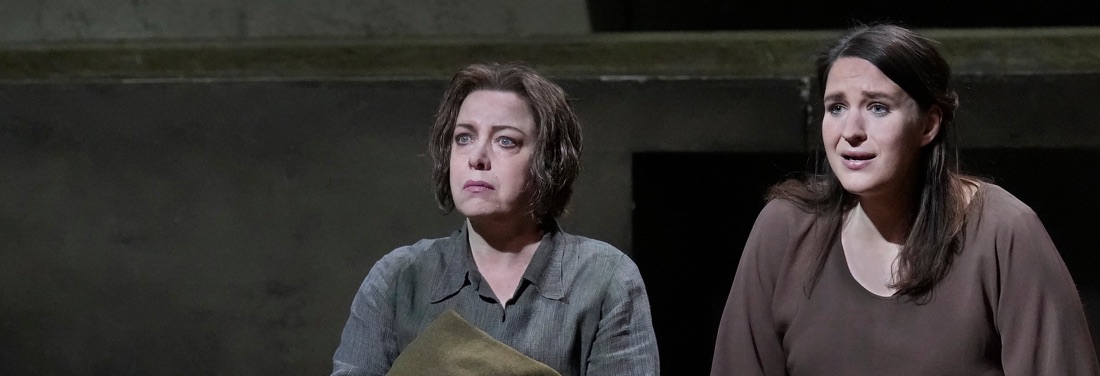
I should mention here, or rather I should have mentioned earlier, that the title role went to a very well prepared cover indeed, Jennifer Rowley, who even was off book for this one-off concert performance, very impressive indeed. I didn’t care for the basic quality of the voice that suffered from an overdriven quality, something like Carol Vaness on a bad night, so the pitch often sounded ambiguous. She did bat out all the wild roulades in the first cabaletta with great energy and attack, and indeed made the part sound so brilliant I was left wondering exactly how the allergy-felled Takesha Meshé Kizart might have coped with the single piece in the opera that requires that kind of virtuosity. (All the rest of Maria’s music is essentially lyric, comparable to the role of Violetta minus “Sempre libera.” But that act 1 cabaletta sounded to me much flashier than the Traviata equivalent, quite different from anything Kizart has done.
But enough speculation. Rowley deserves credit for saving the performance and for singing musically and confidently. She even rose to high eloquence in the score’s great moment, “Havvi un dio” in the final act.
So, anyway, we do get past the first act, and fortunately by that point the broiling heat began to abate a little. At this point, both the plot and the music of the work started to seem leaner and more dramatic. It develops, in fact, into a sort of proto-Ballo, the identical dramatic situation and even the touches of irony leavening the darkness of the story. The big love duet for the guilty lovers is too close to the equivalent piece in act 2 of Verdi’s opera for the similarity to be pure coincidence, though, as it turns out, the placement of this climactic movement in Donizetti’s opera is a little weak, at the end of an act and so not allowing for the humiliating, black-comic interruption by the unknowing cuckold of a husband.
The two leading men, singing roles written for the creators of Ernani and Nabucco, were pretty much on the same level as Ms. Rowley: solid, but not starry. The very light tenor of Luciano Botelho coped easily with the high tessitura of the role of Riccardo but disappeared when singing in unison with the soprano. Baritone Scott Bearden seemed to wield the technique if not the instrument of Cornell MacNeil as the vengeful Enrico, with a top so easy and metallic in color that one has to wonder if he isn’t perhaps a dramatic tenor in disguise.
Crutchfield assembled a convincing, fairly straightforward edition from the various materials Donizetti prepared for various productions of this opera. When in the third act the score turned great, he rose to the occasion with sensitive, poetic leadership.
Shame on the NY Post for not including a review of Caramoor.
La C:
The “Post’s” loss is OUR gain……!
…in a lotta ways, I’m sort of glad they didn’t want a review, as your very well written comments here are pretty spot on…and without the space constraints you are under at that Paper…
I was wondering if i was the only one who found a lot of this Opera pretty un-even.., in it’s composition….
Uneven, yes. I was concerned that Act I would typify the entire score, so was happy when things picked up a bit after that first interval. I liked Rowley more than LaC did, and found her quite lovely at times (I shared the comparison with Vaness, but didn’t find that she came up too terribly short).
My sentiments exactly. While JJ makes the most of the limited space in the Post, it was a pleasure to read this thoughtful review of a work that I only know by name.
Just took a look at Takesha’s Facebook page.
A few quotes …
Blessed & Highly Favored
Takesha Meshé Kizart is putting on the WHOLE ARMOR OF GOD. (Ephesians 6: 10-20) Be blessed
Takesha Meshé Kizart REMINDER: Tomorrow is NOT promised, make TODAY count… SAVOUR THE MOMENT!!! Be blessed
July 15 at 3:35am
Takesha Meshé Kizart astounded audiences at Caramoor International Music Festival in 2008 with La forza del destino, and she returns this summer for the title role in Donizetti’s MARIA DI ROHAN… JULY 24, 2010!!!
Why leave out the hearty good luck and congratulations she left for Rowley? Have you just decided you don’t like her all that much?
?*ANNOUNCEMENT* To My Beloved Friends & Fans: I will not be performing Maria di Rohan at Caramoor on July 24th Due To Illness… this is My 1st Career Cancellation. Please go out and support the cover, Jennifer Rowley, and the entire cast in bringing this rare Donizetti opera to life!!! THANK YOU FOR YOUR CONTINUOUS PRAYERS, LOVE, & SUPPORT. Be blessed
on Thursday
Now admittedly, she’s over the top and ridiculous. But that seems pretty gracious no?
Like us all, she is indeed blessed. I just find all this positive thinking on Facebook too much to handle. A friend of mine engages in it incessantly.
Call me a cynical Brit!
No totally, I don’t know if I could stand more than a cocktail hour of that kind of unrelenting Rainbow Briteness, if I actually had to interact with her in person. But at a distance I can’t say I see signs of destructive levels of divahood.
You know what? If she has the goods as a singer, then that’s all I really care about. We’ve had plenty of eccentric, self-absorbed LEGENDARY divas in the past and we’ll (hopefully) have plenty more in the future. By all accounts, Renee Fleming is perfectly lovely and personable off stage, yet her singing can drive me nuts sometimes and the knowledge of her off-stage personality does nothing to ameliorate the situation for me.
It IS a lot to handle on her Facebook page (and I find myself rolling my eyes) but she isn’t like that in person. There’s no incessant preaching,no “rainbow briteness,” no excessive “me me me”. I’ve posted before she Takesha is a diva but in the better meaning of the word.
OT, but the NYT just ran a nice obituary for Wye (Wendy) Allanbrook:
http://www.nytimes.com/2010/07/26/arts/music/26allanbrook.html?_r=1&ref=obituaries
She was an insightful scholar, smart cookie, and very dear person. Performers and critics of Mozart owe her a substantial debt.
Note: Vanessa Carriddi and Scott Bearden are alumni of Manhattan School of Music.
La Cieca, so far as I’m concerned you have hit another one out of the park (because, of course, I agree with your assessment). I would asterisk one of your comments. The thing about the performance that bothered me most was the lack of pitch-definition in Rowley’s singing. (At least Phil Gossett’s awful singing at his lecture did define the pitches — though the wrong ones as often as not, as was also the case with his remarkable piano-playing.) She was better at the extremes of her register and got better, I thought, as the evening went on, but I do hope somebody can help her either hear or reproduce pitches better. Because, otherwise, I would not willingly subject myself to her singing again.
The mezzo, on the other hand, I would love to have heard more from on the spot.
Very sorry not to have heard this work, of which I have had only a listen or two on recording (with Virginia Zeani, that lovely lady). I wonder why the Post would want to post Norma but not Maria? Of course, one is famous, one is obscure, but both featured the estimable resources of Caramoor, plus Mr. Crutchfield and Mr. Bel canto himself, Philip Gossett.
Some years ago--2003, I believe, I attended the prima of “Elisabeth” @ Caramoor. Did anyone else see it? Does anyone know anything about the interesting genesis of this work--something of a disappointment, but still worth considering, at least once. So sorry to have missed Maria di R., as, even as it may be, it probably was something of a signpost to Verdi, who cribbed a lot from povero Donizetti.
However, if Crowley sounded like Vaness, who had a very weird production of voice, well, that coupled with the heat—-I’ll get the Zeani Maria and content myself therefrom.
Note to Mr. Monty: you are not a cynical Brit but a remarkably sage and balanced Brit!
Camille: Miss Kizart, in case you haven’t noticed, has chronic pitch problems
also -- & most telling in the middle voice, which is also the most disturbing. Many,
perhaps most, of these young singers with rich vocal gifts (which Kizart has), hit
the big repertory far too soon, and you can always hear the lack of ‘finish’ in
their singing, and the lack of a fully operative technique that makes a long
career (or even a short one!) possible. Miss K, to my awareness only from
several You-Tubes not in person, is a candidate for early flame out; sounds
like Rowley may also be so NOT “blessed.”
Sometimes “blessings” are sought in lieu of technique; not a good trade-off
Mr.-Myster --??
Camille could give a Royal Flying Fig about this young soprano and/or her risible “blessed” comments.
Camille expressed only her disappointment in not being able to attend a rare representation of a work that would appear to be important as a “bridge” in the further development of late Romantic opera.
C’est tout.
http://theclassicalreview.com/2010/07/at-caramoor-donizettis-maria-unmasked-as-verdi-influence-minus-the-genius/
I ended up working out of town the weekend of the Norma AND Maria. I gave a friend my tickets who just informed yesterday that he was just too tired to make it up for the Maria. Thanks for the review La C. This was just not my year for Caramoor. No Tanglewood either…what’s an opera queen to do in the dog days of summer? I gave up on Glimmerglass years ago.