

Headshot of La Cieca

Cher Public

  • Hans Lick: So obvious: Parsifal! 1) As wounded Amfortas listens, Parsifal (or is it Gurnemanz?) looks over the... 12:30 PM
  • SilvestriWoman: Congrats, divina Cieca!!! Though it has nothing to do with the Kerfuffle, you can add Mom to your... 12:17 PM
  • operacat: Just curious. . .whose TROYENS do you own? 11:46 AM
  • Bill: Dear Camille – not to worry. Fischer-Dieskau has a treasure trove of recorded samples of his artistry... 11:43 AM
  • Rory Williams: LOL, thanks, Camille! 11:27 AM
  • Clita del Toro: Live Siegfried from Munich is on new—Act I 10:48 AM
  • armerjacquino: Actually, that’s not true about Vickers- I have the Solti AIDA somewhere. 10:14 AM
  • armerjacquino: I don’t have any Crespin (just an accident) or any Vickers (who I consciously avoid). 10:13 AM

The return of Glimmertrash

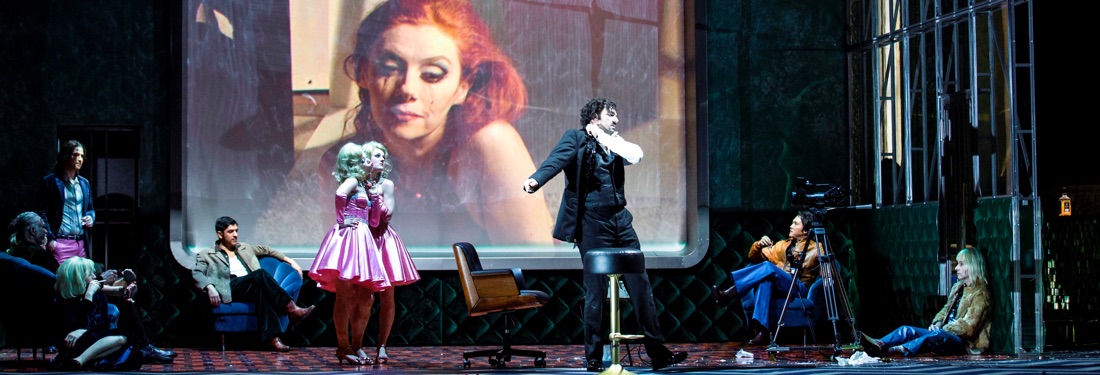
tolomeo_glimmerglassGiven the choice, I’ll take Hans Neuenfels.

“Glimmerglass Opera has a notable record of performing Handel, but its productions have sometimes emphasised cuteness over emotional substance. Rather than improving the situation, Chas Rader-Shieber’s staging of Tolomeo, the first by a professional company in the US, sets a new low…. Rader-Shieber does nothing for Tolomeo except make it the butt of his jokes.” [Financial Times]

“…he preferred to drown the story-line in a never-ending barrage of visual gags, kitsch and cheap laughs. In the end, it was Rader-Shieber’s directing efforts that fell into the open sewer and died.” [CNY Cafe Momus]

Note that this is “F.B.” Michael MacLeod‘s last season at Glimmerglass; next year the reins pass into the hands of  ”D., Y. K.” Francesca Zambello, whose offerings will include the quintessential Callas vehicle Medea, with erstwhile boo-magnet Alexandra Deshorties as the titular witch.

59 comments

  • Signor Bruschino says:

    i love classic lacieca! is there a way to look back at a number of years- its like a magical time machine!

    • OpinionatedNeophyte says:

      From the positive review:

      “Soon, a full-sized swordfish floats into the blue lighting above. The audience’s laughter comes hesitantly, but the message is clear: traditional notions of opera staging would be absent for the rest of the afternoon. ”

      I’ve got no problem with postmodern approaches to theater/opera productions, when there’s a clear intent behind the piece. As weird as the Lohengrin looked (sounded fine) the director invited the audience to think through the implications of the staging decisions. But here, as the review indicates, the “message” is “we are going to be weird because Handel allows us to be weird.” Really? Why put on an opera at all, just do a performance art piece if the point is excess for excess sake. There’s nothing substantial enough for the audience to even think about, disagree on or even boo.

      • Sookie says:

        Have you seen the production? If not, I’d urge you to do so. I heard both cheers and boos when I attended, in addition to people saying that it was the best production they had seen in years.

  • PokeyGascon says:

    I saw Tolomeo Friday night and agree that emotional truth was indeed traded for cuteness in many cases. However, I think it was a fair trade that made an absurd story fun and interesting to watch.

    I was not at all familiar with the piece and it is my first Handel opera. The production was not moving except for the penultimate poison taking scene which was delivered straight up (although on Friday it was interrupted by a 10 minute pause to evacuate a patron in medical distress). IMO the singers all seemed to buy into the interpretation 100% and their joy came through in their singing.

    With less that 2 years as an Opera fan I am starting to understand that I am not much of a traditionalist. I have no training to write an informed review so I go on gut feel and Tolomeo left me feeling great. I would be curious to see it again with a more traditional approach but I do wonder if it would hold my interest.

  • PokeyGascon says:

    Steven LaBrie was perhaps the weakest singer but for sure the most fun to watch in a lovely red pimp costume

    http://barihunks.blogspot.com/2010/06/steven-labrie.html

  • Sanford says:

    Titular witch?
    “They say that life is tit for tat
    And that’s the way I live
    So I deserve a lotta tat
    For what I’ve got to give”

  • Will says:

    I’m looking forward to Medea with Deshorties. Having seen what she could do in a role that’s actually suited to what she’s really all about — Valentine in Huguenots — last summer at Bard, I think she could be extremely effective in the role. Yes, it’s a flawed voice, but the last great Medeas, Callas, Olivero and arguably Gencer, had flawed voices and may well have been more interesting because of that. With her great height and angular features, Deshorties has an exotic look on stage and she’s a committed actress.

    I’m NOT looking forward to one more run of the corrupt, wrong-language falsifications of Lachner version. Glimmerglass would seem to me to be the perfect venue for finally re-introducing the original French with spoken dialog to the U.S. (Sarah Caldwell did part of that version but tarted it up with sung recitatives in 12-tone style in ancient Greek — too gruesome to contemplate).

    • Gualtier M says:

      Alexandra Deshorties’ sung French is about the only good thing she has, Will, in my opinion. Vocally I would say she is less rewarding than Callas, Olivero or Gencer. I would also say she is less vocally rewarding than Sass, Aliberti and Marisa Galvany (who recorded the Mayr “Medea in Corinto”).

      I also find her physically striking but someone who doesn’t seem to know how to use her body – she slumps around the stage with a zomboid expression. School of Maria Ewing. There’s a fine voice in there between the register breaks and shrillness just like there is perhaps a dramatic temperment underneath the weirdly disconnected physical attitudes.

      But none of that good stuff seems to come to the surface and we are left with the vocal ugliness and the stilted dramatics. A real vocal and physical presence but badly used. Can’t say that about Olivero, Gencer or Callas.

      • Will says:

        Gualtier, I think the career got off to a false start in totally the wrong repertory. I always wish troubled artists well and my hope is that she falls into the hands of directors and conductors who can help her find her strengths and/or minimize her weaknesses. Potentially, and I realize this is speculative, Medea could be a fine role for her. And your comment on her French makes me even more frustrated that we’re not getting the unadulterated Cherubini score and French libretto.

        • Gualtier M says:

          Oddly, Will, I thought her very early Elettra in “Idomeneo” and her Tytania in “A Midsummers Night’s Dream” were both good.

          The Konstanze indeed was a piece of miscasting but the “Martern Aller Arten” was mostly impressive (“Ach Ich Liebte” was OUCH).

          From the Konstanze on there was less and less to like.

          I was told that she actually auditioned for the Bard “Les Huguenots” for the role of Marguerite de Valois and was advised to consider Valentine.

          Also, the “tragedie lyrique” version of “Medée” will always be a problem due to the spoken dialogue. You really need a Marie Bell or Maria Casares for the dialogue and then a Maria Callas for the sung portions. To work theatrically you would need francophone singers who are trained in dramatic declamation and can still handle the singing. Few francophone singers are out there and fewer who could handle going from heavy operatic singing to declaiming alexandrines.

          That is why the Italian translation from 1910 of a German sung-through adaptation by Franz Lachner is used in most cases.

          BTW: I have heard the French “Medee” twice. Once by a fly-by-night New Orleans early music group called Opera Quotannis with Phyllis Treigle as Medee. They actually used the complete dialogues and the singers spoke the lines. It was recorded on the Newport Classics label (the musicians played in tune in the studio). Then Constantine Orbelian and the Moscow Chamber Orchestra did a concert with the here-today-gone-tomorrow Irini Tsirakidis as Medée. Her voice had more registers than Deshorties has now. A separate cast of actors (including Lisa Harrow formerly of the RSC) acted edited sections of dialogue in English from the Euripides play to replace the French dialogues.

          Neither approach was fully satisfying. Other recordings of live performances I have heard have cut the dialogue to a minimum.

        • justanothertenor says:

          Gualtier,
          she never auditioned for Marguerite. It was always Valentine.

        • Camille says:

          Don’t mean to butt in to another’s conversation but would like to say alla breve that I found Ms. Deshorties performance as Valentine very worthy, if not downright riveting. I look forward with glee to the Medea.

          Yes, the Opera Quotannis experiment was not entirely successful. I was rather ill or tired that night so unfortunately did not see the denouement when she polishes off les enfants. As I recall now, there were varying degrees of sucess with the recited dialogues, as is usually the case with opera singers shifting their voices in media res.

          I assume the Millo Medea is off?

  • Conchita says:

    I saw Tolomeo last Sunday. It was atrocious. No excuse for a director to put his own ego over the concept of the opera. If it’s an absurd piece, then do it as a minimally staged, semi-concert presentation and focus on the music.

    The singing in general, by the way, was excellent, notably Anthony Constanzo Roth. He’s also very cute and very nice (we met briefly).

    The rest of the Glimmerglass season was uneven, but Copeland’s The Tender Land was perfect in every way.

    • PokeyGascon says:

      I agree with you about The Tender Land. I had low/no expectations going in but ended up loving it. The emotions of that piece were dealt with truly and the music was ripe with feeling.

  • Will says:

    Gualtier–
    I agree about the Elettra but didn’t hear the Britten Dream, unfortunately as I love that piece.

    I didn’t know she had auditioned for the Queen — her taking on Valentine allowed Erin Morley to create something of a breakthrough with her performance.

    I realize I’m largely a voice crying out in the wilderness, but I much prefer these French works with spoken dialog to be performed that way and not with the spurious recitatives, Carmen in particular (for one thing, the dialog always conveys much more information than do the recitatives). That very much includes Faust, should the original materials ever be released by the Gounod heirs in my lifetime.

    Would, in your opinion, Crespin have made a good Medee with the dialog?

    • scifisci says:

      Has Delunsch sung it? In a smaller theater it seems like it could (have) worked with her voice.

      Erin morely deserves even more of a breakthrough…an olympia, zerbinetta, or gilda at the Met are more than deserved I think.

      Totally agree about the spoken recits, especially for Carmen. Adds more dimension to the characters and sounds more natural. What’s the story with the gounod heirs?

      • Will says:

        As I read it, there was an adopted daughter who inherited the manuscript and other artifacts that would reveal the true shape of Faust (what numbers/scenes were his final choice and in what order) as well as give the full dialog. She and descendants are sitting on this material and will not release for any reason.

        • justanothertenor says:

          Will,
          I just had a conversation with a man who has studied the full Opera-Comique score (the original), when his company was debating the possibility of doing that version of Faust. he said he decided against it because the score is unrecognizable. It is missing so many of the “favorite” tunes that he did not think an audience would accept it as Faust. The re-write for the Paris Opera is now so accepted that it almost invalidates the original version

    • Gualtier M says:

      In the 1960′s, Crespin had been asked about singing Medée/Medea in interviews and stated that she felt the part was Maria Callas’ private property. She said she would never touch it. I would disagree and believe she would have been wonderful in either version – especially the French with spoken dialogue. She probably would have sounded like a husky, sexy Simone Signoret in the dialogues just like she did on radio interviews.

      • Will says:

        I always saw Crespin and Signoret as the same type, a feeling reinforced by recently seeing a video of Rom at the Top in which Signoret is riveting and heartbreaking.

        I also have a tape of Rysanek in Medea which certainly has its moments.

  • luvtennis says:

    La Cieca:

    I just read your post on the Opera L thread discussing the new Lohengrin.

    Don’t you think that the key issue here is definitional? I would argue that a production like the Bayreuth Lohengrin is in truth an “adaptation” of the opera by Wagner, not a staging or production of it. Clearly, there is absolutely nothing in Wagner’s libretto that mentions lab rats or laboratories or giant babies. What the director has done is created a new work of art that is derivative of the opera but entirely different from it. Like a movie adaptation of book. A successful adaptation of another work of art highlights or jumps off from themes expressed, or perhaps not expressed in the underlying work. Unless of course you are talking about a parody like “Bored of the Rings”, for instance.

    An argument could be made that any staging of work already in the standard rep is an “adaptation”, but I think that is specious. When a stage director reads a libretto, listens to a score and then tries to recreate something resembling the stage directions left by the composer, then he or she is “producing” the work in question. There is a world of difference between this approach and the re-imagining of the story that is the primary aim of most regie productions.

    So maybe the way to end all this madness is to insist on truth in advertising.

    When you are doing an adaptation (or a record label is releasing a regie production on DVD) simply tell the audience in advance what they are purchasing – a new work based on the opera of the same name.

    • cosmodimontevergine says:

      “a new work based on the opera of the same name.” That’s what I’d call a successful production.

      • BETSY_ANN_BOBOLINK says:

        . . . or one could call it “an unsuccessful production;” it’s all definitional.

        • BETSY_ANN_BOBOLINK says:

          It would certainly solve a lot of problems. There would be no need for long, expensive vocal training; stars would be created on the basis of tit and/or dick size. Pitch problems would be irrelevant since being off-key would be part of the concept. Expensive orchestras could be done away with and replaced electronically. Amplification would solve all projection problems.

          Act One opens with Lakme, a young tough from the ghetto, hiding behind his bathtub and shielded behind a dead horse as 24 bumblebees burst in and spray him with Uzis as the soundtrack bellows out “I can’t get no satisfaction.”

          Ladies and gentlemen, we are present at the death of an art form.

    • La Cieca says:

      No. If the text (words and music) is presented essentially straight, then that is the work. The stage directions are not, in my opinion, “text” in the sense that the words and music are. To begin with, a lot of what we see in scores and librettos does not originate with the composer. Obviously librettists write some of these directions; others are invented by editors, and yet other directions are notations of how a particular production was staged at a particular theater. Ricordi published with Verdi’s blessing full staging books (disposizioni sceniche) that include minutely detailed instructions on how to produce, for example, Aida. Should these directions be followed to the letter, then, simply because they exist and were approved by Verdi? And before you answer, consider that this guide (remember, approved by Verdi) prescribes that the dancing priestesses in the Temple of Vulcan scene should all carry giant feather fans, and that for the final moment of the scene, the ballet girls are to gather around Radames and create a semicircular “single giant fan” fluttering around him as all intone “Immenso Ptha!”

      Well, no, obviously you couldn’t do that today or the audience would roar. There are plenty of other examples of stagecraft in these guides that probably played well in the context of mid to late 19th century theater but would seem desperately hammy today; there are furthermore many purely practical staging indications that today (even in the most conventional productions) are routinely ignored. For example, there should be only an instant’s pause between the final lines of the garden scene of Simon Boccanegra and the following Council Chamber Scene: enough time to raise a backdrop and send a couple of supers running onstage to fetch the few pieces of standing furniture. At the Met, there’s a wait of a good three or four minutes here as one gigantic three-dimensional set (which, by the way, fails to offer a view of the sea, as clearly requested in the stage directions) and the erection of another stage-filling set. So the Met is clearly defying Verdi’s stage directions here: should they then be required to bill their offering as an adaptation of Simon Boccanegra?

      Wagner is of course a somewhat different case since he not only wrote his own text but supervised some early productions of his works. But I submit that even what stage directions are documented should not be treated as holy writ but rather one director’s (Wagner’s) response to the text. As a director, Wagner was working within the theatrical aesthetic of his time, a romanticized pictorial realism informed by the 19th century’s fascination with archeology. A such, he emphasized what he regarded as “authentic” period detail even when working with such obviously non-realistic (supernatural) material as Tannhauser or Lohengrin. In other words, he chose to stage these pieces in a particular style that he found congenial and (he hoped) would communicate effectively with his audience.

      But the audience of today is not the audience of 1850: we have different expectations of what “reality” looks like, and, more important, we have 150 years of group experience of what a “traditional” Lohengrin looks like. The visual elements that so fascinated the 1850 audience read to us as cliches, or, worse, camp.

      A further point, and I realize this one is more controversial, is that in the 19th century there was no concept of a production critical of the text. For better or worse, this kind of “questioning” or “contradictory” production is part of our current theatrical aesthetic. There would be little need for this more confrontational style of production if the works being performed were not so familiar. But Lohengrin, like Hamlet, is so ingrained in our culture that a purely straightforward production of the text is unlikely to add anything new to our understanding of the work.

      The point of a production like that of Neuenfels, I think, is that it operates on two levels: the text (words and music) presented straightforwardly, and the staging commenting on that text. In the case of this new Lohengrin part of the critique seems to be aimed at what the director regards as disturbing or dangerous assumptions inherent in the text, particularly the magical thinking that a troubled nation’s problems can be solved by the arrival of a powerful, all-knowing leader. This dramatic theme is implicit in the work as written and certainly supported in the romantic music assigned to Lohengrin. Should we then simply listen uncritically, or should be be prodded to examine and analyze this political content?

      I think the latter, and I think that Lohengrin as a work is strong and rich enough to support this kind of critical production — particularly in a venue with so strong a tradition of intellectual inquiry as Bayreuth has.

      • BETSY_ANN_BOBOLINK says:

        Ma’am, your apologia is heartfelt and well-reasoned but your idealism is almost certain to be trampled by hordes of rabid goblins crazed by the scent of notoriety. Might as well hand over the keys to Rufus Wainwright and be done with it. I cannot believe you speak of “Aida” as if it were by Verdi when everybody knows it was written by Elton John. Just as “Chocolate Soldier” is based not on “Arms and the Man” but on “The Guardsman.”

      • luvtennis says:

        La:

        Hmmmm.

        I think you are stretching the concept of production to the breaking point in order to rationalize regie.

        First, even if you excise all stage directions for Aida, you are still left with the following:

        Ancient Egypt. Nile. Ethiopian Princess. Jealous Egyptian Princess. War. Burying folks alive.

        All of those things add up to a fairly specific dramatic milieu. No lab rats anywhere.

        Second, the concept of a critical production is so new in the operatic context, La C., that it simply cannot be defended on historical grounds. Neither Verdi nor Wagner EVER expected such a thing (a critical production) and would have been baffled by the notion of someone putting on one of their operas for ANY purpose other than to get butts in the seat. Any edification of those butts (as it were) would come from the music and story – NOT the concept of the director.

        Of course, the world did not end when Verdi died so his expectations are not the be-all, end-all. But you can’t fairly ground a defense of regie in the work, thoughts or worldview of the composers, at least not pre-Berg.

        If I were to defend regie it would be on the following grounds – “Look, these works have been done to death so we are going to try something different to challenge and provoke you.

        As soon as we have a new body of work sufficient to support a opera season, we will turn our creative endeavors to them. Until then, prepare to be crazy.”

        • armerjacquino says:

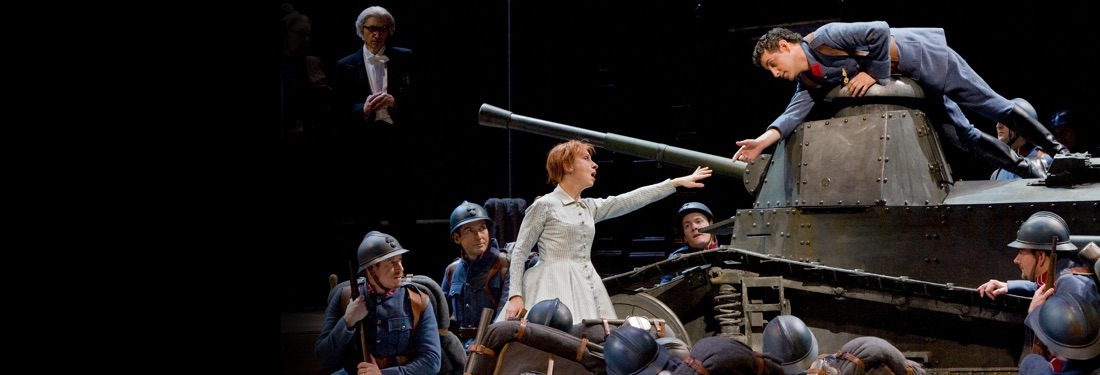
          I read recently about a soprano who sang Norma in a production set in the Spanish Civil War, where ‘Casta Diva’ was delivered from the hood of a tank.

          They wouldn’t have done that in the good old days, would they? They had more respect for the work.

          Someone should have words with this Renata Scotto character.

        • rommie says:

          shouldn;t opera evolve to a point where it is mature enough to criticize itself?

        • La Cieca says:

          But here’s the point: what Verdi or Wagner “would have expected” is irrelevant because they are not alive today, and (more to the point) neither of them would have understood the idea of a “standard repertory” of operas. Yes, both of them saw (and expected to go on seeing) occasional revivals of their most popular works, but only as a sort of secondary attraction in a repertory centered on new works.

          Now, as for “critical” productions of operas, yes, that is a relatively recent trend, beginning in the 1920s, gathering some steam in the 1930s, and then taking off (in Germany especially) by the late 1950s and early 1960s. Wieland’s controversial 1956 Meistersinger was a “critical” production that removed anything identifiably “German” from Nuremberg, a provocative political statement.

          I think that when we call a work a “classic,” what we are identifying is something more profound than evergreen popularity. A classic is a work of such complexity that a single point of view in a single production cannot illuminate every facet of meaning. (Similarly, a great role is one that does not admit of a perfect or definitive performance. There never has been and never will be a Norma after whose performance you could say, “Enough. This role need never be sung again.”)

          Classic operas have been heard so often that the most obvious and broad meanings have been pretty well explored. But there are more subtle meanings that require deeper penetration into the work, and that deeper penetration may require asking the audience to see past what they have seen before.

          Thus: Aida is on one level about the Nile, an Ethiopian princess, and so forth. But it is also about the very basic human experience of loving and not being able to express that love, about loving and not having your love returned, about the having to take an action out of duty even though it will destroy your own happiness. All this emotion is in Verdi’s music, but when music becomes familiar, we sometimes don’t hear all of it any more.

          What a critical production of Aida can accomplish, then, is to make the music sound new again through a change of context, even a context that at first seems to contradict the music. The very dissonance between what we hear and what we see stimulates critical listening to the music, and for that matter critical appraisal of how that music is used to manipulate the emotions of the audience.

          These are all ideals; obviously there are going to be some failed critical productions and some other productions that aspire to being critical but are just gimmicky. Experiencing art is a gamble, and in gambling the chance of losing is an inevitable corollary of the chance of winning.

        • that’s a really lovely explanation, La Cieca. thank you.

        • BETSY_ANN_BOBOLINK says:

          I’ve always been a pushover for idealism. To what extent do you feel this credo represents the current thinking among those involved in opera production?

    • iltenoredigrazia says:

      AMEN! AMEN! AMEN!

      “Truth in advertising” precisely what I’ve been asking for all along.