
Farce majeure

Halfway through the overture to L’italiana in Algeri a pin-up cartoon of our Isabella, Jennifer Larmore, slowly slides up and down a pole, setting the tone for the whole opera.
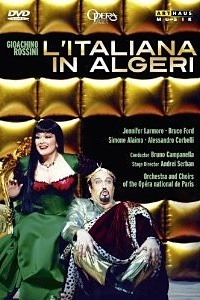
Cartoonish is indeed the first adjective that springs to my mind when trying to describe this 1998 production of Rossini’s opera buffa from the Opéra National de Paris. Stage director Andrei Serban and set and costume designer Marina Draghici found obvious inspiration in the world of classic American cartoons, creating characters that would not be out of place in any episode of Dick Tracy. The eunuchs in Mustafà’s entourage wear eerily realistic prostethic enormous bellies, while his bodyguards don typical gangster suits from the ‘30s.
When he is not an obvious parody of Colonel Kaddafi, Mustafà is portrayed like a crazed version of a late Roman emperor. Isabella enters the stage looking like a dominatrix in latex, and later wears a Harlequinesque gown with the most garish colors human mind can conceive. Occasionally the result is undeniably over the top, such as the distracting gorilla harassing Isabella and Taddeo, or the humongous fake naked breasts hovering over the stage at the end of the first act; at times such tricks verge on the ridiculous, but after all this is one of the quintessential opere buffe.
In 1998 the whole cast was at the top of their game. Larmore had the right type of voice for the title role: sizable, dusky, and especially sexy and sultry. Save for some extreme low notes that are undeniably manufactured, her whole range sounds homogeneous, enabling her to bring out the remarkable quality of a warm, soft-grained timbre. Her coloratura, while not as dazzling as those of Horne, Valentini Terrani or Berganza, is nevertheless fairly precise, accurate, respectable. Idiomatic diction has never been Ms. Larmore’s forte; her Americanized Italian, with its noticeably diphthongized vowels, is frequently too strong to ignore. Physically, despite an awful fright wig of such a black color one would never see in nature, with her curvy, buxom figure she is reminiscent of the archetypical Italian femme fatale.
Bruce Ford brings to Lindoro a darker, even murkier color than that of most interpreters of this contraltino role, as well as a timbre that may not be to everyone’s liking. Technically his voice seems able to execute every vocal trick. He floats his perfectly “in maschera” instrument throughout his impressive range, delivers striking agility, magical pianos (listen to the spell-binding diminuendo on a high B flat at the end of “Languir per una bella”) and is even able to trill on his extreme high notes. My only regret is the cut of a few measures that eliminate Lindoro’s second high C in this aria.
Although he has never been endowed with a sumptuous, booming voice and his low register has hardly ever been that of a true bass, Simone Alaimo (Mustafà) possesses a secure, proficient vocal framework, with impeccable musicianship and a pleasant timbre. While “Già d’insolito ardore” may be the parody of an opera seria cabaletta, it incorporates vocal difficulties typical of that genre. Alaimo’s exquisite coloratura di forza makes this aria nothing less than an ostentatious exhibition of power. A true stage animal, he creates a real character out of Mustafà, a role that loses much of his range when assigned to buffos, a domain in which the costume designer seems to want to wholly confine him, humiliating him with -- among the several extravagant get-ups concocted for him -- an unflattering close-fitting tank top and tight gold lame trousers
Since Enzo Dara’s retirement, Alessandro Corbelli (Taddeo) has been reigning supreme as the buffo baritone of choice. He is just perfect in his absolute command of patter-style singing at the service of a rich, attractive instrument. I can only see young Paolo Bordogna rivaling him in this repertoire.
Elvira is a problematic role. While it is true that it is a minor part, she dominates every ensemble she appears in, notably the finale of the first act, where her two long explosive high Cs function as an outlet for the pent up energy accumulated in this impossibly funny page. Unfortunately Jeannette Fischer, made up and dressed like a classic Mafia bride, offers an acidulous soubrettish soprano unable to tower over the other singers.
Anthony Smith (Haly) and Maria José Trullu (Zulma) competently round up the cast, the latter carving out a space for herself thanks to her bustling stage business.
Bruno Campanella shows once more his unadulterated symbiosis with the belcanto repertoire. The numerous pages of cadenced and repeated accompaniments, which often become a monotonous series of guitar-like chords in the best of cases, and heavy hammer blows in the worst, Campanella fills with subtle yet irresistible verve by imperceptibly but constantly changing the weight and color of each sound. The fusion of the voices with the instruments is electrifying.
The Andantino “Pria di dividerci” is wholly suspended in mid-air, ecstatic and interwoven with languorous melancholy and yet is ambiguously voluptuous. In a few words, his conducting is luminous, light, liberating, never sinking to the level of a vulgar farce as it often happens with more ham-fisted conductors.
Precision, brio and effervescence characterize his approach to this opera, which Stendhal defined “as gay as our world is not”.
“Composition, contemporary composition, is where reviewing comes to life. Complaining about interpreters, or rooting for them, however legitimate, is just fidgeting. Criticism joins the history of its art only when it joins battle, for or against, with the music of its time.”
ive been thinking about this for quite a while now.
Hopefully you’ve been subjecting it to some skeptical interrogation. The quotation comes from composer Virgil Thomson, who obviously had a dog in that particular fight. Anybody who doesn’t think that the contemporary performance of past art – and the criticism thereof – has nothing to do with the history of culture has an impoverished conception of history.
I completely agree with m.croche on this issue. The masterpieces of the past must be kept alive and be subjected to new criticism, which will obviously change with each generation.
In any case I am happy to read another thoughtful review by Ercole Farnese after a long time. I was afraid he might have left for good.
er, “Anybody who thinks that the contemporary performance of past art etc.”
One of these days I’ll type an error-free comment.
What twaddle! Masterpieces will not stay masterpieces when they keep getting mocked, imagined, and presented as if they are the grand renaissance vehicle for forms of the cheapest send-up vaudeville and ‘novelty acts’. When can we expect some sopranos pole dancing their Baroque arias , in a supposed porno cinema setting? What!… hasn’t some European Regie director thought of that , yet?
And then we could expect some punk prat to claim it is a revolutionary operatic vision and interpretation for the Ages.
Have we not heard about ‘things been laughed out of existence?’ Or ‘being sent into the void of silence’?
Any wonder I tend to stick to audio recordings rather than watch opera DVD’s or video’s. Then I do not have to wade through the directorial ‘regie’ schlock grease, visually left behind in the mental nappies of artistic idiots, thought currently ‘cool’.
By audio recordings, I assume you mean shellac.
ianwz: Cynicism becomes you. Perhaps you would know all about shellac being a familiar ingredient of nail polish. Since you apparently chipped your claws in the rush ,trying to be a bit of a silly bitch.
Any sound not of this instant is: but a variable memory from one human to the next; or if preserved in any form, is a recorded one.
And since you appear to want to sneer at recording technology,I suggest you have a closer listen to the rubbishy sound on some of those current ‘mod tripe ‘ opera DVDs’ doing the rounds. Furthermore, do I, or any person need some director clot to TELL US, what the opera is really about? The ‘wacky concept’ visuals and the sound perspectives in many of them, are all over the place.
The usual first reaction: someone’s trying to make a buck at any cost, out of haphazardly-cast shit. Dredged up of course, for a gullible market…’to stock-take’ and sort through ‘the various crazy convoluted ideas’. Better still, if they were flushed into oblivion , with a final squirt of deodorant for good measure….and forgotten.
Fancy having a collection of ‘visual regie turkeys’ on display on one’s shelves in years to come! Then, being unfortunately judged by others casually perusing : observing ‘the tasteless musical company, one keeps’. No thanks. I have enough self respect, to avoid it.
Harry writes: “Fancy having a collection of ‘visual regie turkeys’ on display on one’s shelves in years to come! Then, being unfortunately judged by others casually perusing : observing ‘the tasteless musical company, one keeps’.”
This is a peculiar fear to have.
I’m reasonably certain that an opera which features an entire finale based around ‘boom boom’ ‘crac crac’ ‘ding ding’ can survive some rather cautious stage funny-business.
I am developing an allergic reaction to the word ‘Regie’ being used as an insulting shorthand for any production which does not stick religiously to the Composer’s Intentions or the Performance History (whatever those two things may be, and however they may be divined).
Since it is evidently a topic of great passion for you, I suggest you pick up the current Opera Quarterly. The entire issue is about filming opera. I should warn you though, it does focus on a few productions that had the gall to be directed by Europeans.
If you don’t bother going to see opera live or buying it on DVD, you can probably afford to shut up about what you imagine to be happening in opera houses.
m. courche; my comment “Harry writes: “Fancy having a collection of ‘visual regie turkeys’ on display on one’s shelves in years to come! Then, being unfortunately judged by others casually perusing : observing ‘the tasteless musical company, one keeps’.”…….
What I see, a jest missed on you. I once lived by a golden rule that I found unerringly accurate: and held me in good stead. When meeting people if I found objects displayed in their house I was visiting …that had a common disturbing theme……I quickly tended to give these people a wide berth. Invariably I found later they were in fact ‘had already an unstable history.’. A good litmus test; collections of pictures of tragic ‘sick’ iconic ‘heros and heroines’ scattered around.
I suspect a lot of the fans of the ‘opera regie brigade’ are trendies that have not the fortitude to stand up and be ‘IN – with the out and out crowd’ who have had enough of those spasmodic mentally cruel ‘directors AKA ‘ejaculating regie wankers’.. . The concepts behind ‘the regie push’ , are so undisciplined… A regie devotee is really stating, they love the absolute total unpredictability of it all. That they have a a groveling love for ‘anticipating and getting whatever- they get, thrown at them’.
On far as depicted ‘Art’is concerned ; it is so disparate ‘in any form of style or idea’ except perhaps provoking a sense of gross ugliness, splintered thought logic, anarchy, and disarray …..Now tell us someone:is it a definite ‘School’ of Art, with certain perimeters, no matter how outlandish it is or a manifestation of a pretentious ‘arty frustrate’ having a tantrum?
The best ‘Regie staging’ I ever saw (and I have in fact, seen plenty): …a solo performer performing his own ‘set theater piece’(in a preview) The stage was completely pack- littered with newspapers. No doubt he was also having a personal brainstorm on stage. Till: he sat in a chair, and deliberately dropped a lit match. Within a minute the entire stage was fully alight.He was willingly trying to doing an instant ‘ REAL Brunnhilde’ Then there was panic, people rushing out and stage hands frantically extinguishing the flames. His Curtain Call: Medics ‘carting him away’.
A real five star regie show ‘with red hot attitude’! That is cool! At least for once, its creator revealed what he was driving at! No doubt about that.
Perhaps I’m not as prone to snap judgments as you are, Harry.
If you are such a firm believer in first impressions, though, I’d suggest adding to your exquisitely-appointed shelves a dictionary and a copy of Strunk and White.
“Masterpieces will not stay masterpieces when they keep getting mocked, imagined, and presented as if they are the grand renaissance vehicle for forms of the cheapest send-up vaudeville and ‘novelty acts’.”
Totally disagree. A true masterpiece can withstand any type of wrongheaded staging and emerge unscathed.
Oh, Harry! What a card!
What matters more than contemporary criticism, but runs parallel top it, is contemporary audience’s tastes in repertoire. Bel Canto comes in to fashion and then cycles out. Wagner comes in and then goes out. Etc, etc, etc.
And availability of particular voice types has a huge effect on what repertoire is in fashion at any particular time. Callas/Sutherland/Sills/Caballe for Bel Canto, Horne/Berganza/Valentini-Terrani for Rossini and so on.
I don’t think criticism really affects rep very much.
Well, I agree with the Regie repulsion – ick ick ick! But I do agree that a true masterpiece can hold its own no matter how much Regie-rape it suffers – didn’t someone famous once say something about how the true masterpieces can shine through even the worst performances? — I remember seeing a famous French opera for the first time in a live performance that I hated in so many ways – but I was so struck by the opera ITSELF and the composer’s brilliance – I rushed to find a good recording, and now it’s one of my favorites. Annnnd I don’t know – much as I hate Regie – isn’t it great that we can take huge risks? – SOMEtimes they pay off and when they don’t they can be so funny! I think it would be far worse to have the same old same old over and over and for our ideas of these operas (not the operas themselves but our stiff adherence to dusty musical museum interpretations) to get stale. Finally, though, many thanks to Harry for using the word “twaddle.” I must say it more often – it is tons of fun and it will SAVE me when I start to use nastier words in verbally conservative crowds…
What one forgets in all of this:is what operas, the younger opera-goers accept, as time honored masterpieces that they may wish to say -have stood 2 centuries of onslaughts; and it is simply not true.It is a false ‘given’.
One simple question (with contained examples) : How many Baroque operas were fashionable before Harnancourt came along with his ‘original instruments’ brigade? Who at that time ever performed a Vivaldi Opera? How many Mozart operas were popular repertoire before the recording days of say 1950. Cosi Fan Tutte then, was a rather ‘rare unknown’ commodity. This argument stunt of ‘Oh! it is just a cycle of the singers needed, for certain repertoire ‘ blunts the real historical perspective.
Mind if someone goes and spray paints all the great visual works of Art in museums, every time you want to view them? Since people here are forever expressing that strange ‘horror’ fear of opera presentations being called ‘museum pieces’ in opera houses. Shit, that is normally EXACTLY where ‘great works of Art ARE EXPECTED to be shown in their full historical glory!’Each established opera becomes in itself,also its own ‘museum piece’: with its own varied provenance. Yet it seems as if ,in their own personal life time span it is for opera lovers: ‘their duty’ to be some sort of over-seer guardian, to stop that happening to some opera?. By trying to mock- modernize it, make it trendy or up to the minute
Would we expect Le Louvre to suddenly say “Look we wish to make the Mona Lisa more accessible…..so we decided to stick it on a tripod for it at some Paris street corner for the passers by to admire it. Then have the curators admit some vandals slashed it after a day or two” ?
Unfortunately with opera ; director vandals can and do get to the visual presentation…..After all a live visual presentation of a work of Art ‘that of Opera’ is what we are talking about, are we not? Imagine if it was accepted of others participating, being allowed to take equal identical liberties with the actual music? Thereby : telling the singers to do what they like: hollow, squawk, scream, transpose the music madly, use body microphones, whatever.
If people are willing to defend directors taking crude liberties…..why should not the orchestra, the singers? Or maybe, give the management the right to cut a good portion of the arias because they might have to pay over time pay rates to theater staff for a time run-over?
‘Equal democratic free rights’ for all concerned is the true end result of the regie argument.
Paradoxically then : that would make anyone here screaming about a singer, having a bad night at the Met for example,a complete hypocrite!
Since the singers would be also exercising their artistic rights to make adjustments ‘and stuff the patrons’ sensibilities!’ L.O.L
First MET patron caller ringing……”State your name and complaint, please???!!”!
The argument about paintings is a totally false opposition- or do you not know the difference between interpretative and non-interpretative art forms?
A painting is complete in and of itself, and the important thing is its relationship with a viewer. An opera doesn’t exist until it is sung, played and acted.
This production of L’italiana in Algieri strikes me as a peculiar object of your anti-Regie scorn. After all, this particular opera is a masterpiece of cartoonery, and any halfway competent production is going to reflect that cartoonishness. (Even the Ponnelle production was pretty cartoonish in its own right.) We are not talking here about a more or less realistic depiction of a social milieu.
Harry,…. you COULDN’T be more RIGHT !!!! AMEN !
I do believe that one indication a work is a genuine masterpiece, one whose meaning stands the test of time, is that succeeding generations rush to interpret it in the light of their own experience.
We may not always approve or understand their approach. The monster Handel performances so dear to the Victorians with choruses in the hundreds — sometimes many hundreds lumbering through the music — and full Romantic era orchestras seem inconceivable now. However, they communicated something to those audiences who saw giantism in performance as a reflection of national power and cultural domination. Surely those performances might be considered as much a distortion of the material as the pole dancing soprano, although I venture to assert that in our age, the pole dancer will be singing her roulades and other ornaments vastly closer to the composer’s original intentions than the Victorians ever got to Handel.
I love it when a poster says something really rational, that has been reasoned through, and says it well. I love it even more when it reinforces my own prejudices. Thanks, Will.
“Physically, despite an awful fright wig of such a black color one would never see in nature”
http://unnouveauideal.typepad.com/.a/6a0105362716cd970c010536b5156c970c-350wi
How is she doing these days?
Buster, I don’t think it’s a wig in the case of La Matheopoulos, but the colour is, indeed, arresting.
I bought a second-hand copy of her second ‘DIVA’ book a few months ago. It’s even more gushingly written than the first one and, boy, does she talk up her discovery of Elena Kelessidi, who was terribly in fashion at Covent Garden for a few seasons, but now seems to restrict her activities to Athens.
And whatever happenend to Verónica Villarroel?
I love both books: the opening of her Katia Ricciarelli story, who as a small girl used to climb trees to listen to the birds, and who had to assemble record players in a factory to pay for her singing lessons in particular.
Well, this happened:
IMHO very lovely, though. Very timeless.
Wonderful indeed – thanks! Clever move. She can keep doing that for a long time.
My assumption was always that Verónica Villarroel fell out of favour with Mr Domingo … (The fact she couldn’t sing in tune wasn’t exactly in her favour either.)
The first DIVA book has supplied me with lavatory reading for over 20 years — and I’ve always loved the bit about Ricciarelli’s ‘romantic cold supper’ with Pippo Baudo, but I still can’t get over those phrases which run: “She experienced many Sternstunden in this role, regarded by many as one of the most difficult imaginable in living history,” or words vaguely to that effect.
Villarroel still has an active career but has not been seen at the Met since the run of Luisa Miller a few years ago when she replaced Barbara Frittoli late in the game and then in turn cancelled a couple of her performances, which resulted in the Met debut of Karen Slack. I’ve assumed she’s not a favorite of Gelb’s but I’ve never heard why she hasn’t been back. She has a lovely presence and I found her voice to have a haunting color and a unique resonance in the Met; though somewhere between a lyric and a spinto, she sounded effortlessly huge there whenever I saw her in the house. I even stooped to buying the Andrea Bocelli Trovatore since it’s one of her only available recordings!
According to a website in Spanish she is singing Nedda in Peru in August. It doesn’t seem to be her own website so there is no calender of upcoming pfs.
These cutesy Rossini masquarades bore me, always will.
Tant pis.
Amerjacquino : I love your twisted interpretation of a painting and an opera. You state a painting is ‘complete’ in itself but an opera is not until it is performed?
I think you have overlooked a simple human facility that converge the two points into an equality : the validity of ‘formed lasting impressions’ in the mind. Or are such things not real, according to you?
You forget it is ‘arbitrary’ how a painting is also judged : depending from what angle, perspective, setting, amount of light available, and familiarity with it, over a period of time.
Yes, if only I’d mentioned ‘its relationship with the viewer’.
Oh, I did.
Armerjacquino is right. A painting–or better yet, a film–is complete as soon as it is produced; it doesn’t need to be recreated every time. An opera, on the other hand, has to be recreated every time it’s performed; reading a score will get you about as much there as reading a recipe will satisfy your hunger. It would be nice, I suppose, if every performance of an opera could perfectly reproduce the conditions of its first performance, with as little change in the opera as between two viewings of the same film no matter how far apart in years. But it can’t. Things change.
A point that can be made here is that a film can be re-edited, combined with new footage, played with a different soundtrack or otherwise manipulated, and the image from a painting can also be displayed with various interventions. But the interventions would take place on copies, not on the originals. But there is no such thing as the “original” of a theatrical piece because any realization of such a piece is ephemeral.
Indiana hints as well at the fact that the environment around a performance changes even if the specifics of the performance do not. Audience members view the performance through the filter of different experience, even experiences later in epoch than the thing viewed. In other words, when Wagner first presented the Ring and for several generations after, no one had ever seen Chuck Jones’s What’s Opera, Doc? But now, for better or worse, practically every audience member sees the Ring through that filter, and it becomes imperative for the modern director of the work to confront that knowledge, either by changing the visual aspect so it doesn’t immediately remind the audience of Bugs Bunny in helmet and breastplate, or else acknowledging the joke and making it his own.
And that’s just one “filter” through which opera is seen now: there are also the “fat lady,” the Pavarotti oversized joyous tenor, the chorus who move in unison, the painted castle on the wrinkled sky. There was a time when these conventions were generally and uncritically accepted as part of the operatic theatrical experience, but now, like so many other artistic conventions of the past, they evoke camp.
To get an idea of how potentially dangerous the “fixed” theatrical experience can be, take a look sometime at performances in films from the 1930s through the 1960s. A few of these performances hold up nicely, but many popular and critical favorites of the past today look mannered, self-conscious, or simply insincere. It’s not (necessarily) that the performances were bad in the first place, it’s that we today expect something different, and so (for example) Norma Shearer’s fluttery Juliet comes off as unintentional comedy.
Actually, the Norma Shearer Romeo and Juliet received mixed reviews and lost money, so it can’t really be considered a popular and critical favorite. Audiences who were willing to accept the 40-something Katharine Cornell as the teenage Juliet on Broadway were less willing to cut the 30-something Shearer as much slack in a movie version. Shearer had had success filming another Cornell role in The Barretts of Wimpole Street a year earlier, but Elizabeth Barrett Browning wasn’t a teenager speaking in iambic pentameter–even in the ’30′s, film audiences felt a disconnect.
“It would be nice, I suppose, if every performance of an opera could perfectly reproduce the conditions of its first performance”
Ugh, no. The first performances of Barber, for example, or Traviata were disasters. And I’ve never been very good at gambling, which would make my nights at the Baroques not very cheery.
But the gist of your point is absolutely spot-on.
Things change…but do they necessarily, for the better? We are living in a fast changing era of technologies. Our perceptions of what masterpieces are, are governed by the the ability to make a quick re-comparison of ‘what is’ with reference to various media..How much faith we place in the fidelity of that media to ‘get close enough’ to maintain or discard any former judgments we previously made, is the puzzle.In the 18th or 19th Century, unless one belonged to the privileged classes, to make such comparisons was nigh impossible. Symphonies and operas, that today we take for granted hearing in one shape, form or other, people then ‘might be lucky to hear once in their entire lifetime. Since there was no recordings, no film, no TV, no youTube…everything was ‘live’ or nothing at all. Then there was no jet setting gallivanting singers jetting over the Atlantic to ‘plug a casting hole’ in some opera’s performance for a night or two.
And so, this arrogant luxurious epoch of ‘spinning door change -for change’s sake’ has grown up as the pinnacle of astute cultured awareness. Production people are so totally besotted with the possible available tools to make a mark recreating a historical work, their ideas tend to come out of their arse and not from their mind. People may scream about ‘climate change’ but it is generally considered ‘not cool’ to broach the subject of wanton artistic/cultural change at any cost. As long as some opera production can be labeled ‘mod’, shocking, daring, controversial, obtuse or needing further analysis. The incessant talking and chattering will continue : as if a production by some clot of a director, is considered the next new Wave ‘Last Day at Marienbad’.
I think it is funny to stand back and watch and listen to those individuals that feel it is their duty to defend those creatures that they know in ‘their heart of hearts’ has taken then for a ride. Defending the tacky thread-bare standards …which they want to call ‘the present face of Opera’. The plea ‘we cannot anywhere near create what was the original’ is the big cop-out…..the coward’s reproductive resort to ‘anything goes’. Followed by some comment that ‘we think the composer …if he was alive….would agree with what we are doing’. Let’s not forget that some of the world’s greatest painters had students and workers making ‘identical’ copies of their great masterworks and then sold them. So would a great 15th Century painter say …”well if you want to and you can make an 20th Century abstract….well paint that instead, since it is quicker and I will sign my name on that too!”
If Opera is the Queen of the Arts where all its forces are supposed to come together and unite IN UNISON….the music and libretto and any directional points it contains, are the starting points. Otherwise why not put the Score in a paper shredder and forget the whole damn thing.
“I think it is funny to stand back and watch and listen to those individuals that feel it is their duty to defend those creatures that they know in ‘their heart of hearts’ has taken then for a ride.”
Oh, Harry, I know what’s in your heart of hearts, too. You’re a naughty, naughty boy, Harry.