Headshot of La Cieca

Cher Public

  • Henry Holland: What you end up with is a dismissal of any inherent value...
  • Regina delle fate: Meier gave several series of Isolden in the UK - in German f...
  • brooklynpunk: whatever:..BTW...did you ever make it in to t...
  • whatever: much obliged for the kindness of strangers, armerj ...
  • brooklynpunk: " it does not follow that as many people will embrace opera”...
  • MontyNostry: Presumably JDD was singing that aria, so some of the standin...
  • quoth the maven: Entirely unfair. The union agreed to the contract; the cast,...
  • The Wistful Pelleastrian: That Grammy crowd gave a standing ovation to an opera ari...
  • marshiemarkII: Bravo tenorino!!!!! much as I thoroughly enjoyed the other o...
  • iltenoredigrazia: Thank you, thank you (bow down to the floor, hands to my che...

blog advertising is good for you

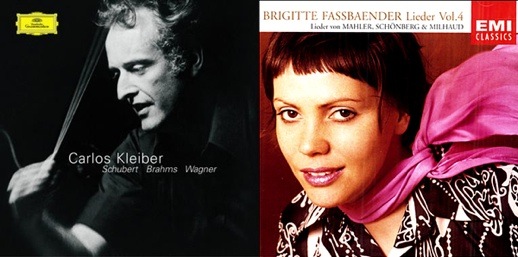
Happy Birthday Carlos Kleiber and Brigitte Fassbänder

kleiber_fassbaenderThe legendary conductor and the protean mezzo-soprano were born on July 3, in 1930 and 1939 respectively.  

62 comments

  • armerjacquino says:

    Some more Kleiber:

    and some more Fassbaender:

  • armerjacquino says:

    And, off topic but too irresistible to pass up, here is the YouTube comment of the year, under a clip of Sumi Jo:

    ‘I do not know why she has not tried sing Isolda from Wagner?! Her voice is similar to Maria Callas and Callas sang? Isolda.’

  • kashania says:

    When the genius meets the morons:

  • Sanford says:

    The Kleiber/Domingo/Cotrubas Traviata is one of the most thrilling recordings I’ve ever heard. And Kleiber’s FLedermaus is pretty amazing, too.

    • jatm2063 says:

      Fassbaender, on the other hand, is rather an acquired taste. I once heard a recording of her singing Eboli, somewhere in Germany, and she tried to carry her chest voice all the way up into the top range. The most bizarre choice one could ever imagine for a role that is practically soprano anyway. Incredibly coarse singing. It might have worked for her if she were singing a contralto role in a German opera, but not for Italian music of any sort.

      • Belfagor says:

        There’s a very exciting live Werther available with Domingo, from Munich in (I think) 1979 – Fassbaender steals it – she is heartrending in it, and her performance charts a real trajectory from prim miss to desperate hysteric – I think the conductor is a young Jesus Lopez-Cobos, and its more muscle than sugar, which works well for that piece – in fact some of the last act sounds unexpectedly Mahlerian…..it’s well worth trying to find.

    • mrmyster says:

      Sanford, you are in good company! You will be pleased to know that
      a fine Violetta, now retired to teaching voice successfully, once described
      the Kleiber Traviata as “definitive,” and made me sit down with her and
      listen to it while she pointed out what was being done right – for once!
      His faithfulness to the score is one-of-a-kind! A very very great
      conductor, he was; far better than papa in my view! I don’t think we
      have Carlos’ equal today nor Karl B. nor Sawalitsch nor Kempe!
      BTW, Sanford, I am still enjoying your “On a sunday morn….” You inspired
      me to hunt down the music and refresh my memory of that delightful
      song. It works well in almost any key. It is so close to conversational,
      one can play around with lots of colors :)

      • Sanford says:

        I love the whole recording but I’m not sure anyone captured Violetta’s anguish and heartbreak at Tu, m’ami, tu m’ami, Alfredo before she leaves him quite Kleiber and Cotrubas… and that includes Moffo (and Callas, yada, yada, yada).

        Thanks for the compliment. I’m already planning the second recital. I’m sure about Jacques Brel/Edith Piaf, and I’m thinking about Faure amd either Poulenc (Le Bestiares) or Berlioz (Les Nuit de t’ete)

        Now I have to go clean up my face. Just watched a fabulous French film, TIme To Leave, starring Melvin Poupaud and Jeanne Morreau, about a guy dying from cancer, which of course, made me think about my mother, who passed away from cancer on 6/22/10.

        • armerjacquino says:

          Nobody does anguish like Cotrubas. Her ‘Boheme’ act III scene with Marcello (where she’s lucky enough to have Allen opposite her) is utterly heartbreaking.

        • manou says:

          Sanford – so sorry to hear about your Mother, it ust have been very hard for you. I saw this film a few years ago, and imagine how you must have felt watching it. I expect you will also find some music hard to listen to without getting emotional.

          All the best.

        • pavel says:

          Sanford,
          Just by coincidence I happened to read a notice about your mother a few minutes ago in the Washington Post. Please accept my condolences on your loss.
          Pavel

        • Sanford says:

          Damn, I just fixed my mascara and now I’m crying again.

        • rapt says:

          Sanford, as one who knows you only through this blog, where your generosity and courage are always apparent–and where the affection with which you’ve spoken of your mother suggests that she was one source of those qualities–I offer you my sympathy also.

        • Sanford, my condolences. I lost my mother to leukemia back in March 2005 and this certainly touches more than one nerve.

          Le temps qui reste is a gentle, sensitive movie, with some marvellous acting. So great to see Moreau, even in her old age. I still remember the movie I saw when I came back from the hospital, around 3 am, sitting and watching by my mother’s bed, the very last night before she died. It was “eternal sunshine of the spotless mind”. Just needed some distraction. She died later that day, Friday, exactly at 18:00, a sacred hour in Judaism. Gary Bertini, a renowned Israeli / Romanian conductor, stuggled for his life in the adjacent room and died a few days later.

        • Sanford says:

          The most horrible part is that her cancer was only discovered by accident on an xray for something else, and was only found the Thursday before she died. That Friday, she had a biospy, Saturday, she had a CT scan, Sunday we were told that she only had a few weeks or months to live, Monday I went to Washington and saw her at 9pm, and she was so weak she couldn’t sit up, and she died at 1:10am on the 22nd. HOw can anyone process anything that fast? The news just kept coming.

          When I discovered opera in high school, she went out and bought me highlights of Nozze di Figaro with Stich-Randall and Rita Streich. What a way to start, huh?

        • CruzSF says:

          Sanford, my condolences. I’m sorry to hear about your loss.

        • Very fast. Too fast to comprehend. Yet staying by her bed during her last hours will be both very painful and somehow comforting. It’s one of the most powerful memories a person can have. Sharing a loved person’s last days/moments is a unique, everlasting privilege that only those who went through it can understand.
          Your memory of your mother having bought your first opera lp is extremely touching. Thank you for sharing it.

        • DrugProduct says:

          Sanford, so sorry for your loss. Please accept my condolences. I too lost my mother suddenly, in a car accident 5 years ago, and that pain is something that nobody can imagine or understand, and it would be better if nobody will ever have to feel that pain. I can only tell you that that pain will never go away, it is as intense now as it was 5 years ago. The only change that time will bring is that you will get to know this pain so well that it will almost be like a strange friend. It makes me appreciate even more every second, and all the beauty that is life. Your mother will always be with you in your thoughts.

        • Buster says:

          I am very sorry for your loss, Sanford.

        • zurga says:

          My condolences to you Sanford.
          Having lost both my parents I certainly can appreciate what you are going through.

    • zurga says:

      Incidentally for those who do not own the recording, it can be heard on Radio Stephansdom this coming Thursday July 8th at 2:00 PM EST.

    • The one thing I love about that recording is the orchestra, for me it is definitive in that aspect. When it comes to the singing, I have mt reservations, but that is another story.

      His Traviata is the only recording where in my opinion the orchestra is at times eclipsing the singers with the amount of detail that goes into their sound and characterization. It was a revelation to me.

  • jatm2063 says:

    In the clip above of Fassbaender as Octavian, I have to say, she is the most convincing woman playing a man that I have ever, ever seen.

  • Constantine A. Papas says:

    Gundula J’s face looks like Netrebko’s. Gould the Austrian have some Slavic/gipsy genes? GJ had a regal stage presence and a killer voice.

    • mrmyster says:

      Well C.A.P., I wish Gundula DID have some gypsy and/or
      Slavic genes: she might be more interesting! I agree that
      her voice is fine and she’s a musician – I have, however,
      always found her quite a stick and a bore. Of course, I
      am of the Jurinac School of Drama :) So, you’ll have to
      forgive me.

      • Buster says:

        Drama was never her forte – I agree, but Janowitz radiated an intimate sort of poetry on stage that I found irresistible. Her Ellen songs were unbelievable – the concentration, the beauty of the singing, her attention to the words.

        Die Götter Griechenlands, the same story. That song can be heard on an Orfeo recital from Salzburg that also includes a wonderful selection of songs by Anselm Hüttenbrenner. When you listen to those, you almost believe he is a great composer.

        • Krunoslav says:

          What did Dame Andrew write of her Carnegie recital? “Dull schoolroom singing”.

          Stage presence surely die Janowitz did *not* have, handsome though she may have been.

        • Buster says:

          Carnegie Hall is probably too big for this, agreed, you really need to see her face:

          I heard her on the same tour, in a hall that seats 350 people. Much better, apparently.

  • Tim says:

    I like the story about a remark a famous conductor made in reference to Kleiber’s alleged anti-workaholic approach to his profession. When told that Carlos was scheduled to do some Bohemes, I think, at the Met he snorted: “His freezer must be empty!”. Makes me like Carlos even more. And from all reports those Bohemes were nothing short of revelatory.
    Tim

  • Hippolyte says:

    I wasn’t living in NYC at the time but I made a special trip to attend Kleiber’s MET debut. It was over 22 years ago but it remains one of the great nights in my opera-going experience and everyone was particularly inspired: Freni, Pavarotti and even Hampson who was merely Schaunard! I also came back for the premiere of the Traviata (one of only two he stayed for and the only one with the cast he rehearsed–Gruberova whom I’m not so crazy about was at her best) and also for one of the Rosenkavaliers which was transcendently beautiful. (I have since gotten in-house recordings of both the Boheme and Rosenkavalier that confirm my memories–I’ve never seen anywhere either the Traviata or the Otello, which I missed–none of his performances were broadcast!). Given that he didn’t really have that many operas in his repertoire (Fledermaus wouldn’t have been an option, nor Tristan at the time), the MET really did get to see so much more of Kleiber in opera than almost any place besides Munich, Milan, London and Vienna.

    • richard says:

      I saw one of the Bohemes and one of the Otellos. they were stupendous performances. I’ve never heard the music played quick like that before (or since!)

      • Belfagor says:

        The opening sequence of his Otello (ROH 1980) was one of the most hair raising things I ever heard – the very first chord was like an electric shock. And the phrasing and flow of the love duet (Margaret Price and Domingo) was so perfectly nuanced. I was a student, and queued up all night, starting when the ballet audience came out the night before. I also saw the Boheme – the previous year – too, with Cotrubas – and I remember the mighty surge in the third act when Rodolfo finds Mimi hiding – the strings played their hearts out!

  • Niel Rishoi says:

    I met Kleiber briefly during the Traviata run in 1989 with Edita Gruberova. She was getting ready for her performance. Kleiber came in to wish her good luck or somthing or other, and she responded affirmatively; this was all in German, but what I witnessed was something amazing. Kleiber was in a hurry and preoccupied. Edita, I have to explain, was and is a humble girl (at heart) from a humble background, from a grape village called Raca, just outside of Bratislava. She is by rank a top prima donna, and can be the diva when called for, but at core of her being she is as down to earth and modest as they come; she is the least egotistical and un-self-absorbed star soprano I have ever known. There is in her being a very gracious sense of decorum and courtesy that bespeaks the way she was raised (one of the agents in Barcelona said that she was one of the NICEST singers she had ever met – Freni and Ghiaurov were the other 2 she mentioned).

    Anyway, there was something in Edita’s demeanor and a breezily matter-of-fact, unforced sweetness toward Kleiber; immediately all the tension left his face and something like a moved, woebegone disbelief was in his expression. He came over to Edita, took her face gently in his two hands and gave the tenderest European styled kiss – one on each side of her face, and then he left. I understood his reaction completely. It still chokes me up to remember this. Later on, I wrote to him to request that he write the “Vorwort” to my book. He wrote back and declined, as he never gives interviews, and as he put it, “sometimes I will do a shortissimo vignette for someone who has kicked the bucket, and as Edita is not selling the farm, thank God, but that is all I ever do.” IT was the wittiest, most gracious decline I have ever received.

    Kleiber was not an institution promoted by record companies: he did what the fuck he wanted or not, did not care what anyone else thought. Eccentric, yes; brilliant – that is not even sufficient. He was a mystery, an anomaly, and he was all music. He won me over forever.