


Headshot of La Cieca

Cher Public

  • erica: Actually, that’s kind of weirdly convincing. 5:19 PM
  • La Valkyrietta: Voigt ain’t Fanciulla, period. I loved her the last time I was happy seeing her live in that... 5:14 PM
  • brunettino: Shucks — AC was my guess too based partly on the French used in the clue, but I got here too... 5:10 PM
  • Camille: Gee, that is bizarre—R 11;I was thinking of you a while back and wanting to let you know I HAD... 4:02 PM
  • kashania: I also checked out the second act finale and agree completely. It’s rare that a moment of hysteria... 3:59 PM
  • Lucy: Like arepo, I’m seeing Andrea Chenier: 1. Courtroom scene, just before “Si, fui soldato.”... 3:51 PM
  • grimoaldo: Hi Camille, you were interested in “Craig’ ;s Wife” with Rosalind Russell.I watched... 3:20 PM
  • Camille: “Inno ad Imene”. Sorry. Just had to try it on for size. Thanks, operaguy. 3:11 PM

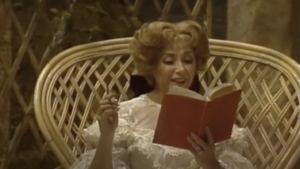
“Tu vois je suis encore coquette!”

anna_bijouxLa Cieca is of the opinion that there are some sopranos who can act Manon, some who can sing Manon, and some who simply are Manon. This snippet from a recent interview may suggest which category Anna Netrebko fits into. 

[Interviewer] TS: Can you just explain what this World Economic Forum thing is?

AN: What?

TS: You’re an ambassador –

AN: I don’t know. They told me something, so I said, ‘Thank you, it’s great.’ I think it’s a great honour.

TS: But you don’t know what it is?

AN: I don’t even know what I have to do.

TS: I think there’s a conference in Dar es Salaam you have to go to.

AN: Me? Oh – I had no idea. Wow. I don’t know.

[pause]

TS: Is that a Chopard watch?

AN: Yes. These are diamonds that are sparkling. Chopard is beautiful, they make in such a beautiful style, but the jewellery I’m going to wear in Manon is not Chopard.
155 comments

    • drtymrtini says:

      I love that she’s singing the gavotte in a back-alley with a bunch of beefy studs. takes me back…

  • louannd says:

    Well English is my first language (oh really LouAnn?) and I think she is DEAD ON right!

  • The Vicar of John Wakefield says:

    Why has no one mentioned the ideal Manon of Our Own Valerie Masterson, who practically WAS French??

    • A. Poggia Turra says:

      Dearest Vicar, I was denied the opportunity to hear the esteemed Ms. Masterson in 1980, when illness forced the great soprano to cancel a performance in San Francisco. Although the understudy was acceptable, the disappointment of not hearing one of the Commonwealth’s fairest flowers saddens me to this day.

    • Sanford says:

      I saw Ms. Masterson at LOC in the early 80s as Antonia in Hoffman, with Welting, Zschau, and Kraus, and she was terrific (as were the rest of them). And she’s my favorite Yum-Yum, too.

    • BETSY_ANN_BOBOLINK says:

      . . . or Dawn French, who practically was Masterson.

      (Nice Italics, Bobolink, old girl!)

    • mrmyster says:

      I LUV Valerie Masterson — a really lovely person and
      fine singer. Problem is, I heard her Manon in English at
      ENO with heldentenor Remedios as des Grieux, and in
      spite of fine voices, Manon in English is DOA — it
      sounds like Gilbert&Sullivan. Ick!
      As I keep telling them at St. Louis, the language is
      part of the music, and you must do opera in the
      language of composition to get the full musical effect!
      And I do very much believe that. And supertitles these
      days make translations for the most part obsolete.

  • Quanto Painy Fakor says:

    But this quote of Netrebko in the “Guardian” is really disturbing:
    “I’m so bad. I’m learning roles at the last moment. Like [Bellini's] Puritani, I learned in one week. And Iolanta I learned when I was already doing staging rehearsals. The problem is, for me, it [is] absolutely impossible to learn one role and sing another one. Now, every day I am having to do Massenet, so I cannot learn Anna Bolena. If I do that, I am damaging my voice and I am damaging my performance. The technique is different for each role. So I have to wait until the time comes for each particular opera.”

    http://www.guardian.co.uk/music/tomserviceblog/2010/jun/17/anna-netrebko-interview-quotes

    • Arianna a Nasso says:

      “So I have to wait until the time comes for each particular opera.”

      Or she could leave sufficient free time between engagements to learn her roles, if she feels she can’t learn one role while rehearsing and performing another.

      Must suck to be her colleagues who have prepared and then have the rehearsal process drag to a halt because she couldn’t bother to do the same.

    • Or she could realize that the technique for singing the roles is the same and that she does not need to sing full out to learn the notes, rhythm and words. If she wasn’t so damn lazy she would be learning her roles but instead the Vienna coaches will have to pound it in her head and we will be lucky if she remembers anything by the time she gets to sing it at the Met.

      And people wonder why I am actually looking forward to Angela Meade in the role…

      Cruz, I’m back!

      • scifisci says:

        LA: Are people wondering? I didn’t realize Angela Meade was considered second rate? I’ve seen her in her two appearances at the Met and I have to say….i think she has one of the best voices around period. Large, beautiful, round, plush, even, and with an absolutely astounding technique. She is really a prime example of lookism in this industry. If she were singing 50 years ago she would already be a big, big star.

        • kashania says:

          She’s very much at the beginning of her career, no? And she’s not understudying Netrebko; she’s sharing the role with her. I think she’s on the way to stardom.

        • scifisci says:

          You’re right, she’s very young, but it’s just so infuriating to have heard her sing a snippet of the Armida finale so brilliantly (and with a blazing e-flat) during an early rehearsal but not given a single performance! And I’m pretty sure she’s doing the same next year–just covering. Her instrument has grown considerably since “the audition” and her Met debut in ernani and it’s become truly special. I can’t wait to hear her as norma!

      • CruzSF says:

        I don’t think I’ve ever heard Angela M sing, but I’m sure she’ll get at least one of the Sirius broadcasts.

  • stuey cheedio says:

    And the good news is….she’s a terrific Manon in this new production. Just in from the dress, and she looked and sounded fabulous (and I’ve not been a fan in the past). She and Grigolo have wonderful chemistry and the conclusion is heartbreakingly done. Odd production, but unmissable for Nebs & Vic.

  • kashania says:

    I, too, found Netrebko to be charming and refreshing in the interview. I just hope that she leaves aside more than a week or two to learn Anna Bolena. She will never be great bel canto singer but she has it in her to do the role justice, as long as she prepares the role properly. It’s an insult to her colleagues and her audience to learn the role right up to the final performance, as she did with Elvira. That Anna Bolena deserves to be a great event at the Met and it won’t be if she comes ill-prepared.

    • She’s singing it in Vienna next spring. So she should know it by the time she gets to the Met.

      I was at the first performance of Netrebko’s Met Puritani. Her lack of preparation was hardly the only thing that sunk it, she had a mostly lousy supporting cast, a terribly dull old production, and no stage direction happening at all. Actually, I thought Netrebko was by far the best thing about it, dodgy coloratura or not.

    • La Cieca says:

      That Netrebko admits she waited too late to start learning Elvira can be taken two ways; a) that she doesn’t care or b) that she indeed does care and has learned her lesson. Not to make excuses, but that year that finished with the Met Puritani was an extremely busy one for her, including four other role debuts (Boheme, Don Pasquale, Manon and Sonnambula) and a new production of Figaro at Salzburg. She says in that interview quoted here that she has learned that it’s difficult for her to try to learn a new role while performing a different role, which was exactly the situation in the fall of 2006.

      So either she is an idiot or else she realizes she fumbled back then.

      Everybody makes mistakes. (Ask the author of Psalm 51.) Caballe made it to the opening night of the Met’s Vespri premiere having memorized something less than half of her share of the libretto and (according to those who were there) mostly either made up music or else just dropped out during the ensembles. (She did go back to work after the prima and eventually got the words into her head.)

      Fleming in 1999 asked to be given the Met’s new production of Traviata then backed out when she saw she would not have time to get the role into her voice in between Lucrezia Borgia, Streetcar and the new Figaro production.

      A certain American soprano (lately a specialist in modern works) is notorious across the business for showing up unprepared, throwing the entire company into a panic, and then “enjoying a triumph” opening night when she manages to get through the performance without a major trainwreck, though meanwhile everyone else in the cast are singing like pigs because they’re exhausted and angry, and the conductor is devoting the bulk of his attention to feeding Miss Lazybones her cues.

      And there are plenty of other examples I am sure the cher public could provide.

      The question is: did Netrebko learn from the mistake she made in not having Puritani mastered? My impression is that, since she has not repeated the error of overbooking new roles, and since she openly talks about the Puritani gaffe, she is cognizant of the mistake and is at least trying not to repeat it.

      Again, for my money, I heard her later in the run and liked most of what I heard. But, looking back at the commentary at the time, I can see remarks like “bring back Ruth Ann Swenson,” which just goes to show there is no accounting for taste.

      • Often admonished says:

        “A certain American soprano (lately a specialist in modern works) is notorious … everyone else in the cast are singing like pigs because they’re exhausted and angry, and the conductor is devoting the bulk of his attention to feeding Miss Lazybones her cues.”

        This is an age-old tactic. Just ask Famous Quickly how many times she pulled it on her descent to low F. A more recent proponent is der Dernesch, mezzo or not, she ain’t ready.

      • kashania says:

        I remember that it was a very busy year for her with a number of difficult new roles. So, yes, I can agree that she has learned from her mistakes in regard to scheduling her roles. However, regarding preparedness, she pretty much repeated the Puritani situation with the Lucia revival, where she relearned the role through the run of performances. In both cases, I liked most of what I heard later in the run but not so much on opening night.

        Having said all that, I’m comforted by the fact she’s performing Anna Bolena before she gets to the Met. She should be fine by then.

        • BETSY_ANN_BOBOLINK says:

          In other words — let her be piss-poor in Vienna or wherever? If word gets around, she’s going to run out of houses that will let her do her “practice runs.”

        • La Cieca says:

          Well, this is going to sound like special pleading, but there’s learning and then there’s getting a role back into the voice after having a baby which is, the first time certainly, an unpredictable process. My impression of the first night of Lucia was not that she didn’t know it, but rather that she was singing very carefully because she wasn’t sure how secure the top might be. To be fair, she did try out the role in St. Petersburg before coming to New York and she did ask to be released from Mimi performances she didn’t think she’d be ready for.

          And, learn or relearn, there are certain singers who generally are better in performances later in the run. Gwyneth Jones was almost always vastly improved by the third performance or so, and this in repertoire she’d been singing steadily for many years.

        • La Cieca says:

          Okay, this is getting silly. Netrebko fumbled on one new role at the Met (at the opening; everyone agrees she was better later in the run) and she followed through with a contract for Lucia that she probably should have canceled. And so now she is a total fuckup arrogant bitch who is “going to run out of houses” because she’s so “piss-poor.”

          Holy Christ, I hate queens sometimes, and more than that I hate people who insist on an artist’s life following a narrative. Now the narrative is that Netrebko is spoiled and lazy, just as Gheorghiu is a nasty bitch, and name-your-own diva is name-your-own character trait.

          I don’t know if other big opera cities are like this, but New York is hell on artists who are anything less than perfect, and, worse, fail to say exactly the right thing every single time someone points a microphone at them. This kind of attitude is what made Renata Scotto’s final few years at the Met an exercise in determination rather than, as they should have been, a lovely autumn of appreciation. This was not because she was singing badly (though, it is true, 1980-81 was a rough year for her vocally) but rather because the queens’ narrative was that she was singing badly, as it were, on purpose. The bad singing was evidence of her lack of respect for Bellini, for Verdi, for the public.

          I hate that use of narrative because it reduces an artist (and, more important, a human being) to a two-dimensional character. No matter what she may do henceforth, every action is judged in terms of how it fits into the narrative. (If Netrebko shows up well prepared and in superb voice, that “means” she was shamed, for once, into doing the basic decent thing, but just watch carefully in the second act and you’ll see her eating French fries, which as we all know is basically the identical act to shitting on Puccini’s grave.)

          Look this conversation: already deciding that the Anna Bolena will be a disaster based on one role (and the first night of the role at that), a different role in its vocal demands, and completely different circumstances (e.g., the Puritani had to be thrown on the stage as a revival of a creaky, lifeless production, vs. the Anna Bolena which will presumably enjoy a full rehearsal period.

          Now, if we could please also free ourselves from the tyranny of “perfection…”

        • BETSY_ANN_BOBOLINK says:

          WELL ! ! ! I NEVER ! ! !

          Next thing you know, we’ll be taken to task for discussing Bryn Terfel’s son’s hangnail.

          BTW, I heard it was really psoriasis.

        • CruzSF says:

          Where in the run was the HDcast of that Lucia with Netrebko. I thought she was pretty dismal, in singing and in acting, in the day’s performance.

          On a somewhat related note: if many first-nights have singers still mastering their roles (I distinguish this from “learning their roles”), do critics owe it to the artists and audiences to re-review the productions on the 3rd or 4th performance? Should opera companies actually provide a little discount on first-night performances for audiences willing to take the risk on artists still warming up?

          I mean to provoke discussion here.

          For myself, I WOULD like to see productions re-reviewed 3 or 4 nights into the run. And having seen a few opening nights where artists were still working out the kinks of the show (and I include conductors) — and where friends reported that performances later in the run were better than my experience — I think (slight) discounts might not be out of order. I now try to avoid the prima when I can.

        • CruzSF says:

          Whooops. Sorry about the unclosed italics above.

        • BETSY_ANN_BOBOLINK says:

          I just took it that you were being terribly emphatic about some really unimportant stuff.

        • CruzSF says:

          What I meant was: how can we be sure that her Vienna Anna Bolena will be piss-poor? I imagine that a fine artist with an appreciation for chinchilla and Chopard would eat well enough to turn in a piss-rich performance. Surely that plate of fries was an aberration.

        • SF Guy says:

          Cruz–The Lucia HD was the last performance of a rather chaotic four-performance run; Netrebko had caught a nasty cold during the earlier St. Petersburg performances and wasn’t fully recovered by the Met ones, then had to deal with an old friend and colleague in vocal meltdown on opening night, on top of the cold and the post-pregnancy issues. Filianoti replaced Villazon at the third performance; the actual HD telecast was the first time she and Beczala had appeared together in Lucia.

          I thought she got through the performance with guts and professionalism, but it was a very cautious performance compared to the one I saw her give in Los Angeles in 2003. It’s unfortunate that the telecast didn’t show her at her best in the role, but them’s the breaks sometimes.

          Interestingly, her interpretation in Los Angeles, with a different cast and director (Marthe Keller) went in a very different direction. At the Met, I found her to be a sympathetic victim of circumstances, but in L.A. she was headstrong and unbalanced from the beginning. It was no coincidence that this Lucia had fallen in love with a deadly enemy of her family; the danger and drama of it was addictive to her. She came across as a Catherine Earnshaw figure, but without the inner safety valve that finally steers Cathy towards Linton instead of Heathcliff. I found it a much more vivid approach, and more secure technically.

          I think it’s commendable that Netrebko is open to rethinking the character based on the director’s ideas and the chemistry between her costars. Of all the opera singers I’ve heard live, I find her to be the most consistenly “in the moment,” to use a phrase I hear all the time from my actor friends.

        • CruzSF says:

          SF Guy: that’s a lot of extenuating circumstances you detail. I do remember the Villazon drama, Netrebko’s sickness, and the heightened expectations after her pregnancy. I also remember feeling gypped out of $24 to see her in HD.

          Real life is what it is. I wish she had just withdrawn due to illness, or had found the strength and professionalism to just pull herself together. For me, much of her coloratura was atrocious that day and I remember her Lucia as mostly a zombie.

        • CruzSF says:

          SF Guy: I will also say that I liked her much better in a Boheme radio broadcast and the Hoffmann HDcast.

        • SF Guy says:

          Cruz–I must say, I didn’t feel gypped–I didn’t find her performance below professional standards, even if it wasn’t the best she’s been capable of in the role. In any case, the pressures to “go on with the show” were tremendous–she’s a big name, and a lot of folks had bought a lot of tickets to see her perform. She’s said in interviews that she felt her career was on the line, and that if she hadn’t appeared, people might have said the pregnancy had ruined her voice. Now that she’s safely reestablished her career, it’s easy to say she should have cancelled, but that’s not the situation she felt she was faced with.

          In any case, my friends and I thoroughly enjoyed the performance even within its limitations; I heard quite a few sniffles around me, and we were all quite glad she didn’t cancel. Different strokes for different folks, and all that.

        • kashania says:

          I liked Netrebko’s HD broadcast of Lucia. I thought she was especially good in the second act (the duet with Enrico was paricularly successful from an acting and singing perspective) and thought that she sang a gutsy Mad Scene, even if she wasn’t perfect vocally. When it comes to Netrebko in bel canto, I sort of make the allowances as I do for CAballe in that rep. I know that coloratura won’t be flawless or dazzling but that she will bring vocal glamour and real feeling to the role.

          I think that Netrebko is smart enough to know that all eyes will be on her for her first Anna Bolena in Vienna. And I’m willing to take into account the “special pleading” regarding her Lucia (that she was just coming back from her mat leave). I want her Met Anna Bolena to be a great success. I want it for her, for the Met, and for Gelb. As much as people like to diss Gelb, I think that he has put together a potentially great opening night by scheduling a new Anna Bolena for Netrebko. I hope that all invovled rise to the occasion.

        • CruzSF says:

          kashania, I’d add that I want her Anna Bolena to be a success for YOU and for ME. Of course, I’ll be listening.

      • pernille says:

        Slightly OT, but still having to do with learning a role.
        Can it really be true that Callas learned Armida in 5 days for her legendary Florence (1952) performance? A recent article by Richard Osborne claims as much.
        Can someone explain how this is possible if true – I’m assuming it’s not “just” because it was Callas – but perhaps I am wrong. Is it a matter of what “learn” means?

      • luvtennis says:

        La Cieca:

        I have rarely witnessed you in a such a forgiving mood.

        Truly now, would you let other singers off so easily for showing up unprepared to sing at the MET?

        Understand, I got nothing against Netrebko. I think she is a second-rate singer/artist with a first rate voice and body (for a singer at least).

        I have tried to sample all that she has too offer, but found nothing to interest me except her Mimi and Violetta.

        As for her Manon? I couldn’t care less. I think the opera is like a dead flower. It may once have smelled nice, but now it’s just dead.

        Now Puccini’s Manon would be a good role for Anna to aspire to.

        • La Cieca says:

          In general, no, I would not forgive singers for showing up unprepared to sing at the Met, not if they did it on any sort of ongoing basis. (See: Pavarotti.) I do object to the narrative of “Netrebko didn’t learn Puritani in time to sing it at the Met,” because that’s not true. She was rough at the prima, but it was a whole performance, and she improved as the run continued.

          I recall the chat at the prima of the Puritani and the chatter than went on in the following week or so, and the narrative of “she didn’t know the music” had not emerged yet. The complaints then were that her coloratura was smudged and some of the high notes were flat. It was only after the word sneaked out that Netrebko learned the part in a hurry and was still working on the music up to the prima and beyond that the meme started “she didn’t know the role.”

          There is more prepared, and there is less prepared, and yes, I would say that Netrebko was less prepared than she should have been.

          As for forgiving, well, every singer has pluses and minuses. For me very large pluses for Netrebko are the glamour of her voice and the generosity of her singing. Another big plus is that (in my experience) she has an instinctive sense of line: not the most elegant always, but she does know how to get a phrase from here to there in a way that sounds musical and lovely. These are all big pluses in my book, and as such they can cancel out some fairly large negatives.

          A far bigger negative, I think, is for a singer to discover somewhere during five years of lead time that she can’t sustain a role, and so, when she finally does sing the prima, she fakes the first 2 1/2 hours and then pulls out all the stops in the big moments of the finale. (And that negative applies just as much to late career Joan Sutherland as it does to whatever moment in her career Renee Fleming is in presently.)

  • SilvestriWoman says:

    Good points here -- why CAN’T anyone sing Manon these days like these gals? Is it really that difficult?

    Idiosyncratic but -- gawd! -- what trill!

    The gold standard:

    Last but not least, Bubbles!

    • SF Guy says:

      Wow. That’s all, just Wow. Do you happen to know if this is part of a longer film (I hope, I hope)? I haven’t been able to track down any info on the usual movie databases.

      • brooklynpunk says:

        Wow..is RIGHT…!!

        THIS COULD make a “Manon” believer , even outta me..who has resisted the “charms” of this work, try as I might….

        BUT…

        This looks great….!

      • rapt says:

        I wish it were part of a longer film, but judging from a similarly elaborate Carmen scene with de los Angeles, similarly lip-synched from her recording, I think these scenes must have been part of a sort of compilation, presumably for television. I recall reading that she herself didn’t care for the mise-en-scene.

      • This clip is part of as TV series from Spain Titled Estrellas Espanolas de la Opera (Spanisrd Opera Stars). This was very much like the British TV program Biographies in Music, but with the caveat that every star showcased was born in Spain.

        They used previously recorded (for the most part) clips and staged them and around that the stars talked about their lives, their work and the rigors of the career. To the best of my knowledge, these are the stars that were showcased:

        Kraus (have never seen it)
        Carreras
        Pilar Lorengar (beautiful)
        Victoria de los Angeles
        Domingo
        Angeles Gulin

        There are many clips of these in YouTube, including what is for me one of the most beautifully staged and sung Tu che la vanita’s ever:

        And by the way, this is how it’s done. The singing here is spectacular and to do it at El Escorial, does it get better than that?

        • rommie says:

          is elisabetta in a trance? coz homegirl has one look!! no suffering at all.

        • SF Guy says:

          rommie–Rlisabetta is a woman of great dignity and self-control, who never loses sight of her responsibilities as queen, and Lorengar’s interpretation reflects this. She’s willing to let her eloquent singing convey the character’s inner torment, while maintaining the character’s necessary stoic demeanor. It’s called subtlety.

        • And interpretation that has been used before I might add: Freni, Todisko, Millo, Callas, Lorengar and many others have just stood and deliver with devastating consequences.

        • armerjacquino says:

          And your post, SF guy, is what I’d call charity.

      • SF Guy says:

        Lindoro–Thanks so much for posting this clip. I was lucky enough to see Lorengar’s Elisabeth when SF Opera did the five-act French version in ’86, still the best performance of that opera I’ve heard live. What a warm, womanly presence, and what a voice…it’s great to have this beautiful souvenir of her interpretation!

      • armerjacquino says:

        There’s a Lorengar ‘Come Scoglio’ on youtube which is described merely as being from a telecast. Does anyone have any more information on this?

      • SilvestriWoman says:

        brooklynpunk, perhaps these will help as well:

        Albeit auf Deutsch and only piano accompaniment:


      • There’s a Lorengar ‘Come Scoglio’ on youtube which is described merely as being from a telecast. Does anyone have any more information on this?

        Iif you are talking about this Come scoglio it is from the program that I was referring to:

        The program includes also Elsa’s Dream and Manon’s In quelle trine morbide:

        • Regina delle fate says:

          Oh, regrets, I’ve had a few. One of them was being in Berlin for a week in November 1974 and being able only to catch Pilar’s Violetta. If I had stayed for six weeks, I could have seen her Pamina, Manon Lescaut, Nedda, Elisabeth in Tannhaüser and, I think, Micaela, as well. She sang everything available to the lyric soprano – all the big Mozarts, Desdemona, Mimi, Butterfly, Tosca, Tatyana, Elsa, Eva, Lisa in The Queen of Spades and doubtless many more. I’m still furious i missed her Fiordiligi and Countess at Covent Garden. Her last appearance, as Alice to Geraint Evans’s last Falstaff was unforgettable. Thank you QPF for these wonderful clips.

        • Regina delle fate says:

          Oops – Lindoro, sorry!

        • Pilar Lorengar and Lucia Popp are for me 2 sopranos who could do no wrong; so i am always happy to sing their praises. The closest i ever got to Lorengar is her autograph in my collection. At one point or another i will find a decent picture of her and will frame both together and put it in my diva wall.

        • peter says:

          Lindoro, I assume you have the heavenly recording of the Arabella Zdenka duet with Lorengar and Donath. Bummer, I couldn’t find it on Youtube.

        • peter says:

          Oops! It’s Lorengar and Auger in the Arabella duet. Donath is the Zdenka on the recording with Varady. Also very beautifully sung.

        • armerjacquino says:

          Auger also sings the Arabella duet with Janowitz, in a recording of a concert in which they are joined by Troyanos for the Rosenkav trio. That CD gets quite a lot of play in my house.

        • peter says:

          Thanks AJ! I wasn’t familiar with that one. All three are favorite singers of mine.

        • OK, OK, I can take a hint. Here is the duet twice:

          1. Lorengar and Auger. And it is heavenly…
          http://canbelto.files.wordpress.com/2010/06/arabella-lorengar.mp3

          2. Janowitz and Auger. Stunning as well
          http://canbelto.files.wordpress.com/2010/06/arabella-janowitz.mp3

        • peter says:

          Mille Grazie!

    • WindyCityOperaman says:

      I wore out three vinyl copies of Bev’s recording of Manon when I was a lonely, closeted opera-loving teen. I felt I was being whisked through time and space and that the opera was happening all around me. If only there were those same experiences today . . . the same kind I had hearing Manon for the first time, playing out these characters in my imagaination with this incredible music. Where are the snows . . .

      • SilvestriWoman says:

        I’ve long felt that I got into opera one year too late. By one season, I missed the Sills-Gedda Manon at San Francisco Opera. Word is, at the end of the St. Sulpice scene, there wasn’t a dry seat in the house. Sure, Sills spun the most exquisite “N’est-ce plus main?” but, for me, it was all about her cry of “Enfin!” when des Grieux finally surrenders.

    • louannd says:

      Bev had the perfect voice for this aria.

    • mrmyster says:

      Nicely staged and played – best of the lot, and much of
      the singing fine, but a bit of flatness keeps creeping in
      in the upper mid-voice and the high D was not clean.
      But, hey, who can complain? I thought it her best part,
      and she mainly sang it beautifully.

  • Clita del Toro says:

    Speaking of Russians and fur; a friend of mine said something to Hvor about his wearing fur–he was not pleased and became quite angry.

    NYCOQ: Yes people are animals, but chinchillas are NOT rats (rodents?); but humans can be more vile and more dangerous than any animal that I know of–don’t you read the newspapers–wars, famine, disease, ethnic cleansing–the Holocaust ????? DUH! Not to mention the harassment and killing of gays in certain countries.

    And don’t forget the vile treatment of animals by humans who provide food for your big mouth!

    Rats, my ass!

  • manou says:

    The “Manon” dress rehearsal was quite something – very elegant (Pelly) production, wonderful costumes (19th Century with a twist – very pale neutral colours for the women, graduating to an amazing palette of pinks with Nebs in fuschia in the Hotel de Transylvanie act, and all the men in black with top hats and very much made to look like predators – a little like the Willy Decker Traviata chorus). Minimalist sets – staircases, staircases and more staircases in nearly every scene, and skewed perspectives. Saint Sulpice is actually in the church, where incongruously Des Grieux has a bed behind a pillar (cue Anna reclining on it invitingly at “Enfin!”)

    I thought she was very very good – not so sure about Grigolo, who definitely looks the part but has to tone down his acting. His voice is a little dry and not intrinsically beautiful – we shall see on Tuesday.

    I cried at the end. Also at “Mais le bonheur est passager/Et le ciel l’a fait si léger/Qu’on a toujours peur qu’il s’envole“.

    • Flamingopera says:

      Is this the production that were getting at Met in 2011-12?

      • manou says:

        Yes. You are getting Beczala instead of Grigolo – there will be advantages and disadvantages.

    • La Cieca says:

      Which part of the 19th century: Empire, Romantic, Crinoline, Bustle, Fin-de-siecle?

      • stuey cheedio says:

        Fin-de-siecle. Think The Merry Widow. Or Gigi.

        • manou says:

          Exactement – but very refined and pared down, so that when Netrebko appears for the Gavotte, she is just this side of gaudy, with too much bling, too much lace, too many feathers and a gown just pinker than the others.

  • Quanto Painy Fakor says:

    Why can’t these people sing in tune?